From the September 2026 issue of Apollo.
Richard Dadd’s life was divided into a promising ‘before’ and a catastrophic ‘after’. As for the ‘before’, he attended the cathedral grammar school in Rochester and drew the local landscape, the river and the Royal Naval Dockyard. He moved to London with his family, drew in the British Museum and, in 1837, entered the Royal Academy Schools. He was a brilliant, prize-winning student who shone among a gifted group of contemporaries including William Powell Frith and Augustus Egg. He was loved for his charm and good nature. He exhibited a series of ambitious fairy paintings, a newly fashionable subject in the early 1840s, that established his reputation as a major talent who could create enticing imaginative worlds but underpin them with the sure grasp of anatomy he had learned at the RA. He seemed destined for a successful career.
The swerve that delivered Dadd to his ‘after’ took place during a journey of 1842–43 through Europe and across the Eastern Mediterranean, through Turkey, Syria and Egypt. He was employed by Sir Thomas Phillips, a politician and lawyer, to record the unfamiliar landscapes and ways of life they encountered. Phillips’s party travelled fast and Dadd complained about having to sketch as he bumped around on mule or horseback. Despite these difficulties, the drawings and watercolours he produced – a fine group of which is displayed in the exhibition – are astonishing in their detail and evocative atmosphere. The exigencies of the journey, however, took their toll and Dadd began to display signs of severe psychosis. He returned home in May 1843 but his mental health did not improve. At the end of August he killed his father, believing him to be a devil in disguise. Shortly afterwards, Dadd was confined, never to regain his sanity or his freedom. After a time, he resumed his art practice and painted both at Bethlem (or Bedlam) Hospital in Southwark and later at Broadmoor in Berkshire, where he died in 1886.
Was Dadd’s art as sharply divided as his life? On the evidence of this exhibition, the first major survey for 50 years, the answer is yes. Would the Royal Academy have staged a monographic show if Dadd had not become ill but fulfilled his early promise as a painter of popular fairy and Orientalist subjects? The answer to that is: almost certainly not. Moving from one gallery to the next, from sand-coloured walls to a sombre, daylightless brown, it is evident that Dadd’s illness caused a profound rupture in his art and a sea-change. Two ambitious oil portraits hang side by side near the beginning of a large section of the exhibition containing a wealth of works Dadd made while at Bethlem (1844–64). One is of the visiting physician at the hospital, Sir Alexander Morison, painted in 1852. The other, created the following year, probably represents a new superintendent, Dr Charles Hood, who was responsible for moving Dadd to a non-criminal ward with better living conditions and access to books and prints. In both portraits there is a sense of Dadd’s artistic vision having been washed clean of pictorial conventions. The results are strange, certainly – the pictures are simultaneously technically accomplished and naive – but they are also rich in colour and detail, and remarkable for the fierce intensity of observation with which they were painted. It cannot have been a comfortable experience to be scrutinised by Dadd.
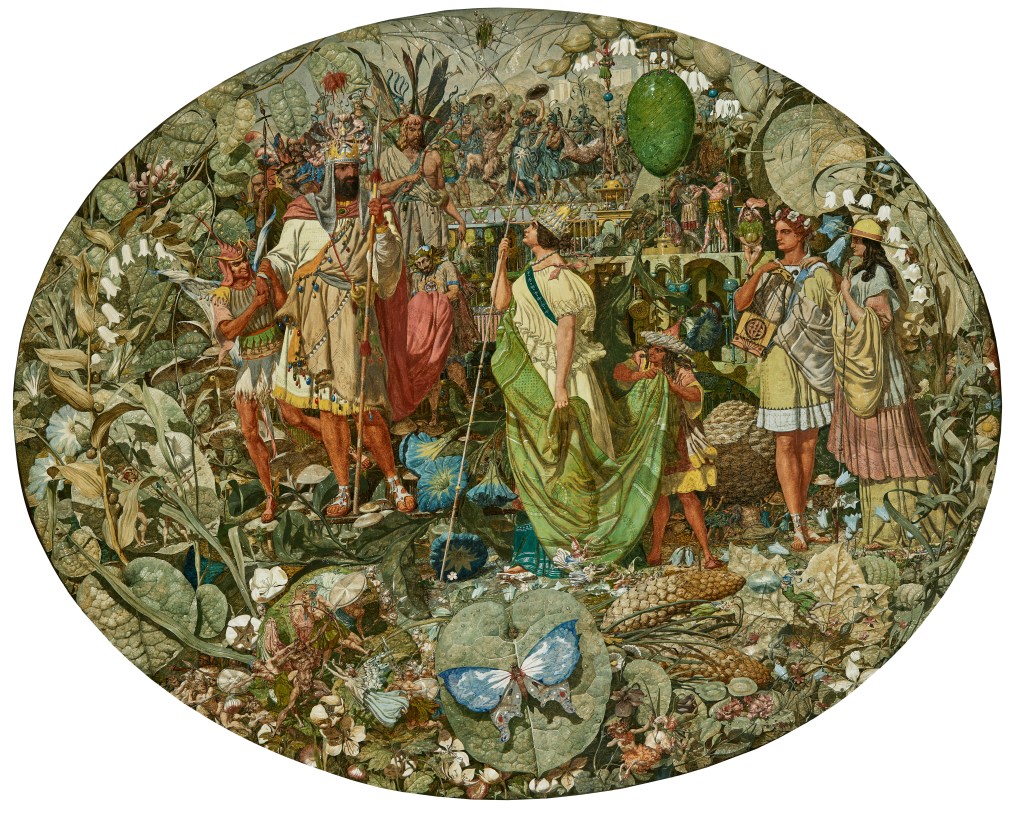
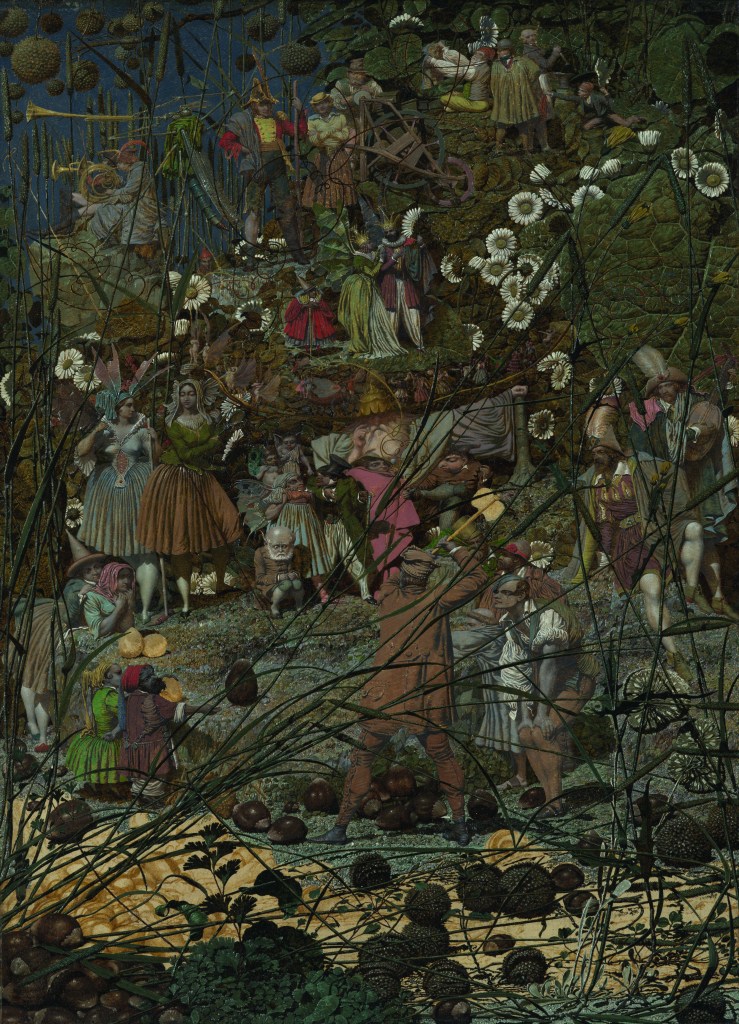
Also in this section hang two of Dadd’s masterpieces, Contradiction: Oberon and Titania (1854–58), probably commissioned by Hood, and The Fairy Feller’s Master-Stroke (1855–64), requested by the hospital’s steward, George Henry Haydon. Though both Shakespearean fairy subjects, they are radically different from his previous paintings. For an earlier picture, Titania Sleeping of 1841 – lent by the Louvre – Dadd created a conventional theatrical illusion of depth. Bats form a proscenium arch through which the viewer’s attention is channelled to a group of figures bathed in light, behind which the background melts into dark foliage. In the two Bethlem pictures, by contrast, visual and narrative priorities are radically unclear. Examining the Fairy Feller, one must peer past grass stems and daisies to seek the action. The eye is not guided and rewarded as it was before but baffled and distracted by the episodic detail with which it bristles. And in place of naked, humanoid fairies are far stranger beings – what a character in Angela Carter’s radio play about Dadd, Come Unto these Yellow Sands (1979), calls ‘the hobs and lobs and all the nasty little demons who exist at the corner of the eye, in the cobwebbed back passages of the mind’.
Dadd’s fairy subjects did not, however, signal a lack of engagement with human psychology or indeed with intellectual debates going on around him. The exhibition’s curators, Nicholas Tromans and Sylvie Broussine, have brought together a group of Dadd’s Sketches to illustrate the Passions, made at Bethlem in the 1850s. This watercolour series, which caustically illustrates human faults and foibles, appears, they propose, ‘to poke fun at the categorisation of mental illnesses that preoccupied Bethlem’s staff’.
A final room of the exhibition is devoted to the works Dadd made at Broadmoor, where he spent the last 22 years of his life. In London he had had to rely on memory and imagination to paint landscapes, while in rural Berkshire he was inspired by the hospital’s terraces and views of open country. His art became more pastoral, though without ever quite losing its mordant edge.
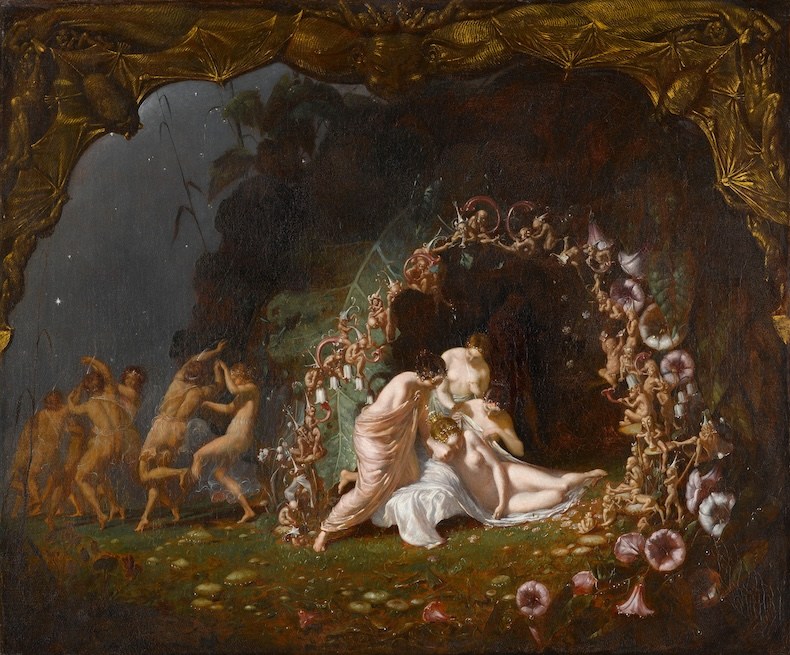
The exhibition’s subtitle, ‘Beyond Bedlam’, rightly draws attention to Dadd’s art – though can it ever be separated from his state of mind? The drawings and paintings he created after the breakdown of his mental health have a level of imaginative freedom, playfulness, enigma and left-field psychological insight previously absent. These are qualities which would not be celebrated until the arrival of the Surrealists, who had their own ways of accessing the cobwebbed recesses of the mind. Coupled with Dadd’s technical skill, they put him among the greatest of Victorian artists, as this eye-opening exhibition demonstrates.
‘Richard Dadd: Beyond Bedlam’ is at the Royal Academy of Arts, London, until 25 October.
From the September 2026 issue of Apollo.