From the September 2026 issue of Apollo.
The story of a group of Greco-Roman sculptures known as the Torlonia Marbles is, naturally, one in which archaeology plays an essential part. But centuries after these ancient works of art were first pulled from the ground, they have undergone a kind of second unearthing, brought to light all over again only in the very recent past. For years, until less than a decade ago, this 620-strong population of deities, emperors, nymphs, satyrs and beasts – probably the most important collection of antiquities still in private hands – was sequestered in a former grain store on the Via della Lungara on the west side of the Tiber in Rome. When 92 pieces from the collection were exhibited at the Musei Capitolini in 2020, few people – scholars included – had had so much as a glimpse of them since before the Second World War.
Prince Alessandro Torlonia (1800–86) was only the third generation of a family who had arrived in Rome from the Auvergne in the mid 18th century and set up as merchants of imported French textiles near Piazza di Spagna. Yet by the time he converted that grain store in Trastevere into a 77-room museum to display his vast collection of classical sculptures, the Torlonia wealth had long been proverbial. Good business had seen the cloth merchants moving into money-lending, the Vatican chief among their clients (Alessandro’s father, Giovanni, had been granted the title Prince of Civitella-Cesi in 1803 for services rendered). Stendhal, invited to a ball at the family’s palazzo on Piazza Venezia in 1827, was by turns appalled and awed by the splendour on display – which included a monumental (and monumentally expensive) sculpture of Hercules and Lichas by Canova, who had overseen the lighting of the work himself and for which a special chamber had been designed. Writing in Promenades dans Rome, Stendhal refers to his host Giovanni Torlonia as l’homme à l’argent par excellence. In Little Dorrit (1857), published around the time Alessandro Torlonia was acquiring his warehouse in Trastevere, Dickens refers to the banking family to illustrate the extent of William Dorrit’s profligacy in Italy: ‘The drafts of Mr Dorrit almost constituted a run on the Torlonia Bank.’
Among the old noble families who were clients of the Torlonia were the Giustiniani, who in 1816 had offered some 270 sculptures collected in the early 17th century by Vincenzo Giustiniani as collateral for a loan of 33,600 scudi. They defaulted on the loan some years later and, after many more years of legal tussles, the collection officially came into Torlonia possession by 1859. By this point, Alessandro Torlonia had already absorbed other significant collections of ancient marbles (and the Torlonia seem to have had a knack for buying property on sites that were particularly likely to yield rich archaeological finds); but it was likely the quality and quantity of the Giustiniani holdings that prompted his establishment, in 1875, of a museum for this ‘collection of collections’ – which, as its first catalogue by the archaeologist Pietro Ercole Visconti boasted, could rival even the Vatican and Capitoline collections.

Things shifted in 2014, with the setting up of the Fondazione Torlonia, and in 2016 with the family formally agreeing to exhibit the collection. Since Alessandro Torlonia’s death in 2017, his grandson Alessandro Poma Murialdo, as the Foundation’s president, has overseen a flurry of outings for the collection. After the exhibition at Musei Capitolini (curated by Carlo Gasparri and Salvatore Settis) the collection was shown at the Gallerie d’Italia in Milan, and then at the Louvre. Meanwhile, a first permanent venue to display sections of the collection was opened in a restored outbuilding at Villa Albani Torlonia, a family property north-east of the city centre, not far from the Villa Borghese. When I meet Poma Murialdo at the site of the old museum in Trastevere on a hot July afternoon, his phone is pinging with updates from Montreal: 58 sculptures from the collection are being crated up ready for their return here after a 16-month tour of North America, the first showing of any of the Torlonia holdings beyond Europe. Exhibitions have been staged at the Art Institute of Chicago, Kimbell Art Museum in Fort Worth and, finally, at the Montreal Museum of Fine Arts.
It’s hard to imagine another 58 pieces slotting in among the marble figures already thronging these few remnant spaces from the Museo Torlonia. To reach these rooms – which make up the Foundation’s laboratori – we have come in off the Via della Lungara via a hefty old wooden door and through courtyards lined with those once-controversial apartments, many of them now occupied by students at John Cabot University, which has its main campus just across the street. One particularly crowded room holds sculptures awaiting attention, while next door are their happier-looking fellows, post-restoration (including the one bronze of the collection, a first-century statue of the Roman general Germanicus). The spaces themselves have been restored – with renewed flooring to better cope with the huge weight of so much stone, and walls painted the original deep red of the Museo Torlonia.
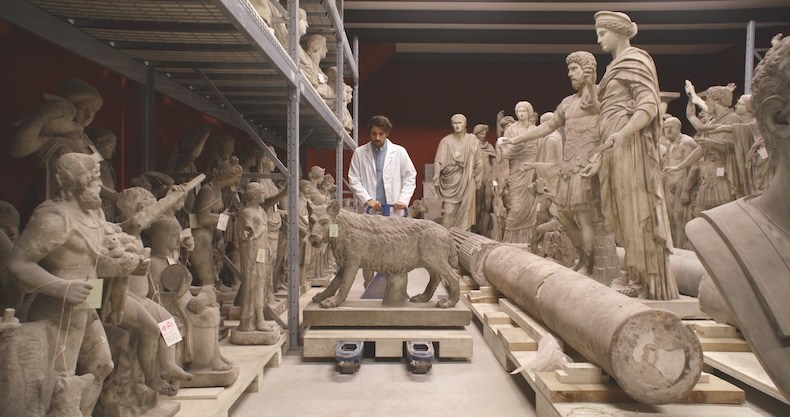
It is Poma Murialdo’s wish, he says, ‘to make the collection more visible; it was very well known by scholars through art-history books, but really like a ghost for the general public. There were generations, and of scholars too, that didn’t have the chance to see the pieces.’ (Gasparri, who has made the study of the collection and Villa Albani his life’s work, is one of the few scholars, he says, who had ‘a good relationship with my grandfather’.) Even family members, it seems, were kept at a distance. ‘I think the first time I saw this collection I was in my twenties, because it was basically closed, my grandfather was very secretive about it; so it’s only when I started working with him that I came for the first time.’ While these laboratori are accessible to academics, students and journalists, Poma Murialdo and his team are now in the process of working out whether it will be possible to allow limited access to the general public. But, ‘There are movement and safety issues, it’s a working space, connected to the conservation laboratory.’
Indeed, in a third area that runs the width of the two sculpture stores, Anna Maria Carruba, who has overseen the conservation of the Torlonia collection since before the Foundation’s existence (and whose work has been financially supported, in the main, by sponsorship from Bulgari), is attending to a statue of Bacchus from the Giustiniani collection. Much of her job is detective work, in this case distinguishing between interventions made under Giustiniani ownership and those made when the sculpture was acquired by the Torlonia. ‘We know from a letter from the Marchese Giustiniani,’ she explains, ‘that to make new parts look antique, they would place the pieces in a urine bath, or in an animal stable, or treat them with tartar deposits from the inside of wine barrels.’ The conservator’s traditional dilemma – to what extent past restorations should be mitigated versus preserved as part of a sculpture’s history – becomes less of a dilemma when the pieces in question have been ‘restored’ by the likes of Gian Lorenzo Bernini. A star of the collection – on its way back from Montreal when I visit – is a statue of a resting goat whose body was carved in the late first century, but whose fresher 17th-century head has been attributed to the baroque master, who worked for Vincenzo Giustiniani as a young sculptor honing his technique.
Distinguishing between interventions of different periods is no easy matter. As Carruba explains, ‘There was a time – specifically during the period when these works became part of the Torlonia collection – when a push for uniformity was made. Many materials used were identical, making it difficult to pinpoint exactly what was original versus what was added later. The aim was to make modern parts look antique and antique parts look modern – modernising the antique meant completely removing encrustations to make the pieces appear pristine and white.’ She notes the influence of neoclassicism here, and that one of Alessandro Torlonia’s chief restorers, Filippo Gnaccarini, had been a pupil of Canova and Thorvaldsen.
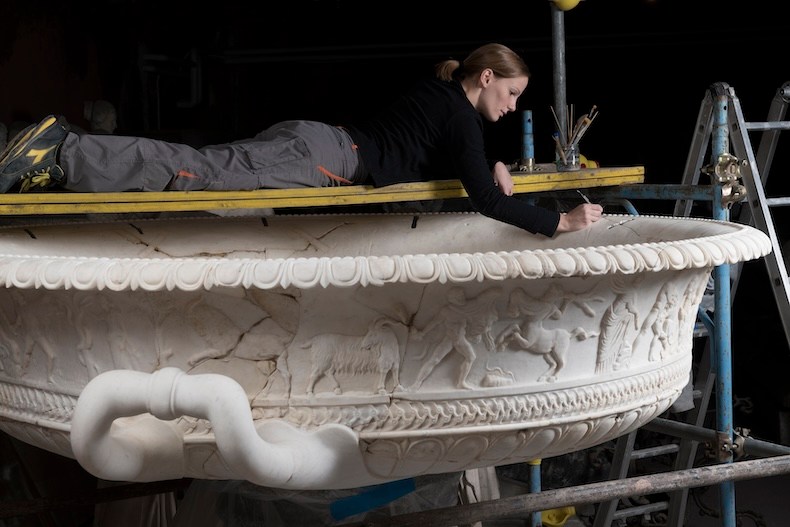
To some extent, the Foundation’s current approach is a continuation of that 19th-century ‘push for uniformity’. ‘Our goal,’ Carruba says, ‘is to restore them to the state they were in when they were exhibited [at the Museo Torlonia] in the 19th century. Two things have changed between now and then: the accumulation of dust that has darkened the works […] and an intrinsic alteration of the materials used in previous restorations. These are the two issues we address in our work: we never add new material, reintegrate missing parts, or reconstruct anything; it is strictly a cleaning process.’ The difference in colour before and after that process can be seen clearly between the two storerooms. (When those first 92 sculptures appeared at the Musei Capitolini in 2020, they were deemed a little too clean for some tastes.)
Often, cleaning will reveal ‘full-on discoveries’, Poma Murialdo says. An invaluable reference point is the illustrated museum catalogue produced by Carlo Ludovico Visconti in 1884–85, 500 copies of which were printed and sent out to European institutions, among other favoured recipients. A well-thumbed working copy is set out near Carruba’s table of cleaning tools; each of the 620 sculptures are here, reproduced in phototype – the detail extraordinarily sharp – and presented strikingly against a black background. A statue of a smooth-skinned young man standing contrapposto with lionskin and club and a pair of apples in his left hand denote him as Hercules. Next door, I’m shown the real thing, post-conservation: a marble figure composed of so many fragments that it resembles a stretch of crazy paving. Known as a ‘pastiche’, it comprises 125 pieces of mostly ancient marble, a 17th-century creation.

Carruba’s work as Torlonia conservator extends also to the collection of antiquities – of which there are more than 1,000 – at Villa Albani Torlonia, which I visit the following day. Completed in 1767 for Cardinal Alessandro Albani, nephew of Pope Clement XI, the villa was designed by the architect Carlo Marchionni as a setting for Albani’s collection of ancient sculpture; and, having been bought more or less lock, stock and barrel by Alessandro Torlonia in 1866 and remained in the family, is an unusually complete survival of an early neoclassical Gesamtkunstwerk.
As Albani’s great shrine to antiquity was taking shape, he appointed ‘father of archaeology’ Johann Joachim Winckelmann as his librarian and to advise on and arrange the cardinal’s collection – most of which he had built up over decades from acquisitions and excavations. That you are stepping into the evocation of an ancient classical past is felt as soon as you enter the villa’s circular atrium, where marble varieties in different shades of grey harmonise on walls and door surrounds, or make unusual striped frames for statue niches painted Pompeiian red and housing Roman goddesses. Through one of those doorways, stairs lead up to the Sala Ovale, where a restored statue of Apollo takes centre stage, its Greek marble shimmering in the light after layers of gesso have been removed.
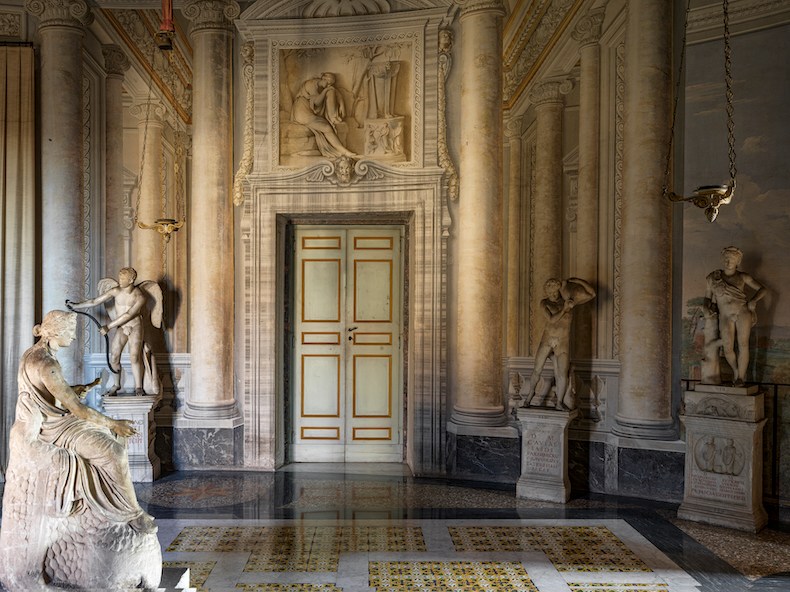
From here a succession of relatively compact rooms make up the cardinal’s private apartment, the walls hung with tapestries, with portraits of Albani family members and properties – several by Gaspar van Wittel – and, among older paintings, an arrestingly spare canvas of Bacchus and Ariadne by Guido Reni. At the end of this enfilade is a studiolo known as the Gabinetto del Lapiccola, a richly decorated room designed as a foil for the ancient figurines and reliefs set into niches or panels. Among them is a bronze Apollo Sauroktonos from the early first century, excavated in 1778 on the Aventine Hill. Thought to have been modelled on a celebrated statue by Praxiteles, according to the classicist Dionigi Strocchi the find prompted Cardinal Albani to rush to the dig, where he was ‘said to have picked it up and held it in his arms, taking it right out into the street and putting it into his carriage himself’.
From the Esquiline Hill, meanwhile – on the site of Maecenas’s villa, no less – came the most important Greek work in the collection, occupying part of a suite of reception rooms on the other side of the villa, overlooking the gardens: a large relief probably carved c. 430 BC in the workshop of Phidias, sculptor of the Parthenon marbles. Full of movement even in its fragmented state, the scene depicts a rearing horse behind two heroic figures in combat, possibly a representation of the Peloponnesian War. The largest room here is the central Galleria del Parnaso, decorated with a riot of precious marbles – giallo antico, porphyry, cipollino marino – and pilasters of Raphaelite grotesques formed of micro-mosaics. The gallery takes its name from a ceiling painting by Anton Raphael Mengs of Apollo and the Muses at Parnassus.
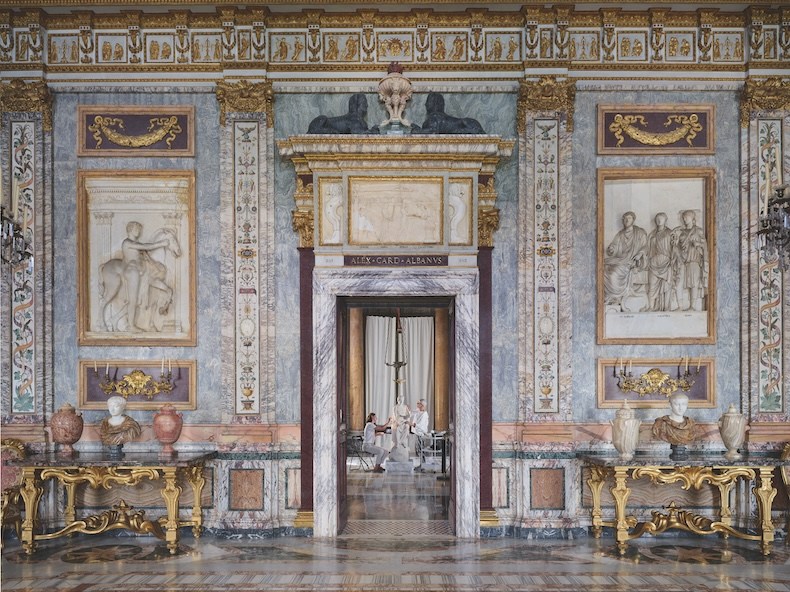
Henry James, visiting the villa in 1873, seemed determined to be underwhelmed. ‘Yesterday to the Villa Albani. Over-formal and (as my companion says) too much like a tea-garden […] The collection of marbles in the Casino (Winckelmann’s) admirable and to be seen again.’ Even he couldn’t fail to be awed, however, by the jewel in this collection’s crown: a marble relief of Antinous from Hadrian’s villa at Tivoli, set into an ornate chimneypiece in a specially assembled room off the Parnassus gallery. ‘If there be not imagination,’ James wrote, ‘even in our comparatively modern sense of the word, in the baleful beauty of that perfect young profile there is none in “Hamlet” or in “Lycidas”.’ The Antinous was one of many of the villa’s pieces seized by the French army for Napoleon’s museum in Paris – and the only one to return.
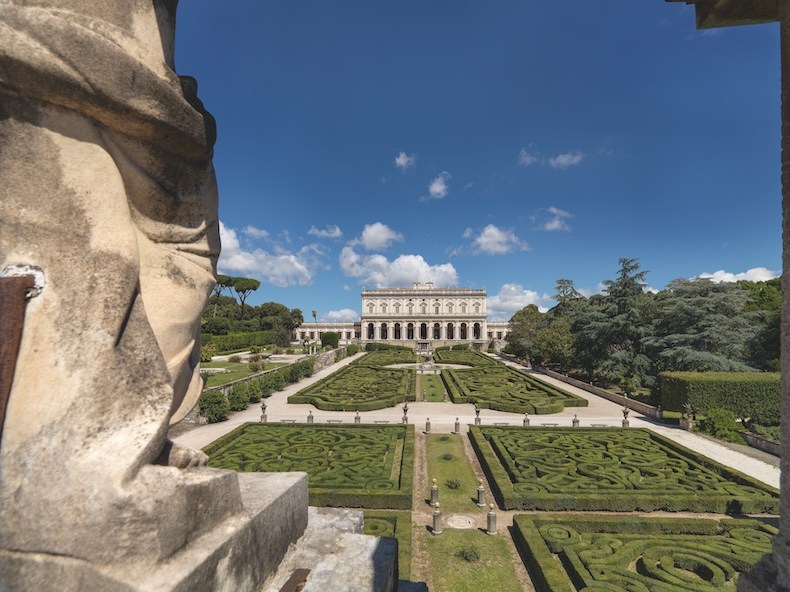
Winckelmann collaborated closely with Albani on the decoration of this room, the walls of which are painted with vistas of ancient Roman horti populated with their patrician owners – intended, no doubt, to draw parallels with this ‘villa of repose’, and its own gardens. Taking the cue, we move from the main house down into those gardens, where the cicadas are at full volume in the heat. Away over to our left is a cluster of buildings and pavilions, today occupied by members of the family, and including the Sala del Biliardo, where Winckelmann lived while here. We pass a colossal bust of Trajan that came from the emperor’s Forum, via Villa Medici, around which Alessandro Torlonia built an opus-sectile brick aedicula stamped with his own name. From there, walkways through curlicued parterres lead to the relative cool of the Kaffeehaus, a semicircular pavilion sheltering a parade of ancient Roman deities and emperors, many of them restored by Carruba over the last decade. (Until recently, a room off this building housed a series of Etruscan frescos from the François Tomb, so named after the archaeologist Alessandro François, who discovered it in 1857 on Torlonia property in Vulci. The paintings, from the 4th century BC, were acquired by the Italian state for €15m and are now on view at the National Etruscan Museum at Villa Giulia.)
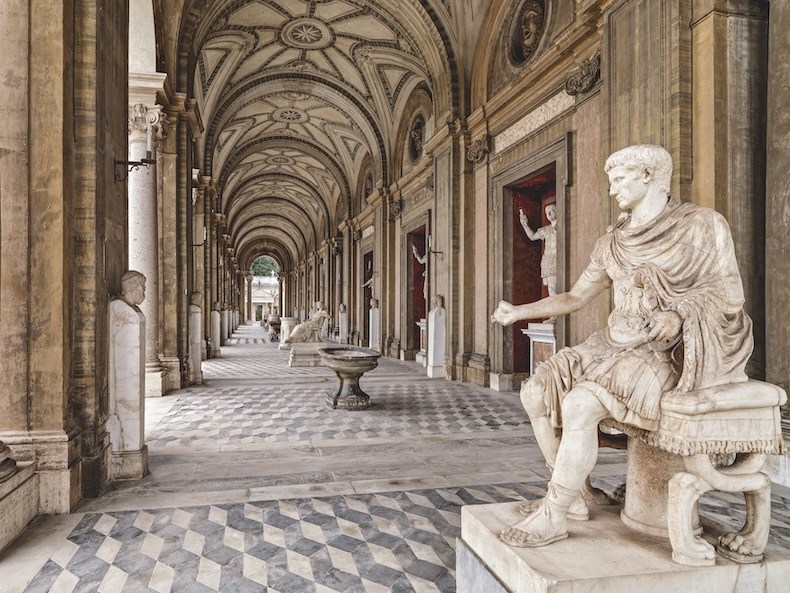
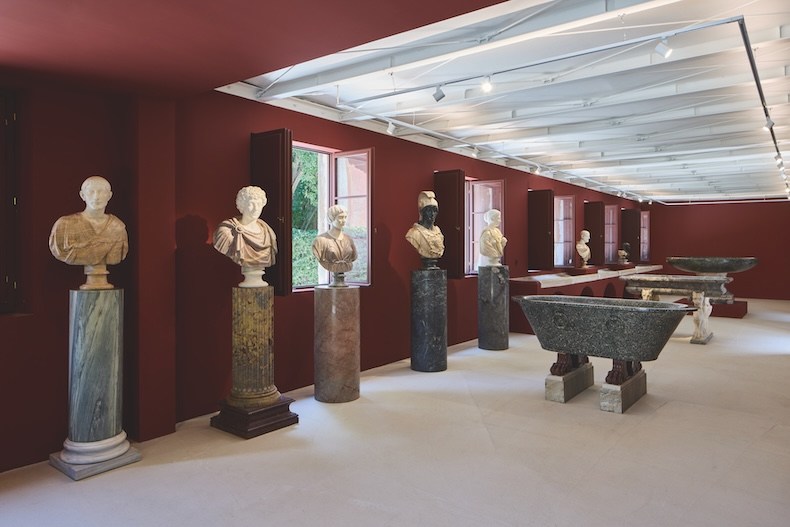
At the western edge of the gardens where they meet the Via Salaria entrance, two former stable blocks have been renovated to provide display space for select pieces from the Torlonia Collection. Now referred to as the Antiquarium, it’s here that I meet the Foundation’s director, Carlotta Loverini Botta, who has just landed from Montreal and is supervising the installation, in the south stable, of a new exhibition on the theme of polychrome marbles, curated by Gasparri. Fifteen of these 44 sculptures are the latest to have been restored in the laboratori in Trastevere. Portrait busts are displayed on ancient column drums as they had been in the Museo Torlonia, or along the old horse mangers that retain their bowls bearing the Torlonia crest. Chief among the bigger pieces in the room is a monumental Roman krater – known as the Torlonia or Medici Vase – carved from rare green Egyptian breccia. ‘At the Louvre show,’ Loverini Botta explains, ‘this piece was installed near a seated royal captive carved from the same marble – it was once part of Albani’s collection, displayed in the Kaffeehaus, before it was taken for Napoleon. They were both part of a group of sculptures that Albani acquired from the Medici, and centuries later at the Louvre they were reunited.’
Alessandro Torlonia wasn’t averse to rearranging the display of some of the Albani collections after his acquisition of the villa in 1866. ‘He took around 50 sculptures of animals to his museum in Trastevere, to complete the animal theme of that collection,’ Loverini Botta says. ‘We have brought 15 back here.’ They now keep company in the north stable with another monumental basin – the Cesi Torlonia vase, an Imperial-era crater carved in high relief with scenes from a Bacchic symposium. Thought to have come originally from the gardens of Agrippina the Elder – Caligula’s mother – it’s another element of the Albani collection that has made its way back here from Trastevere.
For now, after years of wrangling between the Torlonia family, the Foundation and the Italian cultural ministry – and while discussions for a permanent public venue are ‘ongoing’ – a feasible interim arrangement seems to be moving into place. A third building near these scuderie is being renovated, with a plan for a collection display on the theme of childhood. Direct access from the Via Salaria makes it possible to keep this part of the garden open to the public. (Since 2019, the Villa Albani itself has also been open for pre-booked visits on certain days, and at the Foundation’s discretion.) Further tours to major institutions abroad are being discussed, including host venues in Asia, while a symposium on research developed for the shows in North America is planned for the spring. Little by little these long-hidden antiquities, and the worlds that they have inhabited over the centuries, are re-emerging into the light.
‘Marmora Romana’ opens on 18 September at the Antiquarium, Villa Albani, Rome.
From the September 2026 issue of Apollo.