For most of the art world, summer ushers in a period of calm before the back-to-school intensity of early autumn, but for Ella Walker, the pace in recent months has picked up. When we meet at the start of June, the British artist is preparing two paintings for the Courtauld’s annual commission, which will be installed in the gallery’s entrance from early September until this time next year. Though they’re in their early stages during my visit to her east London studio, the paintings are Walker’s from a mile away: theatrical and slightly unsettling scenes with references ranging from early Renaissance masterpieces to the films of Federico Fellini.
Walker first visited Italy just after graduating from the Glasgow School of Art in 2015. She came to Florence, she says, ‘looking for something to be interested in’. There, she found Giottos in the Basilica of Santa Croce, as well as Cimabues and paintings by Piero della Francesca. Her interest in proto-Renaissance art grew while studying at the Royal Drawing School under Timothy Hyman, a scholar of Sienese painting. ‘We had a lot of helpful conversations around that period when painting was transitioning from this iconography that was all about pattern, surface, colour and texture into a more naturalistic style.’
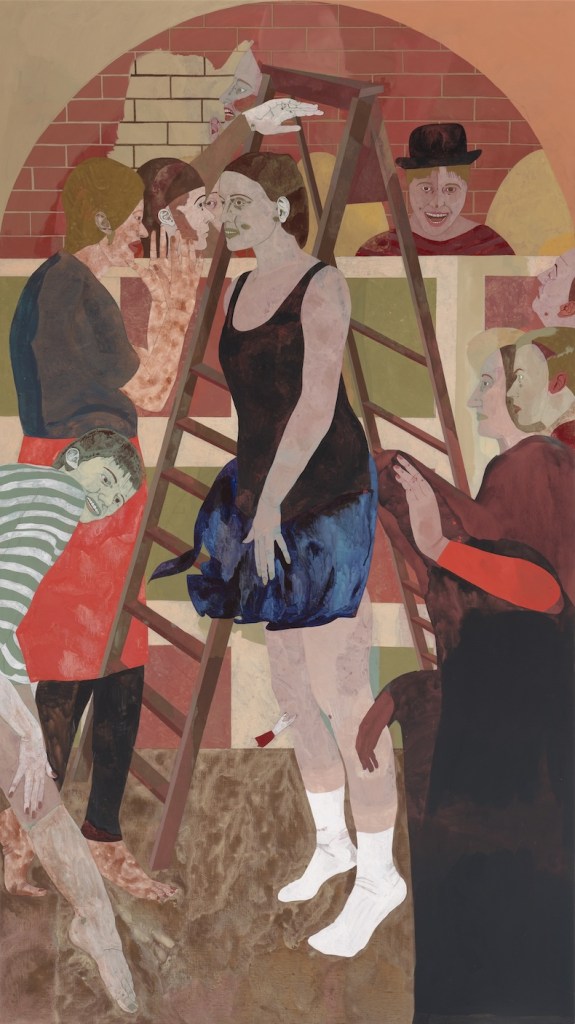
For Walker, the pull of trecento art comes, in part, from the simplicity of the ‘religious narrative […] what colour and figures represents what, how people learned through the visual’. It’s interesting, then, that her intention with her own paintings is to do the opposite. ‘I’m really trying to not pin down any specific moral sense […] whether the characters are good or bad.’ Her works, she says, ‘disrupt any clear distinction between right and wrong’. Figurative paintings often lend themselves to a narrative reading, but in Walker’s work, the story is deliberately elusive. The composition of Verdaccio Wall, one of the commissioned works, draws on the Masaccio altarpiece in the Basilica of Santa Maria Novella in Florence, but its figures do little to evoke the Holy Trinity: a stepladder stands in for Christ’s cross; figures chatter nonchalantly around a central figure standing in her socks.
What Walker’s paintings owe more obviously to the style of Cimabue or Piero della Francesca is their shallow depth of field and ‘sense of flatness’. Figures stack up beside each other with little tonal variation; depth, she says, is ‘suggested through line’ rather than shading. The texture of Walker’s paint heightens this even quality: her works are matt and built up in washes, with mottled patches and paint left to drip and dry unevenly – an appealing contrast to the sharpness of her lines, which are drawn with chalk or pencil. She’s at her most enthusiastic when discussing pigment – ‘It’s my favourite thing to talk about’ – and although batches of each coloured powder can vary, she’s unbothered by inconsistency when mixing up her paints. ‘I’m happy for them to have texture […] I like the fact that the surface is quite varied and unstable.’
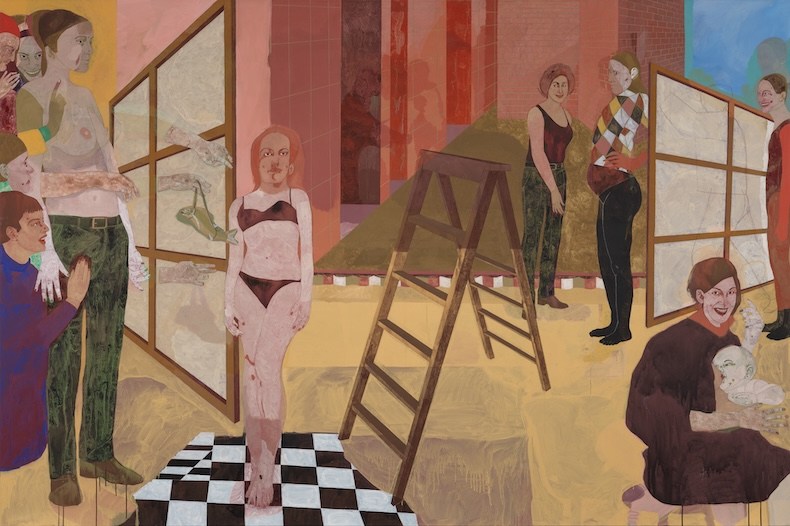
Though the paints can yield unexpected results, Walker is much more controlled when it comes to the positioning of her figures, creating scenes that feel ‘stage-like’. Theatre and dance are rich sources, she says: the elaborate sets of the Ballets Russes, the operatic performances of Maria Callas and the costumes of Commedia dell’arte. The clothes worn by her figures are almost always picked from film: the bowler hat in Verdaccio Wall is reminiscent of Giulietta Messina as Gelsomina in Fellini’s La Strada (1954). The consistency of Walker’s representation of women – figures from mythology or cinema; defiant, sexually self-possessed – is often remarked on. ‘People say, “You only paint women” and I find that so interesting – I don’t think they’re all women!’ Yes, there’s a ‘female-centric energy’ to the work, Walker says – especially in her nods towards figures such as Callas – but there’s also a deliberately ‘uneasy tension’ when it comes to representations of gender.
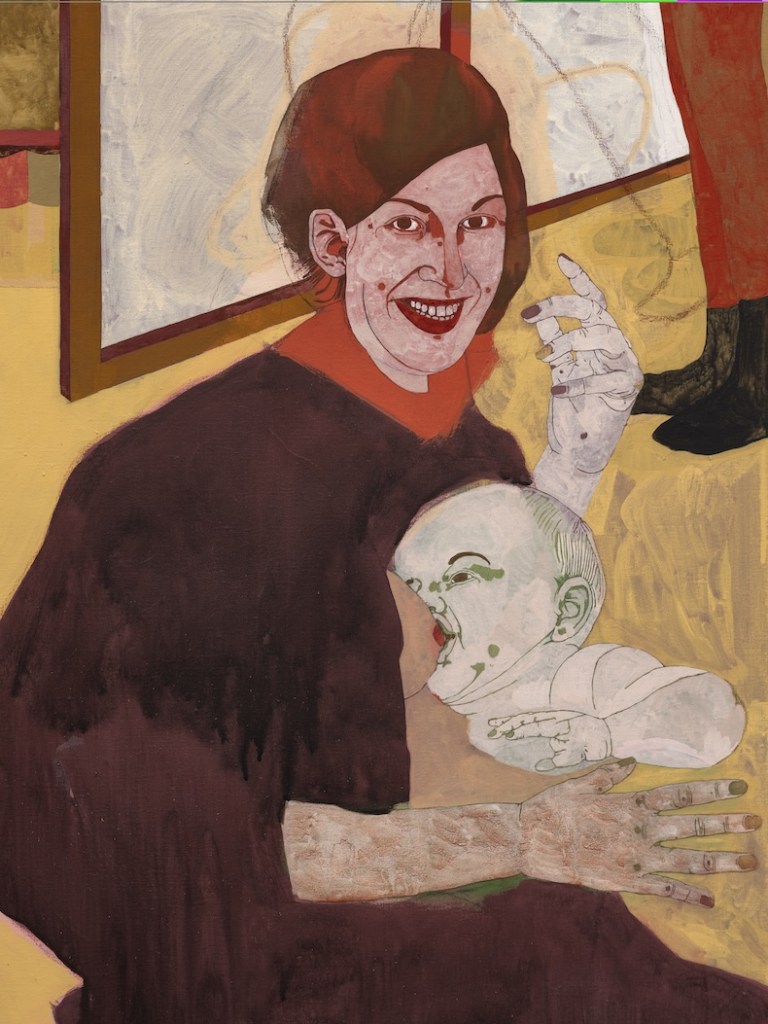
The Studio, the larger of the two paintings Walker has made for the commission, is more personal, working in elements ‘informed by me and the way I live’. Canvases viewed from behind, their stretchers visible, create vector lines that pull our eyes to the centre. There’s a jumble of character; severed hands floating mid-air that ‘look like they’re about to pinch’. The scale of the figures, Walker says, in reminiscent of trecento and Renaissance works, where the most important figure was usually the largest. Here, the hierarchy of figures ‘doesn’t make any sense […] I want it to be dreamlike, to leave people wondering what’s going to happen next.’ The ladder of Verdaccio Wall reappears, rising just beyond the floating canvas, which doubles as a window containing the chaos within. In the corner, a mother nurses a child: a nod to Walker recently becoming a parent. This experience, she says, increased her interest in the dichotomy between softness and harshness; the nurturing of a child contrasted by the looming pinch of the floating hands. But, she laughs, ‘Maybe that’s just the hormonal brain talking.’
To have her paintings hung in the same building as Botticelli’s The Trinity with Saints Mary Magdalen and John the Baptist (c. 1491–94), Walker says, is ‘incredibly exciting’. Elena Crippa, the gallery’s senior curator of contemporary art, told her that the painting was originally made for the Santa Elisabetta delle Convertite in Florence, a former convent that took in repentant prostitutes. ‘I thought, excellent, I love it even more.’ When I ask what she hopes audiences passing through the Courtauld will think of the paintings, she says, understandably, that it’s hard to know. She seems pleased at the idea of them walking away a little confused – but definitely intrigued, too.
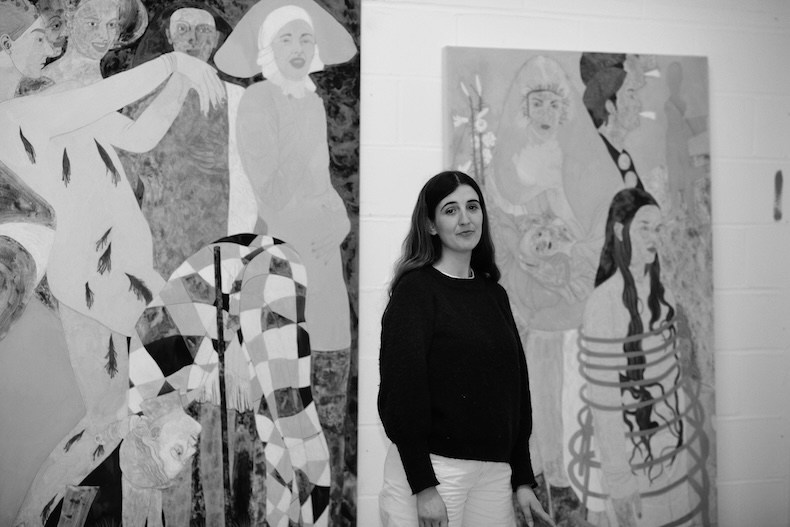
Ella Walker’s commission for the Courtauld Gallery, London, will be on display until August 2027.