The recent retrospective of the work of Beatriz González (1932–2026) at London’s Barbican Art Gallery epitomised the defining struggle of modern Colombian art. This was an art mocking its own deference to the European canon, featuring versions of European masterpieces on items of furniture and using newsprint images and flat, bright colours to depict the murders, internecine warfare, violence against women, assaults on indigenous rights, narco-terrorism and attacks on justice that tore apart González’s nation for most of her lifetime. For Colombian artists, the task of creative self-definition has long been entwined with the country’s successive crises of government. Ten years after the historic peace struck between the leftist FARC rebels and the Colombian government in November 2016, ending 52 years of conflict, a semblance of stability has enabled an outward-facing art market to take root, and the world is beginning to appreciate the full scope of the art produced in the country since the Second World War. In 2025 González was accorded a special focus at Bogotá’s international art fair, ARTBO. In 2023 her deceptively naive painting Sueño dorado (Meditación), from 1968, set a new world auction record of $139,700, at Sotheby’s New York, above the low estimate $120,000.
It was not that Colombian art was not valued. From 1819, when the country gained independence from Spain, the collecting and exhibiting of art, from pre-Columbian artefacts onwards, was encouraged as a means of nation-building. In the 1930s the government set up an annual competition, the Salón Nacional de Artistas, to stimulate a national artistic community. But it was during the 1950s, as violence gripped the country and the Salón was abandoned, that thanks to the combination of a coffee boom and the founding of the first private gallery and the first private art museums, the art scene proper was born.
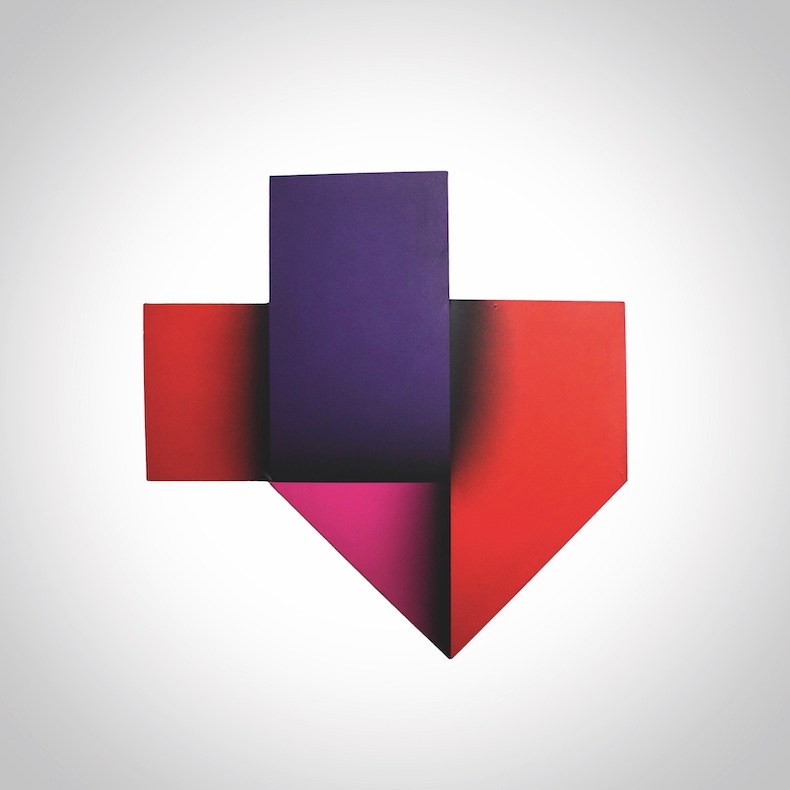
Different strands emerged. Edgar Negret (1920–2012) was a pioneer of geometric abstraction. Settling in New York between 1955 and 1963, he experimented with wood, metal sheets, nuts and bolts to produce his first Aparato mágicos (Magic Machine), painted in red, black, blue and white. With its references to nature, myth and urban infrastructure, Negret’s practice set him apart from the pure geometric abstraction of other Latin American countries. He exhibited in New York alongside artists such as Agnes Martin and Ellsworth Kelly and, in 1968, at Documenta in Kassel. Returning to Colombia, he became a leading figure among a loose group of abstract artists that included Carlos Rojas, Eduardo Ramírez Villamizar, Omar Rayo, Germán Botero and Manolo Vellojín. New York-based Leon Tovar Gallery will bring works by Negret and his yonger, more Op art-oriented contemporary Rayo (1928–2010) to Independent 20th Century. Leon Tovar, the gallery’s director, reports that collectors seek out unique pieces by Negret from the 1960s until the early 1980s and that Rayo’s work of the 1960s and 1970s is of particular interest.
An opposing current in Colombian art was represented by Fernando Botero (1932–2023). His defiantly popular paintings of voluminous people and animals drew on a local figurative tradition, exemplified also by the Surrealist painter Alejandro Obregón (1920–92), but with independent glee. ‘Boterismo’ encompassed themes from family, music-making, card-players and the circus to the horrors of Abu Ghraib. Since the 1970s his rotund bronze sculptures have made him globally famous. In November 2023 his painting The Musicians (1979) sold for $5.1m at Christie’s New York (estimate $2.5m–$3.5m), and a year later his monumental muscled bronze sculpture Horse (1992, artist’s proof one from edition of three plus two artist’s proofs) achieved $4.9m against an estimate of $3m–$5m at Sotheby’s New York. Linda Benrimon, of David Benrimon Fine Art, New York, who has represented the artist since 2000, says, ‘We place sculptures all over the world’; and Kristen France, head of Latin American art at Christie’s New York, says that ‘there is currently new interest in his early 1950s work, when Botero first came to New York’. An early still life will be included in the Post-War to Present sale on 1 October. France adds that over the last 20 years, the Latin American market has been transformed from a local market, with collectors focusing on their own countries, to a global one.
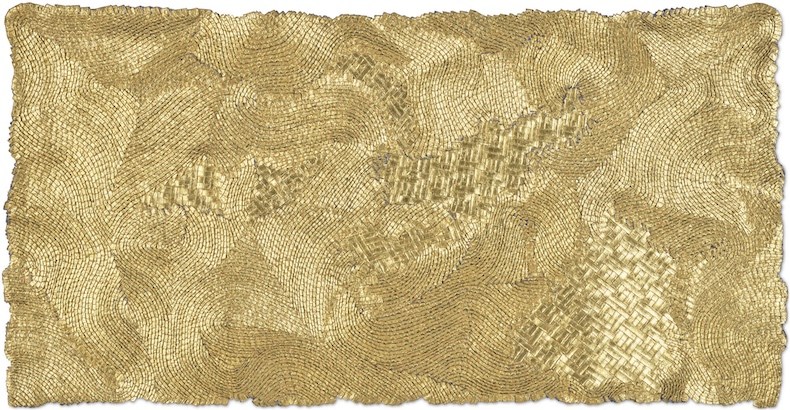
Another market colossus, alongside Botero, is the artist Olga de Amaral, born in Bogotá in 1932, whose shimmering gold textile works, often on an architectural scale, reach into seven figures. De Amaral’s market has benefited in recent years from growing interest in both women artists and craft traditions. She arrived in the United States in 1954 to study textiles at the Cranbrook Academy of Art, near Detroit. By 1967 she was teaching at the Haystack Mountain School of Crafts in Maine and was included in ‘Wall Hangings’, an exhibition at MoMA, New York, in 1969. Her first solo show was at New York’s Museum of Arts and Design in 1970. In the early 1970s she lived in Europe before returning to Colombia, representing her country at the Venice Biennale in 1986. Kaeli Deane, a senior director at Lisson Gallery, which represents the artist, remembers selling de Amaral’s Umbra 53 (2007) for $449,000 (estimate $140,000–$180,000) at Phillips New York in 2015, when she worked at the auction house. This represented an 83 per cent jump in her auction record. In May 2025, also at Phillips New York, Imagen perdida 27 (1996) achieved $1.2m, more than twice the upper estimate, only to be trumped by Christie’s six months later, when Pueblo H (2011) was chased to $3.1m against an upper estimate of $600,000. While the market has been made by de Amaral’s gold pieces, Deane reports that since Lisson first presented her work in 2021, ‘We have made a conscious effort to show the different bodies of work – including the horsehair work from the 1970s, for instance – and the focus of interest has broadened considerably.’
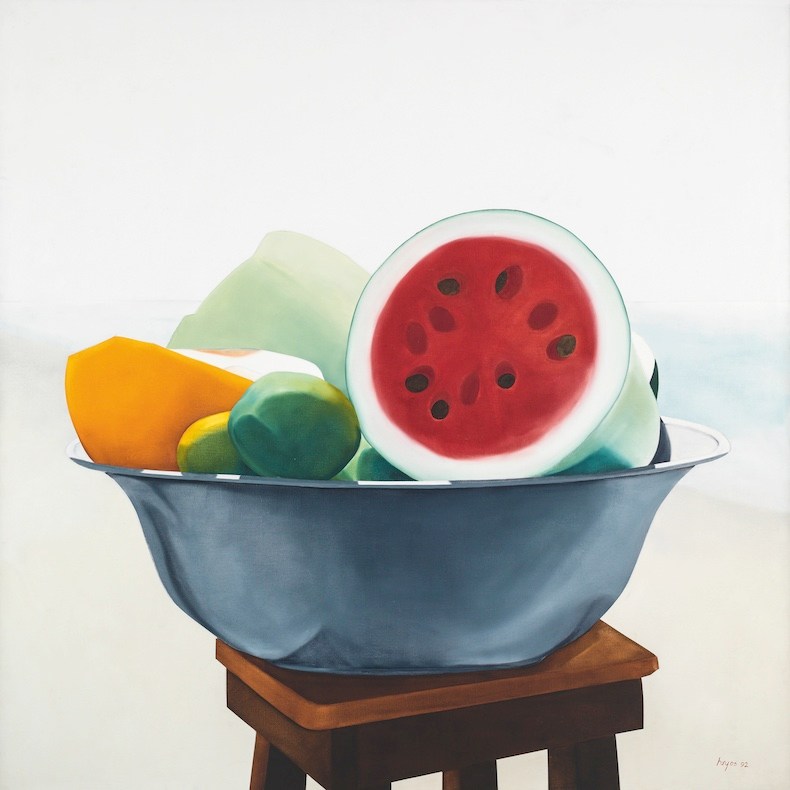
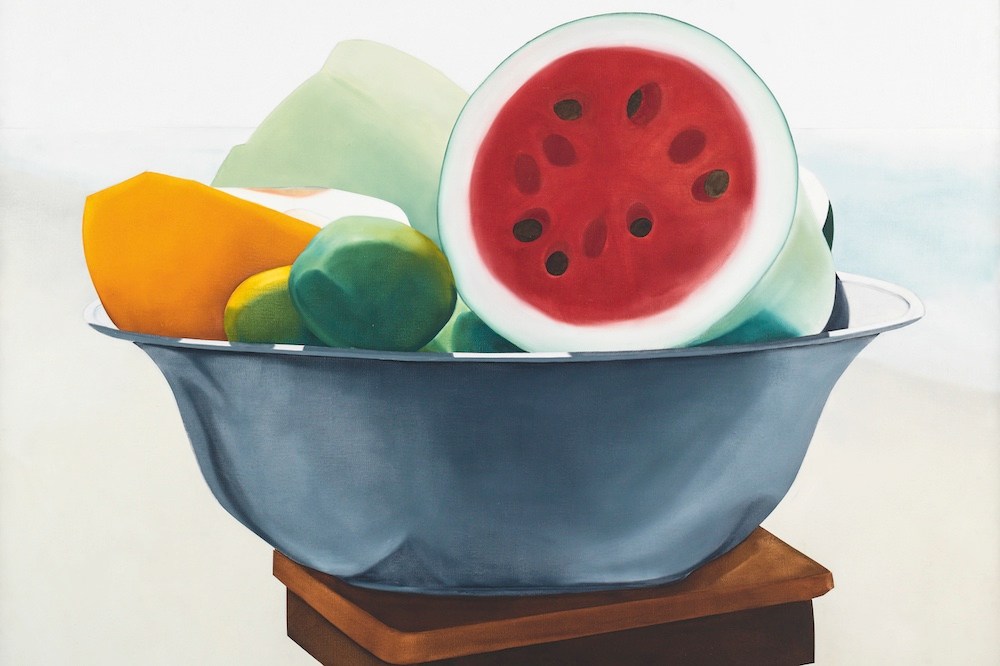
Another significant Colombian woman artist from the middle years of the 20th century, Ana Mercedes Hoyos (1942–2014), is also receiving new interest. Omayra Alvarado-Jensen, of Instituto de Visión, a Bogotá-based gallery dedicated to overlooked conceptual practices, says that Hoyos’s oeuvre falls into two parts. Conceptual, minimalist, geometric space and light work was her main focus until the 1980s; then, a switch to brightly coloured figurative paintings of fruit and flowers, many of them paying homage to European masters while evolving a distinctive colour palette and sense of perspective. This second body of work, which caught US attention in the 1980s, led Hoyos to an examination of her country’s history and people. She discovered the community of San Basilio de Palenque, the first freed African city in the Americas, where she began to paint women selling fruit. These paintings have become extremely popular – in May 2018 at Christie’s New York, Bodegón de Palenque (1989) achieved $212,500 (estimate $60,000–$80,000). France says, ‘We rarely get the great pieces – truncated human bodies in the marketplace.’ Alvarado-Jensen says that ‘people dismiss Hoyos for being too successful,’ but she points out the sophistication of the angled points of view, the almost cubist fruit and the cropping of the compositions, with sometimes just sections of the fruit sellers’ limbs visible. ‘She understands the power of what these women are doing […] She takes the Black female figure and exalts it in space.’ The gallery will bring a solo show of her work to New York as part of Independent 20th Century.