Kimbell Art Museum, Fort Worth
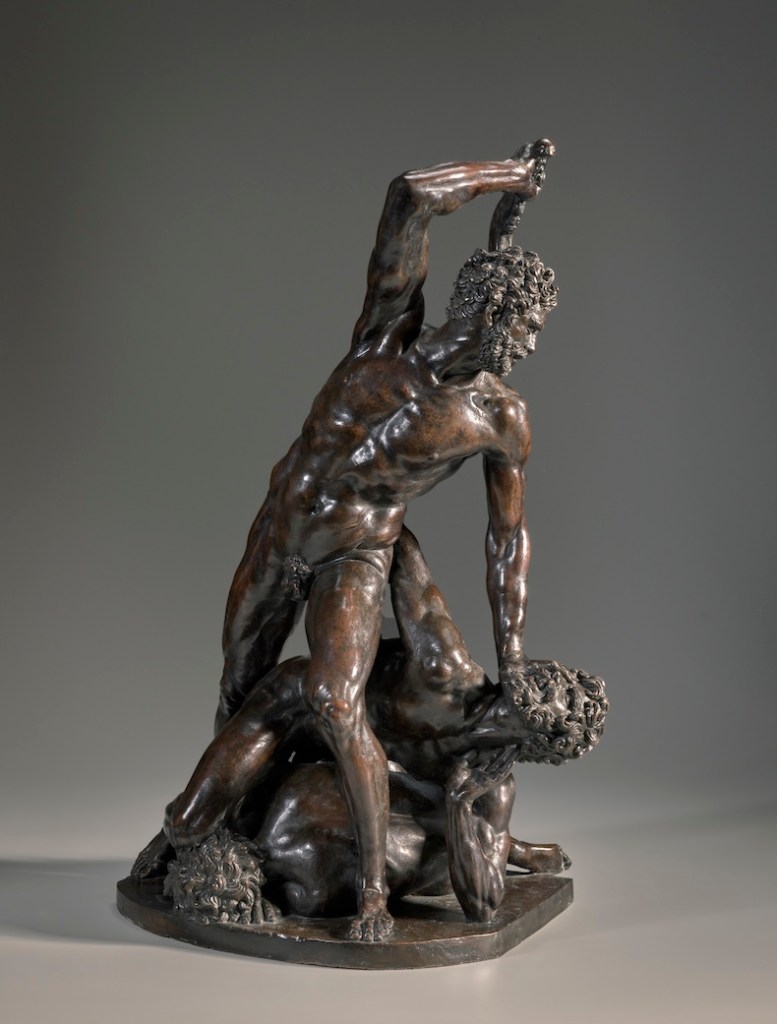
Samson and Two Philistines (1624), Stefano Maderno
The sculptor Stefano Maderno is not nearly as well known today as his near-contemporaries Giambologna or Gian Lorenzo Bernini, falling somewhere into the gap between the Mannerism of the former and the latter’s baroque style. But in his day he was highly regarded and created several minor masterpieces, not least his evocative marble sculpture of Saint Cecilia, commissioned to mark the discovery of the saint’s body in the crypt of Santa Cecilia in Trastevere, Rome in 1599. The Kimbell Art Museum has acquired another masterpiece by Maderno, a 63cm-high bronze sculpture depicting the biblical tale of Samson fighting two Philistines: one lies motionless at his feet while the other cowers as Samson raises a donkey’s jawbone in the air, ready to strike. The sculpture is a rare find: the only extant small-scale bronze securely attributed to Maderno and the first 17th-century bronze to enter the Kimbell’s extensive sculpture collection.
Minneapolis Institute of Art
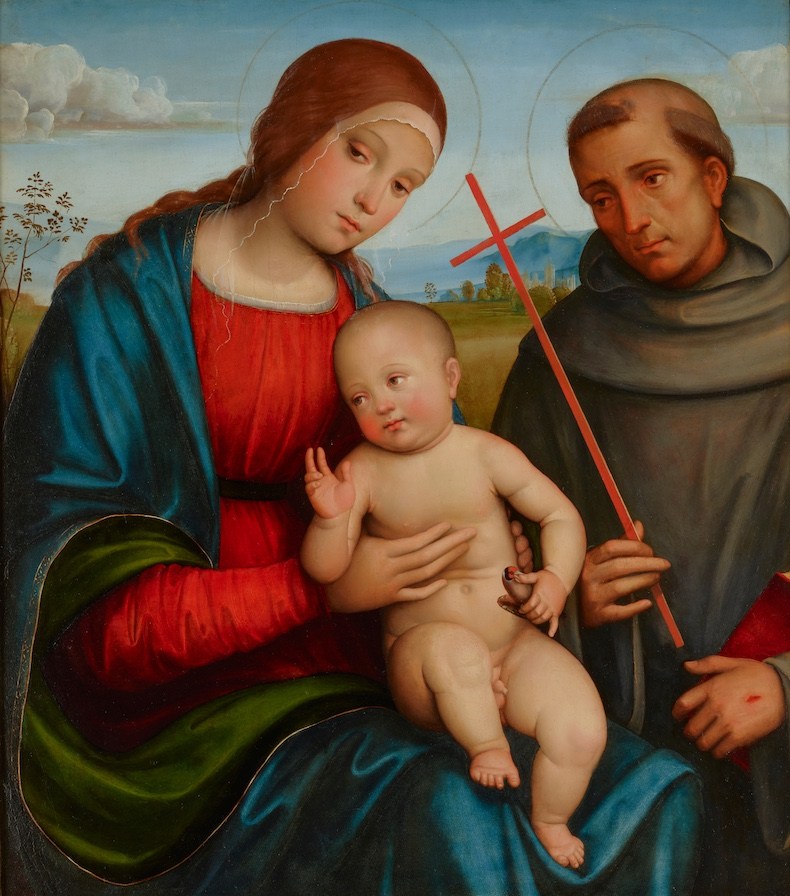
Madonna and Child with Saint Francis (1503), Francesco Francia
What was lacking in the work of early 15th-century Italian painters such as Bellini and Piero della Francesca, Vasari wrote, was a ‘sweet harmony of colouring’ – a quality he thought present in the work of Pietro Perugino and the Bolognese artist Francesco Francia, and which made the masses run ‘like madmen to this new and more lifelike beauty’. Those lush colours are evident in Francia’s Madonna and Child with Saint Francis (1503), which has been acquired by the Minneapolis Institute of Art. Painted for his patron Paolo Zambeccari, whose name is inscribed alongside the artist’s on the parapet, this solemn work shows the Christ Child holding a goldfinch and Saint Francis bearing the stigmata on his hand.
Museum Prinsenhof, Delft
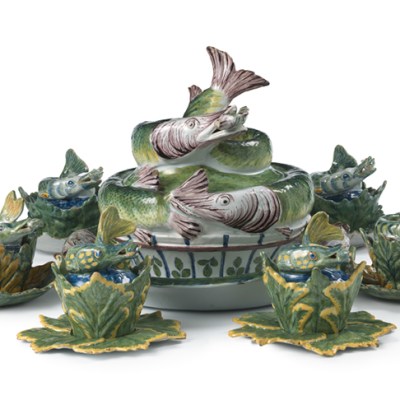
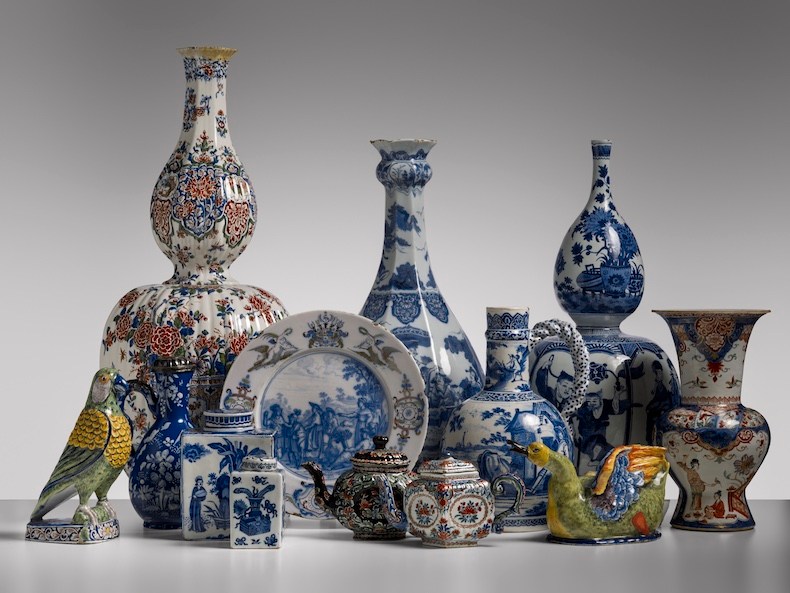
De Bruyn collection of Delftware
The Museum Prinsenhof may be closed until 2028 for major refurbishment but that hasn’t stopped it from acquiring new works. The museum has, unsurprisingly, one of the most expansive collections of Delftware in the world, and has added to it with the purchase of a private collection of ceramics built up by the Rotterdam-based businessman M.C.G. de Bruyn (1893–1964). The collection includes teapots, gourd vases, ceramic animals and more, but the standout objects are two plates from the prestigious Het Moriaanshooft pottery, made in around 1680 for the Dukes of Braunschweig-Lüneberg. Decorated with scenes from the life of Pope Leo X, they are among the earliest examples of Delftware to feature multicoloured gold painting.
Hirshhorn Museum, Washington, D.C./The Gund, Ohio
Two works by Joan Jonas
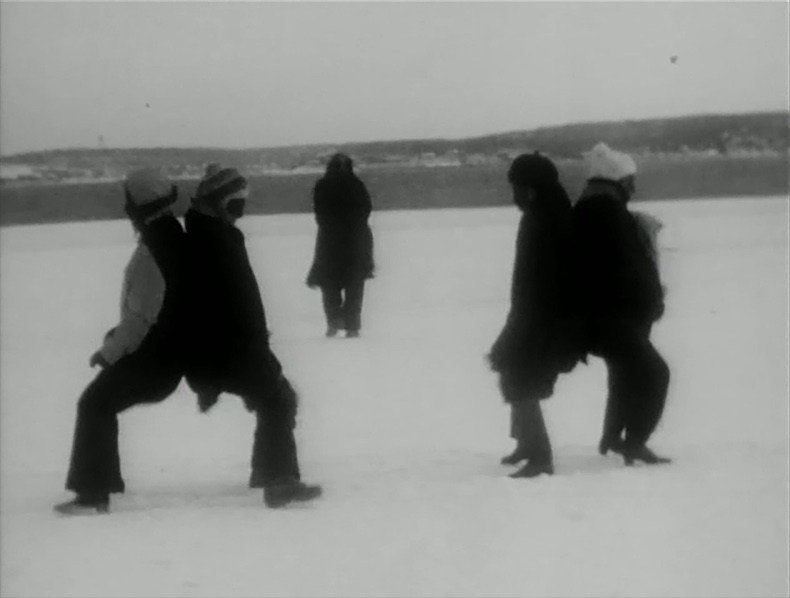
The Hirshhorn and the Gund have announced their joint acquisition of two works by the American performance art pioneer Joan Jonas. Wind (1968), currently on show at the Hirshhorn, is a short silent film in which a series of couples move across a Long Island beach, buffeted by the wind. Mirror Pieces Installation II, conceived in 1969 but reworked in 2014, is an installation comprising three long mirrors against a wall; a dress and jacket hanging above them, each decorated with mirrored panels; and a television, turned to face the mirrors, playing another of Jonas’s films: Nudes with Mirrors (1969). These are the first works by Jonas to enter the collections of either museum.
Musée des Beaux-Arts de Rennes
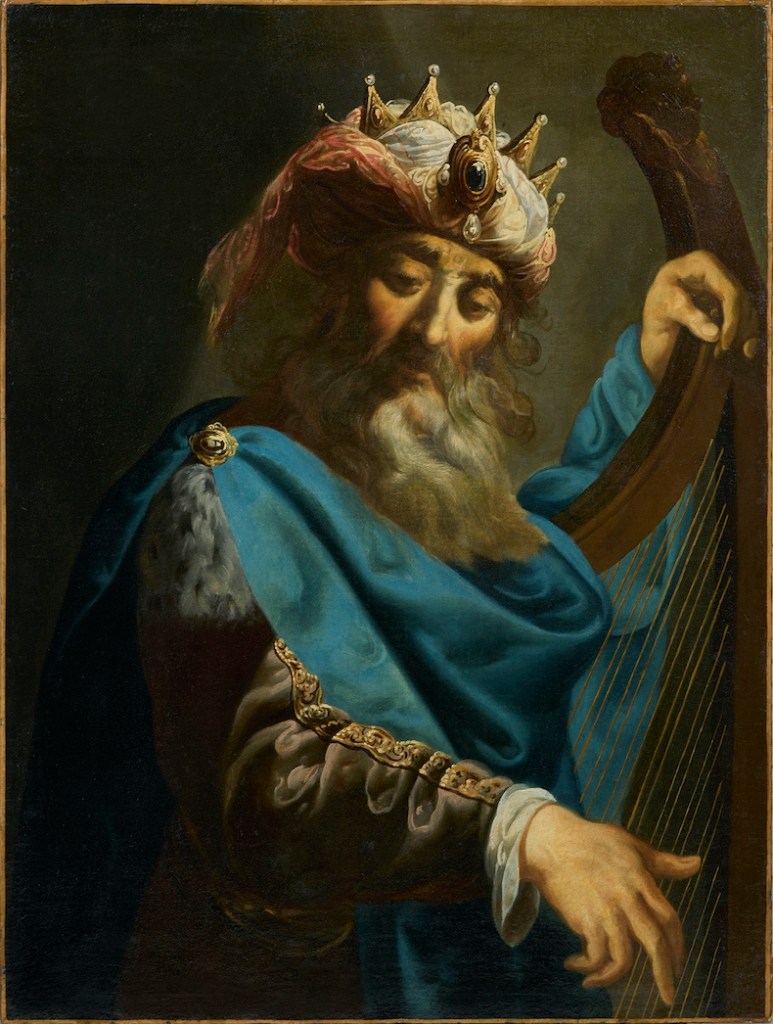
King David Playing the Harp (c. 1635), Georges Lallemant
Many depictions of David portray his battle with Goliath or its aftermath, but there is a rich tradition of artists showing his musical side: the greatest such depiction is by Gerard van Honthorst in 1622, though the following decade Rembrandt painted him playing the harp before King Saul. The French artist Georges Lallemant – about whom relatively little is known and whose works include devotional paintings, woodcuts and genre scenes – produced his version in around 1635. It’s an expressive work that foregrounds King David’s jewel-encrusted crown, his flowing blue outfit and the dexterity of his hands. The work has been bought from F. Baulme Fine Arts by the Musée des Beaux-Arts de Rennes, which already owns a Holy Family by Lallemant.
J. Paul Getty Museum, Los Angeles
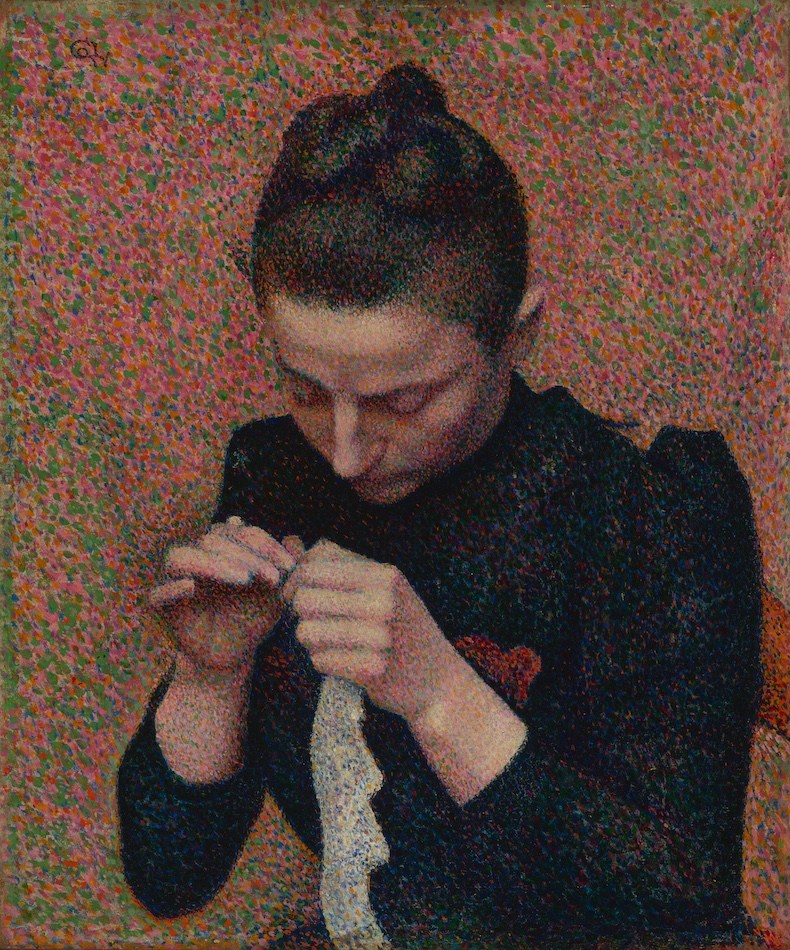
Young Woman Crocheting (1890–91), Georges Lemmen
It might come as something of a surprise that the Getty has, until now, no pointillist works in its collection. That has been remedied by the acquisition of Young Woman Crocheting (1890–91) by the artist Georges Lemmen, one of the members of Les XX, a group of Belgian artists including James Ensor who came together in 1883 and held annual exhibitions of their work – partly in disgruntlement at L’Essor, the artists’ association that had dominated Belgian art since 1876. The painting, an intimate portrait of the artist’s sister Julie, was bought from Gallery 19C and French & Company at TEFAF Maastricht.