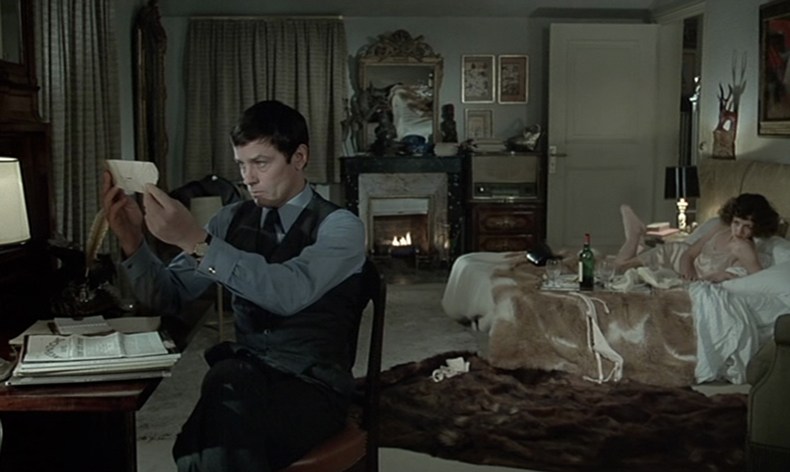
One of the most chilling scenes in Monsieur Klein (1976) – Joseph Losey’s thriller about a Catholic art dealer who is framed as a Jewish man in occupied France – plays out in the Grand Palais in Paris. It’s January 1942; a convoy of Tractions Avants – the long black Citroëns favoured by the occupiers and Resistance fighters alike – glide into the museum and park by a maze of temporary partitions that suggest an art fair for ghosts. The sequence has no dialogue and barely any sound: this isn’t so much a raid as a ballet de voitures, and the muscular grace of the cars’ movement is its own kind of degenerate art.
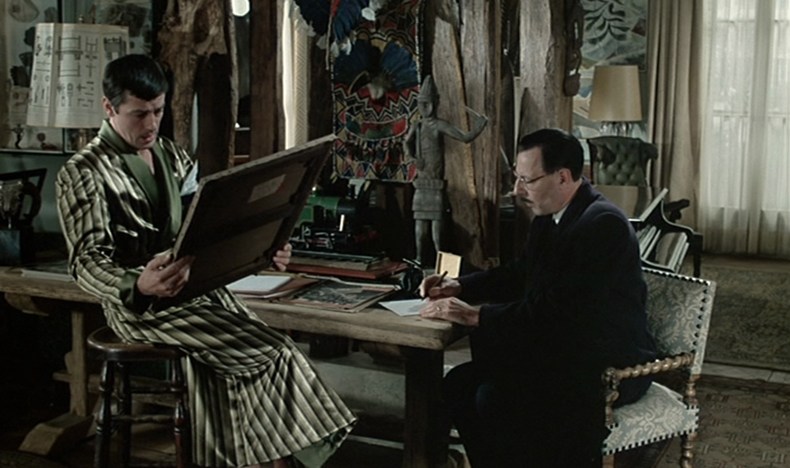
The authorities are paying a visit to the dealer, Mr Klein (Alain Delon), to strip him of all the paintings and statues in his possession. It almost serves him right. We first meet him in his well-appointed apartment on the rue du Bac; he is playing hardball with a Jewish Frenchman (Jean Bouise) who is selling off his art collection before leaving the country. The unfortunate man wants 600 gold louis for a 17th-century Dutch painting that has been in the family for generations; Klein offers him 300, his every gesture peremptory. ‘Recently I’ve seen many clients like you, urgently needing to sell,’ he says. ‘I assure you it’s most unpleasant for me. Very often I would rather not buy.’ He buys the painting for 300.
As the gentleman leaves he notices a copy of Informations Juives, a French/Yiddish newspaper, on Klein’s doorstep. Someone has apparently confused the dealer with, or fingered him as, a Jewish Mr Klein, and he spends the rest of the film trying – and failing – to convince everyone that there’s nothing Jewish about him.
By the time the film premiered at Cannes in 1976, France was only beginning to reflect on the realities of the German occupation and the collaboration of French citizens. Marcel Ophuls’s The Sorrow and the Pity (1969), a four-hour documentary about the extent of collaboration in Clermont-Ferrand in the Auvergne region, was briefly stifled by the French state before making it into cinemas in 1971. One of the interviewees in the film is a shopkeeper named M. Klein, who in 1940 had taken out an ad in the local paper to announce his ethnic bona fides. ‘I have the honour of informing my loyal customers,’ it read, ‘that contrary to any anonymous allegations, I come from an old French family.’ Confronted by Ophuls’s camera some 20 years later, he stood by his actions. (The clip is available on YouTube. Most of the commenters take his side.)
The scene prompted the screenwriter Franco Solinas, a committed communist and wartime Resistance member, to write a study in French amorality and apathy during the war. The premise, which hinges on mistaken identity and the ever-enclosing net of an uncaring justice system, is often described as Kafkaesque, but it’s truer to say that the film inverts Kafka’s nightmare logic. Here the system’s indifference goes without saying: it’s the main character’s moral indifference that’s really troubling.
Klein is far from indifferent, however, about the man who shares his name – and to whom, it is hinted, he bears a striking resemblance. (Losey carefully seeds oblique but recurring clues and symbols – clock faces, theatrical props, a photo of the doppelgänger with his face obscured – despite being unconcerned with resolving the plot’s central conundrum.) Klein’s obsessive pursuit of his namesake through a series of Paris locales propels the film; it often plays like a diabolical inversion of Hitchcock’s North by Northwest, with the protagonist’s self-confidence pushing him further into an abyss rather than helping him vault out of it.
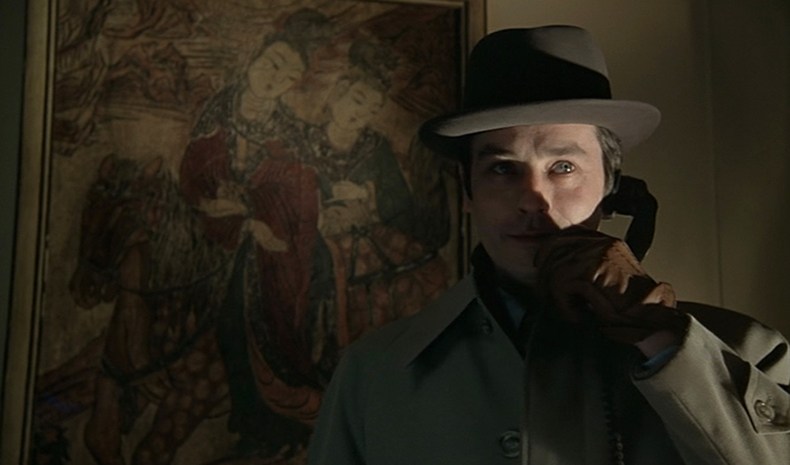
Delon was 41 when he produced and starred in Monsieur Klein – more than a decade into his own career as an art collector and no longer in the frame for the murder of his bodyguard, Stevan Marković, in 1968. His extensive questioning by police may help explain why, by the mid ’70s, one of the world’s most beautiful film stars had begun to age prematurely; still, in his fifth decade, the actor’s face remained just about handsome enough to resemble a mask of composure that is gradually chipped away by obsession and bewilderment. Few could combine arrogance, urbanity, charm and sangfroid like Delon, who thought Monsieur Klein the greatest film he’d ever made.
Losey managed to coax marvellous performances out of Delon, Jeanne Moreau and Michael (here credited as ‘Michel’) Lonsdale despite not speaking a word of French. Instead, the director, who wrote for architecture journals in his youth and spent six years as a tenant of the architect Émile Aillaud in Paris, mastered the language of manipulating space: the scene with the Citroëns is only one of several breathtaking sequences that isn’t so much directed as choreographed. The way Losey moves Delon through space, isolating him or framing him in mirrors and through panes of glass, helps pin down a figure who looks high and low for his double but is incapable of looking at himself.
The final scene begins in the Vélodrome d’Hiver, where some 13,000 Jews were rounded up for deportation in 1942. (The film-maker and critic Jean-Baptiste Thoret suggests that 1970s viewers would have been reminded of the Chilean junta’s detention of thousands of political prisoners in the national stadium in Santiago.) Other details resonate too: the fragility of Klein’s birthright citizenship, for instance, which rests on whether he can find the right family documents. Towards the end of the film Klein’s friend asks him: ‘How can a man as distrustful as you suddenly show such confidence in the post office, the railways, the bureaucracy, even the police?’ Klein replies: ‘Because I’m a good Frenchman.’