From the October 2026 issue of Apollo.
A curious piece of language creep has taken place this year. I noticed it first in a BBC news feature about someone unsavoury – a gangster, a royal spouse, someone dictator-adjacent, I forget the particulars. The subject of the report maintained tight control over their public image. According to available information, their life was positive, upbeat, legit, rosy. Of course, warned the reporter, we had to bear in mind that all this had been curated.
‘Curated.’ That made me sit up. The same usage reappeared in a different story the following week. It has since made regular cameos, even popping up amid this year’s updates to Entitled, Andrew Lownie’s forensic takedown of Andrew Mountbatten-Windsor and Sarah Ferguson. Somehow, ‘curate’ – a word once associated with the museum archive and the organising of exhibitions – has become a synonym for dissimulation, deception, fabrication and economy with the truth. With, in short, the art of falsehood, rather than with art per se.
I recently revisited Mervyn Peake’s Titus Groan (1946) ahead of the book’s 80th anniversary. Set among the scheming occupants of the monstrous palace of Gormenghast, Titus Groan is a fantasy novel written by an artist – vividly imagined, with much to say about the creative act. In the book’s opening chapter, the cadaverous manservant Flay visits the palace’s sculpture gallery, the Hall of Bright Carvings, to inform its curator, Rottcodd, that a baby has been born to the noble family of Groan. Rottcodd lives a secluded life in the Hall of Bright Carvings, ineffectually polishing the art entrusted to his care while the dust pools about his ankles. As Flay leaves, he puzzles as to why he has visited Rottcodd with this piece of news, then realises that the curator is the only person to whom he could have delivered it. Of all those in the palace, only Rottcodd is so distant and out-of-touch that he had not heard it already.
Rottcodd is an artist’s joke at the expense of archivists, academics (phonetically, the name is ‘doctor’ backwards) and guardians of the status quo. In the 80 years since the publication of Titus Groan, the imagined activities of that mythic figure, the curator, have described a peculiar arc from fusty conservation, through gatekeeping, tastemaking, trend forecasting and fetishised connoisseurship.
In the early 21st century, the curator became a glamorous art-world star. The ascent of the curator coincided with the increasing globalisation of art, the rise of the Internet and the expansion of art schools in Europe and North America. ‘Art’ transformed from a containable knowledge class into a rapidly accelerating and expanding field. Like that other superstar of the era, the club DJ, the curator was a selector – someone able to make sense of this bewildering cultural proliferation.
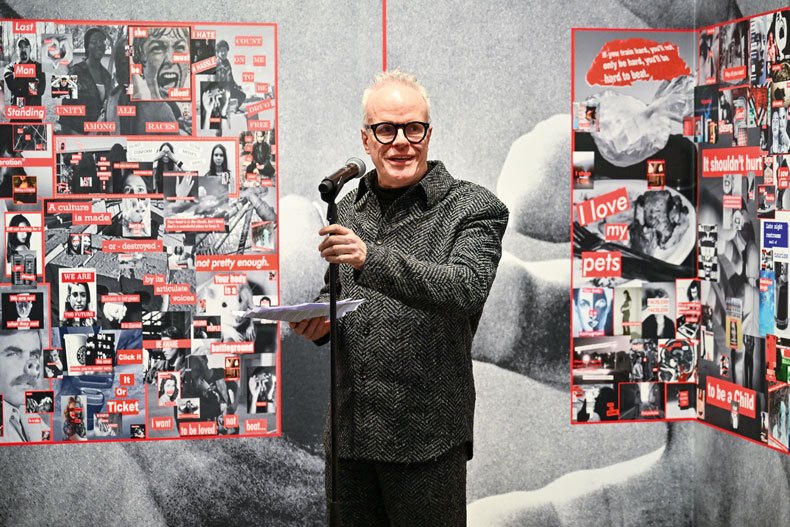
By the 2010s, figures such as Hans Ulrich Obrist and Klaus Biesenbach were referred to without irony as ‘super-curators’: a new breed of superstars circumnavigating the globe, forever chasing the next biennale. They flaunted punishing schedules. HUO’s nomadic networking and ideas group, which met at 6.30am, was literally called the ‘Brutally Early Club’. The art world had apparently acquired Silicon Valley’s appetite for visionaries and hustle culture.
In 2014, David Balzer’s deliciously snarky book Curationism: How Curating Took Over the Art World and Everything Else charted how the language of curation had started to creep out of the gallery and into daily life. This was the decade in which hostesses proclaimed themselves to have curated bookshelves, chefs to have curated cheese plates and male models to have curated sock collections. Oversensitive curators (aka me) got shirty about all of this and expended disproportionate energy attempting to explain that ‘curate’ came from the Latin curare, meaning to take care, and that the now ubiquitous phrase ‘carefully curated’ was thus tautological.
The ridiculous spectacle of the curator-as-celebrity and all that it says about the art world’s self-importance is impeccably skewered in Ruben Östlund’s film The Square (2017). Claes Bang plays a hapless museum curator whose life amounts to a series of facades: professional elegance barely masking personal chaos, performative radicalism cracking to reveal inherent conservatism. Much of the film’s story turns around the uneasy relationship between art and marketing: that which can be tamed and commodified, and that which cannot.
It is this tension that has surely inspired the most recent linguistic creep to afflict the curator. In the arena of social media, ‘curating’ is essentially a fancy term for marketing. To have a ‘curated’ Instagram feed is to have a social media presence that is controlled to display the desired image of your life and products, whether you’re a make-up influencer, a tradwife or a con artist. Such soft but habitual forms of deception have brought ‘curate’ down with them, such that the word might describe an act of falsehood rather than of preservation.
Coincidentally, in the same period that this linguistic shift occurred, a reckoning has taken place around the partiality of museum collections. Archives are now understood to reflect choices and decisions about which stories should be told, which forms of human creativity should be valued, and how. The idea that any museum might tell an absolute and uncontested version of art’s story seems outdated. For everything that is shown there is something unshown, for every inclusion, an exclusion, for every history, an alternative telling. By this reckoning the recent shift in the use of the word ‘curate’, despite arriving by an entirely different route, seems absolutely fitting.
From the October 2026 issue of Apollo.