From the October 2026 issue of Apollo.
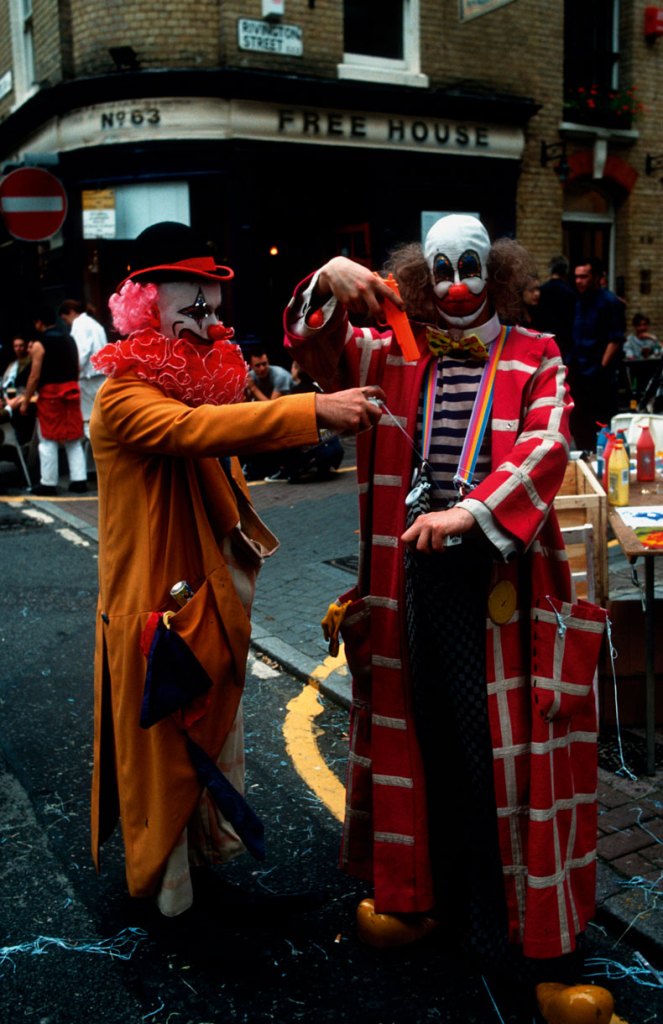
Sometime in the summer of 1993, a fellow art student told me about a sort of art bazaar that she said we had to go to. She had heard about it from a friend who was planning a new digital art magazine called Mute, who in turn had heard about it from an artist called Gavin Turk, who was just a few years older than us. The next Saturday, we set off from our squat-turned-shortlife-housing co-op in Wimbledon for Old Street. Our destination was the first Fête Worse than Death, and it was immediately memorable for how long it took us to find it. My friend claimed to know east London well; that she didn’t was apparent once we had walked the four-mile round trip to Maureen Paley’s gallery on Beck Road in Hackney and back again. The crossroads of Charlotte Road and Rivington Street, our target, was just five minutes from the station.
The fete has gone down in 1990s art-world legend. Damien Hirst and Angus Fairhurst dressed up as clowns and sold spin paintings for £1. Turk had a bash-the-rat stall. Gary Hume dressed up as a Mexican bandit and sold tequila shots, while Adam Chodzko, in a white coat, ran an unspeakably bad nail bar. The few pubs in the area, which catered to the rougher end of the City trade, normally shut at weekends; Joshua Compston, the 23-year-old founder of Factual Nonsense, one of the first galleries in the area, was rumoured to have persuaded the Bricklayers Arms to open with a £1,000 guarantee. It was silly, rough-and-ready and a lot of fun – and possible only because these Shoreditch backstreets were run-down and largely deserted. The police finally moved us on at 3am.
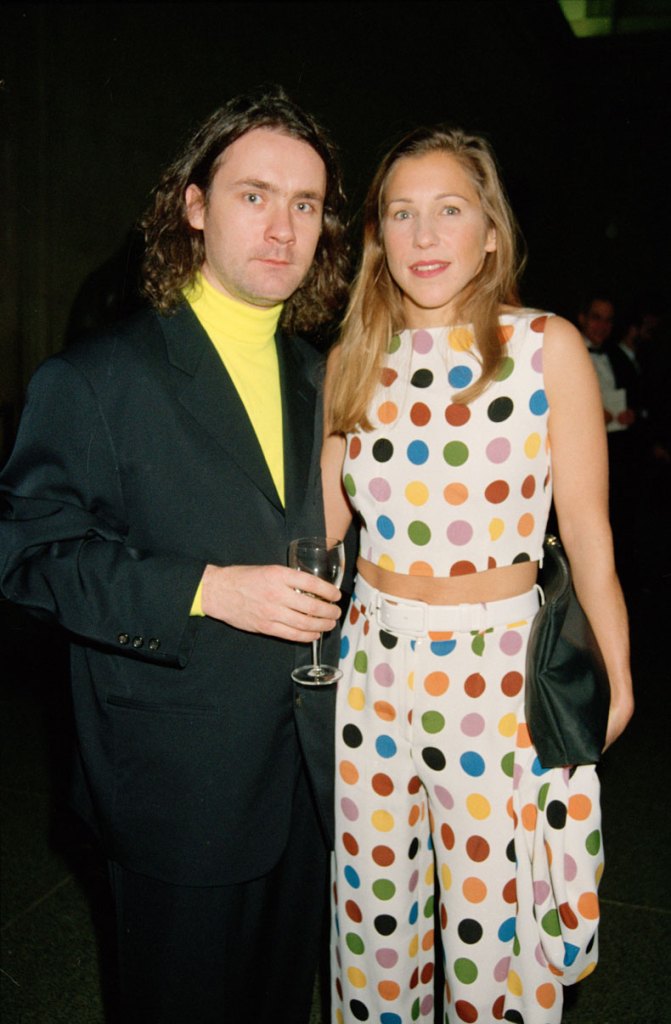
Most of the artists involved were not well known outside art-school circles. Only Hirst was actually famous – and at the time not in the household sense of the word. In the previous five years he had curated the ‘Freeze’ show in Surrey Docks while still at art school, had his first commercial show (at the short-lived Woodstock Street Gallery), his first institutional solo show (at the ICA), was the star of Charles Saatchi’s first ‘Young British Artists’ show at his Boundary Road gallery and was in that summer’s Venice Biennale in the Aperto (emerging artists) section.
Many, but not all, of the artists in the fete had gone to Goldsmiths: then, as now, one of London’s best art schools. But otherwise the colleges of the 1990s were radically different. St Martin’s, where I studied, was tiny. Before its merger with Central (which taught craft and design) there were fewer than 700 students, mostly studying fine art or fashion. Central St Martin’s now numbers nearly 5,000 in a flashy, purpose-built complex in King’s Cross.
The economics of art schools was different too. British students got free tuition. Poorer students got up to £3,000 a year in maintenance grants. With a weekend bar job and a few degree-show sales it was even possible to leave in profit. (Today, a three-year degree at the University of the Arts London, of which Central St Martin’s is now a part, costs between £46,000 and £71,000, and overseas students pay much more.)
Most art schools still taught by technique – painting, sculpture, film, printmaking, photography. But Jon Thompson, the artist who led the Goldsmiths course, had spent two decades dismantling the barriers between the disciplines. Life drawing was out post-structural French theory, group ‘crits’ (sessions where students discussed their work) and cross-year studios were in. The artist Michael Craig-Martin, meanwhile, blurred the boundary between ‘high’ and ‘low’, fine art and the mass media in his own work and was an influential tutor.
London art students emerged into a city that was emptier than today. There had been a steady population drift, caused by suburbanisation and slum clearances, from the 1950s onwards. By 1991 it had fallen from 8m people to a low of 6.8m. There was poor-quality, run-down housing to rent cheaply in 1990s London, even if the squats of the ’70s and ’80s were rapidly disappearing. London had also changed from being a major manufacturing centre to a service and finance-based economy. Around 100,000 jobs connected to the river were lost by the time London’s last working docks closed in 1981 and around 100,000 more as surrounding manufacturers closed. The property crash and recession of 1990–92 added to the swathes of disused factories and warehouses.
This meant that space for studios and pop-up exhibitions was far easier to find than now. Like many art students, my last few months at college were spent looking at empty buildings across east and south-east London. People helped each other – a group of ex-Goldsmiths artists showed some of us from St Martin’s around a secure, weatherproof, but unheated industrial block they had secured near Southwark Bridge, with advice on how we could do the same.
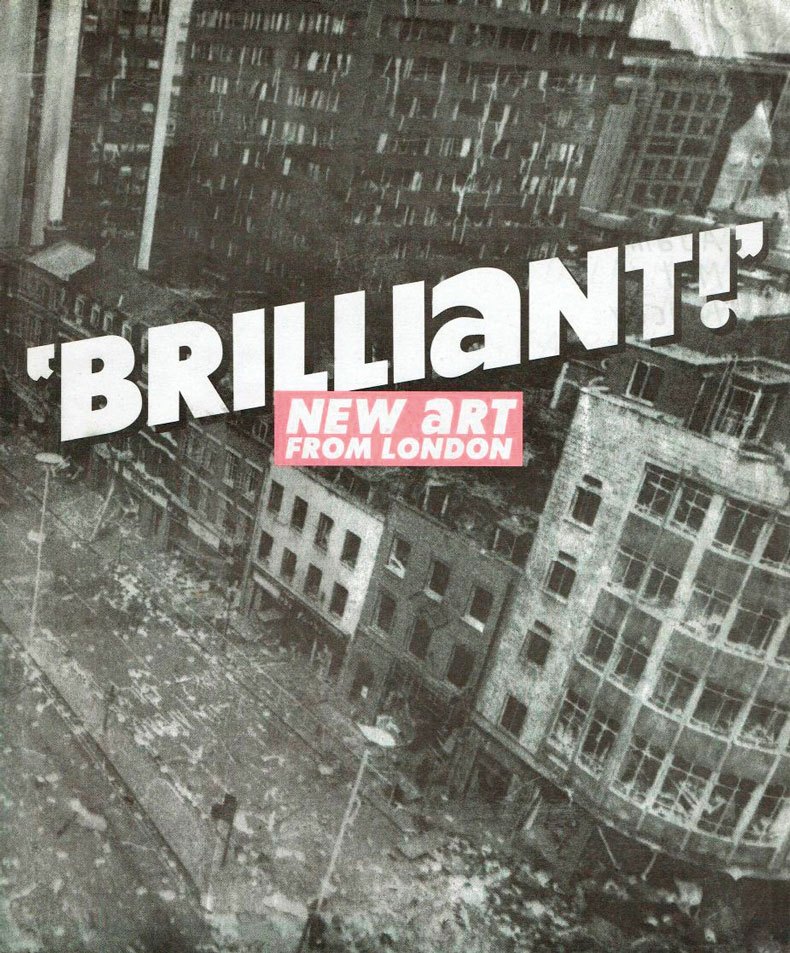
London was much dirtier, rougher and less safe than it is today. Crime reached an all-time high in 1995: a stretch of road in Hackney was known as ‘murder mile’ and riots – while not as frequent as in the early 1980s – could be explosive and violent. The IRA was still bombing London: the Baltic Exchange in 1992, Bishopsgate in 1993 and South Quay, Docklands, in 1996. In 1995, the Walker Art Center in Minneapolis staged a show called ‘Brilliant! New Art from London’ with a picture of the aftermath of the Bishopsgate bomb on the catalogue’s cover.
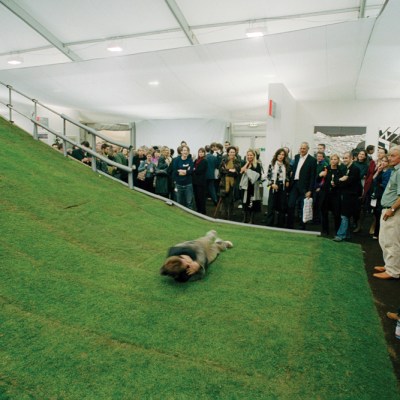
Ironically, little of the work of the artists who were becoming famous – loosely but often inaccurately lumped together as YBAs – was even covertly political. Michael Landy’s Market (1990), shown in Building One (part of a former Peek Freans biscuit factory) in Bermondsey, was a rare exception: he presented empty market stalls, once common all over London, covered in fake grass, as minimalist sculptures, their owners and customers long since gone. In 1993, as the recession dragged on, Gillian Wearing took to the streets, asking people she saw to write down their thoughts on a large sheet of paper and photographed them. In one of the most affecting, a smartly dressed City worker wrote, ‘I’m desperate.’
If there was a common thread uniting the work of the artists in the Walker show, it was a rejection of the political, theoretical and conceptual art that had characterised much of the 1970s and ’80s, or of more commercial painting. ‘The games of conceptualism had already been played out,’ says Matthew Slotover, who, along with Amanda Sharp, founded Frieze magazine in 1991. ‘And there was no money around, apart from Saatchi. It wasn’t like: “You’ve got to make paintings because that’s the thing that sells.” There was a lack of opportunity that creates a freedom from pressure, because no one’s doing anything. And an excitement about: “I’m going to have to take some risks, because otherwise, what am I doing?”’
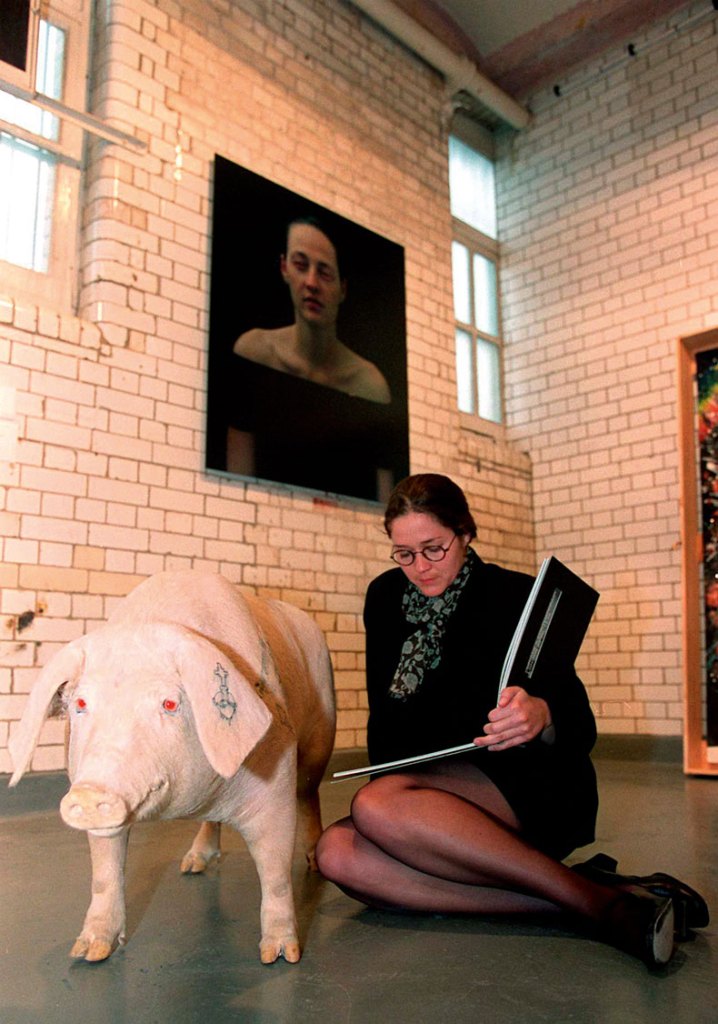
I first saw Damien Hirst’s A Thousand Years – a rotting cow’s head in a glass case being eaten by flies that would die when they came into contact with an Insect-o-cutor also placed in the case – in a show called ‘Gambler’ he organised with Carl Freedman in 1990. We are so familiar with Hirst’s work now that it is hard to convey the excitement that greeted his early pieces: here was an artist who wasn’t making obscure conceptual points with text, like the group Art & Language, or browbeating us with leftwing politics like Peter Kennard. Here was an artist taking on the big, romantic themes of life, death and fate. It was aesthetically sensational and full of youthful bravado. It was all the more atmospheric because, unlike Hirst’s other vitrines, this one was not totally sealed: an unpleasant odour of rotting meat leaked into the space.
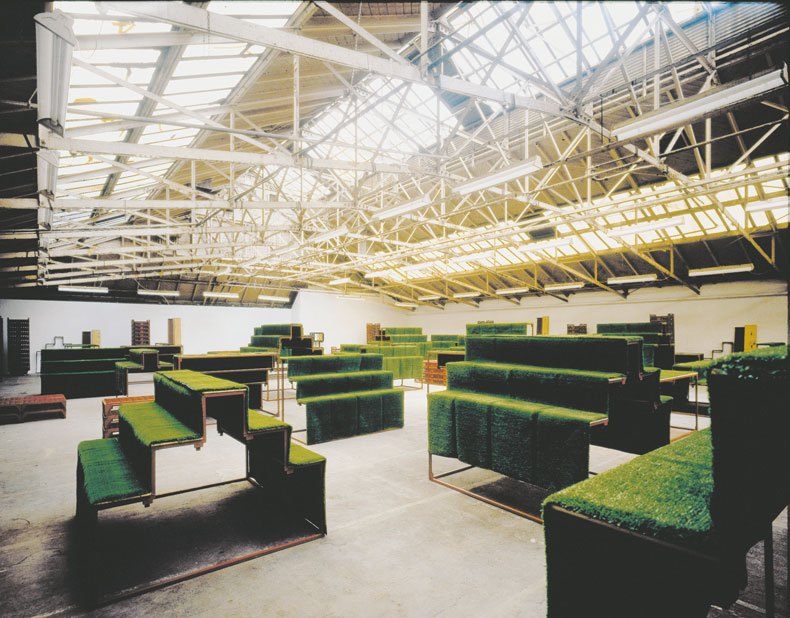
Dane Gallery; © Michael Landy
Other artists dealt with their own bodies and identities, celebrity, commodification and fame. Marc Quinn made rubber casts of his skin hung on lines, and made a cast of his head from his own frozen blood. Turk made Pop, a sculpture of himself as Sid Vicious mimicking Warhol’s famous 1963 silkscreen print of Elvis. Denmark Street, east of Soho, was rammed for its first outing in a disused space in 1993. Sam Taylor-Wood photographed beautiful, rich-looking people hanging around doing nothing much (apart from occasionally having sex) in luxurious spaces. She photographed herself, her trousers round her ankles, with a T-shirt with FUCK, SUCK, SPANK, WANK printed on the front.
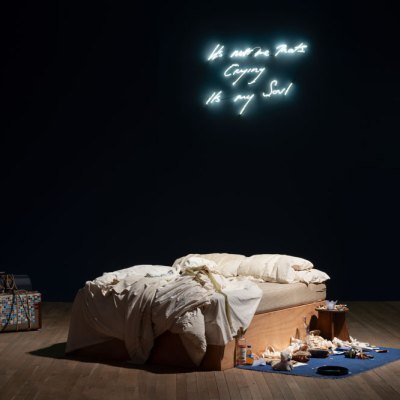
Much of this sent the British tabloid press wild, at a time when the Sun had a circulation of 4 million. But in truth, most of it was not really that shocking. An exception, perhaps, were works such as Jake and Dinos Chapman’s Fuck Face Twin or Two Faced Cunt (both 1995): it’s hard to imagine either being shown now. ‘It was a moment that was pre-globalisation, pre- the monetisation of the art world and pre-lifestyle-ification of the art world,’ says Alison Gingeras, a curator based in New York and Warsaw. In 2010 she co-curated ‘Pop Life: Art in a Material World’ at Tate Modern, which included artists such as Turk, Tracey Emin, Sarah Lucas and Hirst alongside Warhol, Koons and Keith Haring. ‘Now you have art students who are aspiring to be rich, famous, know certain kinds of people and wear certain clothes. And YBA was the start of it,’ she says.
This month Tate Britain will open an exhibition curated by Edward Enninful, the former editor of Vogue. It will focus on the YBA ‘scene’: the artists, fashion designers, models, photographers, chefs and pop musicians who hung out together, as their fame and money grew, in clubs like the Groucho and Atlantic Bar. But many remember it differently. Landy, despite his prominence, describes the 1990s ‘as a struggle’. He joined Karsten Schubert on the last day of his degree in 1988, but left the gallery five years later. He says that he ‘spent a lot of time after putting on my own exhibitions, selling bits and pieces, just trying to survive’. In 2001, Landy made Break Down, systematically destroying all his possessions in an empty shop on Oxford Street. A comment on consumerism and value, it is now considered one of the defining works of the decade.
Nevertheless the excitement around the YBAs was a major shot in the arm for the contemporary market, even if it took most of the decade to develop. In 1990, London meant Old Masters and Impressionists: upmarket taste was aristocratic. The auction houses did not generally sell the work of living artists – which made Christie’s sale of contemporary art in a Clerkenwell warehouse in 1998 a defining moment.
The most important dealers, selling fine paintings and objets d’art, included Agnews, Colnaghi, Partridge Fine Art and Mallett. Marlborough sold establishment British artists such as Henry Moore, Francis Bacon and Frank Auerbach. The Grosvenor House Fair was still a major thing (it shut in 2009). Georgina Adam, an art-market expert, recalls ‘dealers sidling up and saying, “you must come and see this snuff box, it’s come from Princess Margaret”.’ The few contemporary galleries – Lisson, Anthony d’Offay, Victoria Miro and Annely Juda among them – were much admired, but they tended to focus on mid-career international artists.
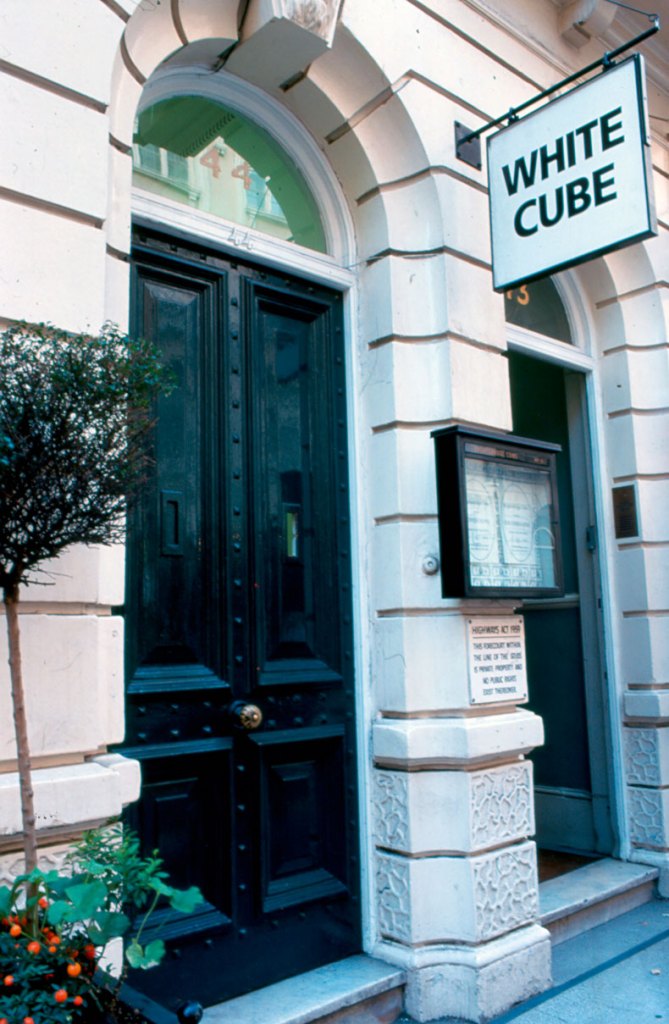
Around 1990 Hirst had met Jay Jopling, the Eton-educated son of a Tory life peer. Jopling soon started selling art from his Brixton house; three years later he founded White Cube. I don’t remember the earliest days of White Cube, upstairs in two small rooms off Duke Street, next door to Christie’s. I do remember what seemed like another monumental trek east to a huge Docklands warehouse for its inaugural project. The Immaculate Stereoscopic Conception of Mr D (1993) was an Alice-in-Wonderland-like, multimedia installation by another Goldsmith’s graduate, Itai Doron. Even crazier than the art was the number of cool, affluent-looking people who had been persuaded to go for an evening out at the disused site near Canary Wharf.
Soon after that, the list of other new galleries started to grow. Frith Street gallery, Stephen Friedman (now closed), Modern Art and Timothy Taylor all opened at this time. By 1997 Sarah Lucas had persuaded her friend Sadie Coles, then at D’Offay, to set up on her own. Slotover says that at some time in the late 1990s he realised that there were enough London galleries to be the base for an international fair. The first Frieze Art Fair was originally planned for 2000 until a venue proved a problem; it eventually took place in 2003.
Glenn Scott Wright joined Victoria Miro as co-director in 1997. He says that, although the early 1990s ‘was special, it was also very tough. There was an optimistic spirit but there were hardly any collectors.’ For two years, until it folded, he had a gallery on Dering Street with Maureen Paley. ‘We showed Angela Bulloch, [Peter] Fischli and [David] Weiss, Mike Kelley, Jenny Holzer. Really amazing artists but zero interest.’ British collectors were few and far between: Janet and Gilbert de Botton, Doris and – of course – Charles Saatchi. ‘If they didn’t come to a show, you didn’t sell anything,’ Scott Wright says.
It would be years before I would talk to an art collector – not until I had stopped trying to live as an artist, trained as a journalist and starting working for the Art Newspaper. But the artists, galleries and curators who knew Saatchi say it really is true that the nascent contemporary scene could not have survived without his Machiavellian, media-manipulating and marketing genius. He was as much a secret dealer (he would buy up whole shows of young artists and just as quickly flip them) as a collector. But from the mid 1980s to the late ’90s, his gallery in Boundary Road, St John’s Wood, was also one of the most important art spaces in London. He and the artists he championed quickly became drivers of the capital’s non-commercial scene.
In 1994, the Serpentine – which throughout the 1980s had put on exhibitions of mid- and late-career British artists most people have now never heard of – asked Hirst to curate a major show. ‘Some Went Mad, Some Ran Away’ included Sophie Calle, Kiki Smith and Hiroshi Sugimoto, as well as some of Hirst’s Goldsmiths mates. It marked a turning point in the institution’s fortunes. At the Royal Academy, its brilliant but irascible exhibitions secretary Norman Rosenthal was also a fan. He had been impressed by ‘Freeze’ and, in 1997, when another show fell through, he pulled together the now legendary ‘Sensation’ from Saatchi’s collection. The tabloid press, in delighted rage, pilloried it for Marcus Harvey’s painting of ‘Moors Murderess’ Myra Hindley, comprising imprints of a cast of a child’s hand. Cooler heads worried that, with values boosted by the show, Saatchi would start selling – which indeed is what happened.
Meanwhile, over at the Tate (now Tate Britain) on Millbank, director Nicholas Serota was working hard to realise a decade-long dream: a huge temple to contemporary art to rival the Museum of Modern Art in New York. It would need what seemed like enormous amounts of money – up to £150m – even with the cash for good causes generated by the new National Lottery. Public funders, who had traditionally been hostile to contemporary art, would not be easy to persuade. Serota’s opinion of YBA was not always easy to read. But Alex Farquharson, Tate Britain’s current director, credits the ‘visibility and popularity’ that the leading YBAs generated with prompting public investment. In 1995, the Millennium Commission confirmed £50m for the project.
By then, the whole of London felt like it was changing, as the City and property markets began to boom. The new Labour government, elected in 1997, proved as friendly to the rich as the Tory administration before it. In 1994 John Major had introduced a ‘golden visa’ scheme that gave residency rights to anyone who invested the relatively modest sum of £1m. Tony Blair embraced it, and the UK’s then generous ‘non-dom’ scheme, with enthusiasm. Rich foreigners from Russia, China and India, as well as Europe and the United States, poured into London. Suddenly there were people to buy art, join cultural boards and patronise London’s museums and galleries.
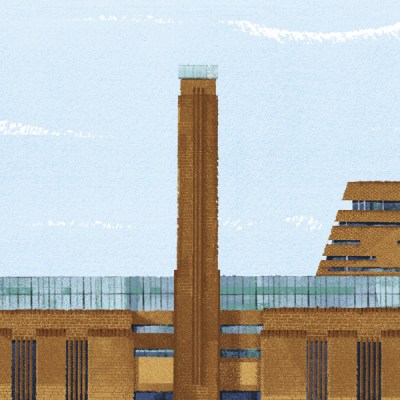
Early in 2000, Serota took me on a tour of Bankside Power Station in Southwark, a few months before it opened as Tate Modern. I was overawed more by the scale of the architecture – not least the silent turbine hall – than the museum’s intimidating director. I was disbelieving when he pointed to the electricity substation outside and said that one day it would be the site of an extension. Now Southwark is filled with multimillion-pound flats and office blocks: one of them sits on the studio block to which, 30 years ago, I had enviously aspired. Shoreditch too has changed: architects, branding agencies and the Royal Drawing School fill Charlotte Road, while Rivington Street has a luxury Art’otel at one end. The studios, the early galleries, the illegal party spots are long gone. Yet unmodernised, ungentrified, unchanged bar a red coat of paint over its original navy blue, the Bricklayers Arms is still serving – a lone survivor from the 1990s.
‘The 90s: Art and Fashion’ is at Tate Britain, London, from 8 October–14 February 2027.
From the October 2026 issue of Apollo.