From the October 2026 issue of Apollo.
At the meeting of two rivers in Afghanistan’s central highlands, a brick tower rises from a narrow strip of ground. The mountains close in around it. There is no modern city beside the tower; the 12th-century Minaret of Jam stands almost alone. Several hundred miles to the west, in the city of Herat, the surviving minarets of the Sultan Husayn Bayqara madrasa – built at some point between the 15th and 16th centuries – overlook a busy urban landscape. Both structures are under threat of decay, made worse by Afghanistan’s recent history.
At Jam, the surface of the 65-metre minaret is covered with bands of raised brickwork: interlacing geometry, calligraphy and verses that circle the shaft. From a distance, the tower appears slender and simple. Up close, almost none of its surface is plain. Turquoise-glazed lettering interrupts the warm colour of the fired brick. Around the lower shaft, narrow bands of calligraphy carry Surah Maryam, the Qur’anic chapter named after Mary. But water from the nearby rivers is penetrating the foundations, causing the tower to tilt, while parts of the facade are falling away.
‘The minaret leans about 3.4 degrees toward the Hari Rud [one of the two nearby rivers],’ says Ekram Basim, a site engineer with Aga Khan Cultural Services-Afghanistan (AKCS-A). In 2025 AKCS-A excavated the riverbed at the foot of the minaret to a depth of three metres after the water level rose, Basim says. Clearing is continuing while conservationists work out what to do about weather damage to the ornamentation above. In Herat, meanwhile, a diagonal crack runs through the south-eastern minaret of the madrasa, damage sustained during earthquakes in 2023. AKCS-A has fitted a temporary belt around its middle but Basim says it cannot support the weight indefinitely. ‘It is in a very bad condition,’ he says. ‘If there is even a small earthquake, it may collapse.’
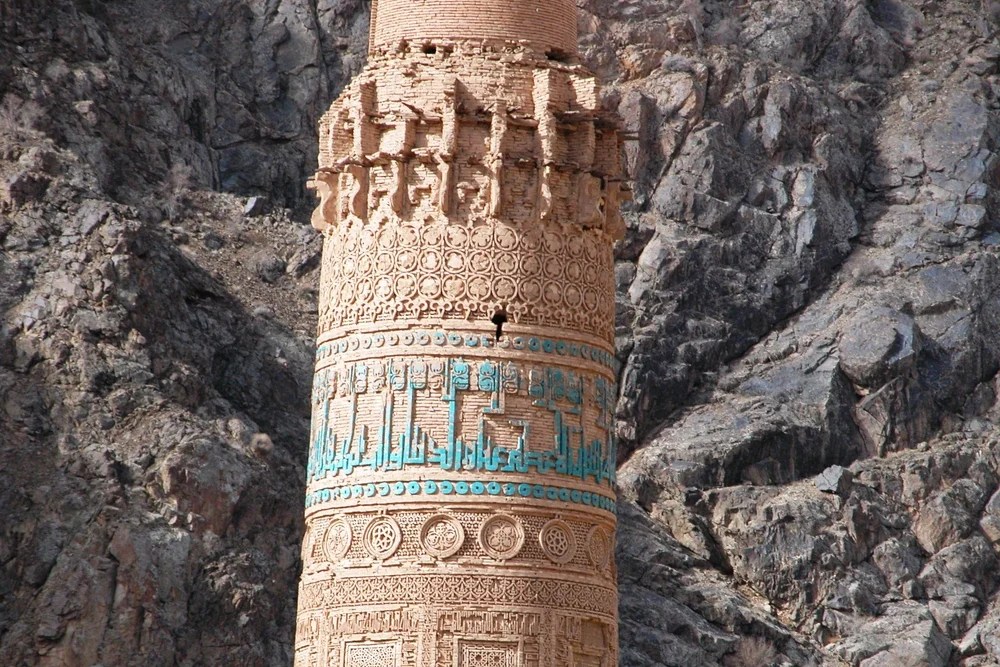
Across Afghanistan, a dwindling pool of engineers and conservation specialists like Basim are trying to maintain the country’s ancient monuments in a situation where skills and outside funding are scarce, and residents struggling to earn a living have little left for buildings that need constant care. Although the US withdrawal and Taliban takeover of 2021 have complicated matters, these problems stretch much further back. Take Jam, for instance, which became Afghanistan’s first UNESCO World Heritage site in 2002 and joined the endangered list the same day. Built in the Ghurid period, when rulers from central Afghanistan controlled an empire extending into Iran, Central Asia and northern India, its original purpose is uncertain. The tower, which UNESCO attributes to Sultan Ghiyath al-Din Muhammad in 1194, may have belonged to a mosque, served as a victory monument, or combined religious and political functions. What’s clear, however, is that it was not originally an isolated monument: fortifications, the remains of a settlement and stones bearing Hebrew inscriptions lie nearby, and are believed by some experts to be the lost city of Firuzkuh, the Ghurids’ summer capital.
The archaeological site is slowly disappearing, as remains have been dug out by treasure hunters over the past quarter-century. Looting follows the seasons, says a retired archaeologist familiar with Jam, who asked to remain anonymous. ‘Every winter when the snow closes the road the digging stops. Every spring it starts again.’ The police checkpoint at the entrance to Jam’s narrow valley searches for weapons, not antiquities. ‘The boys there would not know a Ghurid coin from a bottle cap.’
Efforts to protect the site have been hampered by the terrain and years of insecurity. ‘The Taliban made the road hell for travellers,’ says the retired archaeologist. Access is now safe, but difficult terrain continues to complicate conservation. Recent conservation efforts date back to at least 2020, with the launch of a UNESCO-led programme, accompanied by $1.9 million in funding from the Geneva-based heritage foundation ALIPH. In 2025 AKCS-A received a $40,000 grant for emergency riverbed clearance.
Sayed Bashir, a final-year archaeology student, wants to record the remains that survive around Jam before more are lost. ‘What I want to do is survey work,’ he says. ‘Nobody is recording what is on the’’’ ground before it isn’t.’ He hopes to map the Ghurid settlement with a drone, but says getting permission was difficult. ‘The Ministry is friendly to us in principle. In practice you wait, and the man who signs does not know what a drone survey is.’
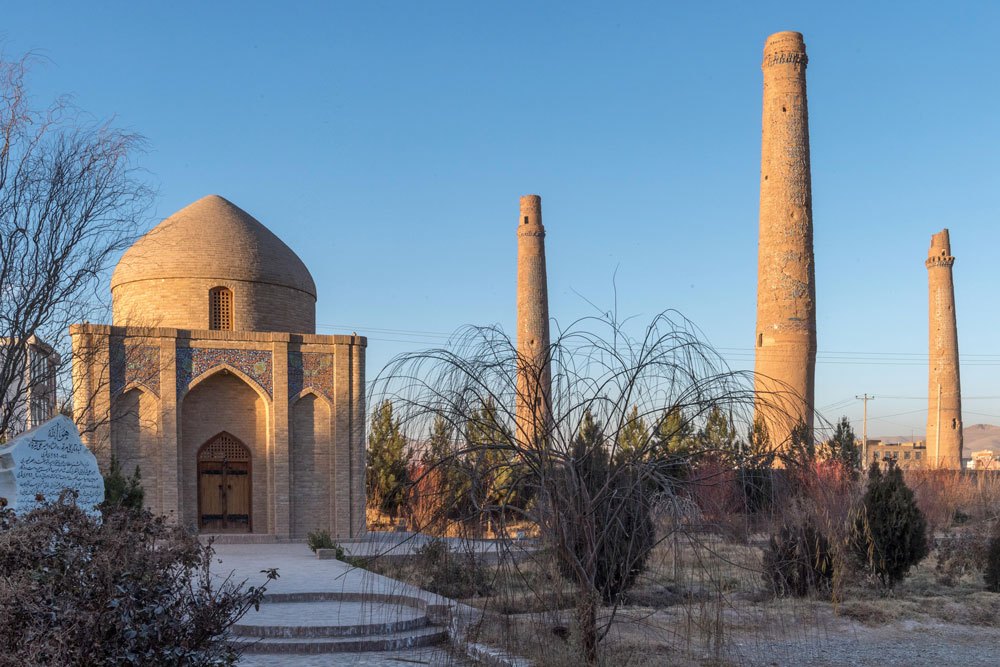
In Herat, an industrial and trading centre of 700,000 people, the modern city has expanded into the grounds of the Musalla, the former religious complex where the Timurid dynasty once built mosques and madrasas. Its familiar cluster of towers is only part of what remains. Basim counts six extant minarets, four of which belong to Sultan Husayn Bayqara’s madrasa. They’re accompanied by one survivor from the Gawhar Shad mosque, plus a stump from its attached madrasa.
AKCS-A has worked with the Taliban government’s Ministry of Information and Culture to clean and strengthen the brickwork on the latter. Decorative fragments recovered from the site were put back and a layer of lead was laid across the top to keep rain from entering. The minarets have long suffered from subsidence: Basim says that two of Bayqara’s towers were already leaning when they were surveyed in the 1970s. The south-eastern tower suffered the worst damage from the 2023 earthquakes, leaving a crack at 45 degrees, but the other three remain structurally sound – although their facades have deteriorated. For the cracked tower, the belt buys time. But stabilisation requires substantial funding, says Basim.
Nazir Ahmad, a history graduate who volunteers at the Herat National Museum, keeps evidence of the monuments’ slow decay on his desk. ‘I have a jar of tile fragments I picked up after the last big earthquake,’ he said. ‘I should not have picked them up, [but] I could not leave them.’ Besides natural disasters, Ahmad sees the Timurid monuments threatened by the encroaching city. ‘There are wedding halls next to the old city and apartment blocks from the 2010s within sight of [Gawhar Shad’s] mausoleum. The municipality could not stop them then and does not try now.’ Bibi Gul, a widow who lives behind the mausoleum, was spreading washing on her roof when the shaking began in 2023. ‘The first one I did not understand,’ she said. ‘The second one I was on my knees. I looked at the minarets because that is where you look. Dust came off the top of one like smoke. Some pieces came down.’
Under the Taliban, Herat’s municipality has shown an ambivalent attitude to the archaeological site. A road through the area, closed in 2007 over concerns about traffic vibrations, reopened for several weeks recently. Bibi Gul felt the vehicles from her house. ‘The trucks came through, and the whole street felt it in the floor,’ she said. ‘Then it closed again. Nobody explained either time.’ In 2025 more than 300 rickshaws confiscated by the Taliban – an initiative to reduce congestion on Herat’s crowded roads – were driven into the Musalla complex and left parked there for months, according to one resident who asked to remain anonymous.
Bashir the archaeology student, who was visiting family in Herat, saw ‘rows and rows of blue and yellow rickshaws, more than I could count, inside the sight line of Gawhar Shad’s mausoleum’. A young armed guard watched them. ‘I asked him if he knew what the towers were,’ Bashir says. ‘He said, “Yes, they’re illegal, they are ours now.” I asked him who built them. He didn’t know.’ According to Ahmad, there is supposed to be a hundred-metre vehicle-free zone around the site. ‘It was drawn up in 2014 with UNESCO money. [But] nobody in the traffic department has seen it.’
The rickshaw ban also exposed the economic pressures that overshadow conservation. Haji Nasrullah, who owns a carpet shop near Herat’s Great Mosque, says half his customers once came by rickshaw. ‘Business is bad because nobody comes, and now nobody can get here either,’ he says. The sight of rickshaws parked on open archaeological ground might spell danger for the historic remains – but for locals it represents a loss of livelihood.
‘You are asking me about minarets?’ says Zarghona, another Herat resident who lost her home in the province’s Zinda Jan district to the 2023 earthquakes. ‘Hundreds of people died. My village became dust in eleven seconds. My mother-in-law was inside her house.’ Yet a group of engineers who surveyed Herat’s towers also visited a small collapsed shrine near her village, according to Zarghona. ‘Nobody else wrote anything down,’ she says. ‘So maybe the towers are how the rest of us get counted.’
As in Jam, support for conservation efforts in Herat comes from several sources. AKCS-A’s work on the fifth minaret is funded through an ALIPH project worth $685,000 in total, while the Afghan Cultural Heritage Consulting Organisation, a non-profit group founded by local experts in 2011, also works in Herat. According to Basim, conservationists are frequently only able to make temporary repairs to ancient monuments, due to a lack of funding and a shortage of specialists and experienced local workers. This situation predates Afghanistan’s current government, but the country is also now suffering a more severe brain drain – many specialists left after 2021, while women have been barred from universities – that makes it difficult to carry out work even when the authorities allow it. ‘Permission is not [the same thing as] capacity,’ says the retired archaeologist. ‘The Emirate does not have engineers who know Timurid brick. It does not have conservators.’
Bashir says the loss of women from his department is visible in the classroom. ‘Half my cohort were women. Now the benches on the left side [of the classroom – where women traditionally sat] are empty. Nobody sits there, out of some kind of superstition.’ Teachers have also left. One female former archaeology student, who asked to remain anonymous, says she was two weeks from completing her semester when the ban was announced in December 2022. Her class was supposed to conduct fieldwork in Herat. ‘I had read the German [archaeological] mission’s reports on the citadel excavations,’ she says. ‘I knew the trench numbers. I never went.’ The former student now teaches English online and follows reports of flooding in Jam from her home in Kabul. ‘In May 2024, when the water surrounded the minaret I sat in my room looking at the photos and could not do anything,’ she said. ‘That is what it is to be an archaeologist in this country if you are a woman. You watch.’
The Taliban’s takeover has made an already difficult funding situation more complicated. Western governments have suspended direct co-operation while continuing to provide resources via international organisations and independent NGOs. ALIPH, which is backed by governments including France, the UK, China, the UAE and others, along with private foundations such as Getty, remains an active donor, having funded 32 projects across Afghanistan since 2019. A few governments still offer direct assistance: China, for instance, hosted training on heritage preservation in 2024. The main problem, according to the retired archaeologist, is that Afghanistan has no dependable maintenance budget. ‘When a grant ends, the work ends,’ he said. ‘Maintenance is the thing that saves a building, and it is the thing nobody funds, because you cannot put a plaque on it.’
In Herat, tiles shaken loose by the earthquakes continue to turn up on the ground. When Bibi Gul’s grandson found one, she told him to put it back. ‘Then I was ashamed,’ she says, ‘because the ground is where they get lost.’
From the October 2026 issue of Apollo.