From the November 2026 issue of Apollo.
Have you ever seen a piece of pottery with a glaze so rich, so luscious, you wish it were edible? Someone at the Museum of Oriental Ceramics (MOCO) in Osaka certainly has. It’s a hot summer’s afternoon and I’m in the museum cafe, choosing from a selection of drinks and snacks inspired by its collection, one of the finest in the world, which ranges from Han-dynasty pottery (206 BC–AD 220) to ceramic sculpture by contemporary Japanese artists. Perhaps a biscuit decorated to resemble a dish by one of the 20th century’s greatest potters, Shōji Hamada? I choose instead an iced matcha with dots of chocolate dabbed inside the glass – a riff on a 14th-century bottle from China in pale green celadon dotted with brown iron spots.
The cafe looks out on to the water. MOCO’s brick-and-glass building is on Nakanoshima, a long, thin island sandwiched between two branches of the Kyū-Yodo river in the city’s centre. That the celadon bottle is a designated National Treasure – there are two here, out of the 14 pieces of pottery that have earned the designation in the whole of Japan – has not stopped the museum from having fun. A certain lightness of touch is evident throughout MOCO, a lightness that coexists with its world-class collection and its displays. (The museum’s mascot is ‘Moco-chan’, a mischievous-looking feline – actually a tiger – who slinks across a large blue-and-white painted jar from Joseon-dynasty Korea on prominent display in the museum’s lobby.)
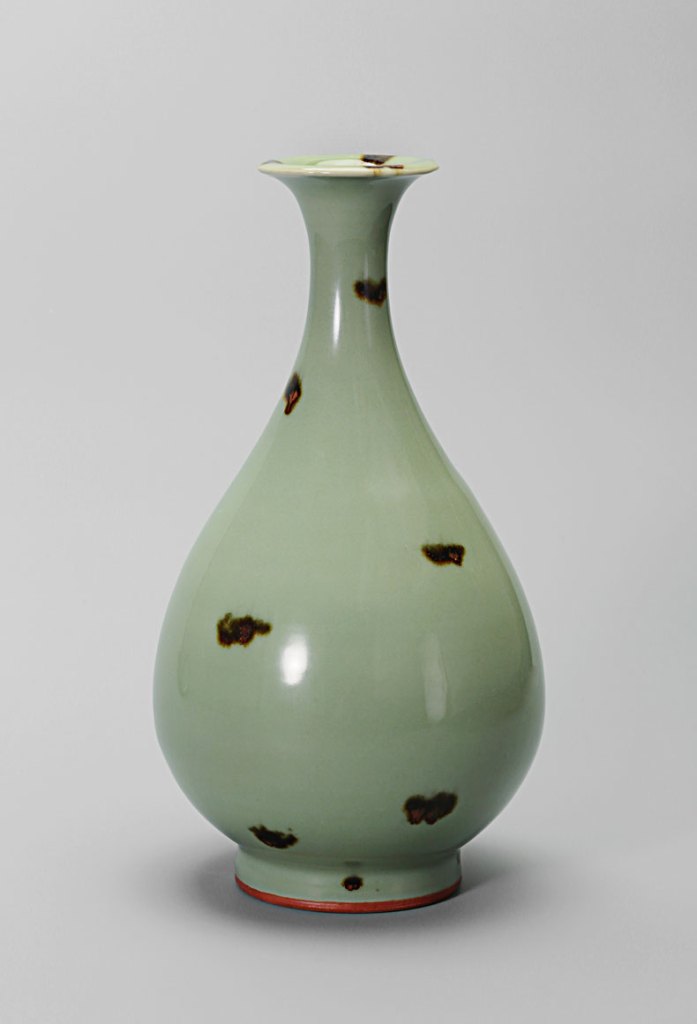
Later, in one of the three Chinese Ceramics galleries, this one focused on the Song dynasty, I see the celadon bottle itself. It is a perfect thing, enhanced by sensitive display. A wall text states that ‘in ancient times’ the ideal condition for appreciating the luminous delicacy of celadon wares was thought to be ‘a sunny autumn day at around 10 o’clock in the morning, in a room facing the north, into which natural sunlight comes filtering through the shoji (sliding paper doors)’. To replicate that effect, the museum has designed an ‘optical duct day-lighting system’ – in layman’s terms, the windowless gallery has hidden light wells inside vitrines, diffusing harsh sunlight to levels those fastidious connoisseurs would have approved of. (An artificial light box takes over on gloomy days.)
MOCO’s second National Treasure comes, like the bottle, from the Ataka Collection. This extraordinary assemblage of 965 mainly Chinese and Korean ceramic objects was brought together by the businessman and arts patron Eiichi Ataka. After Ataka & Co. went bankrupt in 1977, the Sumitomo Group – which was appointed the trustee – prevented the dispersal of the collection abroad by buying it and giving it to the city of Osaka. MOCO was founded in 1982 for its study and care. The second National Treasure comes from Song-dynasty China. It is a chawan (tea bowl) with a gold rim and a yuteki – ‘oil spot’ – glaze, in which a glossy black ground is flecked with iridescent spots of silver, like oil on water. In the 16th century the bowl was owned by the imperial regent Toyotomi Hidetsugu, whose uncle built nearby Osaka Castle. It has an almost cosmic beauty, like some astral phenomenon distilled into solid, hand-sized form.

Usually, one could only imagine handling such a precious piece. But at MOCO, while the real thing sits safely in its vitrine, a plain white replica, which precisely reproduces the original’s scale, form and weight (349 grams), is available for visitors to handle.
A screen reflects your movements and digitally transforms the replica into the real thing. I turn it over in my hands, taking the opportunity to virtually examine its foot ring. The high-tech conceit goes some way to solving the problem faced by every museum of the applied arts: if the objects in your collection were designed for use, how do you convey that experience to visitors who must use only their eyes, never their hands, and certainly not their mouths?
Other innovations include anti-seismic platforms for displaying objects, so that visitors can see ceramics that aren’t trussed up with safety wires: a treat in this earthquake-prone country, where even some of the sleekest, most apparently modern museums still rely on fishing line to keep their collections secure. Several of MOCO’s platforms go a step further, with shock-proof turntables, apparently the world’s first, which rotate like lazy Susans to show off works from every angle.
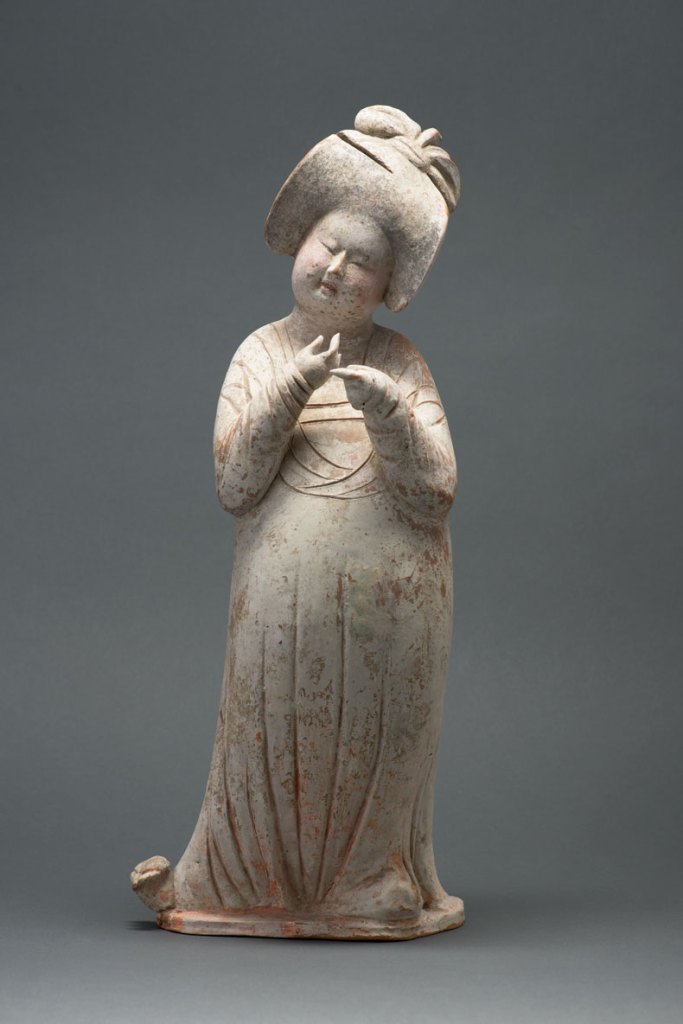
The painted earthenware form of a wonderfully plump and graceful Tang-dynasty lady appears to great advantage displayed this way. A few steps away, another figurine of a court lady, who looks more child than woman, has a waist only marginally thicker than her neck. Both are yong: sculptures of an unusual realism that were intended to serve a tomb’s inhabitant in the afterlife. That not much time separates the two – the slim figure is from the seventh century, her rounder companion from the eighth – is a reminder of how, then as now, the churn of fashion dictates the ideal female form. (Make what you will of the fact that the latter appears in printed form on the cafe’s biscuits.)
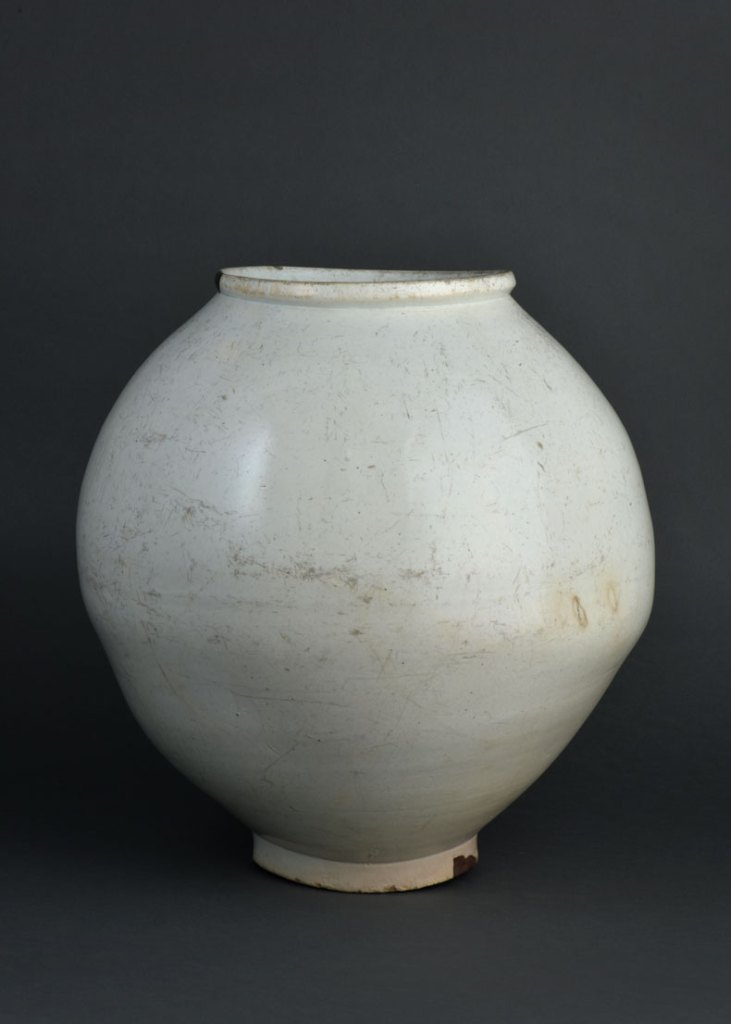
Elsewhere, a gallery of Korean works features a Joseon-dynasty moon jar (dalhangari) that has a particular resonance. Like all moon jars, it gains its charm from both simplicity – a pleasing roundness, an unadorned milky surface – and subtle irregularities (the slight wobble where two thrown halves were joined to make a spherical form; the undulation of an uneven rim). But in 1995 it was smashed into hundreds of fragments, not by an earthquake but by a burglar. A photograph next to the pot shows it reduced to shards. Untold hours of labour by conservators mean that the jar today is not only whole but appears unchanged: testament to the craftsmanship of both that early 18th-century potter and today’s conservators and custodians.
In the 45 years since MOCO’s founding gift, other donated collections have swelled its holdings to some 6,000 pieces. The proportion of those from Japan remains surprisingly low compared to those from China and Korea, but among them is a group of some 200 pots by Shōji Hamada – a Living National Treasure – made between the 1930s and ’70s. These chargers, tea bowls, vessels and more, many decorated with dynamic brushwork or poured glazes, rival those held in the museums of Mashiko, the rural pottery town where Hamada lived and worked. These pieces were collected by Horio Mikio, a close friend of the potter, who Hamada invited to kiln unloadings to take his pick of the freshly fired pots. Mikio used these pots daily before donating his collection in 2000. At MOCO, even Japan’s greatest treasures feel approachable.
From the November 2026 issue of Apollo.