From the November 2026 issue of Apollo.
When one considers the great monochromatic chroniclers of 20th-century London life – Bill Brandt, say, or Roger Mayne, perhaps the Soho roué John Deakin – the name of Henry Grant may not immediately come to mind. Yet in his own quiet way, this roving photojournalist produced a record of the capital’s changing face that is quite unique, and substantial enough to form the backbone of the London Museum’s vast photographic holdings.
Born in 1907 into a family of Whitechapel hat and cap manufacturers, Grant found little of interest to him in the millinery trade and instead considered being an engineer or an architect; by the end of the Second World War, however, he had become a professional photographer, initially doing formal portraits, then eking out a four-decade career as a Fleet Street freelancer. His body of work combines reportage and street photography – he would visit all parts of the city on assignments, and then use up any spare film in the camera by documenting things he spotted that interested or amused him – and it is vast: his entire archive of 30,000 black-and-white photos, negatives and contact sheets was acquired by what was then the Museum of London in the late 1980s, meticulously if haphazardly preserved in an assortment of old Tesco boxes, metal filing cabinets and repurposed manila envelopes with bygone postmarks.
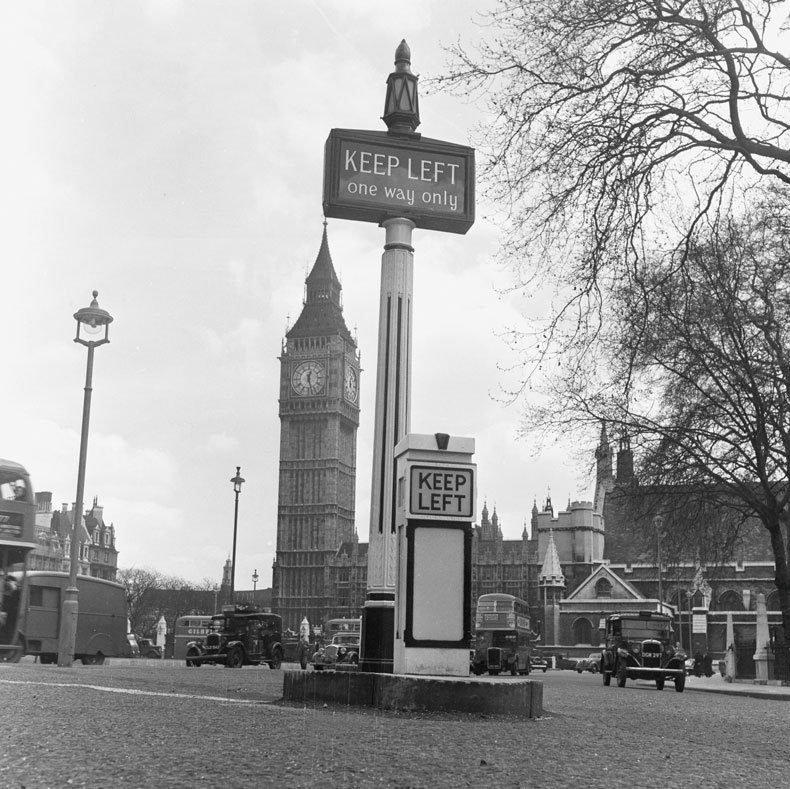
‘I work on the principle that there must by an uninterrupted flow of movement – the camera can capture only a fraction of the flow but it must leave the rhythm of the movement undisturbed,’ Grant wrote in 1950 of his methodology. This should not be taken as a suggestion that his photography is principally concerned with ‘action shots’; it is more about capturing things as they are, in motion, rather than setting them up in fake formal poses. There is undoubtedly a dynamism in Grant’s work, but it operates on a timescale too large to be captured by a camera shutter; the kind of forward-looking post-war optimism, Progress with a capital P, that might be associated with Mass Observation films with perky titles such as ‘Britain on the Move’. There are great numbers of people interacting with exciting new tech, mostly with lots of wires and Bakelite carapaces, or representing social change on more day-to-day levels: cashpoints and bottle banks, Caribbean bus conductors in carefully pressed flares, a traffic warden faced with the dilemma of a donkey cart in a parking bay. ‘Grant and his wife Rose were both committed socialists, regular contributors to the Daily Worker (now the Morning Star),’ explains Francis Marshall, senior curator of visual media at the London Museum. ‘This can be seen in many of the subjects he chose.’ There are, for example, any number of rallies and political gatherings, from duffel-coated Aldermaston marches to some kind of pensioners’ demo with bulldog-faced grannies straight out of a Giles cartoon. A subtler (and wittier) invocation of Grant’s politics can be seen in a study of Parliament Square from the general election year of 1951, a shot of traffic signs which acquire new meaning from the Palace of Westminster behind: ‘Keep left: one way only’.
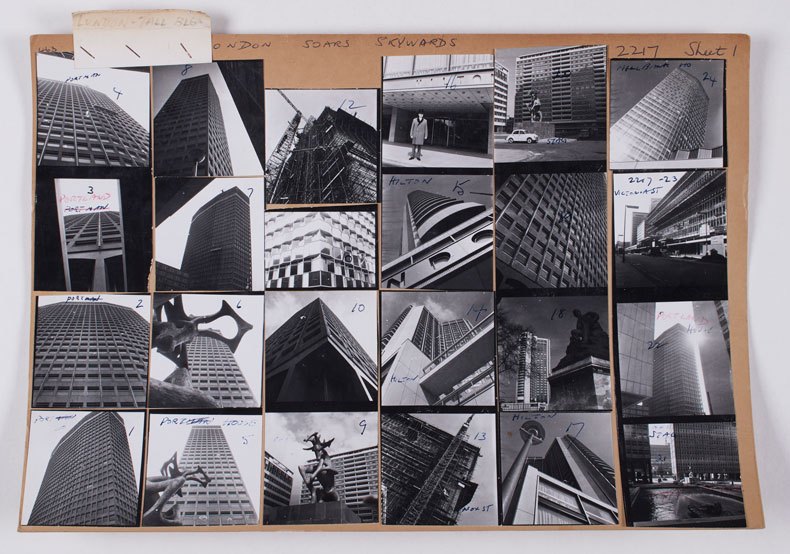
There is a palpable sense of the post-war project in action, of building a better world, or at the very least trying to do so. Grant’s photos of the capital are like individual frames from an unfeasibly long time-delay film, showing the city growing and changing like a flower opening up in accelerated time. Thus fog-choked and almost traffic-free streets of decaying terraces that stretch out like a De Chirico cityscape (in one case with a large banner reading ‘We want clean air!’) are supplanted by ‘streets in the sky’, modernist towers and office blocks that even when new are beginning to acquire the familiar stains of rainwater. Reflecting his erstwhile ambition to be an architect, Grant transforms these new edifices into almost abstract forms, great geometric planes seen from acute angles or reduced to stark silhouettes. His thoughts about the new shapes of London generally have to be inferred, but the title of a contact sheet of new high rises (‘London soars skywards’) suggests there was at least some element of hope in Progress. One shot from 1972 is, however, not so equivocal about it all: a striking chiaroscuro affair with a quiet street overshadowed by the bulk of the Westway, its ominous black arc curving in from the side like a front on a meteorological chart. The title? Motorway ‘Blight’ Off Ladbroke Grove.
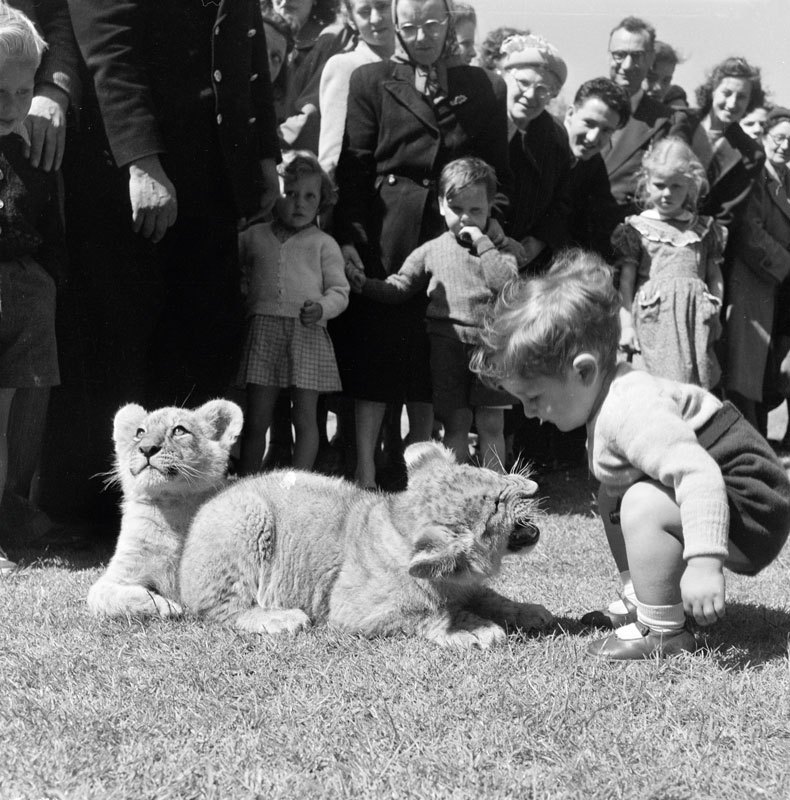
It is easy to see, in certain compositions, the longtime newspaperman’s innate understanding of how the shadowplay of deep blacks and whites works on the page, even when translated into Ben Day dots and reproduced on newsprint. That said, Grant is not an artist photographer, and his work is rarely about the posed or theatrical; if there is drama, it is of the understated Shelagh Delaney sort. His interest in the apparatus of the welfare state and the changing face of the city is primarily about ordinary people and how it affected them, looking at this Land of Promise and interrogating how (and if) such promises were kept. The few famous faces (the likes of Basil Spence, John Berger, Rosalind Franklin, Dave Brubeck, Ken Livingstone and Lulu) are generally seen in medias res, as one might expect from Grant’s stated aims; they are not hagiographic portraits, but simply people going about their business like anybody else. A contact sheet with the achingly modern title ‘Sculpture in Ciment Fondu’ depicts visiting lecturer Edward Ardizzone with students at the Royal College of Art, including a pre-fame David Hockney, his dark hair cut en brosse but with owl-like spectacles making him instantly recognisable. For the most part, however, Grant is photographing ordinary Londoners, and with an incredible naturalism; even his posed portraits have a sense of calm, as if he were saying nothing more than ‘Look over here’ then clicking the shutter. The result is an extremely evocative composite view of day-to-day life from the 1940s to the 1980s. We see people both at work – commuters, secretaries, market traders, an au pair girl peeling potatoes in a kitchen with Lucienne Day curtains – and at leisure: visiting the zoo, riding the bumper cars at Battersea funfair, dancing around lampposts serving as makeshift Maypoles, eating in cafes and shopping for consumer goods.
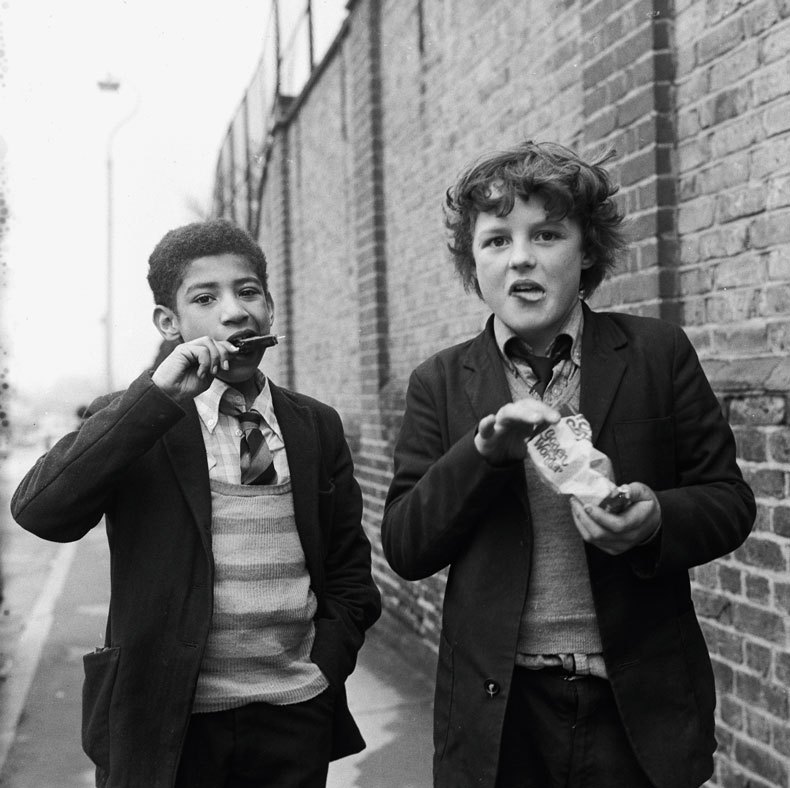
And, of course, there is the school system, for one notable recurrent theme in Grant’s vast oeuvre is a sympathy for young people and the world in which they found themselves. In part, this is perhaps a straightforward reflection of his environment: post-war London was a remarkably young metropolis, with some 2.5 million inhabitants under 25 in the early 1960s. Another reason is professional, since he had a regular gig as a contributor to the Times Education Supplement: there are multifarious schoolchildren confronting modernity in their home-knit jumpers, measuring out metric distances using trundle wheels, creating models of Gemini astronauts, eating crisps and smoking fags, and practising their vocab in language labs, those very tech-driven affairs that presupposed the key elements to linguistic acquisition were a lot of headphones and aerated fibreboard.
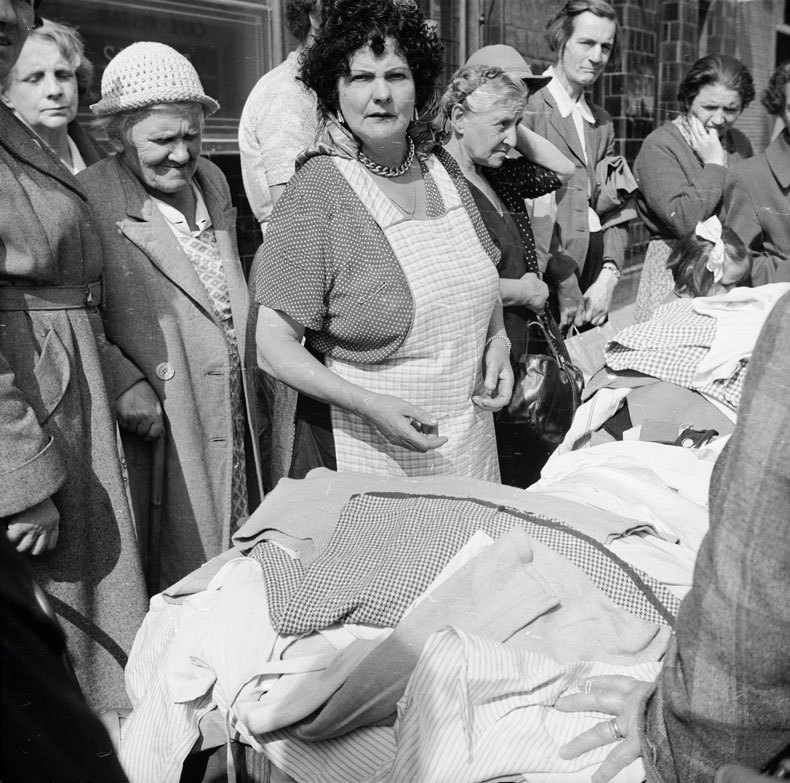
The ever-changing youth styles on display are, in their way, a microcosm of London’s rapid evolution, and so era-specific are they that it is often possible to date images to specific years by the clothes and haircuts alone. Grant observed as huge lacquered beehives of the early 1960s wilted into the rather lank styles favoured in subsequent years, and as teddy boys in drape jackets and the clean-cut mods in the audience for Ready Steady Go! were supplanted by (or, for all we know, became) the hirsute rockers queueing for a gig at the Roundhouse. By the late 1970s, Grant was documenting mohican-wearing punks in their natural habitat, remarkable for a man by then himself in his seventies. And what is perhaps most noticeable about all this is how distant they are from more familiar, heavily directed fashion shots of the time: the clothes are au courant but often cheap or imperfectly cut, and worn with a slightly hangdog aura, as if caught out in the rain (although perhaps that is simply an artefact of the greyscale prints, which make a sunny day in London seem almost inconceivable).
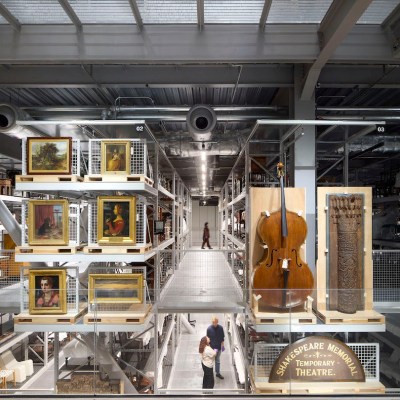
‘Grant’s work is so various that if we’ve got a gap, there’s almost certainly something by him that we can use,’ says Marshall. So watch out for almost 100 of his photos cropping up in the permanent galleries when the London Museum opens in its new venue, the former Smithfield Market in Farringdon, at the end of this month. Grant created, inter alia, many evocative images of traders and punters, both at Smithfield and other historic London markets such as Leadenhall and Petticoat Lane, which would seem a natural fit; they depict a largely bygone world of carcasses hanging up to air and housewives browsing through piled-up fruit. Equally, there are shots of the hygienic new supermarkets that ultimately replaced them, all part of the continually changing face of the city. What might Grant have made of the fact that the old meat-trading hub is now home to a dynamic new museum, with his own work sprinkled liberally throughout? That’s Progress, I suppose.
London Museum, Smithfield, opens on 28 November.
From the November 2026 issue of Apollo.