From the November 2026 issue of Apollo.
There is a basic story one can tell about the short life of Franz Marc. He was born in Munich in 1880, studied at that city’s Academy of Fine Arts and was shaped by his encounter with Fauvism and Post-Impressionism on a trip to Paris in his early twenties. He had partly concurrent romantic relationships with two similarly-named women, both painters in their own right: Marie Schnür and Maria Franck. He had formative collaborations with August Macke and Wassily Kandinsky. With the latter, he edited The Blue Rider almanac (Der Blaue Reiter, 1912), a groundbreaking collection of art, essays and music.
He experimented with a variety of artistic styles, from Expressionism and cubism to pure abstraction, and developed his own symbolic colour theory. He was particularly interested in depicting animals, trying to paint them ‘as they themselves see the world and feel their own Being’. He was killed by a grenade splinter in 1916 at the Battle of Verdun. His art was branded ‘degenerate’ by the Nazis, at least until it was pointed out that Marc had died in military service.
It is hard to find a shape when looking at this biography. The edges are blurry, the forms overlapping; his artistic development cyclical rather than linear. Marc’s last works are not the culmination of a long career, but delicate pencil sketches of abstract compositions he made in a field notebook. They might well have been the seeds of paintings he was never able to make.
‘Franz Marc: The Quest for a Better World’ at K20 in Düsseldorf allows viewers a chance to find their own way through Marc’s oeuvre. On display are more than 120 pieces, an impressive number given that many of Marc’s works have been lost, are in private hands or are rarely lent. The stylistic variety, even the disparity in quality, is liberating. Moving through the show feels like watching Marc at work in a studio, trying the same gesture or pose in another context, combining ideas that didn’t always fit, occasionally fumbling outright.
Marc’s empathy for animals is clear throughout. One of the earliest pieces in the show, The Dead Sparrow (1905), is an exquisite small-format oil painting of a brown-and-cream sparrow lying on its back. The bird’s head is thrown back and its yellow beak and little eyes are shut – as if it is still in pain. Even in death there is a sense of movement about the sparrow, especially in the lively tufts of feathers at its neck. Set in an elaborately carved, baroque frame, The Dead Sparrow recalls the nightingale of Marie de France’s 12th-century poem ‘Laüstic’, killed for its unwitting part in a love affair and preserved in a reliquary.
The way Marc painted an animal’s neck could convey a world of emotion. Dying Deer II (1908), a drawing in pencil on paper, shows the deer on the ground, its legs folded uncomfortably underneath its body, while it rears its head up and seems to howl at the sky. Its elegant, almost too-rounded body contrasts with the vulnerability of its exposed jaw and chest. The same curve can be seen in one of the creatures in Birds over the Village (1913), done in watercolour and gouache on brownish paper. Here, the birds are stylised and geometrical, drawn out of basic circles. The white paint highlighting their bodies is also used for the clouds, so that they seem to be melding into the sky. One bird closes its eyes and holds its head back. The same gesture seen elsewhere seems proud in this context, or prayerful.
Marc’s animals are most captivating when in motion. In Mare with a Foal (1909), an oil in Monet-like pastel tones, we are presented with the mare’s substantial rump on the right side of the canvas. Her head is tilted gently to observe her offspring. The foal’s legs are splayed and its entire body is tense. It might be trying to stand, but it looks as though it is straining to escape the picture frame. Looking at it, I felt the energy of a young creature’s frustration with its limitations, as well as a mother’s tender patience.
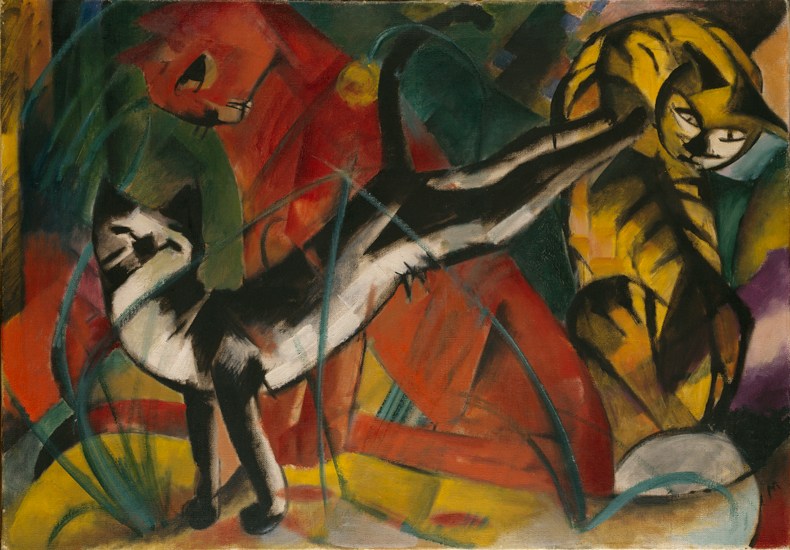
Often, Marc catches animals mid-leap. The Yellow Cow (1911), an oil on wood, bounds across a cubist landscape with a vim one doesn’t usually associate with cows, its eyes closed in delight. Marc’s cats jump so forcefully they become balletic. In both the tempera drawing Playing Cats (1912/13) and the oil painting Three Cats (1913), a cat lands on its front paws with its hind legs extended energetically in the air.
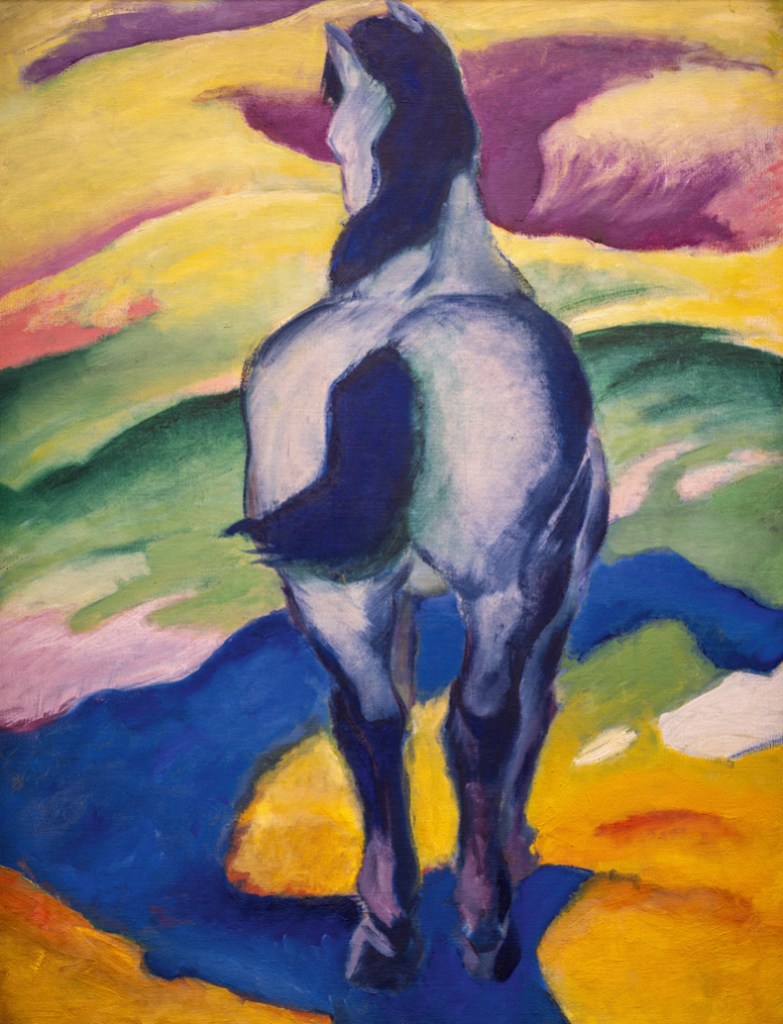
Franz was fond of a Rückenfigur (a figure viewed from behind), and there are plenty of animal behinds on display in full sensuousness. I laughed when I reached Blue Horse II (1911), however. The horse in question is pictured from the back, floating above a vivid, abstracted landscape. Ahead of it are a river, distant hills, shapes suggesting clouds and snow. The composition recalls Caspar David Friedrich’s Wanderer above the Sea of Fog (c. 1817), only the Romantic visionary has become a horse.
Some paintings on display are less polished. In Cats, Red and White (1912), the white cat’s face is drawn on too delicately for its form and the background is dominated by a queasy shade of green. Jumping Dog ‘Schlick’ (1908) has a charming energy about him, but might also have been done by a less experienced artist. These are, to be sure, matters of taste, but it is fascinating to see that Marc’s creative process involved not only repeated experimentation with different styles, but the occasional misstep.
Sometimes, however, the story of Franz Marc makes sense. The large-scale oil World Cow (1913) conveys the boldness of his vision. Painted in scarlet and partly composed out of circles, the cow could serve as a symbol of life, even of eternal return. Beneath and behind it are angular glaciers, mountains, a tiny village, humbler animals. Inside its transparent stomach is a small green hill with a ghostly ruminant grazing on it. The cow remains magnificently unbothered by the world it contains, half-lowering its dark eyelash as it gazes at the viewer.
‘Franz Marc: The Quest for a Better World’ is at K20, Düsseldorf, until 24 January 2027.
From the November 2026 issue of Apollo.