From the November 2026 issue of Apollo.
One of the first objects visitors encounter in the Milwaukee Art Museum’s exhibition dedicated to the Shakers, the utopian Christian sect founded in the 18th century, is a peg rail. It is a perfect summary of the Shaker approach to design. Peg rails free up floor space, since Shaker furniture, clothing and tools are designed to be hung from the pegs, and they give interiors a visual coherence, encircling rooms with evenly spaced objects.
Functional, simple, elegant – this ethos informs the design of every object made by the Shakers, so named because of their energetic style of worship. The Shaker chair was so popular that it became one of the community’s most lucrative commodities and still commands high prices on the secondary market. The Shakers were always improving their designs and even produced a ‘tilting chair’ with a ball and socket on the back feet, so people could lean back on their chairs without fear of falling or the floor being scratched.
Clean lines and natural materials are so closely aligned with the Shakers that it’s nearly impossible to extricate their religious beliefs from their influence on design. ‘I don’t want to be remembered as a chair,’ Sister Mildred Barker reportedly said.
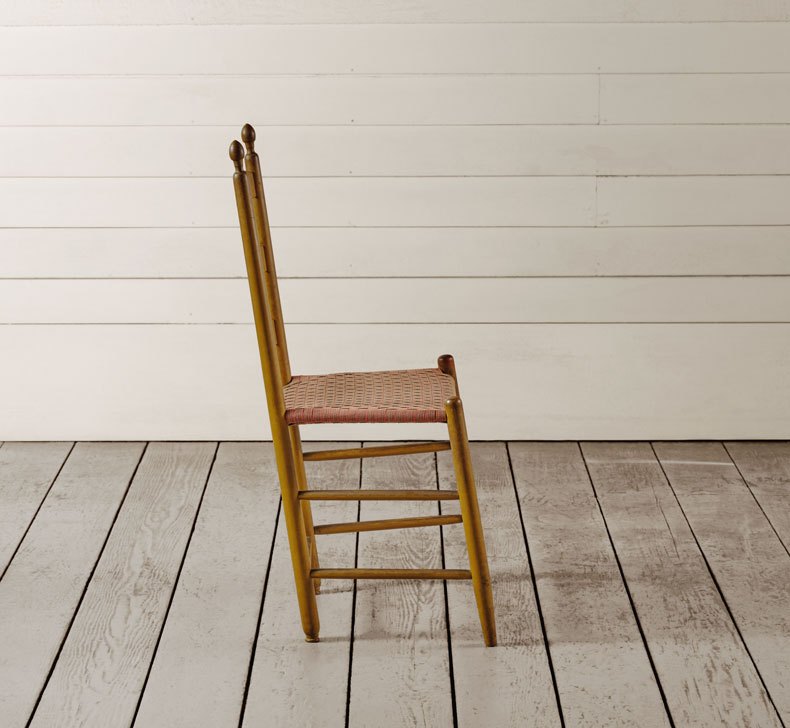
Yet the rules governing the Shaker aesthetic were integral to the community’s founding. ‘Trifles make perfection, but perfection is no trifle,’ proclaimed Ann Lee, the illiterate factory worker from Manchester who joined the Shakers in 1758, and became their leader in 1772, henceforth known as Mother Ann. Her decision to link style to the soul was well ahead of Adolf Loos, who declared in 1910 that ‘lack of ornamentation is a sign of spiritual strength’.
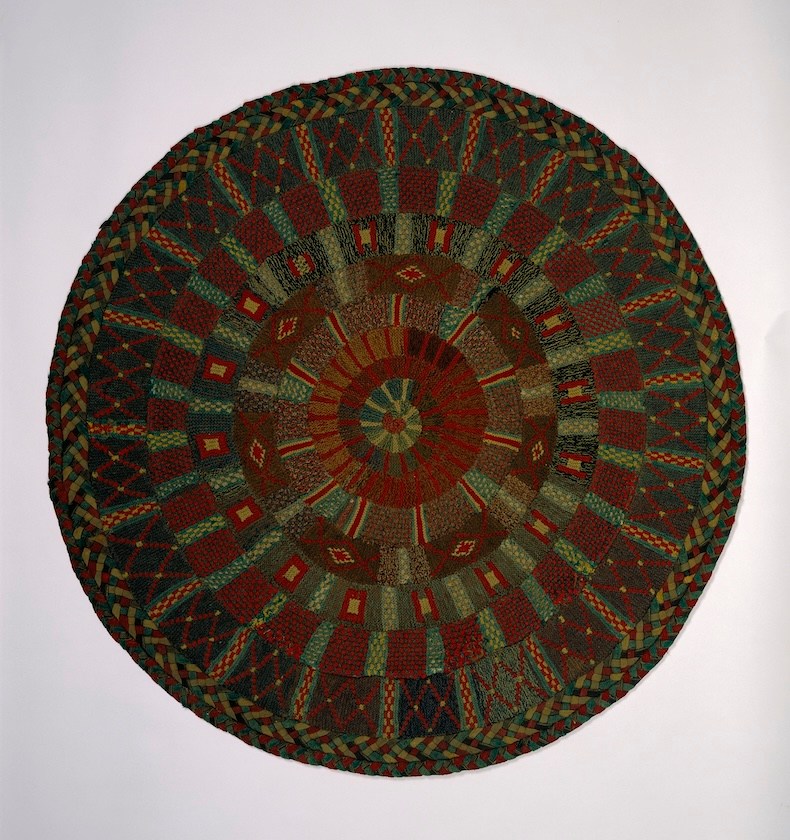
Do I want to live in a world that lacks ornamentation? I’d prefer not to. There are few functional objects in the exhibition using colour; one of the more vibrant is a wool rug knitted in deep jewel tones from c. 1893. I spent more time looking at that rug than any other object in the show, admiring the careful handiwork and the bold palette. Its maker, Sister Elvira Hulett, had something to express and found an outlet for her creativity in the rug. Such an object seems like it should have been anathema to the Shakers, though according to the exhibition catalogue, at some point they relaxed their rules around decoration.
But Mother Ann had far greater concerns than extraneous ornamentation. She led her followers to America in 1774, where she renounced the institution of marriage, insisted that women have equal rights and that property should be shared. She also decreed that Shakers practise celibacy. These tenets are nearly as radical now as they were then, and the Shakers struggled to find acceptance. Mother Ann and her followers were driven out of Harvard, Massachusetts, in 1783, when locals decided that their dancing, which they supposedly sometimes did naked in the woods, was dangerously disruptive. Still, enough people were compelled to join the Shakers that their numbers quickly grew.
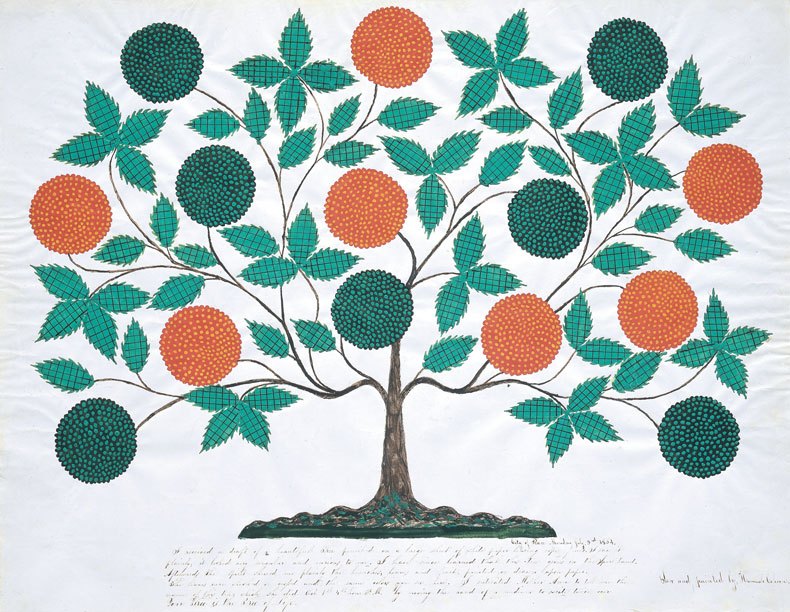
After Mother Ann died, later leaders reigned in the dancing, creating staider routines for the Shakers to follow. The gender equity also eroded somewhat. Men were allowed outside of communities in order to sell Shaker goods, while women had to stay put. Harriet Martineau, a British journalist and writer, visited America in the mid 1830s and found the Shaker women to have a ‘soulless stare’, dancing ‘like so many galvanised corpses’. At the same time, she was impressed by their communal lifestyle and predicted its widespread appeal. ‘It will never now rest till it has been made matter of experiment,’ she wrote. ‘There is at least every encouragement to try.’
One section of ‘The Shakers: A World in the Making’ is devoted to objects for the young and the infirm, featuring a Shaker chair that has been modified with wheels and cradles for children and sickly adults. Seeing these tenderly made devices for the collective care of people who can’t care for themselves, I realise that at the heart of the Shaker experiment is a tragic paradox. To live in a humane world where all of your needs are met, you have to give up on the one thing that makes you human:
connection to the outside world.
The question this exhibition, co-organised by the Vitra Design Museum, ICA Philadelphia and Milwaukee, asks is: what does it mean to build today for tomorrow? The exhibition itself is the answer. It’s a breathtakingly installed show, using panels of plain cloth in natural hues of sage, sky blue and goldenrod as backdrops for the Shakers’ elegant objects. A video featuring a contemporary dance performance choreographed by Reggie Wilson of the Fist and Heel Performance Group, inspired by Black Shakers such as Rebecca Cox Jackson, who started a Shaker colony in Philadelphia in 1858, shows dancers stamping and clapping in joyful unison. Why not embrace sustainability, community and ecological awareness, and rebuild the world anew, using the Shakers as a model? But there is a bigger question, left unanswered and to an extent unasked by the exhibition’s curators: what do we have to sacrifice to achieve such a vision?
There are a handful of contemporary artworks in the show responding to the Shakers, and one of these, by Amie Cunat, is a scale model of part of a Shaker meeting house. Cunat has reversed the interior and exterior of the model, though given how plain these are, it is hard to tell the difference. But as I sat inside the space, painted a monochrome deep blue, I began to feel a touch anxious. I agree that we need to think more seriously about building for tomorrow, but I’m not convinced that the Shakers offer the best place to look for inspiration.
‘The Shakers: A World in the Making’ is at the Milwaukee Art Museum until 31 January 2027.
From the November 2026 issue of Apollo.