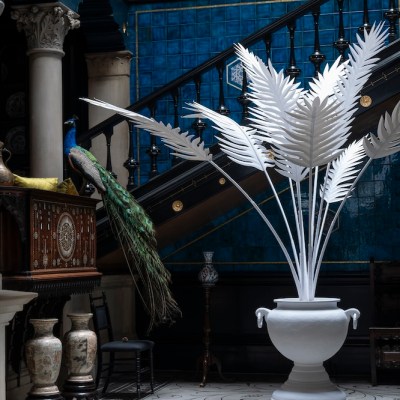
This review of The Arab Hall: Frederic Leighton, Traveller and Collector appears in the November 2026 issue of Apollo.
In the late 1870s, the celebrated artist Frederic Leighton commissioned a domed extension to his west London residence that featured a wooden lattice from Cairo, a cushioned alcove, mosaics and a fountain pool full of Japanese fish. Emblazoned with white Arabic characters on a blue background, a panel of antique tiles in the south-west corner reads, ‘This home radiates joy and gives happiness to all who gaze on it. Fortune is inscribed upon its doors: enter in peace, safe and secure.’ A mixture of threshold charm and Qur’anic welcome to paradise, this inscription conjures an idea of the domestic haven important in Arab culture, and evidently too in the mind of a Victorian artist whose love of musical and artistic gatherings gave way to long stretches of time travelling and working on his own.
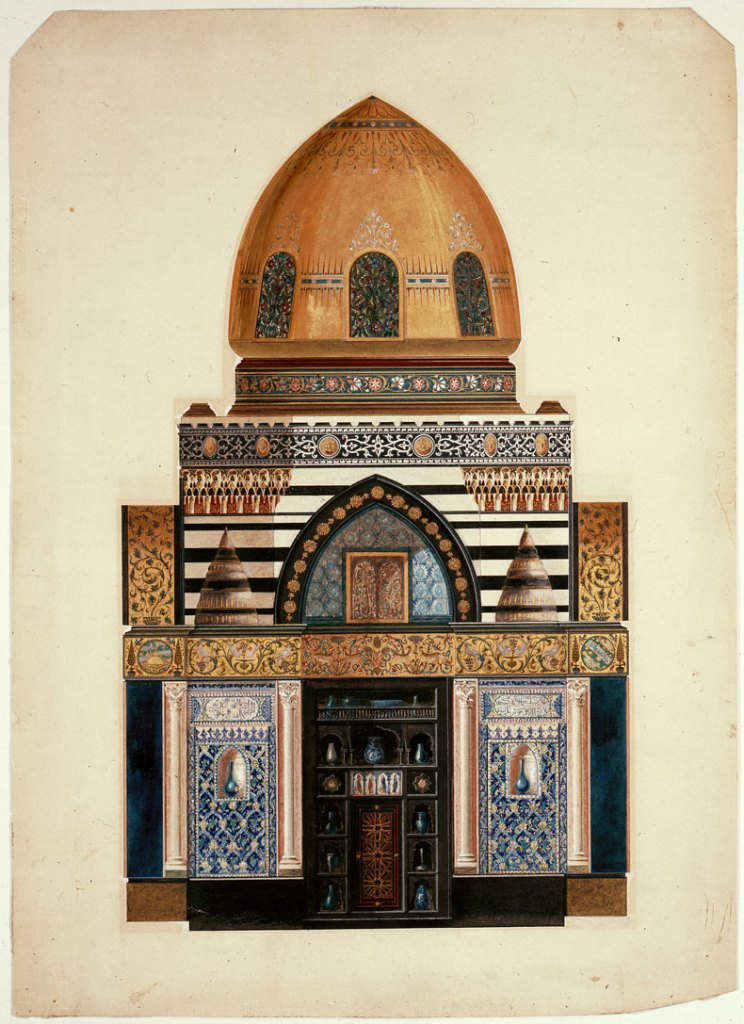
Melanie Gibson’s impressively researched compendium of the Arab Hall project delays the main event: it is not until page 179 that we reach a chapter titled ‘Building the Arab Hall’. Prior to that, the reader is introduced to Leighton’s privileged and cosmopolitan upbringing; his travels and his associated habit of collecting Damascus tiles and other antiquities (as shown by the surviving record of payments at Coutts); his debts of influence to Edward Lane, Owen Jones, Richard and Isabel Burton, Charles Newton and other representatives of Victorian ‘Islamophilia’; and the details of his social circle, several of whom, such as the architect George Aitchison and the Arts and Crafts pioneers William De Morgan, Walter Crane and Gertrude Jekyll, earned lifelong loyalty and esteem by designing and furnishing what became the archetypal palace of art of the Aesthetic movement. In this way, the structure of the book discloses a reading of what the Arab Hall was: a settling place for a man who collected sights, sounds and objects from the Middle East in a home that combined the functions of studio, art collection and social scene. The implication is that we really can’t understand the Arab Hall unless we have absorbed the life and logic that envisaged its necessity.
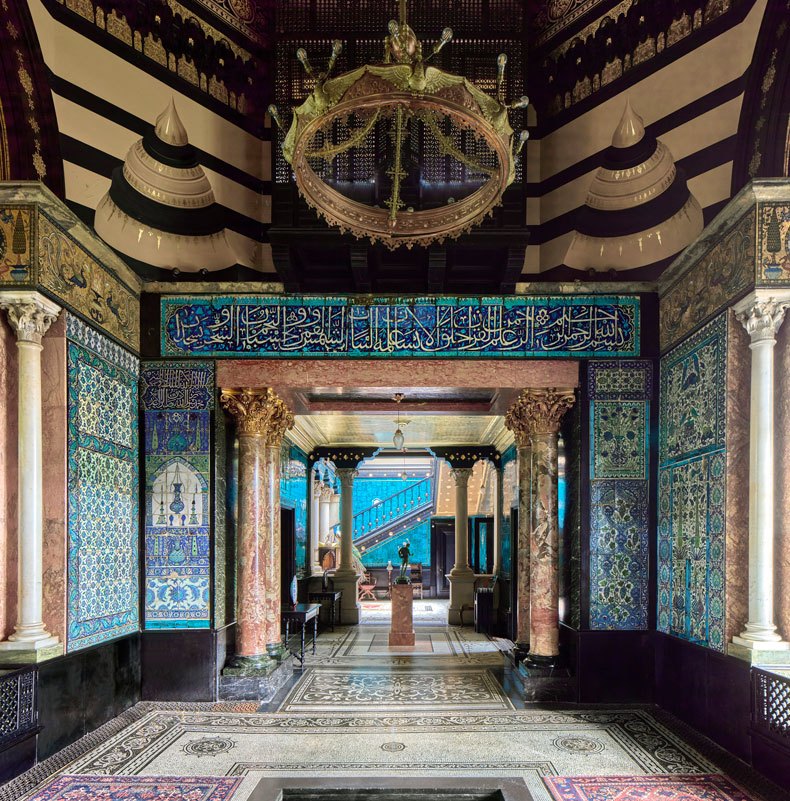
A great deal of suggestive information accumulates along the way. While Leighton’s Orientalism was in certain respects typical of the period, it reflected not only the flow of Victorian imperialism but also the ebb of the Islamic presence in medieval Europe. He was fascinated by the religious and domestic cultures of Cairo and Damascus, but equally so by the decoration of the Alhambra in Granada. Other parts of Andalusia and Moorish Spain, such as Toledo, were key sources; equally, he found the model for the Arab Hall’s ground plan at the Zisa palace in Palermo. The Sicilian city’s mixture of Byzantine, Norman and Islamic styles inspired his eclectic sensibility, which rejected architectural purism in favour of a softer give and take. While architecture features prominently in many of Leighton’s painted backdrops, the human figure often takes centre stage. It is perhaps surprising, for this reason, that he was drawn so consistently to a decorative tradition conditioned, as he saw it, by the Islamic prohibition on figurative work. Still, one readily intuits the appeal of a geometricism and calligraphy that offered calm, simplicity and the compensation of vigorous strokes and lively repeats. Here, too, Leighton rejects purism. Crane’s figurative designs establish the mosaic frieze as a place of exemption, declaring a preference for cultural meeting points over civilisational clashes. Even where restoration is the aim, the effects are generative. The colours and vibrancy characterising De Morgan’s better-known pots and tiles can be traced to his conjectural replicas of elements missing from the antique schemes Leighton was able to procure, a task he achieved with almost total success.
Latent, too, is a fascinating account of what might be called decorative technology. The decision of patron and architect to draw the surfaces of interior walls, the latticework of alcoves and the substance of windows, from repurposed antique stock, evidently modifies the ‘new build’ principle of the whole. This was a fresh vision in old coverings and in many respects a novel development in structural recycling, albeit one haunted by the commercial pillage that saw buildings in the Middle East pulled down to serve a burgeoning Western market for antique ‘salvage’. We take for granted the tiling of our modern bathrooms, but the ‘wipe clean’ philosophy of this hygienic age has its roots in Eastern furnishings. A more decadent history of the tile’s qualities emerges from Gibson’s explanation that tiles would not absorb smoke stains and were therefore chosen for the many Victorian smoking rooms inspired by Leighton’s famous interior. Crucial, too, is the quite foreign assumption that water can be accommodated within the home, and equally that the benefits of an open courtyard can in some degree be internalised. And perhaps in this regard the extreme heat of the Middle East and the inclemency of the British climate prompted a shared interest in roofing over what might otherwise be open to the elements.
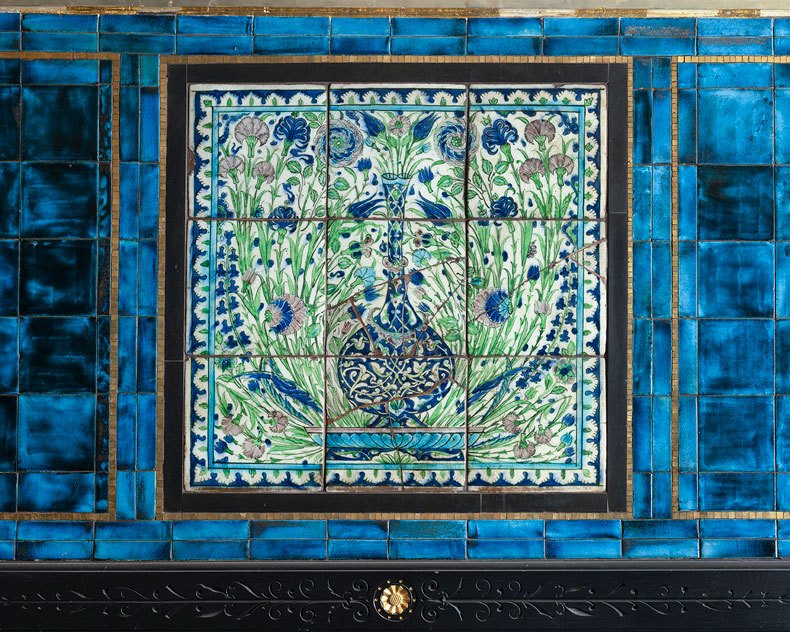
This is not to say that the technological transfer was in every respect successful. The defective Victorian varnish that De Morgan applied to his tiles exhibits tell-tale crazing, while the first attempt to plumb the Arab Hall’s central fountain failed on account of cracks appearing in the basin. Even the Japanese fish expired, disturbed it seems by the careless feet of guests smoking and drinking coffee after dinner. What survives, thanks to the foresight of the house’s first preserver, Emilie Barrington – and, since 1926, the custodianship of the Royal Borough of Kensington and Chelsea – is a building refreshingly unanxious about the points at which East meets West. Thanks to its own scholarly care, this book also issues a salutary check on the assumption of one-way imperial exchange. This is a story of unequal power relations, certainly; but also of hybridity, reverse influence and creative mimicry.
The Arab Hall: Frederic Leighton, Traveller and Collector is published by Gingko.
From the November 2026 issue of Apollo.