From the November 2026 issue of Apollo.
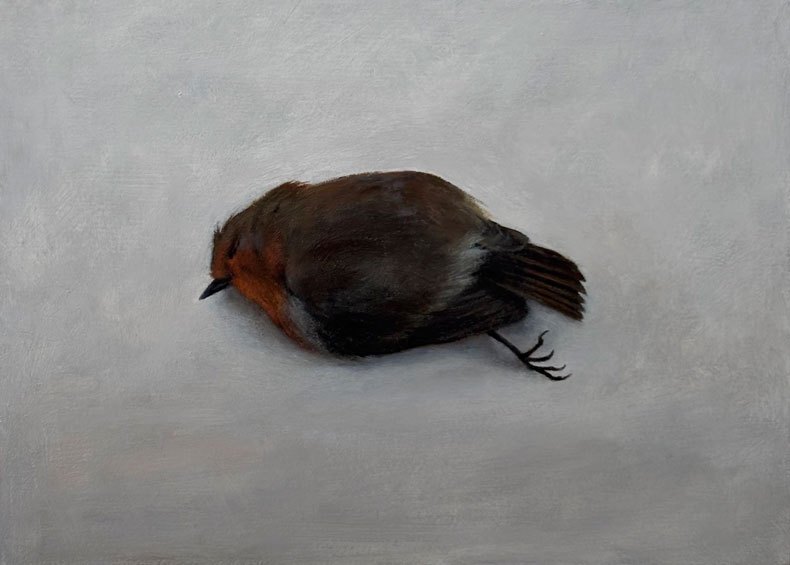
A robin lies, presumably dead, on a chilly, lightly scumbled off-white surface. Its feathers are ruffled, adding to the suggestion of cold. Its eye is closed; the leg we see clearly is precisely painted, its claws tapering to fierce little points. We might be looking at an academic exercise from a past century, set in place to test a student’s powers of observation and technical skill. But somehow, we know we’re not.
George Shaw (b. 1966) has become well known for his meticulous figurative paintings and drawings, in particular his suburban landscapes, usually featuring the Tile Hill estate where he grew up, between Coventry and the Forest of Arden. One’s first and not unreasonable response to these works might be to slot them into a realist tradition, given Shaw’s precise rendering of detail, not to mention a certain dourness of affect. There’s an ethical aspect to this, a piety, almost: the idea that certain people and places are insufficiently valued, in art as in life. And that’s part of what Shaw is addressing. But the work is suffused with something else and the more you look at it the more you see.
The pictures Shaw produced during a residency at the National Gallery and exhibited there 10 years ago were made in response to the gallery’s collection of pastoral, erotic and mythological paintings. Some of these references were a little on the nose for my liking: bacchanalian revels revisited as a magic carpet of discarded pornography in a clearing, an abandoned tarpaulin that looked vaguely like drapery. But these works threw new light on Shaw’s more apparently prosaic depictions of marginal spaces – alleys, garages, culs-de-sac – which seemed on closer inspection to pulsate with something unseen and unsaid. (He’s particularly good at puddles, in which reflected fragments of trees and sky seem charged with a greater intensity than the surrounding scene.)
Ex National Treasure – I’m guessing the title refers to the robin’s role in the iconography of Christmas – might seem to sit oddly in the latest exhibition of Shaw’s work at Anthony Wilkinson Gallery in London. Like most of the works on show, it’s small – though the bird depicted is bigger than life-sized – and it doesn’t obviously talk to the other works, which are in his usual vein. But the show is also steeped in the writing of William Blake. The title, ‘Albion Groans’ comes from Blake’s long prophetic poem Jerusalem: the Emanation of the Giant Albion. The opening lines of ‘To Autumn’ appear as graffiti in one picture. A shattered and repaired life mask of Blake, which apparently watched over Shaw in the studio until the vibrations from a speaker shuffled it off its precipice on to the floor, lurks in a fireplace at the gallery.
The social and political comment one expects to see in the realist tradition is present here and there in a crumpled Union flag or a general sense of neglected social housing as a zone of disappointment and violence, but it’s allegorical rather than literal, charged with a Blakean spirit of revelation. Shaw has even set himself up as a sort of Blakean artist-poet, devising text pieces – bawdy, ecstatic rants, lit with flashes of sardonic humour – to accompany each instalment of the exhibition.
Shaw’s handling of enamel paint is notably more assured than many contemporary artists’ use of oils and, in isolation, Ex National Treasure, acutely observed, skilfully rendered and filled with a certain pathos, might seem like a very competent still life (the French nature morte might be more apposite in this case). But in its present company, it’s charged with a feeling of transcendence – Coventry’s answer to Zurbarán’s Agnus Dei, perhaps. In Blake’s poetic menagerie the robin, like the lamb, serves as a symbol of innocence (‘A robin redbreast in a cage/Puts all Heaven in a rage’) and vulnerability (‘A happy Blossom/Hears you sobbing, sobbing,/Pretty, pretty Robin,/Near my Bosom.’) Blake was no one’s idea of a naturalistic artist, whereas Shaw, whatever else he is up to, attends to the specifics of his subjects with diligence and lucidity, not to mention a sense of style. This robin isn’t a bravura feat of painterliness of the kind that Chardin or William Nicholson might have created, but in a way it’s all the better for that, in its quiet, insistent presence, its smallness and sadness.
From the November 2026 issue of Apollo.