Shouting Is Breathing (2006), Honoré d’O. Middelheim Museum, Antwerp. Photo: Tom Cornille; © Honoré d’O

‘Four things to see’ is supported by Bloomberg Connects, a free arts and culture platform that provides access to museums, galleries and cultural spaces around the world on demand. Explore now.
Each week we bring you four of the most interesting objects from the world’s museums, galleries and art institutions, hand-picked to mark significant moments in the calendar.
Before turning to art, Alexander Calder took a degree in mechanical engineering. He invented both the mobile – the name was supplied by Marcel Duchamp in 1931 – and its earthbound counterpart, the stabile, a term coined by Jean Arp. Calder died in New York at the age of 78, on 11 November 1976 – 50 years ago this week.
Calder’s motorised and wind-driven works of the early 1930s were early forms of kinetic art, a movement that gathered force after the Second World War and reached international attention with the 1955 exhibition ‘Le Mouvement’ at the Galerie Denise René in Paris. Not all of it moves. Motors, wind and the touch of a hand drive sculpture that physically shifts, but kinetic artists also made static objects that appear to ripple, swell or vibrate as the viewer walks past – motion supplied by the eye rather than the machine. This week we examine four works that explore kinetic art.
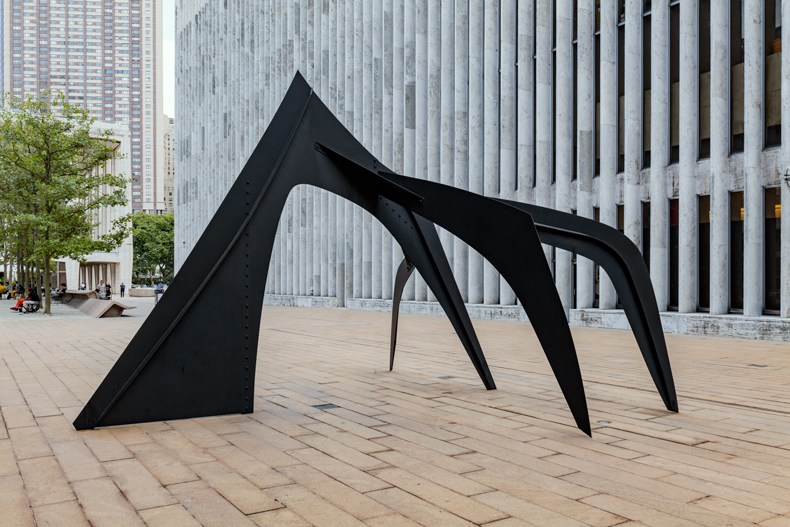
Le Guichet (1963), Alexander Calder
Lincoln Center for the Performing Arts, New York
Calder’s best-known works turn in the air. This one stands on the ground: black steel plates arch and intersect to form a canopy on splayed legs outside the New York Public Library for the Performing Arts. Le Guichet (‘the box office’) takes its name from a cut-out in one plate – only visible from certain angles – that mimics a ticket window, one of many French titles Calder used after the years he spent studying in Paris, where he befriended Léger and Duchamp. A stabile does not move, so the sculpture hands the job to its audience: the openings frame the plaza differently from every angle, and visitors, young ones especially, take up the implicit challenge of walking straight through the middle on their way into the library. The sculpture stands still, while the choreography is left to us. Click here to read more.
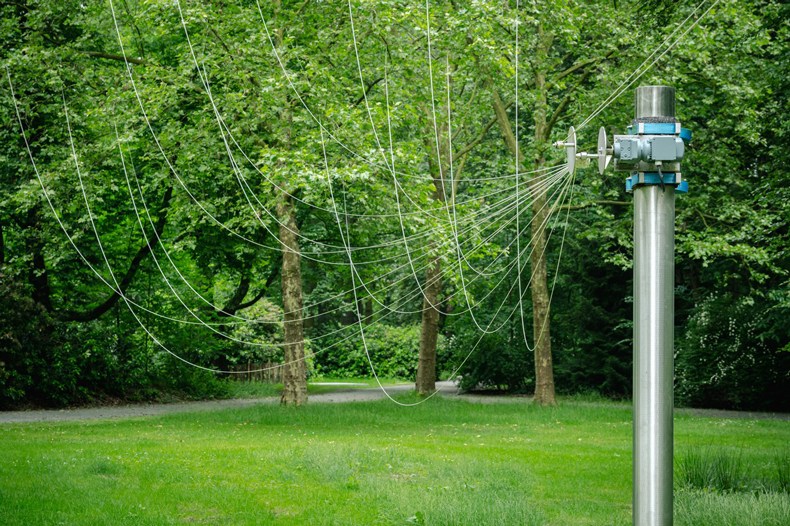
Shouting Is Breathing (2006), Honoré d’O
Middelheim Museum, Antwerp
A column, or steel tree, carries a motor at its head, from which wires run to the branches of a living tree, drawing them into movement. Speed and timing vary, sometimes fluid, sometimes halting, so that one tree can seem hesitant and the other insistent. When the wind picks up, mechanical and natural motion become impossible to separate, and part of the authorship passes to the weather. Belgian artist Honoré d’O avoids making objects in any conventional sense, preferring installations in which art mingles with its context. Click here to learn more.
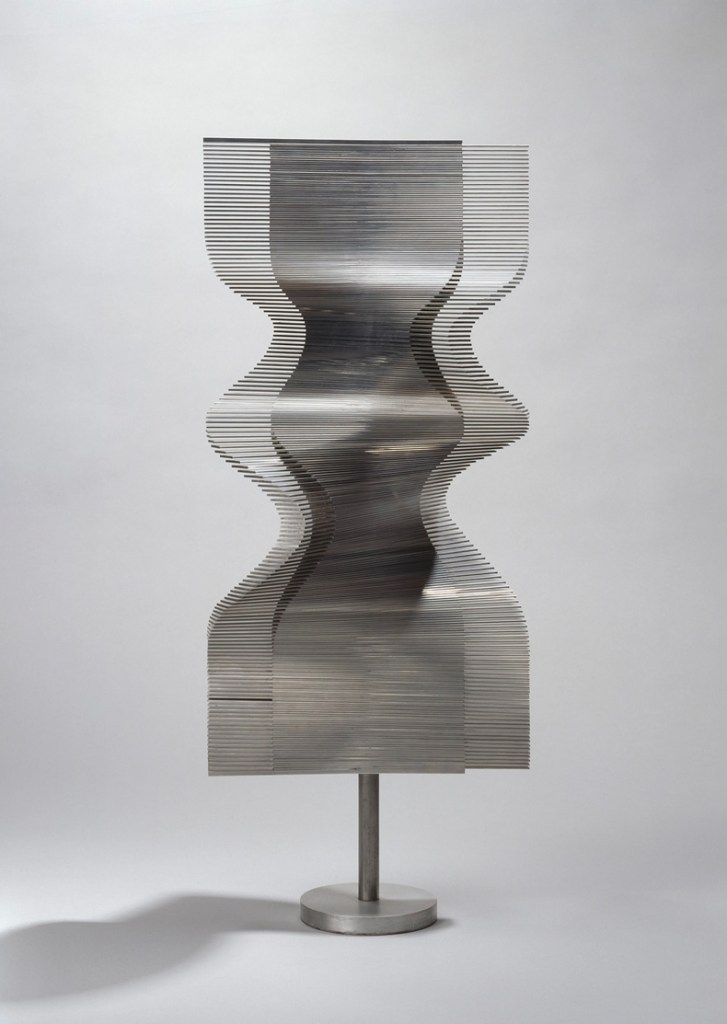
Joyfully (1976), Raimo Utriainen
Ateneum Art Museum, Helsinki
Utriainen planned his sculptures on millimetre graph paper, and the precision shows. Thin metal slats, stacked in parallel along a hidden axis, build a form whose profile swells and narrows in a series of waves; walk around it and the surface appears to undulate, light travelling along the edges as you go. A central figure in post-war Finnish sculpture, he made the slat construction his signature from the early 1970s, producing objects that read as solid and transparent at once. The whole effect depends on the eye refusing to see what is actually in front of it: a stack of flat plates, entirely still. Click here to find out more.
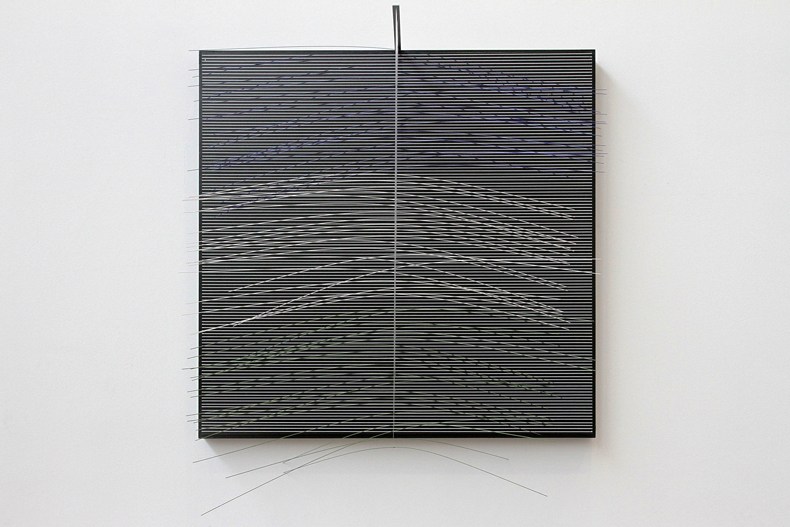
Tres vibraciones (1988), Jesús Rafael Soto
Musée d’Art Contemporain du Val-de-Marne, Vitry-sur-Seine
It’s only when the viewer moves that this work starts to vibrate. Fine white stripes run across a black square panel, and in front of them dozens of slender wires arc outwards in three bands, each a different colour, their ends poking out beyond the edges of the frame. As you pass, wires and stripes seem to shimmer and slide across each other. Most of the vibration is optical, but the wires also move, mounted so lightly that a current of air will cause them to tremble – real motion and apparent motion in the same object. The piece belongs to the Vibraciones series that Soto began in the late 1950s, using ideas he took from physics, mathematics and music. Click here to discover more.

‘Four things to see’ is sponsored by Bloomberg Connects, a free arts and culture platform that provides access to museums, galleries and cultural spaces around the world on demand. Explore now.