From the December 2026 issue of Apollo.
On a blazing afternoon this August, I shook the diamonds of a chain-link fence on 7th Street in Washington, D.C., and wondered how to get into the National Gallery of Art. To make it this far had been no easy task. I had spent an hour circling concrete barriers, tracking and backtracking down Constitution Avenue before a gun-slugging National Guardsman directed me to a series of tents through which I would need to pass to gain entrance to the National Mall. Cutting across the sculpture garden towards the West Wing, I heard a volley of low revs burst out from behind the blue spikes of Coosje van Bruggen and Claes Oldenburg’s sculpture Typewriter Eraser, Scale X (1999). The squall became louder as its source approached: shiny cars that zipped down Constitution and around the corner of 7th Street before tearing off towards the mall in a wake of black smoke. It was the test run for the ‘Freedom 250 Grand Prix’, the last of a number of sporting events – including a youth ‘Patriot Games’ and a UFC fight on the White House lawn – that formed the official programming for the country’s banner year. On the other side of the track, a banner dangled like a taunt: ‘Celebrating American Art and Artists 250.’
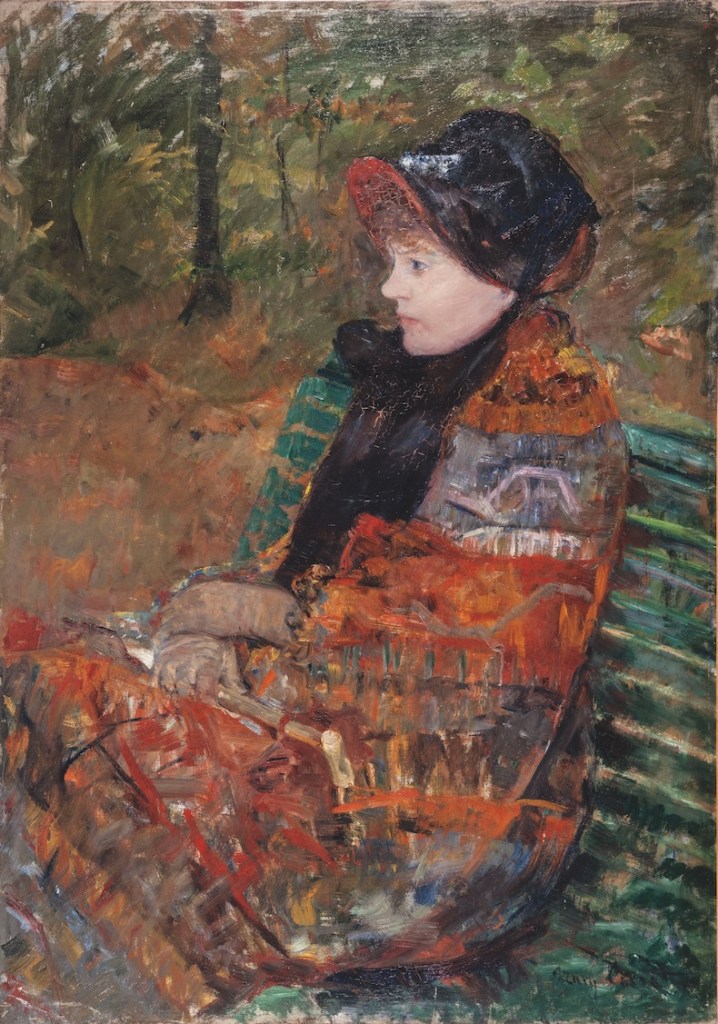
The subject of the show I had come to see loved ‘motoring’, as she called it. But her feelings about America seemed to be a bit more complicated. This year marks the 100th anniversary of the Pittsburgh-born painter Mary Cassatt’s death and the 250th of America’s birth, and the word ‘independent’ is everywhere – not least in exhibitions devoted to the painter. This autumn, the show ‘Mary Cassatt: Being Independent’ opened at the Musée d’Orsay in Paris (until 31 January 2027) before it travels to London and Boston. ‘Mary Cassatt: After Impressionism’ at the Art Institute of Chicago (until 3 January 2027), meanwhile, tries to see the artist as independent from the Indépendants – the group better known as the Impressionists, of which Cassatt was the only American member. And ‘Mary Cassatt: An American in Paris’ at the National Gallery of Art (NGA) earlier this year considered Cassatt’s defection to that city to be the ‘bold […] move’ of a woman painter carving out a career abroad that might not have been possible at home. For her part, Cassatt understood independence as a self-sufficiency born of security as well as desire: ‘I am independent! I can live alone and I love to work’ is reproduced in many a wall text.
It’s easy to smile at that earnest exclamation, reflecting a 19th-century faith in labour that was nevertheless hard-won by its women. But the constant recourse to this line in these exhibitions suggests some anxiety about the theme dovetailing with a semiquincentennial steeped in a particular form of nationalism. Independence, we learn from the Orsay catalogue, was not ‘a condition Cassatt simply possessed’, nor should it be seen as a ‘claim to exceptionalism’. In the introduction, synonyms are to be found in words such as ‘self-determination’ and ‘borderless, unconfined position’ rather than ‘freedom’. The omission seems deliberate: ‘far from being an abstract ideal’, the text argues, ‘independence is consistently made manifest in Cassatt’s career’. This hints at a distinction never explicitly made. We are dealing here not with American independence, but with an American’s independence – which could only be accomplished through a severance, however incomplete, from the country itself.
This year, a quiet constellation of shows on both sides of the Atlantic has put a particular kind of American artist in the public eye: not the patriot but the expat. The centenary exhibitions devoted to the painter John Singer Sargent, born in Florence to American parents, finished in January with the Musée d’Orsay’s ‘Sargent: Dazzling Paris’. At the Peabody Essex Museum, Massachusetts, in spring, ‘Edmonia Lewis: Said in Stone’ introduced audiences to a sculptor of Black and indigenous Mississauga descent who traded Boston for a studio in Rome. And Tate Britain’s ‘James McNeill Whistler’ presented audiences with an artist who never quite owned his Massachusetts roots and made his name painting London’s dockyards. In a year where the United States’ official birthday celebrations were low on artistic attractions, 19th-century American artists have been headlining some of the most important institutions at home and abroad. And yet, the artists highlighted were not quite Made in America.
Cultural provincialism is a cliché often applied to the United States, but in the 19th century, as Ruth Iskin describes in Mary Cassatt between Paris and New York (2025), the charge was justified. Though Ralph Waldo Emerson had declared as early as 1837 that, in the realm of literature at least, ‘Our days of dependence, our long apprenticeship to the learning of other lands draws to a close,’ it would have been stretching the truth to claim the same for the visual arts. Institutions providing art education were badly funded, venues available for an artist to exhibit work were slim and homes with collections of Old Master paintings ripe for the copying – the final step in a traditional artistic education – were few and far between. American artists could cobble together an education from existing academies, making do with the lessons of foreign painters hired to train local brushes, but it was the paucity of collections and of collectors which, up to the end of the 19th century, drove them abroad.
Cassatt, for instance, had enrolled at the Pennsylvania Academy of the Fine Arts in Philadelphia at the age of 16. Within months, her brother quipped, she was scheming to get to Rome. It would take five years before she settled in Paris, where she became the private student of the academic painter Jean-Léon Gêrome, and nine to make it the Italian capital, where she worked in the studio of a French engraver. Charges of amateurism always attended women’s painting in the 19th century, especially in the United States, where amateur painters trained alongside ones aspiring to professionalism in academies desperately in need of their tuition. In Paris, Cassatt would have joined those ‘innumerable young women in irreproachable toilets who devote themselves, in France, to the propagation of masterpieces’, as Henry James described the clientele of the Louvre’s Salon Carré. Few could have mistaken her for a dilettante, much less an ingénue: a photograph from
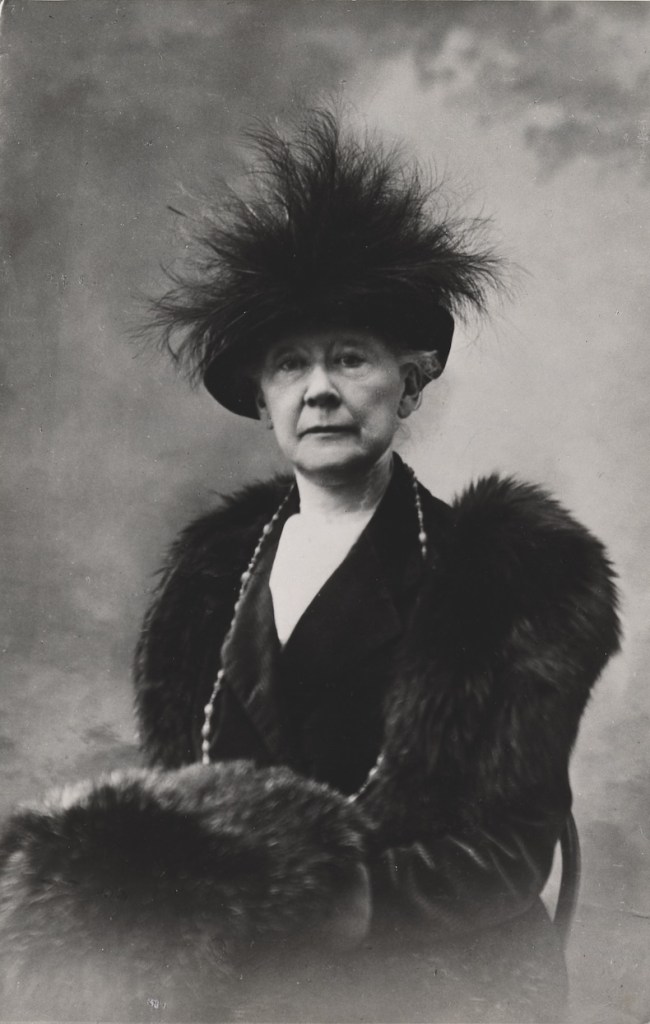
c. 1867 shows a self-possessed 23-year-old in a crisp day dress and tie, hair pulled back in a no-nonsense chignon. She has not shed a certain puritan primness that must have marked her out as both ambitious and American. She is not yet that chic doyenne who, 50 years later, nonchalantly sported a lapelled blazer, fur shawl, pearl chain and a bevy of feathers flying out from a sleek black chapeau.
But she was on her way. In 1868, Cassatt had her first painting accepted at the Salon: The Mandolin Player, a painting of a girl strumming her instrument that owes its golden light more to Rembrandt or Chardin than to the plein air painting group with which she would later be associated. She exhibited there again in 1870 before the Franco-Prussian War cut short her prodigious rise. Back in Hollidaysburg, Pennsylvania, she languished, writing to a friend: ‘I cannot tell you what I suffer for the want of seeing a good picture.’ When returning to Paris seemed impossible, she set her sights on a new frontier: ‘I am too ravenous for money and am determined to make some, not by painting though […] I am very anxious to go out west next fall and get some employment.’ Instead, Cassatt convinced the bishop of Pittsburgh to commission for Philadelphia’s new cathedral copies of Correggio’s paintings in Parma and, when she set sail back for Europe, in December 1871, she had no plans to return. In 1874, just a few months after the opening of the first Impressionist exhibition, Cassatt settled in Paris for good.
At a moment when most Americans flocked to Europe in pursuit of leisure, Cassatt was part of a generation of artists who went for work. Some, like Lewis, found in Europe a respite from the racism that would have stunted their careers at home. Others, like Whistler, found patrons willing to pay for styles too advanced for the United States – and, in that painter’s case, a sympathetic audience for Confederate allegiances that still carried a certain cachet in London long after the Civil War. Cassatt came to Paris simply because it would be best for her career: as an artist, and as a woman artist. ‘Women do not have to fight for recognition here, if they do serious work,’ she wrote in 1894. In Paris, she lived without a husband or dependents. Avoiding the social obligations that attended the elite circles she ran in back home, she logged eight- to ten-hour days, even on Christmas Day. She was dogged in her determination to make money, not because her family lacked means – her father was a stockbroker and her brother became a railway magnate, so rich that papers (falsely) claimed his sister to be an ‘heiress’ – but because her father, who had once told his daughter that he would almost rather see her dead than an artist, believed studios and models to be unnecessary luxuries, and so Cassatt determined to pay for them herself.
In a painting made after Cassatt threw her lot in with the Impressionists – a bold gamble for an artist looking to turn a profit – we see the painter taking stock of herself as she prepared for the show that would make her, as her father, newly converted to her cause, exclaimed, ‘known to the Art world as well as to the general public in such a way as not to be forgotten so long as she continues to paint!!’ The Cassatt we see in Portrait of the Artist (1878) is antsy: perched on the edge of a sofa, she looks for something outside the frame and kneads her knuckles in impatience. Burgundy lines slip nervily down the glossy olive covers of fat cushions; lavender slashes suggest in a few strokes the crushability of a satin sleeve and the sheen of a silk glove.
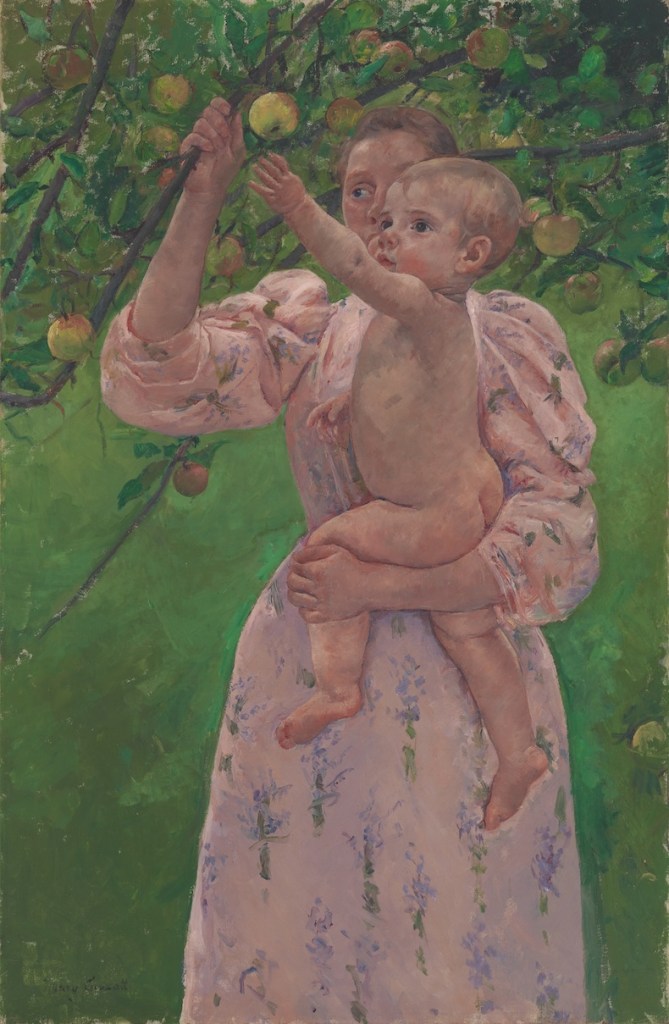
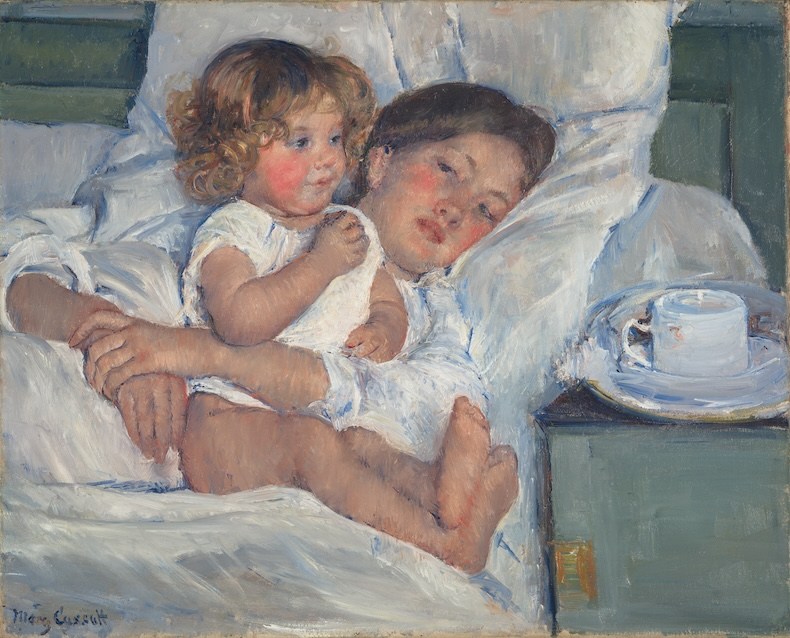
There is a mercenary briskness to Cassatt’s brushwork that bespeaks both restlessness and relentlessness, qualities that might seem to better describe New World tycoons than an artist best known for her paintings of women and children, which make up the bulk of the shows at the NGA and the Art Institute. But these subjects sold. If the Salon painter William-Adolphe Bouguereau had already secularised the subject of the Madonna and Child, Cassatt took that formula and depicted mothers and their progeny with a disarming frankness: a woman who bends a bough to the grasping fingers of her young child, for whom there is nothing in the world except the waxy green of an underripe apple; or a young mother lying in bed, longing perhaps to doze but keeping a wary eye on the dimpled toddler breakfasting on a biscuit beside her. Such domestic subjects might not seem to belong to any national tradition in particular. But to critics, they had the twang of an American man. After Cassatt’s solo show in New York in 1895, one declared her ‘a true American representative. Her work is masculine, vigorous, and full of a powerful personality.’
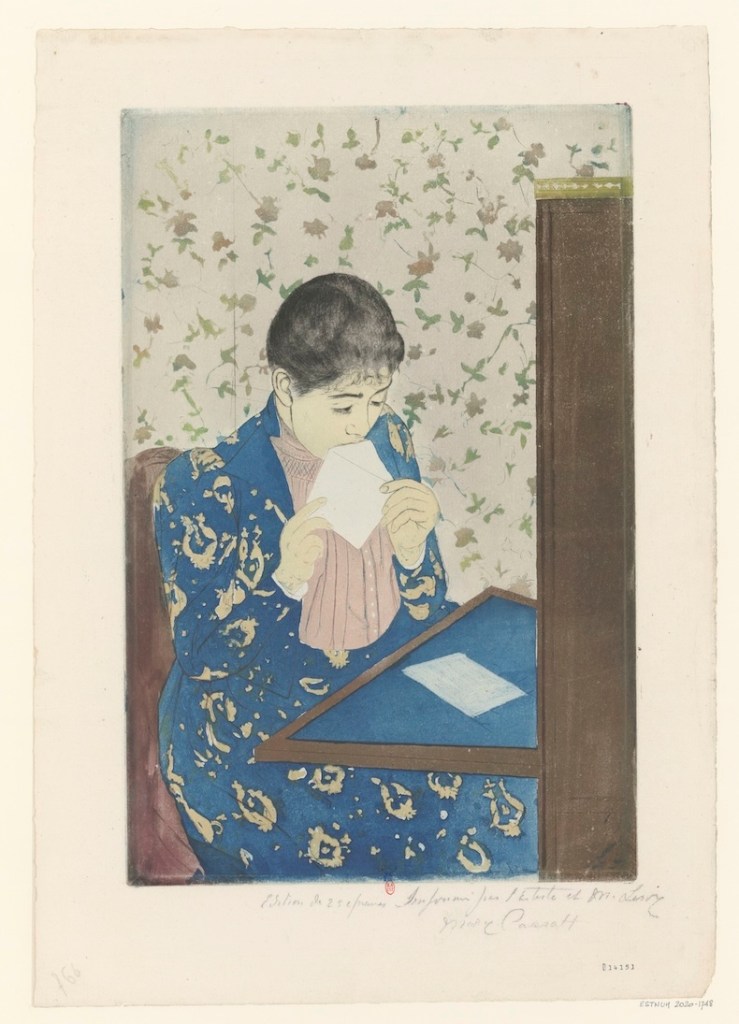
For a ‘true American’, Cassatt was much indebted to European tradition. The Letter (1890–91), with its slanted room and swimming patterns, tempts us into an amorous vertigo that alludes to the erotic epistolary scenes of Vermeer. And in In the Omnibus (1890–91), the trio of Mary, Elizabeth and the baby Jesus familiar from many a Renaissance altarpiece is replaced by a bored mother, a fussy nurse and a cream puff of a child in a coach rattling across the Seine. Degas considered the tondo-inspired Mother and Child (The Oval Mirror) (c. 1899) to be ‘the greatest picture of the 19th century’. Even the mural, now lost, that Cassatt made for the Women’s Pavilion at the Chicago World’s Fair of 1893 rewrites the biblical fall from grace as an awakening into knowledge by way of Botticelli’s Primavera.
Cassatt’s early years of copying around Europe had given her a good eye for Old Masters. She put it to use in her paintings and prints and in a project that she pursued with equal devotion: the reformation of American taste. Around the same time that Cassatt moved to Paris, some of the first and most renowned US museums were established: the Met, the Art Institute of Chicago and the Museum of Fine Arts, Boston, were all founded in the 1870s. Their funding came more from private donations than the state, and Cassatt, leveraging her connections back home, made it her mission to turn newly moneyed Americans into connoisseurial collectors – or, as she put it, ‘to help fine things across the Atlantic’. Of William Walters, who began the museum named after him in Baltimore with the purchase of its founding collection for 3.5 million francs, Cassatt remarked: ‘It would not be my way of buying pictures.’ Instead, she scouted collections not yet listed, flagging for the Art Institute an El Greco in Madrid and even attempting to secure Manet’s Olympia for an American buyer before Monet’s public subscription, backed by Sargent, thwarted her plans for its export.
Cassatt’s was a theory of trickle-down collecting, in which private acquisitions would find their way to public collections. She did not hesitate to guilt deep-pocketed friends into joining her cause. According to the art dealer René Gimpel, Cassatt ‘bullie[d]’ the banker James Stillman, then one of the richest men in America (and her favourite motoring partner in Paris), ‘and that’s how she made a collector out of him. In front of the Velasquez [sic] she told him, “Buy this picture. It’s shameful to be rich like you. Such a purchase will redeem you.”’
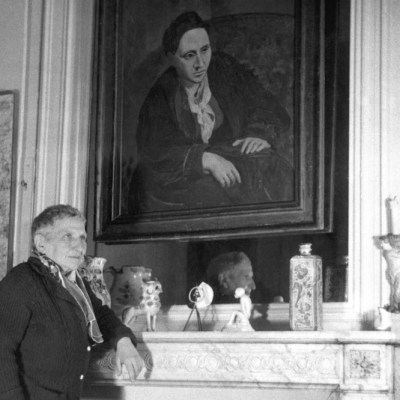
Scholars estimate that thousands of Old Master and Impressionist paintings entered the United States under Cassatt’s guidance. It was part of her grand plan to keep Americans at home. The expats, she worried, were no longer the strong-willed, decent sort immortalised in Henry James’s The American (1877). In the 19th century, Americans like Cassatt had needed Paris for its pictures. An unfortunate visit to Gertrude Stein’s salon in 1908 (‘I have never in my life seen so many dreadful paintings in one place; I have never seen so many dreadful people gathered together’) may have convinced Cassatt that her countrymen were being corrupted by the city in which her own career had been carved.
She wanted to prevent, said the art critic Forbes Watson, ‘the coming generation of American art students from turning into café loafers in Paris’. No longer could a want of paintings justify the kind of life that she herself had pursued. Now, her patriotism judged that Americans should stay put: ‘Something must be done,’ she is said to have declared, ‘to save our young American artists from wasting themselves over there.’
Cassatt couldn’t see into the future, failing to predict the Lost Generation and all those Americans – from James Baldwin to Joan Mitchell – who, like Cassatt and others before them, pioneered art from abroad. We might see her expat-patriotism, her refusal to live in a country to whose artistic future she was unusually committed, as a position of convenience. But if so, it paid dividends to the homeland from which she could never quite be (or perhaps never wanted to be) free. Museums across the country are seeded with the fruit that fell into the gap between Cassatt’s independence and her attachment. Visitors from around the world come to see them hung on American walls. Just not on race day in Washington.
‘Mary Cassatt: Being Independent’ is at the Musée d’Orsay, Paris, until 31 January 2027; then travelling to other venues.
From the December 2026 issue of Apollo.