From the December 2026 issue of Apollo.
Just inside Dundee’s Cooper Gallery, some spidery green handwriting expands over a blackboard. ‘The classroom, with all its limitations, remains a location of possibility,’ it begins. This quotation, from the writings of the American philosopher bell hooks, introduces the gallery’s exhibition ‘Jamming the Ignorant Art School’. An expansive ‘open classroom’ upstairs features (among much else) a library of materials supplied by the Otolith Group, Sheba Chhachhi’s representations of 1980s feminist street theatre, and archival material from the 1968 Hornsey College of Art sit-in.
It’s a demonstration that some of the most radical thinking in art has emerged from the very institutions that it critiques. The Cooper is itself the in-house gallery of Dundee’s famous Duncan of Jordanstone College of Art and Design (DJCAD). But amid swingeing cuts at the University of Dundee, DJCAD will cease to be a distinct department and the gallery is threatened with closure.
As the university comes to terms with a major financial crisis in which multiple bosses’ heads have rolled, craft-based courses have been hit hard. Textiles and jewellery have suffered from staff reductions, according to an investigation by the student newspaper the Jute Journal. In 2025, the ceramics workshop was reported to be ‘effectively shut down’ after the departure of the technician.
Sixty miles down the road, lecturers recently took six weeks of strike action over plans to cut 1,800 jobs at the University of Edinburgh, because of its own financial crisis. As part of that, the Edinburgh College of Art (ECA) is withdrawing undergraduate degree programmes in three areas: textiles, performance costume and jewellery and silversmithing.
Perhaps thanks to the automation – and alienation – of so much of modern life, global demand for artisanal goods is rising. But just as British prime minister Andy Burnham speaks of expanding vocational education, Britain’s art schools appear to be downgrading technical skills. And things are not rosier over the pond. One famed centre of artisanal study, Philadelphia’s University of the Arts, closed in 2024, and another, the California College of the Arts, will follow suit at the end of this year. In Virginia, VCUarts has quietly shuttered its furniture design programme. Can there really be a craft renaissance when so much of the educational infrastructure that supports these sectors is crumbling?
‘Craft education matters because it is the connective tissue that allows for so many other things to happen,’ says Michelle Millar Fisher, chief curator at Cooper Hewitt, Smithsonian Design Museum in New York. ‘There’s a sense of disinvestment in craft-based programmes, and I think it comes down to that age-old question: what’s the use of this kind of programme? How is it going to get somebody a job?’
For Annie Warburton, chief executive of the Goldsmiths’ Company, the answer to that should be obvious. Research by the Fraser of Allander Institute published in July found that the jewellery sector contributes almost £10bn in gross value added (GVA) to the UK economy and supports more than 130,000 jobs. ‘When I speak to manufacturing jewellers, they are increasingly interested in re-shoring manufacture [to Britain],’ she says. ‘Increasingly, we’ve got buyers […] who genuinely care about where things are made, and we’d rather buy fewer things and know that they’re made under ethical conditions.’
Yet it’s ‘a very tall order’ to get the current UK government to take heed of ‘what could be lost’, Warburton says. ‘Right at the moment when AI is in the ascendant, and we’re asking ourselves what is it that makes us human, the intelligence in our hands, those creative, practical skills, are being eroded.’
Millar Fisher, who has recently finished writing a book about craft education, points to ‘flourishing’ independent craft schools such as Haystack Mountain in Maine, which offers residential short-courses each summer. ‘They have more people applying to them than they can support and take in. Even as university education is kind of imploding, there are these more independent spaces of craft that are flourishing.’ But when university programmes wither and die, the whole craft sector suffers. ‘It’s chipping away at those amazing and important lineages of teaching and learning,’ she says.
Warburton applies this directly to Edinburgh, where the head of the jewellery and silversmithing department was for many years Dorothy Hogg, whose work is now held in the V&A and New York’s Museum of Arts and Design. ‘She was one of those iconic teachers who created generations of makers, some of whom are now teachers themselves.’
Craft has fought a centuries-long and unfinished battle to be valued as an equal to fine art – ever since the separation of the two in Renaissance Europe. Art schools in the West were traditionally independent of universities – but in both Britain and the United States they have increasingly been absorbed into larger institutions. They have often taken over art history degrees and and launched new subjects like art theory, which attract high-paying international students and demand less physical space and fewer staff than traditional discipline-based programmes. The classroom might well be a location of possibility, but it is also a good deal cheaper than the studio or workshop.
The absorption of ECA into the University of Edinburgh, in 2011, has been key to its own changes. Principal Juan Cruz, himself a successful artist, is reluctant to call it an art school at all. ‘It’s a comprehensive school of creative disciplines really,’ he says. In line with common practice in the wider university, undergraduates can take courses in other disciplines from throughout the university in their pre-honours years.
Cruz says that staff in the axed specialist programmes won’t lose their jobs, and their courses can be easily converted to electives for generalised degrees. Lecturers dispute this, saying it takes at least a year to get electives approved by boards of studies, and that this has not begun.
Millar Fisher, who originally hails from the Scottish Borders and visited ECA degree shows in her youth, asks: ‘If you don’t see whole areas of work represented at [degree shows], how do you know that that kind of material knowledge and that conceptual experimentation exists in a particular area, if it’s just completely excised from the record?’
Cruz acknowledges that ‘of course there is a danger’ that binning programmes could discourage applications to ECA from people seeking careers in specialist crafts, and thus render the new electives unviable. But he suggests that the new approach will give students time to find their niche. ‘People are applying for those programmes when they are 17 or 18, and in many instances the exposure that people have to those fields is going to be quite limited,’ he says – particularly if they’re from deprived backgrounds.
That’s a perspective that runs counter to almost every other area of education or industrial policy in Britain – whether it’s the introduction of vocational GCSEs at 14 or the lowering of the minimum train driver age to 18 – designed to avoid school-leavers ruling it out as a potential career. But for Cruz, it’s different strokes for different folks. ‘There will be institutions who, if they’re able to, will focus on much more solely specialist degrees. For the kind of institution that we are, we want to support specialism within the context of the broader experience for the student who comes here. We’re obviously not going to be doing everything in relation to those areas, but we are developing […] a kind of particularity around it.’
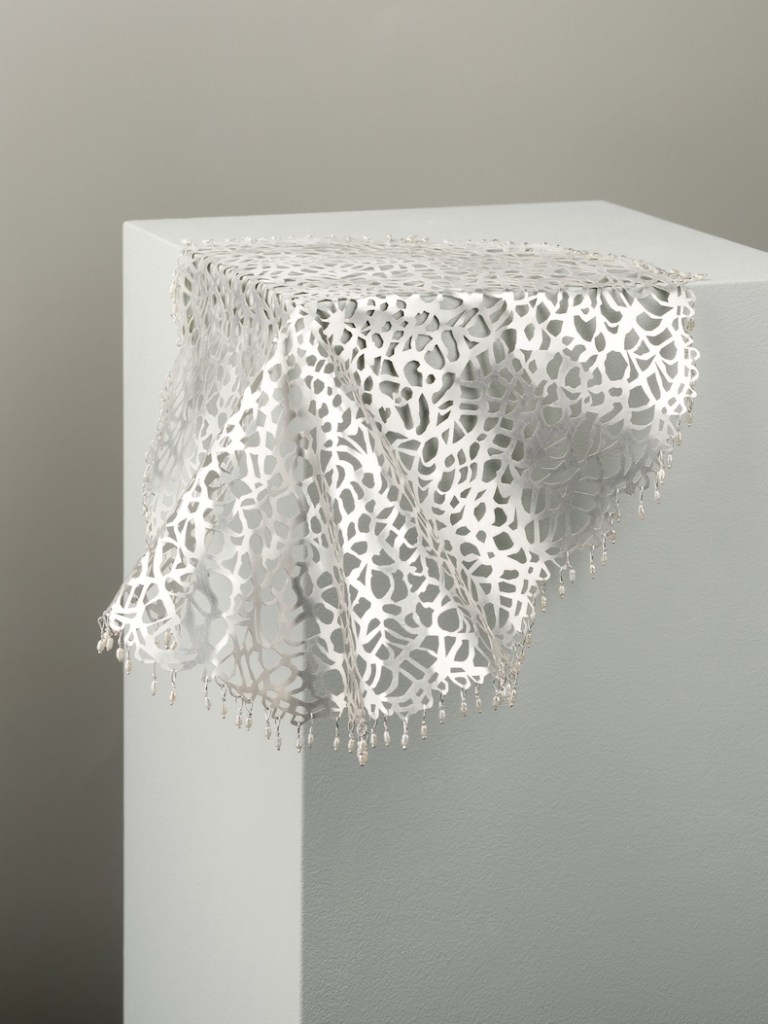
At last summer’s degree show, some of the most exciting cross-disciplinary work in fact came from specialist craft students. In her collection ‘Distorted Doillies’, jewellery and silversmithing graduate Eleanor Louise Scott represented woven lace in raised fine and Britannia silver. Her project involved archival research at the Newhailes House in Musselburgh, and also featured a series of paper embossings of the patterned silver.
But Cruz questions the narrative that has formed around the cuts at Edinburgh, saying that ‘this idea of the craft programmes […] is a nomenclature that was never present before’. Craft, he says ‘is much more ubiquitous across ECA’, and that many mediums on offer, such as photography and ceramics, already don’t have their own degrees. ‘It’s so evident that we value craft, we value technique, we value things made by hand and things made with materials,’ he says. ‘But that is not at the expense of, or in opposition to, what we value in terms of the technological advances that enable digital fabrication, that enable virtual reality, that enable stuff that’s done with artificial intelligence.’
The Goldsmiths’ Company has commissioned its own research tracking changes in education provision, participation and skills gaps, which will be published in the new year. ‘Policymakers aren’t makers with their hands,’ says Warburton. ‘They will prioritise film, TV, media entertainment, gaming – because they get the red carpet.’
Natalie Melton, executive director of the UK Crafts Council, argues that these sectors will suffer too. ‘At Edinburgh, with the costume course going, you have Bafta-winning costume designers coming out of that course. If you don’t have people who can make costumes or make props for film and TV and theatre, then you’re damaging the wider creative industries.’
Cruz says that criticism from professional bodies has been ‘very focused on a small, a particular section of ECA’, saying that ‘some of the accusations of undermining craft are tough, and a little bit extreme’. He has met with Craft Scotland, which has co-ordinated opposition to the changes, and says it would be ‘helpful to have more dialogue’. The university maintains that decisions ‘have been guided by in-depth consideration of data and disciplinary insights from academics and experts in their field’. But Cruz admits there was no engagement with industry figures prior to the announcement of programme closures, nor with current students.
Up the road, Dundee was built on craft skill – and is known for its prowess in jute, jam and journalism. It’s hard to imagine that the V&A would have come to the city without the Cooper Gallery. As the latter faces a setting sun, its programming is considering the wider trajectory of higher education. ‘We’ve almost lost sight of what creative practice is about,’ says its director and principal curator, Sophia Yadong Hao. ‘They’re removing critical thinking from education, and we’re all becoming docile bodies – and then using the financial crisis as a disguise. All these managers are happy to do all this.’
The degrees that will survive at art schools, Yadong Hao says, are those that will make the most money. ‘What triggered [the 1968 occupation at] Hornsey was not exactly the same, but a very similar economisation of art education, and a lack of understanding of creative practice. But now universities, under capitalism, they think it’s absolutely legit to kick out anything to do with creative, critical thinking.’
As for craft, even pleas for its economic value appear futile – thanks to a lack of joined- up thinking in government. ‘If universities are run as business units, where you’re cost-cutting the bits that are most expensive to run, then you’re storing up long-term issues about the vitality and health of the creative industries as a whole,’ the Craft Council’s Melton says. ‘Once you dismantle those centres of excellence, it’s incredibly hard to rebuild them again.’
From the December 2026 issue of Apollo.