From the March 2026 issue of Apollo.
‘The most mysterious object the British took from Africa in all their wars,’ Barnaby Phillips tells us, is a ‘large and dark bronze jug’ that is now in the British Museum. That it was made in England during the reign of Richard II is clear from its elaborate series of engravings depicting falcons, lions, stags (Richard’s personal emblem) and an inscription in Chaucerian English. Yet it was looted from the palace of Asantehene Prempeh I during the British occupation of Kumasi in 1896. The kingdom of Asante (in modern-day Ghana) only came into being 300 years after Richard’s death in 1400, and so the question of how exactly this ewer arrived there is an intriguing one: perhaps it found its way to West Africa via Portuguese traders; perhaps it was a gift to a North African ruler and was later sold across the Sahara. Even more compelling than its provenance, however, is the question of how we ought to consider this object today. As Phillips puts it: ‘Should we regard the “Asante Ewer” […] as colonial loot or recovered heritage?’
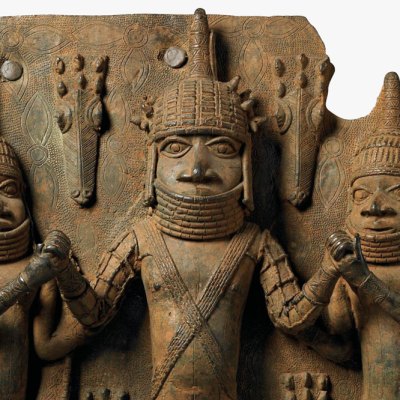
The African Kingdom of Gold is the follow-up to Loot: Britain and the Benin Bronzes (2021), Phillips’s acclaimed entry into the hotly contested territory of what to do with colonial-era plunder from Africa. If, at times while reading, this feels like the difficult second album, that is largely for reasons beyond Phillips’s control. On the one hand, the global fervour surrounding restitution has cooled somewhat. Phillips opens and concludes his narrative with the ‘joyful moment’ when 32 objects from the Asante regalia were returned to Kumasi in 2024 on a three-year loan by the British Museum and the V&A – a historic achievement, but no longer accompanied by much prospect that the British government will soon remove the legal strictures that prevent these museums from repatriating objects on a permanent basis. Moreover, the history of the Anglo-Asante wars – though just as ‘ugly’, to use Phillips’s word – is far longer and more convoluted than that of the punitive expedition to Benin in 1897.
This is a history that poses a difficult and highly specific set of questions. An investigative journalist by training, Phillips has a knack for standing back from the story he is recounting, ceding the stage to a wide array of characters who speak to us directly. The author has no need, for instance, to make explicit his disdain for Sir Garnet Wolseley, governor of the Gold Coast and commanding general of the British forces who blew up the Asantehene’s palace with dynamite in 1874 – not only because Wolseley’s journal makes clear the odiousness of his views on the ‘lazy’ and ‘cowardly’ nature of the people he was fighting, but because these views are presented in such stark contrast with those of so many of his contemporaries, who praised both ‘the undaunted courage’ and the cultural industriousness of the Asante.
The narrative of these colonial wars is predominantly recounted from a British perspective, though counterbalance is provided with useful and consistent reference to the few near-contemporary written sources by Asante scholars, notably the History of Ashanti compiled by Prempeh II in the 1940s. Nonetheless, in dwelling a little too long on well-trodden colonial history, Phillips leaves himself vulnerable to a charge articulated later in the book by one Ghanaian interviewee, who worries about ‘Asante history [being] reduced to a series of wars against the British’.
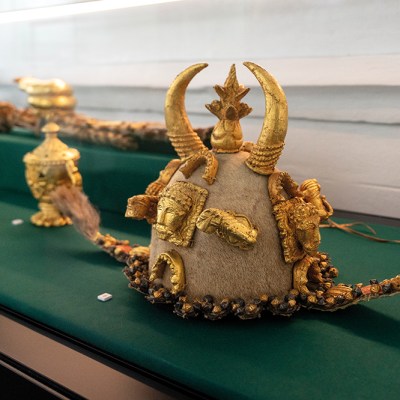
On its own terms, however – as ‘a tale of how African objects became symbols of British power’ – the book succeeds. In the second half, its key protagonists become the innumerable objects, predominantly cast in gold, that were plundered from the Asante during the campaigns of 1874, 1896 and 1900. The meticulous retracing of the histories of these objects from the colonial era down to the present is impressive – all the more so given that the Asante regalia is an altogether more elusive proposition than the Benin Bronzes. Phillips explains that ‘whole categories’ of Asante objects listed in colonial officers’ inventories have irrevocably disappeared, with much of the gold simply melted down and sold for bullion value. Conversely, despite the best efforts of the British, the fabled Golden Stool – chief symbol of the Asantehene’s rule – along with many other key objects remained in Asante. Catastrophic though the scale of looting by the British undoubtedly was, whether measured in cultural or monetary value, Phillips is justified in wondering whether ‘an enormous weight is being put on these objects […] if we expect their return to somehow repair the profound rupture of colonialism’.
None of these complexities deter him from the ‘Sisyphean task’ of ‘track[ing] down all the loot the British took from Asante’. In the process, Phillips proves above all that people with a background in investigative journalism should be employed to do provenance research more often. He pursues a magnificent-sounding ‘bronze group of about 50 little figures’ (on which Wolseley had set his heart) until the trail goes cold in the estate of a Russian aristocrat near Moscow, sacked and razed in 1917. He follows the trajectory of a cast-gold ram’s head, technically at very least the equal of the famous trophy head in the Wallace Collection, through the hands of the ‘blimpish’ General Sir William George Knox and into the jealously guarded hoard of the Royal Artillery, housed in almost total secrecy at their barracks in Wiltshire.
Throughout, Phillips remains especially alive to the shifting meanings that specific objects take on during their passage through history. This sensibility lends him authority when the rightful future of these objects appears more straightforward – as with the ram’s head, or else the monumental brass bowl known as Aya Kese, believed by the Asante to contain the souls of the departed. ‘Perched on top of a ladder in a chilly warehouse next to the A1,’ Phillips writes of his visit to the National Army Museum’s storage facility where the Aya Kese now languishes, ‘I was struck by an overwhelming sense of absurdity.’
The African Kingdom of Gold: Britain and the Asante Treasure by Barnaby Phillips is published by Oneworld.
From the March 2026 issue of Apollo.