From the April 2026 issue of Apollo.
‘This afternoon she was peculiarly restive. She would really like to do something of which her well-wishers disapproved. As she might not go on the electric tram, she went to Alinari’s shop.’ Poor Lucy
Honeychurch. For E.M. Forster’s frustrated young heroine in A Room with a View (1908), unchaperoned for a rare moment in Florence, the greatest act of rebellion she can muster is to buy herself photographs of some of Italy’s most celebrated artworks. Her selection is, in more than one sense, revealing: two classical male nudes – the Idolino and the Apoxyomenos – Giorgione’s Tempest, and Botticelli’s Birth of Venus. If only briefly, this small bid for liberation via nude imagery does the trick. ‘She felt a little calmer then, and bought Fra Angelico’s “Coronation”, Giotto’s “Ascension of St. John”, some Della Robbia babies, and some Guido Reni Madonnas.’
Lucy Honeychurch would have found the Alinari premises at the western end of Via Nazionale, just around the corner from Santa Maria Novella. That Forster drops the photography firm’s name so casually into his narrative, without explanation, indicates its renown and pre-eminence in Florence, at least for Edwardian tourists. A photograph from 1899, nine years before the publication of A Room with a View, shows its window displays arranged with portraits and studio photography on one side, and on the other reproductions of well-known paintings and sculptures (mostly religious works, but at the very top, what looks like a detail of the nascent Venus’s head). Up on a first-floor balcony, Alinari staff pose informally for the camera, behind them an arrangement of sailcloths on ropes suggesting a studio in which light can be controlled. Recorded in other photographs of the same date are the spaces of the complex beyond, where employees are pictured making contact prints from glass negatives, setting up a camera in an elaborately furnished portrait studio or cleaning extra-large glass plates on a terrace, the duomo of the Medici Chapel visible in the background.
Today the building is occupied by apartments, small hotels and other businesses, its shopfronts offering fast food and almost-as-fast jewellery. Amazingly, however, having first established itself in 1852, Alinari endured as the world’s oldest photographic agency until only a few years ago, retaining its headquarters (if not a shop) on this stretch of the Via Nazionale – renamed Largo Fratelli Alinari in the 1980s – up to that point. But in 2019, having been plagued for many years by financial difficulties, the company sold the premises, and the future of its vast archive hung in the balance until the Tuscan government moved to buy it, along with image-licensing rights, for around €17.4m. (Back in 2008 the photographer and photography historian Italo Zannier had valued the holdings at €138m.) Meanwhile the collection, including some 470,000 fragile glass-plate negatives, a number of antique lenses and around 400 cameras, was moved to a private storage facility a short train ride north-west of Florence, which is where I meet Claudia Baroncini, director of the Alinari Foundation for Photography since its creation in 2020.
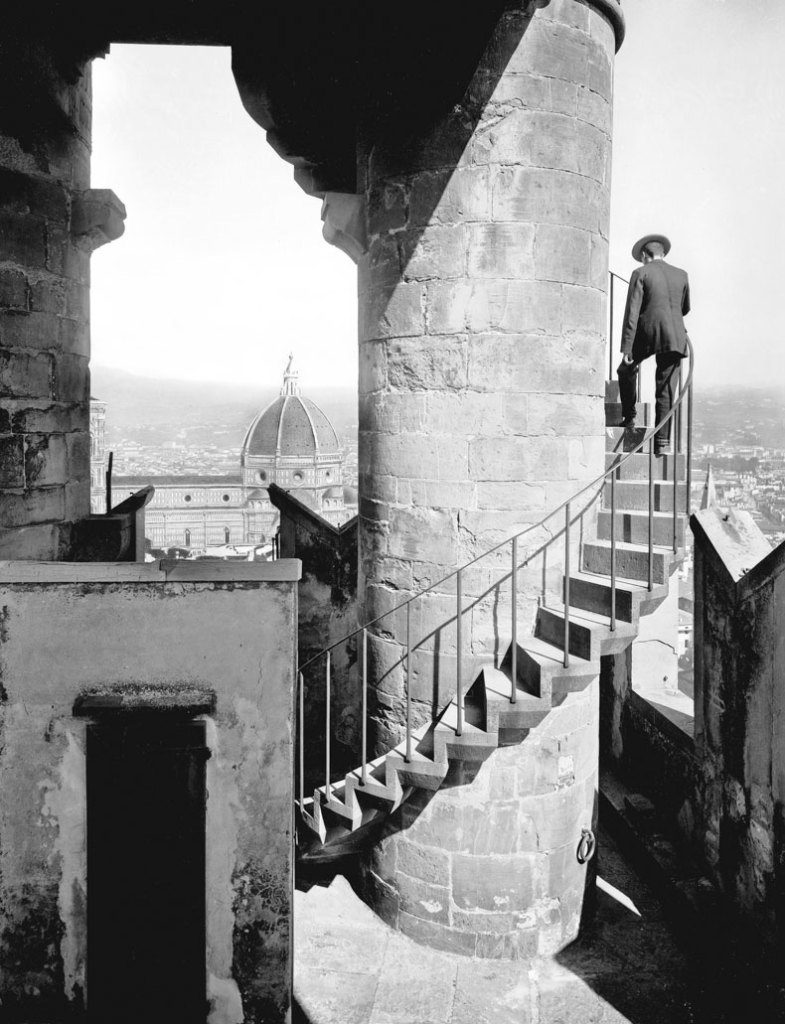
As we walk through the hangar’s various units, past rows of red fire extinguishers as tall as we are (all that film) and busy technicians and conservators in white coats, Baroncini explains how the archive, which is mostly packed away here in thousands of boxes as it awaits a more permanent home, came to encompass more than five million items. In the late 1950s, the company bought up the archives of several other important photography agencies, who began around the same time as Alinari: Brogi, Anderson, Chauffourier. Those archives, together with the original Alinari heritage, make up what Baroncini calls ‘the heart’ of the collection, only five per cent or so of the five million objects; the other 95 per cent was acquired by Claudio de Polo, owner and president of the company from 1982 until 2019. As we walk through the building my eye catches boxes labelled with noteworthy names such as the photojournalist Luigi Leoni and the architect, designer and photographer Carlo Mollino. The geographical bounds of this archive extend well beyond Italy; Baroncini shows me, for instance, exquisite hand-coloured albumen prints of scenes in Japan by Felice Beato, one of the first photographers to take pictures in East Asia. But that core part of the collection is the foundation’s chief concern. As Baroncini says, ‘In this archive there is the story of Italy. Alinari helped to build the idea of Italy in the world; I think English people especially know Italy, the old Italy anyway, through the photos of Alinari.’
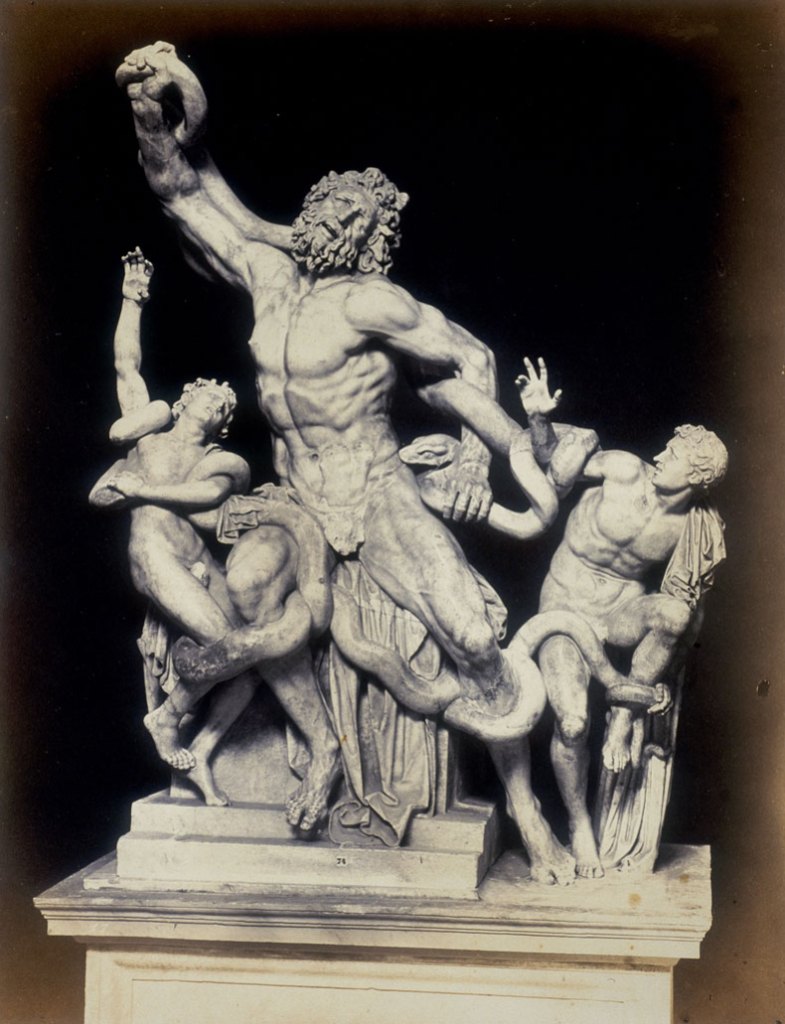
When brothers Leopoldo, Giuseppe and Romualdo Alinari set up their eponymous photography firm in the early 1850s, they were among the vanguard of those pushing the capabilities of this new technology. Henry Fox Talbot’s discovery of photogenic drawing in 1839 and Louis Daguerre’s announcement that same year of the ‘daguerreotype’ may reflect fierce Anglo-French competition in the field, but more generally in Europe a climate of scientific exchange could be found, and Italy was no exception. In Rome, for instance, an international group of photographers had begun meeting regularly at the Caffè Greco on Via dei Condotti. They included the Italian Giacomo Caneva and Englishman James Anderson, both of whom are well represented in the foundation’s collection (one can imagine the purse-lipped Miss Bartlett dropping her Baedeker in horror had Lucy Honeychurch bought Anderson’s photograph of c. 1855 of the Laocoön sculpture – every bulging vein and straining sinew captured in high definition).
Leopoldo Alinari was encouraged to take up photography by a copperplate engraver named Luigi Bardi, with whom he was apprenticed, and first set up a studio in 1852. Bardi helped the brothers buy the best equipment available and his investment seems to have paid off fast. Henry Cole, in the process of setting up the South Kensington Museum in London, was ordering albumen prints from Alinari (among others) as early as 1853 (the V&A has 686 works related to Fratelli Alinari in its collection). In 1860 Alinari was the first firm permitted to photograph works in the Uffizi. It had already published, with Bardi in 1856, the first album of views of Tuscany – photographs of monuments, buildings and vistas in Florence, Siena, Pisa and other sites of the region. (It’s a pleasing thought that certain frames in Merchant Ivory’s adaptation of A Room with a View will likely have been informed by Alinari photographs, whether consciously on the part of the film-makers or not.)
The Alinari brothers’ connection to the engraving tradition is significant. As Arturo Carlo Quintavalle points out in his book Gli Alinari (2003), some publishers in the early 1840s were using daguerreotypes of city views to produce more accurate engravings (just as Ruskin was using them in Venice for his sketches). Those engravings then in turn influenced the viewpoint, angle and framing of photographs capturing the same subject using glass-plate negatives, which produced much crisper images than daguerreotypes. The Alinari were by no means alone in this – many early photographers sought to recapture the same scenes Piranesi had etched a century before; and in The Idea of Italy: Photography and the British Imagination, 1840–1900, Chitra Ramalingam argues that Fox Talbot reworked the origin story of his seminal 1839 discovery to give it a more romantic Grand Tour setting.
If much of this early photography was concerned not only with antique subjects but also with antique ways of representing those subjects, the Risorgimento, by contrast, provided a fittingly modern focus for the new technology. Stefano Lecchi, who made very early photographs at Pompeii, was also known for a series documenting Garibaldi’s defence of the Roman Republic against French-backed papal forces in 1849. These were the earliest photographs of war recorded on paper negatives – though even this series had been conceived as classic views of Rome, before events overtook the original project. Reflecting the extent to which photography and Italian reunification developed in tandem, Fratelli Alinari was photographing a greyer Garibaldi in striped poncho and embroidered velvet smoking cap some two decades later, c. 1865–70 (and never was hand-colouring put to more intentional use, it seems, than in the many photographs of the celebrated general in his red shirt).
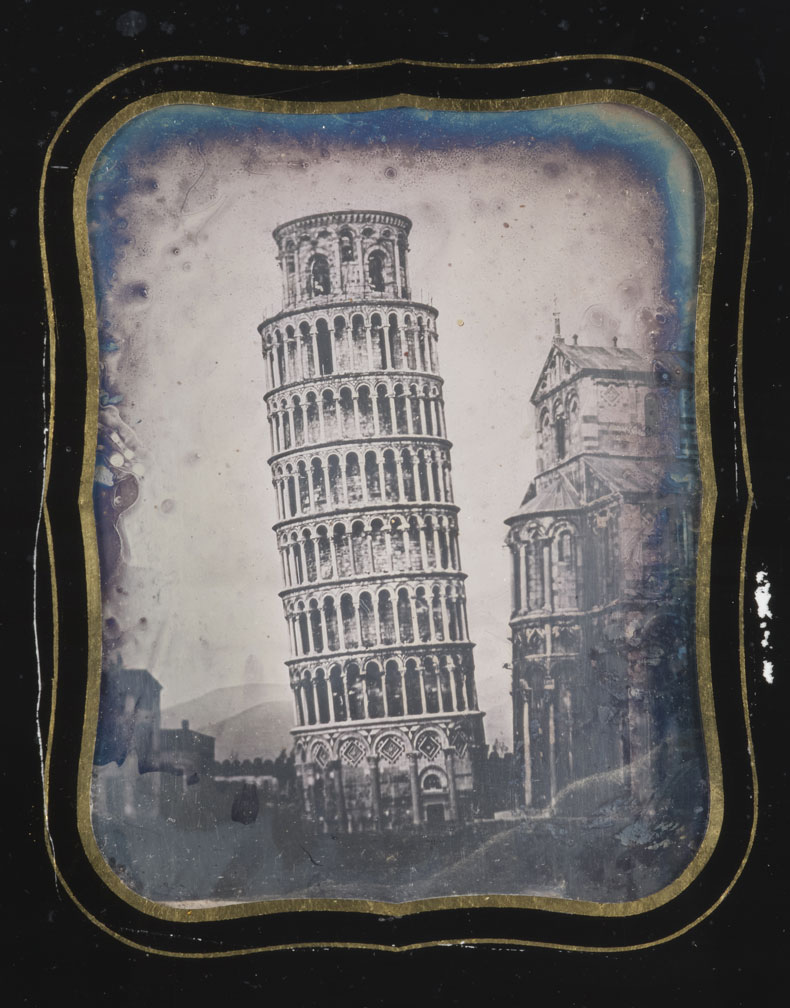
Whether or not the Alinari brothers et al. were thinking consciously about national identity when they published their views of Tuscany and beyond, and their reproductions of great Italian art, those images, so much more widely disseminated than their engraved predecessors, were surely building on an ‘idea of Italy’. At the storage facility, Baroncini shows me a recent acquisition: an album bound in green leather with an embossed floral pattern, and gilded type pronouncing an ‘Album Fotografico’. It contains albumen prints from the years 1852–58, mostly by Alinari, but also by some of the brothers’ most eminent contemporaries: Anderson, Robert MacPherson, Bisson Frères. We move from Pisa – Pisano’s pulpit in the Baptistery of San Giovanni, a panoramic view of the city, the leaning tower – to Florence – Ulisse Cambi’s glowering statue of Benvenuto Cellini in the loggia of the Uffizi, carved only 20 years earlier; Giambologna’s Fountain of the Ocean in the Boboli Gardens, with a gardener’s ladder adding a charmingly quotidian note to this scene of Renaissance splendour – and on to Siena, Rome, Viterbo, Perugia, Assisi.
With five million items to archive and conserve, it comes as a surprise to hear that the foundation is still making acquisitions. But it becomes immediately clear why this is an important album for the collection: the quality of these large-format prints is astonishing – the detail visible in MacPherson’s photographs of the carved reliefs on the inside of the Arch of Titus in Rome demonstrates, apart from anything else, the value of these early images for historians and restorers. Moreover the €47,000 price tag, which the foundation paid with a grant from the ministry of culture’s ‘Strategia Fotografia’ initiative, included documents and other photographs relating to Alinari’s early years. The whole volume, with its 81 prints, has been digitised and can be explored in the online catalogue.
Another album in the collection may be a more direct response to the final unification of Italy that came with the annexation of Venice in 1866 and Rome in 1870. Bound in red leather with gothic detailing, this volume dates from 1870–80 and is simply titled ‘Italia’. It contains 130 albumen prints by Giorgio Sommer, known especially for his photographs of plaster casts of Vesuvian victims at Pompeii, one of which is included in this extensive visual journey through Italy. More pertinent, perhaps, is the album’s flyleaf, featuring an engraving of an allegory of Italia holding a laurel wreath over miniature illustrations of the newly minted nation’s greatest hits: the Colosseum, Pisa’s leaning tower, Vesuvius, the Lion of Venice.
Arguably, the content of such an album might not differ much from one assembled by, say, a British visitor to Italy from the same era, wanting to bring home a record of their travels. What paintings and engravings had been to the Grand Tourist, photographs now were to the package tourist. The first of Thomas Cook’s organised itineraries in Italy took place in 1864 – the year, as it happens, of George Eliot’s third trip to Italy. The previous year she had published the final part of her historical novel Romola, set in 15th-century Florence. The Leipzig publisher Tauchnitz printed copies with pages left blank for readers to add relevant photographs bought at Alinari or other outlets. As Victoria Mills notes in The Idea of Italy, it makes for some interesting clashes of chronology, as seen in one individual’s copy, pasted with a photograph of the Via dei Bardi – Renaissance-era buildings, yes, but recognisably 19th-century passeggiatori.
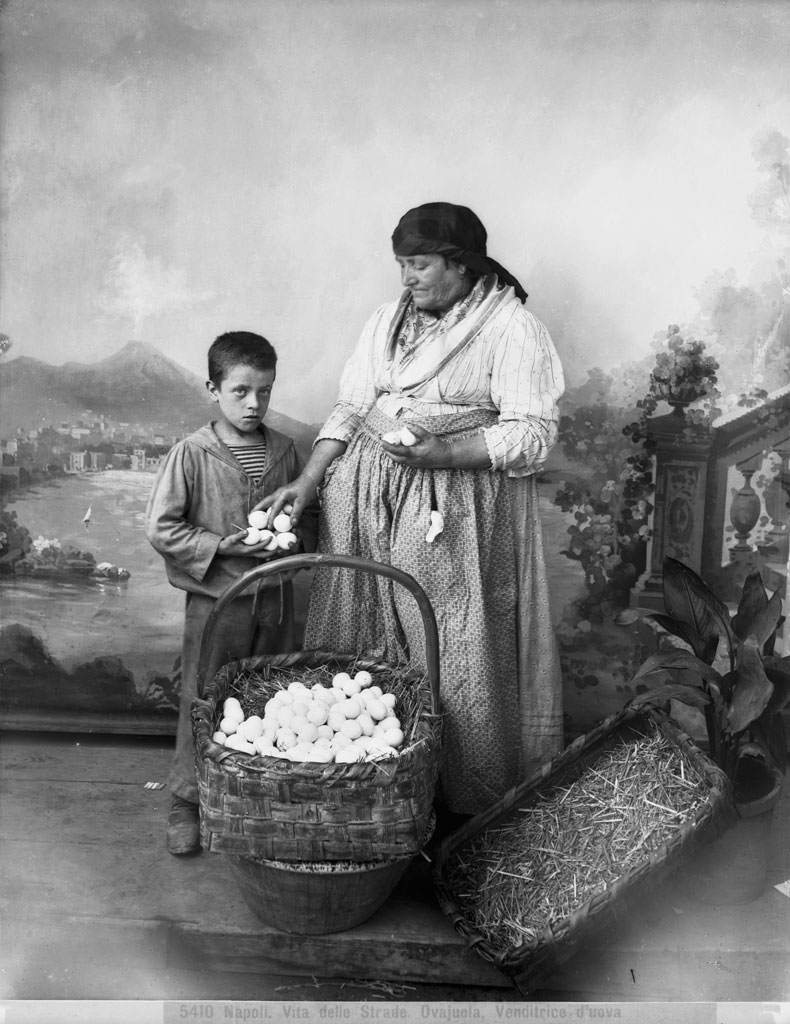
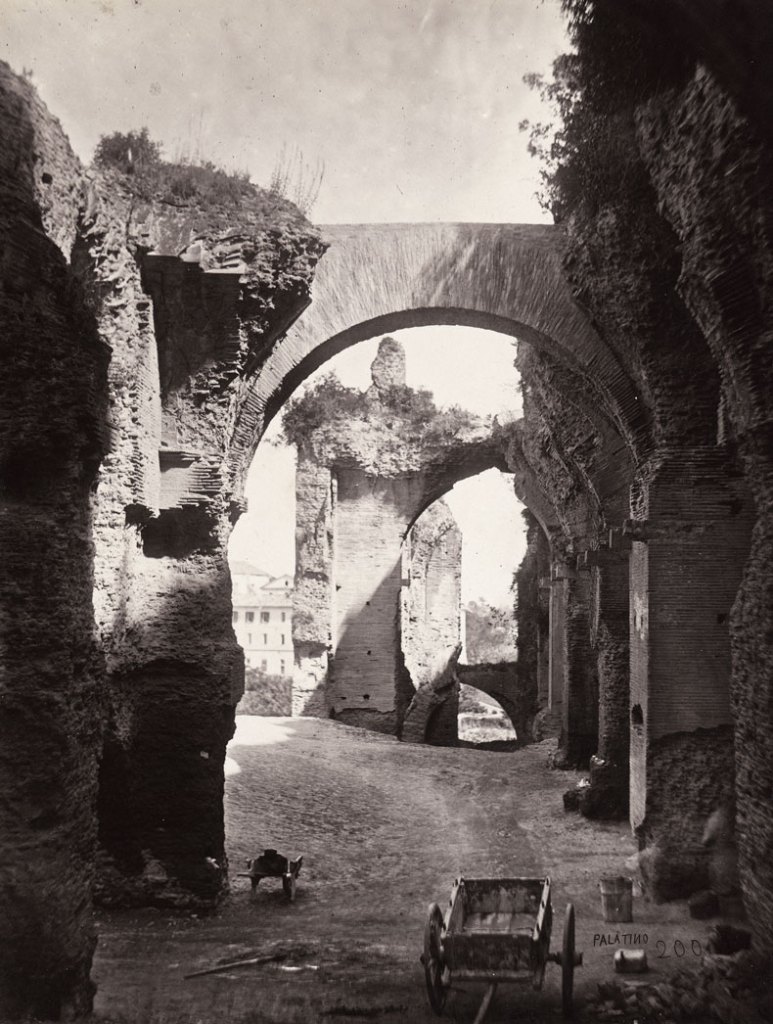
The foundation’s website currently holds upwards of 225,000 images from its holdings (including new photography commissioned as recently as 2022), and more are being scanned and added every week. Any number of connections and patterns will emerge as you look through this virtual archive, revealing much about photographic fashions and influences in any given period: you might compare the many shots of the Colosseum, or the ruins on the Palatine, or Pisa’s leaning tower, or Vesuvius erupting. Genre scenes, too. The French photographer Gustave Eugène Chauffourier, for instance, made a lively portrait of a watermelon seller on a Naples street in c. 1870–80. The picture, made on a gelatin-silver glass plate, is necessarily posed, but it’s clearly a real stall, with life at its edges suggested by blurred bystanders eagerly leaning into frame. There’s an earlier version of this photo from c. 1865 by Giorgio Conrad, who has hauled his Neapolitan watermelon vendors (or are they actors?) into a studio with their stall, the main seller posing mouth-open, mid-hawker’s cry. An albumen print on paper, its hand-colouring adds to the scene’s artificiality. But in a photograph from c. 1880–90, we find Chauffourier doing something similar: he has photographed a woman and young boy with a huge basket of eggs against a painted backdrop of the Bay of Naples; the effect is more painterly than performative, and it’s tempting to think Chauffourier was inspired by Titian’s ‘old crone’ of an egg seller, as Francis Haskell called her, in his Presentation of the Virgin at the Accademia in Venice (which in turn was informed by Cima da Conegliano’s version, now in Dresden).
Other photographers clearly have paintings in mind – in c. 1907–10 the physician Giorgio Roster, whose autochrome slides are among some of the earliest colour photographs in the archive, photographed two figures in a field of poppies that can only be a winking recreation of Monet’s Poppy Field near Argenteuil (1873). Meanwhile, painters such as Francesco Michetti were using photography as an aide to drawing from life – witness a beautiful stereoscopic image (c. 1890–1900) that make the soles of a male model’s naked feet the focus, like those in a Caravaggio.
While image licensing continues to play a part in the foundation’s operations, the focus in this new era of state ownership is less on sales and more on scholarship: ‘We want to make it a more research-friendly system,’ Baroncini says. Digitising the archive along those lines continues apace; in one makeshift ‘laboratory’ in the storage facility, some of Alinari’s large-format glass negatives are set up on light boxes, photographed by a Fujifilm camera fixed into position above them, the resulting images appearing on a computer nearby: the ‘Seated Hermes’ bronze from Herculaneum, then the ‘Drunk Faun’, both in the Museo Nazionale in Naples – every chisel mark as clear as if the sculptures were in front of us. Next door, I’m shown one of the largest of these glass plates, or giganti di vetro, as they are known here. Invented by Giuseppe Alinari in 1890, these ‘imperial’ negatives measuring up to 114.5cm by 84.5cm produced extra-large-format positive prints, and there are 170 in the collection. It takes both Baroncini and a colleague to coax one enormous fragile plate out of its crate – the Medici Venus, as it turns out, from the Uffizi. It’s almost lifesize and, as an object in its own right, breathtakingly beautiful.
Meanwhile, a recently completed project has been the cataloguing and scanning of 8,000 negatives from the archive of the Wulz Studio, set up by Giuseppe Wulz in Trieste in 1868. The firm was taken over by his son Carlo and then Carlo’s daughters, Wanda and Marion, in 1928, and their experimental photographs will be the subject of an exhibition at the Estorick Collection in London this autumn.
Setting up a permanent home for this extraordinary archive is, of course, a matter of urgency. The latest plan is for the foundation’s main venue to be in a building that formerly housed the carabinieri – just behind Santa Maria Novella, not far from Alinari’s old headquarters. While that would house positive prints, the foundation’s 25,000-volume library, and a museum, another site in Monte Catini, an hour from Florence, will provide restoration and digitisation labs, temporary exhibition spaces and storage for glass plates and films (at the requisite low temperature). The scale of the challenge may often keep Baroncini awake at night – ‘This archive feels like our Sagrada Família!’ – but she views it ‘as a mission’, she says. ‘I want to see the archive in a safe place, and my colleagues working in a dedicated venue.’ If Gaudí’s seemingly never-ending masterpiece can reach completion, the custodians of the Alinari collection should take heart.
To view the online catalogue of the Fondazione Alinari per la Fotografia, click here.
From the April 2026 issue of Apollo.