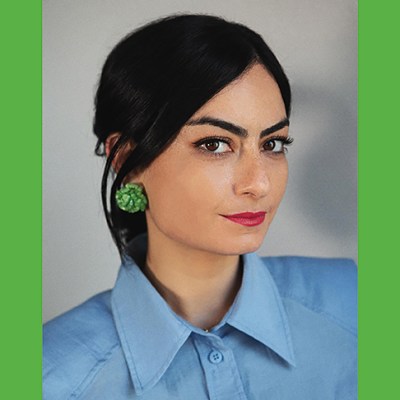
Tucked away on the top floor of a terracotta building just beyond Marrakesh’s central boulevards and souks, Amina Agueznay’s atelier is surprisingly tidy for an artist who is preparing for the biggest exhibition of her career. Last August, the architect-turned-artist was chosen as the Kingdom of Morocco’s representative at the 61st Venice Biennale – the first edition in which it will have its own national pavilion.
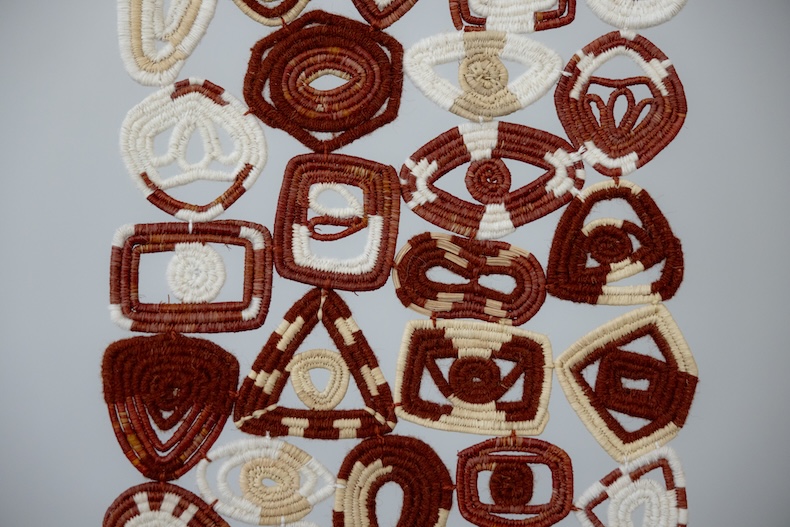
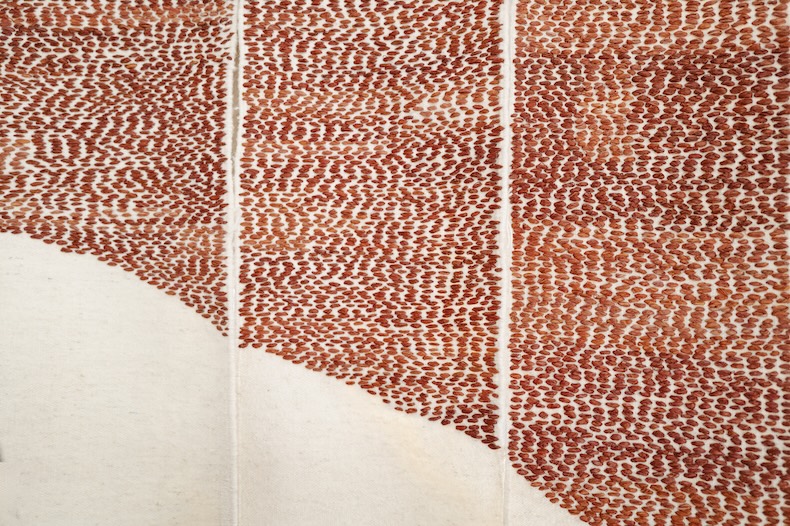
‘When we started thinking about the project, there was so much excitement. When we were selected, we felt this huge sense of responsibility,’ Agueznay tells me in early April. By that point at least some of the pressure has eased: 90 per cent of her textile installation for the pavilion has been shipped off to Venice. Titled Asǝṭṭa – Amazigh for ‘ritual weaving’ – the project comprises more than 150 hanging wool panels, each woven on a vertical loom and stitched with raffia with the help of 166 artisans based across Morocco. Working ‘in the field’, as Agueznay puts it – travelling between the ateliers of these makers, in the Middle Atlas mountains or Jerada Province in the north-east – is where she feels most at home. ‘When I got back in the field and started the project, the tension was gone.’
Agueznay is no stranger to a nomadic way of working. Born in Casablanca in 1963 into an ‘artistic family’ – her mother is the painter Malika Agueznay – she moved to the United States to study architecture. On her return to Morocco in the late 1990s, she began designing jewellery. Soon after, Agueznay was asked by various government organisations to work with traditional artisan studios – of weavers, leatherworkers, woodworkers – helping them find new methods of making that preserved their craft while making it more commercially viable. Weaving is a time-honoured, and largely female, tradition in Morocco. ‘Making by hand,’ Agueznay says, ‘is rooted in our history’ and passed down through generations. Sustaining it is crucial. ‘You have to have continuity and transmission, or else it all stops’. The sharing of techniques is something that Agueznay feels fits with the theme of this year’s Biennale, ‘In Minor Keys’, conceived by the biennial’s late artistic director Koyo Kouoh.
Through her work with artisans, Agueznay’s jewellery grew in scale, the delicately crafted pieces evolving into larger textile works. One such work is Noise (2018), made during a weaving workshop in Asilah, which travelled to the Le Al Maaden Museum of Contemporary African Art (MACAAL) in Marrakesh, marking Agueznay’s first collaboration with the museum’s artistic director Meriem Berrada, who has curated the Venice project. It was Berrada who first suggested they propose a work for the biennial. ‘Meriem said, “Read the description of the project; this is for you”.‘
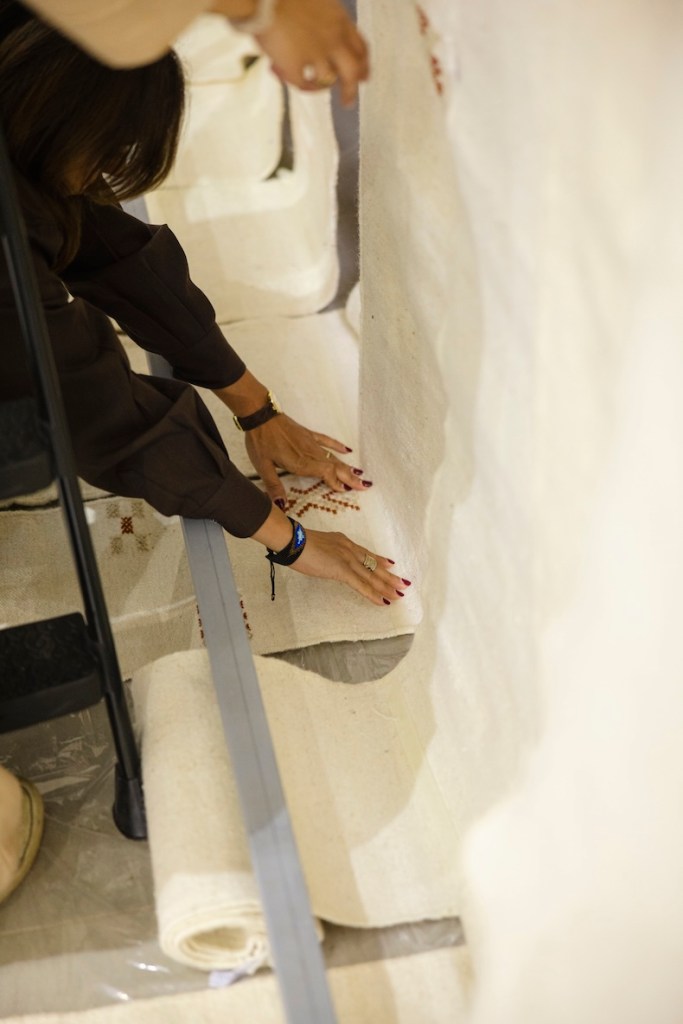
Realising Asǝṭṭa, says Agueznay, has put her team to the test. The process involves creating prototypes and designs for the final works before allocating sections to the makers – alongside giving some artisans free rein to create their own designs. ‘It can be a physical strain, going in the field’ to deliver the designs, Agueznay says. ‘Sometimes you’ll travel five or six hours for a half-hour visit.’ The final bands of wool, each stitched with Malagasy raffia, will be suspended from a steel structure in the Arsenale. Visitors will be able to wander through it. Raffia, Agueznay says, is a material she has a ‘special bond’ with, formed during her residency at the Fondation H in Antananarivo, the capital of Madagascar. ‘It was like raffia paradise’.
Weaving the palm-derived fibre into the pale wool weft is laborious work, something that she knows ‘wouldn’t have been possible on my own […] from the artisans out of the field in the Middle Atlas to the Souss-Massa region, everyone was committed to working on this project, on our project’. Agueznay’s training as an architect and the architecture of Morocco, with its riads and their concealed inner courtyards, is expressed through the idea of âatba: the crossing of a threshold. Stepping through the work, she says, will be to move between ‘inside and outside, private and public’.
‘For someone who made her career in Morocco, I’m proud. I’m over the moon,’ says Agueznay about being selected to represent her country for its first national pavilion. She’s aware that textiles may not appeal to everyone, but hopes that Asǝṭṭa will evoke a response in its viewers. ‘For me, indifference is the most terrible thing. You’re not a fan of the work, great; you’re a fan, great.’ Her wish for each viewer, she says, is for them to ‘get a little bit of that beautiful energy that comes from the commitment that these ladies and men who stood by me had for this project. That’s all I want.’ After Venice, she’s not entirely sure where Asǝṭṭa will end up, only that it’s ‘coming back home’, where the artisans who helped make it can experience it for themselves.
‘Asǝṭṭa’ is at the Kingdom of Morocco pavilion at the Venice Biennale from 9 May–22 November.