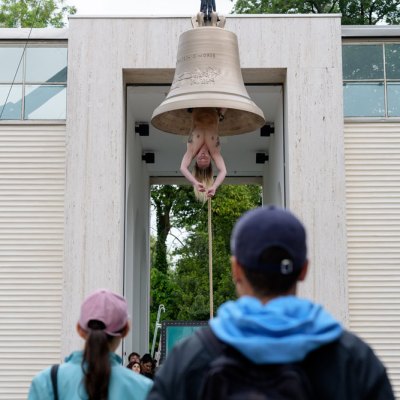

For hundreds of years being an artist consisted of sitting in your studio and meticulously putting brush to canvas or burin to copper. A slightly higher level of physical exertion was needed if you were a sculptor or a plein air artist, but art was still basically a sedentary job. Then in the mid 20th century performance art took off and everything changed: Yoko Ono, Carolee Schneemann, Marina Abramović and others would put their bodies through toil in museums or on stage, stabbing their fingers with knives or asking the public to cut off bits of their clothes. Performance art was one of the most talked-about aspects of this year’s Venice Biennale after the Austrian artist Florentina Holzinger hung nude and upside down inside an oversized bell suspended high above the ground.
This week two Russian extreme climbers snuck up to the very top of the Empire State Building, got engaged and then unfurled a banner that read ‘When the power of love beats the love of power the world knows peace’ – which, coincidentally, sounds like something you might read at a Yoko Ono exhibition. The detail that most raised your correspondent’s eyebrow is that Angela Nikolau and Ivan Beerkus, who hid in the building overnight before emerging the following morning and climbing from the observation deck to the top of the spire, describe their practice in artistic terms: Nikolau has said in an interview that rooftopping is ‘my art form’ and on her website she describes herself as a ‘neo-artist working with extreme performance, visual art and projects with global reach’. She also makes and sells NFTs of the stunts, while Beerkus makes videos documenting their exploits, and moonlights as a DJ, often doing sets atop wind turbines and other tall structures.
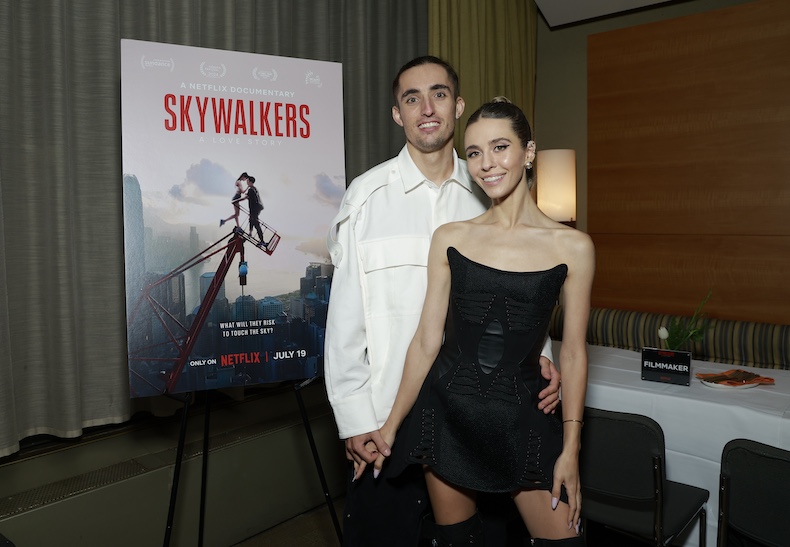
Perhaps, given that the top of the Empire State Building offers a decent view of Madison Square Garden, Nikolau and Beerkus were just trying to get some insight into the ongoing preparations for Taylor Swift and Travis Kelce’s wedding this weekend. But what is clear is that, for some artists, the buzz of the opening night of a gallery show is simply not enough – and indeed, this daredevil couple are far from the first to scale extreme heights in search of artistic fulfilment. Zhang Huan’s performance piece To Add One Meter to an Anonymous Mountain (1995), for example, consisted of the artist and nine of his peers climbing Mount Miaofeng, near Beijing, and lying naked on top of one another in order to do as the title demands.
Huan, however, did not put himself in real danger to create this work of art. Philippe Petit, best known as the subject of James Marsh’s thrilling documentary Man on Wire (2008), has been risking life and limb for decades, performing guerrilla tightrope walks across various landmarks including Notre-Dame and the Twin Towers. Petit is a self-described ‘high-wire artist’ as well as, apparently, an author, magician, lock-picker, linguist, connoisseur of French wine, chess player and 18th-century-method timber framer who claims to have been arrested more than 500 times, on five continents, for street juggling. He has also been artist-in-residence at the Cathedral of St John the Divine in New York since 1982, where he performs high-wire shows. In 2024 he walked across a tightrope in the cathedral’s nave right through a textile installation by the artist Anne Patterson, which consisted of more than a thousand ribbons hung from the ceiling.
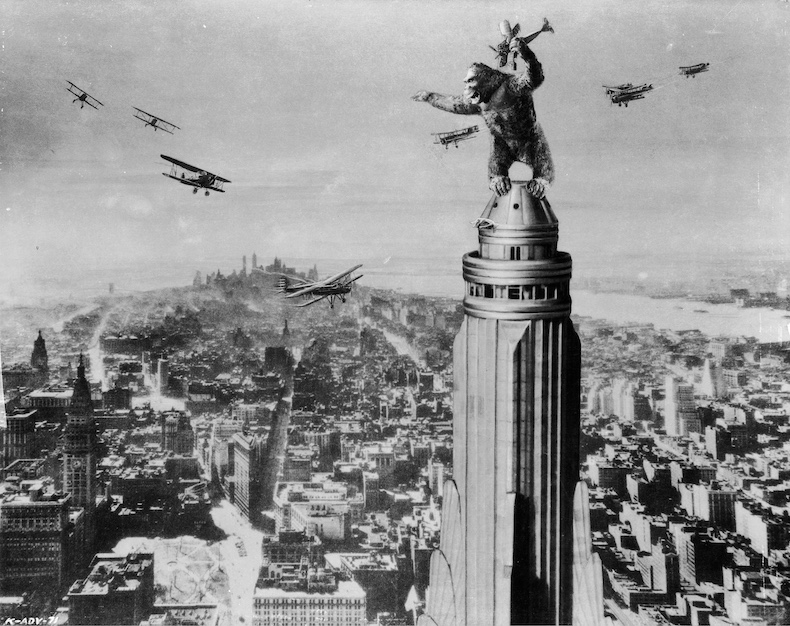
Nikolau and Beerkus have been arrested and charged with reckless endangerment, criminal trespass and a host of other felonies and misdemeanours. It’s a kinder fate than that which befell the most famous figure ever to scale New York’s most famous skyscraper, King Kong – though who has made the greater contribution to visual culture, only time will tell.