
This review of Anne Vallayer-Coster by Kelsey Brosnan appears in the October 2026 issue of Apollo.
The career of Anne Vallayer-Coster (1744–1818) neatly exemplifies the difficulties faced by the best women artists in late 18th-century France. On the surface she possessed more than enough talent to overcome the obstacles, large and small, that bedevilled her peers. She was elected to the Académie Royale de Peinture et de Sculpture in 1770, at the age of just 25, at a point in time when only 15 women had been admitted in more than a century. Her acceptance took place in the same year the shutters came down and the academicians, squeamish that too much female influence would prove detrimental, voted to cap women members to four. Having gained entry to this male enclosure, Vallayer-Coster voted for the restriction.
Although, as a woman, she was precluded from life classes and much of the training male artists received in painting the human figure, thus precluding the blue-ribbon genre of history painting, she exhibited at the Salon for 45 years. Her career as a painter of still-life assemblages and flower pictures was independently sustained and bookended by royal and imperial patrons – Marie Antoinette in the early years and the Empress Joséphine towards the close.
This outline of success nevertheless needs to be tempered. The critic and Encyclopédiste Denis Diderot put her renown into stark perspective in 1771 when he compared her work to that of the 71-year-old Jean-Siméon Chardin, doyen of still-life painters. While Vallayer-Coster’s work was ‘excellent, vigorous, harmonious’, he wrote, ‘it is not Chardin, however, but if it is less good than this master, it is far above what is to be expected of a woman.’
And it is as an artist defined by her gender that Kelsey Brosnan approaches Vallayer-Coster in her crisp new biography – part of Lund Humphries’s Illuminating Women Artists series. Her contention is that Vallayer-Coster worked adroitly within those constraints to make paintings that were thoroughly engaged with her times rather than being polite and decorative emanations of a female sensibility, however proficient.
Brosnan categorises Vallayer-Coster’s paintings in terms of the senses, as images that invoke touch, taste or smell, and cites Enlightenment discussions around such themes to show how the painter was alive to contemporary discourses. She also interprets the paintings as essentially knowing.
For example, in 1769, Vallayer-Coster presented The Attributes of Painting, Sculpture and Architecture and its pendant The Attributes of Music as her reception pieces for the Académie. The former is a clear homage to Chardin’s The Attributes of the Arts from three years earlier. It too depicts a collection of carefully arranged objects – sculptural models, paints and portfolios – in a dark interior, but Brosnan reads them as declarations of Vallayer-Coster’s fitness to become an academician. A plaster bust of the Belvedere Torso is proof that despite the lack of figure drawing lessons she can master the human figure, and daringly a naked one at that; it is contrasted with the clay bust of a woman (a self-portrait possibly) still being kept damp under hessian for the sculptor to finish off, encapsulating the debate over the merits of the ancient and modern as well as her skill at grisaille; meanwhile, an artist’s palette and porte-crayon are references to the old dispute of colore versus disegno. Here I am, says Vallayer-Coster, an artist every bit as intellectually and technically capable as any man.
Something of this masculine equivalency is also on show in her hunting still-lifes. The inclusion of a gun among the dead game in pictures such as Trophies of the Hunt (1774) is evidence that the painter, despite being a committed Parisienne, was au fait with the fad for hunting that flourished under Louis XVI, who hunted almost daily. Few women participated, though Madame de Pompadour and Marie Antoinette were exceptions, so for a female painter to depict this manly sphere was audacious. The blood dripping from the dead animals advertised that she was unsqueamish too.
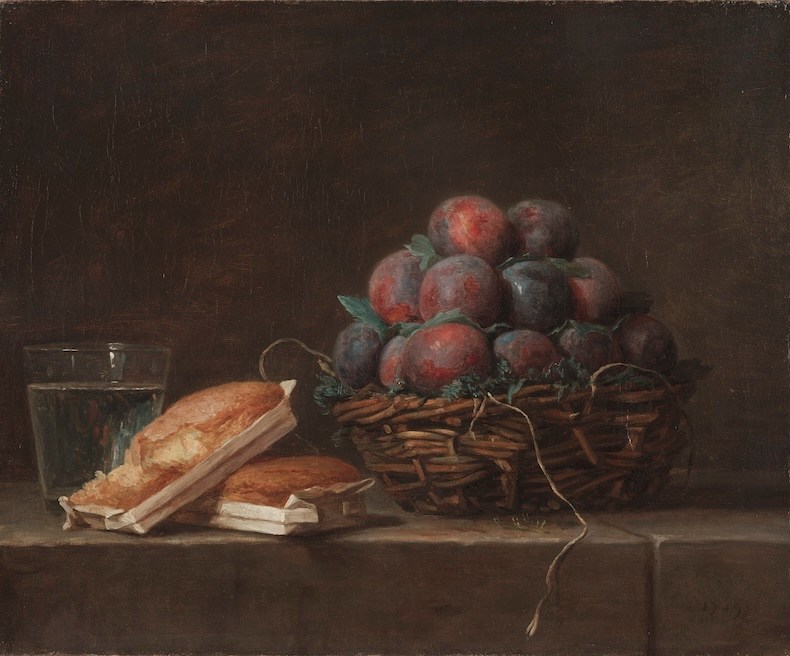
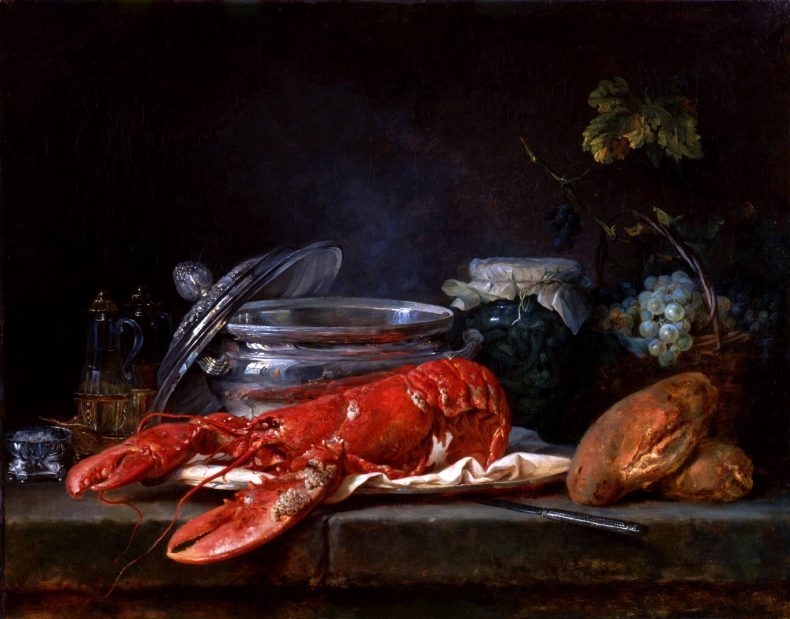
Her still lifes of food – fruit, hams, shellfish – were perhaps more respectable because they invoked the kitchen, a place where female rule was the norm. Vallayer-Coster was, according to acquaintances, a woman of personal modesty who knew how to deport herself, so these were appropriate pictures. They were also works in which she could examine contrasts in colours, tastes and textures; indeed she used roughly ground lead, stone and shell in the red she used when painting lobsters. Brosnan finds fortitude here too since, according to a contemporary: ‘The fish stalls are unspeakable […] our modern fishwives will not part with a scale or fin until it begins to stink.’
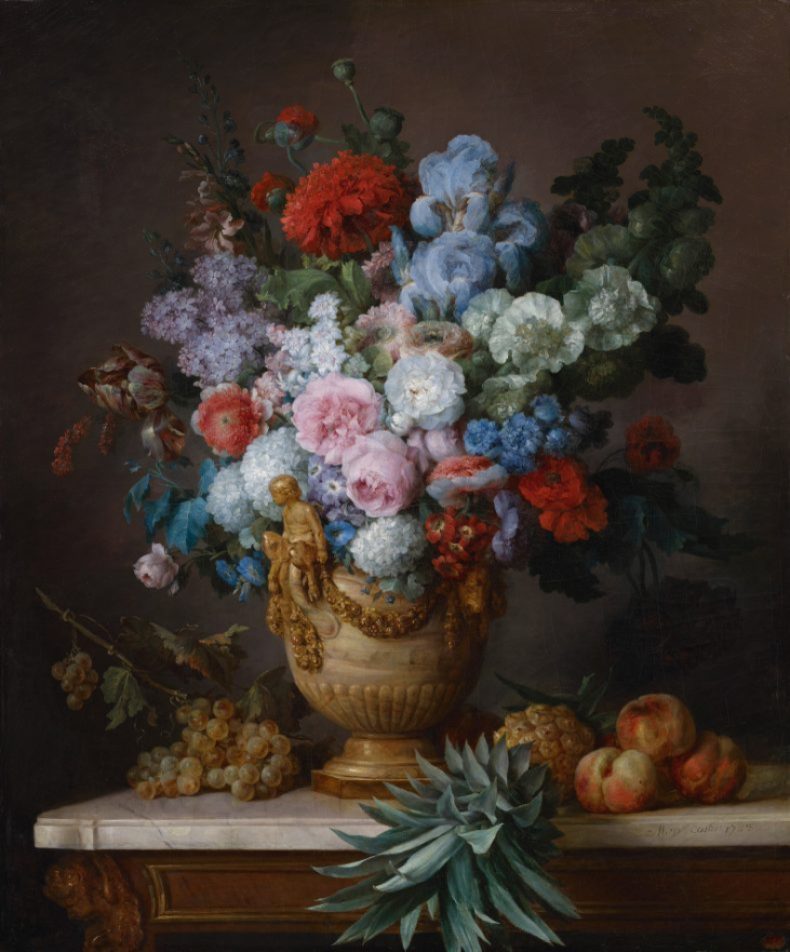
Flower paintings comprised about a third of her known output of paintings (137 works) and Brosnan, as she does when comparing painting to cooking, draws parallels between Vallayer-Coster and perfumiers. These pictures were not just meant for the eye but to trick the nose too: Marie Antoinette’s perfumier Jean-Louis Fargeon wrote that the faecal stink of Versailles ‘could turn the stomach’, so flower paintings were a psychological nosegay. Such works won praise. According to one critic at the Salon of 1777, Vallayer-Coster’s ‘flowers are so fresh […] that one is tempted to pick them and make a crown for her. She has, so to speak, treated them like history painting.’ A pretty compliment albeit a patronising one.
There are gaps in Brosnan’s method: there is little comment on the Dutch sources of Vallayer-Costa’s still-life genres, especially of figures such as Pieter Claesz and Willem van Aelst; and more could have been made of her relationship with Marie Antoinette, who not only secured lodgings in the Louvre for her but mysteriously entrusted her with a ‘portfolio’ when trying to flee Paris in 1791. Nor is there much discussion of Vallayer-Coster’s highly competent portrait painting. But Brosnan succeeds in showing why she deserved better than Bonnefoy de Bouyon’s sniffy appraisal: ‘It is better to succeed in a pretty, minor genre than to stumble in a higher one.’
Anne Vallayer-Coster by Kelsey Brosnan is published by Lund Humphries.
From the October 2026 issue of Apollo.