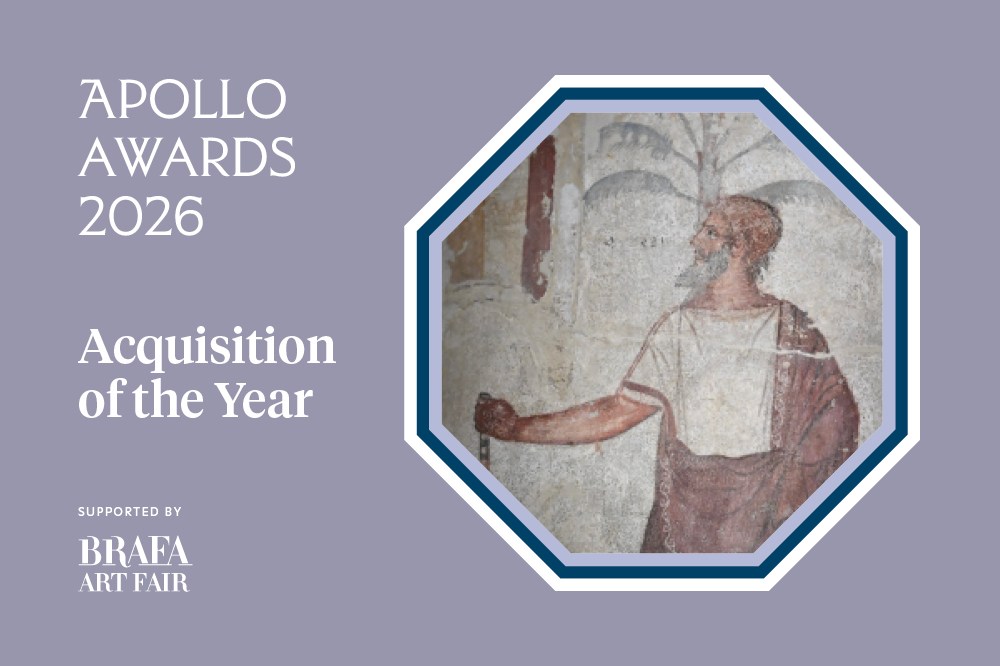
National Etruscan Museum of Villa Giulia, Rome
The François Tomb frescoes
In April 1857, the Florence-born archaeologist Alessandro François entered one of around 60 tombs that he and his team had recently uncovered on land belonging to Prince Alessandro Torlonia in northern Lazio. Part of what was known as the Ponte Rotto necropolis from the ancient Etruscan city of Vulci, this particular tomb had looked promising, and it delivered: inside was a T-shaped burial chamber from the fourth century BC decorated with frescoes that reimagined scenes and figures from the Iliad and from Etruscan history and legend; here were birds and beasts in an upper-register frieze echoing some of the bloodthirsty human action below; and here, too, was the purple-robed aristocratic tomb owner, Vel Saties, with his attendant – both of them, along with other figures, labelled with painted inscriptions. Taken altogether, here was Greek myth and Roman history viewed through an Etruscan lens.
Six years after their discovery, the frescoes were removed from the tomb walls in 37 panels. They were displayed at the Jesuit-founded Kircherian Museum in Rome (dissolved in 1916), and then the Torlonia Museum in Trastevere, before being transferred in the 1940s to another Torlonia property in Rome, the Villa Albani. When D.H. Lawrence was making his tour of Etruscan sites in April 1927, he was aware of the fame of the paintings from the so-called François Tomb but not, it seems, their whereabouts. The burial complex was, as he writes in Etruscan Places, ‘one of the very, very few painted tombs found at Vulci. We tried in vain to get in. Short of smashing the lock, it was impossible.’ Lawrence was surely not aware, either, that just a few years previously the Italian state had made its first attempt to acquire the fresco panels from their private owners. More than a century later, in May this year, a deal was finally completed – with credit due to the brokers involved, since by 2026, thanks to Italian inheritance laws, the owners numbered 21 individuals from the Torlonia, Sforza Cesarini and Gaetani families.
The François Tomb was one of three notable acquisitions made in quick succession this year by a government keen on making a splash (and splashing out) where Italian cultural heritage is concerned. At €15m, the Etruscan frescoes were a little more expensive than Antonello da Messina’s Ecce Homo ($14.9m, or around €13.4m), but half the price of Caravaggio’s portrait of Maffeo Barberini, future Pope Urban VIII (€30m). And while they may not have the pulling power of baroque painting’s enfant terrible, their contribution to our understanding of the Etruscans, a civilisation from which precious little documentary evidence survives, is invaluable. Massimo Osanna, director general of museums in Italy’s culture ministry, called the tomb ‘one of the most important monuments of Etruscan civilisation’, and of ‘exceptional historical and artistic importance’.
The fresco cycle’s new, permanent display at the National Etruscan Museum of Villa Giulia in Rome should nudge more people to visit one of the city’s most underrated museums – already worth the trip north of the centre for the gloss-black bucchero pottery, a dazzling trove of jewellery (ancient and modern) or, one of my personal highlights, a large collection of bronze hand mirrors intricately engraved with scenes from Greek and Etruscan myth. (Admittedly, some of that €15m would have been usefully spent on getting the word out; at the end of July, the month the tomb frescoes opened to the public, I had them – and much of the museum, which is housed in a late Renaissance villa built for Pope Julius III – to myself.) The paintings have been given their own climate-conditioned complex off the villa’s courtyard, one that recreates the original layout of the tomb, though with larger proportions to accommodate up to 20 visitors at a time. Here you can get close enough to the frescoes to see the brushstrokes. Examine the shading on the face of a dark-haired, dark-eyed young man, and you might think of the Fayum mummy portraits made centuries later in Roman Egypt. Looking at a scene in which Achilles slaughters Trojan prisoners at the tomb of Patroclus, I also found myself wondering about a through line between the multicoloured wings of Vanth, herald of death in Etruscan mythology, and the rainbow wings of angels in Christian art.
Setting the François Tomb within the context of its discovery and reception, an accompanying temporary exhibition offers a fascinating snapshot of archaeology and the market for European antiquities in the 19th century. Here the museum has reassembled many of the extraordinary objects that were found in the tomb, which include gold necklaces and earrings sold to the Musée Napoleon (lent by the Louvre), and exceptionally fine vessels – one taking the form of a horse’s head – bought by the British Museum from the goldsmith and antiquarian Alessandro Castellani. Also on display, from the Museo Gregoriano Etrusco in the Vatican, is one of the artist and archaeologist Carlo Ruspi’s full-scale watercolour copies of the frescoes, which, while clearly bearing more than a hint of neoclassical artistic license, were made before the paintings were detached from the tomb. (It was from these Vatican copies that most scholars and amateur Etruscologists, like Lawrence, would have known the frescoes.)
To say that the originals have not seen the light of day since they were sequestered in the Kaffeehaus of Villa Albani would not be quite true. In 2004, the panels travelled to the Bucerius Kunst Forum in Hamburg for the exhibition ‘The Etruscans’, ahead of which they underwent restoration. They then spent three months on display in Vulci, where they were responsible for a huge spike in visitor numbers. Their return to the public sphere, this time for good, is most welcome.
Sophie Barling, senior editor of Apollo.
‘The Return of the Heroes’ is at the National Etruscan Museum of Villa Giulia, Rome, until 31 December.