Why have there been no great women artists? That question, the title of Linda Nochlin’s 1971 polemic, is trotted out whenever there is a new exhibition of a lesser-known female creative – and ‘Asta Nørregaard: Truth and Beauty’, at the Nasjonalmuseet in Oslo until October, is no exception. Looking to retrieve another late 19th-century woman painter from art historical oblivion, the show might have done better to cite an author closer to home. In 1886 the Norwegian painter Kitty Kielland published The Woman Question, a book responding to a conservative pamphlet of the same name. In response to the claim that women could not be geniuses – that there are ‘no first-rate female historians, no Beethoven or Mozart’ – she writes: ‘I do not think that women working in any field have as yet had the same facilitating conditions, yes, the crucial conditions, that men have had, to study and develop themselves.’
Though Kielland’s argument foreshadows the one that Nochlin would make, to greater acclaim, nearly a century later, the artist was writing at a time when those conditions had in fact begun to change. She was part of a coterie of women artists who were at the forefront of movements both artistic and political. In 1884, for example, she co-founded the Norwegian Association for Women’s Rights; in 1886, with her life partner Harriet Backer, she helped form the Fleskum Group, one of the most renowned artist’s colonies in the nation’s history; in 1889, one of the paintings she made there won a silver medal at the Exposition Universelle. For a late 19th-century woman painter, Norway was not a bad place to be.

Asta Nørregaard (1853–1933), the third wheel of that trio – Kielland, Backer and herself, who were known even in their own time as ‘the foremost representatives of Norwegian female painting’ – might have disagreed. Not about whether Norway was good for women, but whether it was good for painters. ‘I have a very dark view of the future here in Norway, as far as art is concerned,’ she warned in 1908.
Why dark? It was not for lack of opportunity. Though not independently wealthy, Nørregaard was always independent. Orphaned at 19, she enrolled in Bergslien’s painting school in the same year that the Norwegian radical Camilla Collett lobbied for women’s right to work outside the home in her essay ‘On Women and their Position’. It was at Bergslien’s that Nørregaard met Backer, whom she rejoined in Munich when the two talented pupils outgrew what Kristiania, then still a provincial town, could teach them. At their next stop, in Munich, Kielland joined the pair and, though the three remained friends when they moved to Paris several years later (Backer first in 1878, with Kielland and Nørregaard following in 1879), the allegiances were becoming clear. In 1887, as the painter Hildegard Thorell recounted, a bitter fight broke out between Nørregaard and Backer. What came between them? A man – Monet. ‘Miss Backer started to talk about the new exhibition on the rue de Sèze, being surprised that A. and me did not understand one of the exhibitor’s works, Mr. Monet’s art […] thereupon a fierce dispute developed between Asta and Miss B. Asta thought they went too far in extravagant taste, and Miss B. in return hurled the sharpest and nastiest words in Asta’s face, who was horrified to hear her explain it might as well be over between them.’
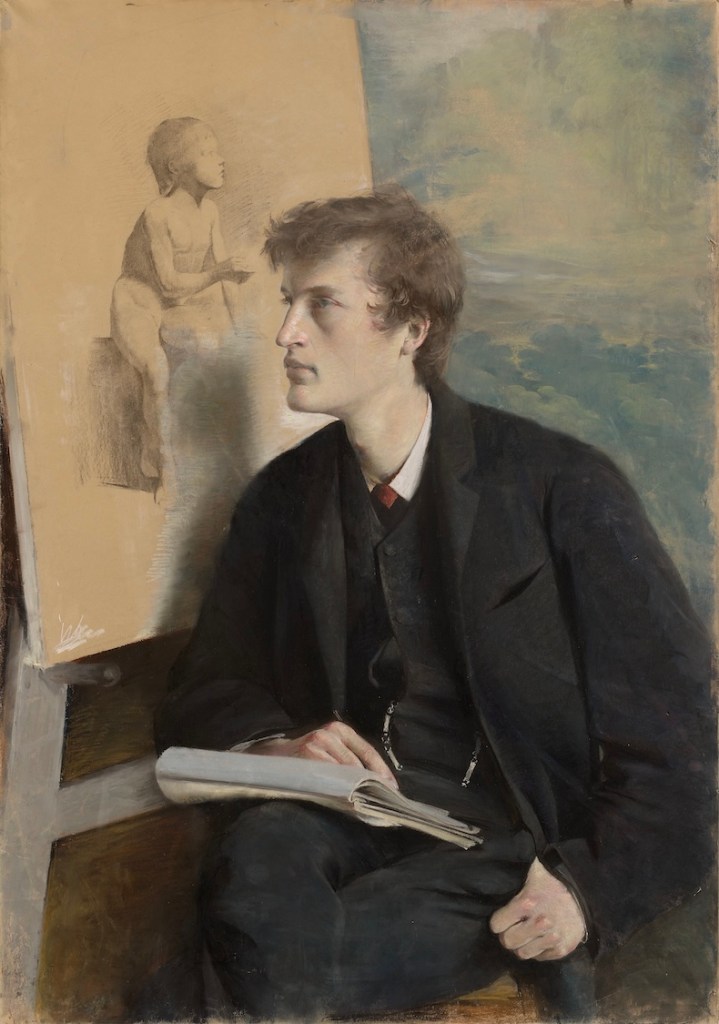
In Paris, the three artists had trained under the academic realists then in vogue: Jean-Léon Gérôme, Léon Bonnat and – perhaps most popular among the Nordic expats – Jules Bastien-Lepage. None of them really outgrew the influence of realism’s precision, though Kielland’s concern with landscape and Backer’s turn towards a hazier abstraction would distance them from their teachers in the ensuing decades. What was at stake was perhaps less a matter of paint than principle. Where Backer seemed to have found the light in Monet, Nørregaard remained sceptical, complaining in 1890: ‘At the moment, bold sunshine effects with brilliant colours are highly in vogue; but, really, you cannot always just decide to follow whatever a certain clique declares is the only path to salvation.’ That clique became her cross to bear, and she would spend her life resisting the ‘tyranny’ of Impressionism – a position that cost her friendships and seems to have landed her, as one critic ominously observed, on ‘the wrong side’.
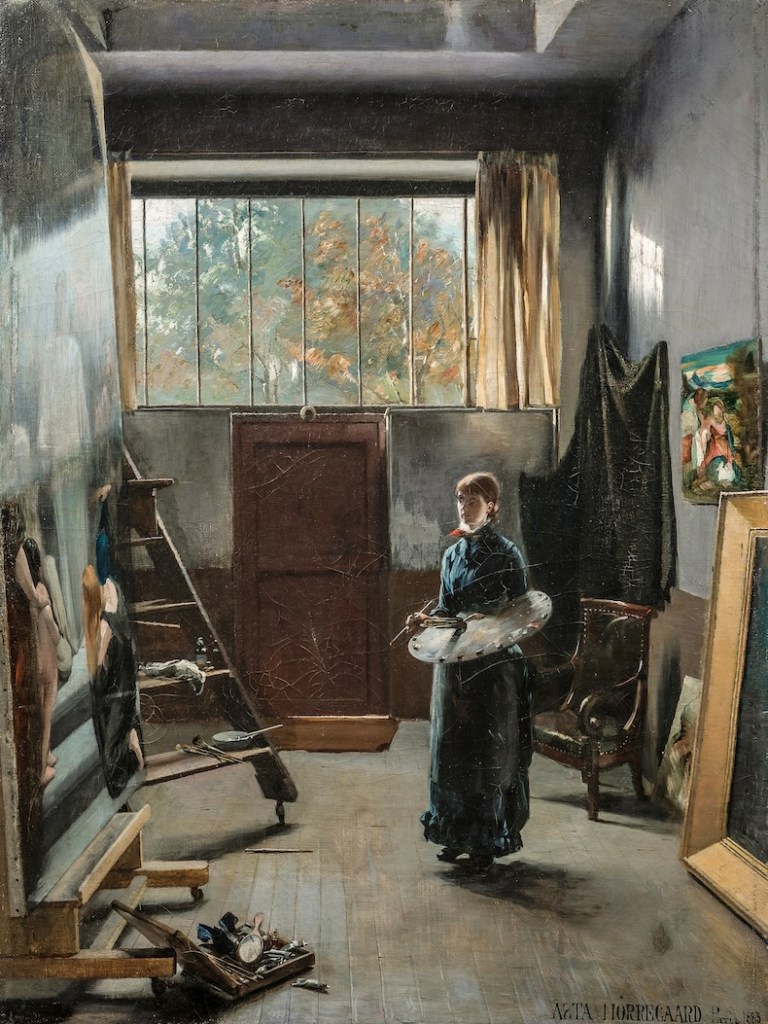
It wasn’t that she couldn’t imitate the fluffy freedom of that movement; it was that she didn’t want to. The Nasjonalmuseet’s show opens with a quiet work from 1883, the year Nørregaard turned 30 and a year after Waiting for Christ (1881), a highly celebrated but lacklustre painting exhibited first at the Salon and then at the Kunstforening in Kristiania, had earned her a prestigious commission for Gjøvik Church. In In the Studio, we see Nørregaard settled in the soft autumn light of her Parisian atelier. Before her is the altarpiece over which she would agonise for the next two years, while on the wall behind her are stashed signs of her pedigree (an Italian copy) and of her emergent métier (a cloth backdrop and unoccupied chair). Through an upper window on which she turns her back, amber leaves tussle with the grey clouds of a spinning sky: it is probably not an accident that this sliver of Impressionism is kept behind bars, revealed only by the grace of a curtain briefly pulled back.
In 1889, Nørregaard moved back to Kristiania and left her business card, so to speak, at its Autumn Exhibition. Self-Portrait (1889) hints at the combination of pragmatism and verve that would, in time, make her Kristiania’s premier portrait painter. Critics such as the art historian Jens Thiis would, predictably, try to dismiss Nørregaard as a mere ‘fashion portraitist in Kristiania’s world of high-society ladies’, but it is true that Nørregaard was an astute observer of women and their attire in a society in which women were attaining ever greater heights. Thanks to the efforts of public figures like Ragna Nielsen, one of the women’s rights activists that Nørregaard painted in 1903, and also to her steady income as a sought-after portrait painter, Nørregaard would have been able to vote for the first time in municipal elections in 1901. Many of her best works are of women soon-to-be enfranchised on account both of their struggle and of their wealth.
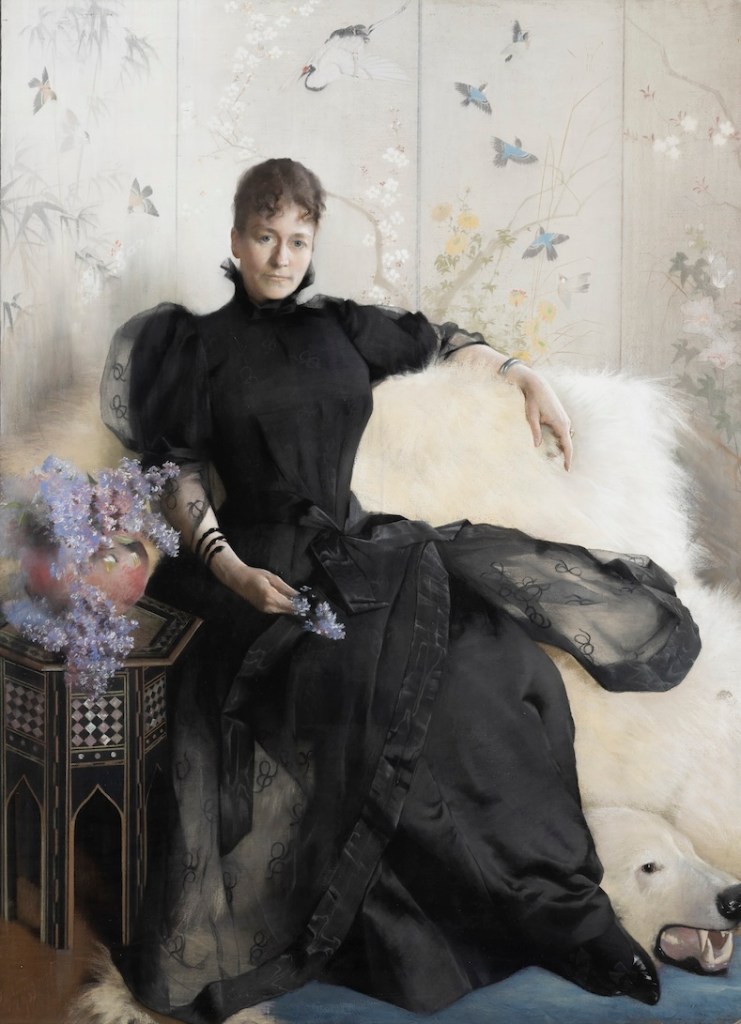
Her Portrait of Elisabeth Fearnley (1892), in which the wife of the shipping magnate lounges on the skin of a slain polar bear and against the delicate designs of a pale silk screen, for example, is a masterclass in contrasts: black against white, silk against fur, snout against shoe. She absently fingers her lush prize. We don’t need the onyx snake bracelet curling up her arm to know that such a woman could be dangerous. Or take the sitter whose wilful green gaze distracts us from the brocaded blossoms blooming across her chest, Katti Anker Møller (1900), an advocate both for unwed mothers and for a woman’s right to an abortion, about whom Nielsen lamented: ‘Imagine someone so pretty can say something so ugly!’
Nørregaard came to prominence, as the catalogue makes clear, at a moment when avant-garde styles were hooked to avant-garde causes: when Impressionism, in Norway, could suggest both nationalist and feminist bona fides. The past decade has seen retrospectives of both Backer (Nasjonalmuseet, 2023) and Kielland (Lillehammer, 2017), and though Nørregaard is the natural successor to such efforts, her resistance to what she called ‘the most modern’ art makes her a trickier figure to recover. Though she was not naïve about the sexist criticism that her work could engender – ‘The biggest objection against me is that I paint pretty dresses,’ she told the magazine Nylænde in 1899 – her battle was not just for women to be painters but for painters, including women, to have the right to choose: to paint in whatever style they preferred, even ones deemed academic or conservative. It’s tempting to take a declaration like the one she made to the sculptor Walter Runeberg in 1908 – ‘I cannot abide being tyrannised – I want my freedom’ – as a woman’s desire for independence, rather than stylistic liberty. In a way, it was both: a plea to paint as she liked.
‘Asta Nørregaard: Truth and Beauty’ is at the National Museum, Oslo, until 18 October.