Most of the self-proclaimed prophets that you’ll meet are quacks. But sometimes, maybe twice or three times in your life, you might come across someone of the guru archetype and quietly ask yourself: could he be the real deal? B.J. (‘Backward Jesus’) Newton (1926–94), a self-taught painter and self-proclaimed ‘habitual criminal’ from California, created dozens of paintings during his bouts of jail time throughout his life that make me wonder if he might be on to something. Most of the pictures are bogged down by his untrained hand, producing crude, jerky forms that lack the sorts of transcendent or angelic qualities that one usually expects from religious imagery. But the fact that he made so many, despite his clear lack of dexterity with a brush, only adds to their authentic charm – as if he were possessed by a compulsion to get these visions out into the world.
Newton was the odd one out among the inmates whose craftwork was for sale at the Folsom Prison store. Most of their products ranged from quaint ceramics to overly sentimental charcoal drawings of pin-up girls. Newton’s paintings featured demons screaming in an inferno, a mad man scavenging for food and water in the desert, a close-up of a bird’s face with tears rolling down its cheek. Newton’s precious few hours of creative time were not an escape from, or remedy for, the torture of confinement. He stared right into the abyss – taking on the questions one must be forced to consider about themselves, human nature and society when the law has deemed you unfit for cohabitation with other free individuals. Newton’s rich and enigmatic depictions of no man’s land reveal a deep suspicion of the universe – a stark world view, as foreboding as it is compelling.
One untitled oil painting from 1976 depicts a giant five-pointed star appearing out of a circle of flames over the ocean’s horizon. Its bottom two points sit on the surface of the water, almost as if the star is walking towards us from afar. The water at its feet burns and boils like orange lava. The sky looms in a brooding earthy red, scalded by the star’s monstrous presence. The left-hand portion of the sky maintains a greenish hue, with clouds whisking around in a Turner-esque frenzy – mimicking the chaos created by the clash of opposing galactic forces. A wall of bright foam curls over itself on the water as it approaches the shore. Dashes of white highlights – rubbed into the turquoise ground underneath – radiate from the surface of the ocean with a cursed, eerie glow. The star, black points surrounding a fiery orange centre, recalls a sheriff’s badge – as if Newton seeks to imbue the panoptic eye of the law with an apocalyptic fury.
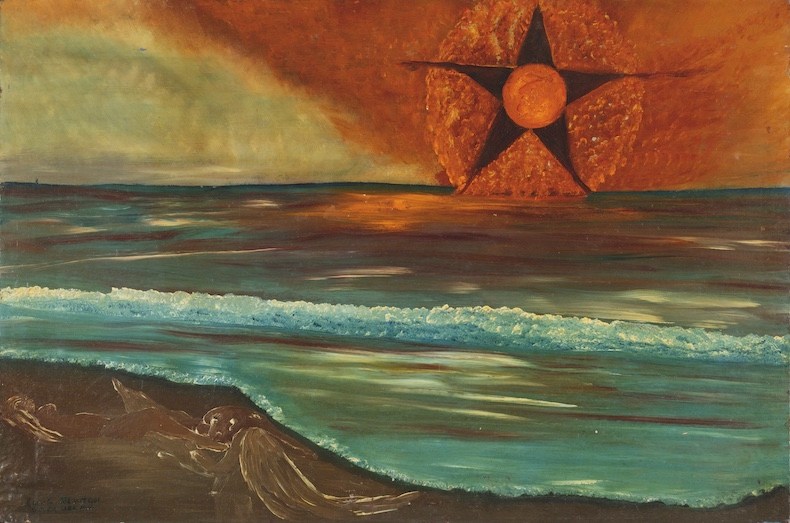
It is so easy to get wrapped up in the momentum of the landscape that you might miss the small patch of dirty-brown beach in the foreground. Here, two faintly painted mythic creatures appear to be engaged in a sort of ritualistic or sexual act. A woman lies on her back, her form made up of a few faint white marks mixed with the colour of the earth – perhaps to suggest she was made out of the sand, rather as humans were made from the materials of the earth in many cultures’ mythic origin stories. Below her, a giant bird tenderly holds up her ankle and rubs its beak against her foot: a kiss? A caress? A salacious lick?
The meeting of extremes – animals and people, water and fire, creation and destruction – raises disconcerting questions. Was Newton clued into cosmic truths that we have the luxury of avoiding thanks to the distractions of freedom? Or were these images born out of prison-induced psychosis? What sorts of heated thoughts flashed through his head as he painted this picture in his cell? Did it appear in his dreams? If you take the paintings seriously enough, they’ll surely reappear in yours. Newton’s work forces us to put aside prejudices about what a serious and deep painting ought to look like – in refinement, in subject. Their undeniable power makes it impossible to dismiss them. But even if you do, the paintings will haunt you later, prompting you to wonder: was Newton going crazy or am I?
Works by B.J. Newton will be exhibited by Fraenkel at Independent 20th Century.