
The ancient Chinese philosopher Laozi stated in the Tao Te Ching (late 4th century BC) that ‘great tone has no sound’ and that ‘great Dao is formless’. These principles – and the idea that there are certain truths our senses are unable to grasp – are explored in ‘Beyond Form’, the latest exhibition by BAISHUI, which is taking place at the Business Design Centre in London, during the London Art Fair, until 25 January.
Taking water as its central motif, the exhibition uses an array of artistic means to express ancient East Asian philosophies, particularly those relating to the invisibility of underlying forms of nature and the limits of our perception. BAISHUI’s art, which encourages us to consider our relationship to our own surroundings, is designed to work well in a range of geographies and contexts; it’s fitting, then, that so much of her work is inspired by water, which is not only reflective but also uniquely able to flow from place to place, frequently defying physical or cultural boundaries.
Perhaps the clearest example in this exhibition of BAISHUI’s interest in making the intangible tangible is her series Infinite Dao: Water Towns (2023–). For this series, named after the ancient Chinese towns known for their rivers and canals, BAISHUI deconstructs a painting related in some way to Daoist cultural heritage into 3,000 fragments. In an elegant union of art, maths and nature, BAISHUI infuses each fragment with water patterns that resemble the Fibonacci spiral, using a proprietary algorithm. She then reassembles the pieces, manually but with digital assistance, to embody a return to oneness – a core tenet of Daoism. The resulting work is immediately striking, vibrating with movement from the ripple effects yet betraying no sign of the dissolution of the original work into thousands of pieces.
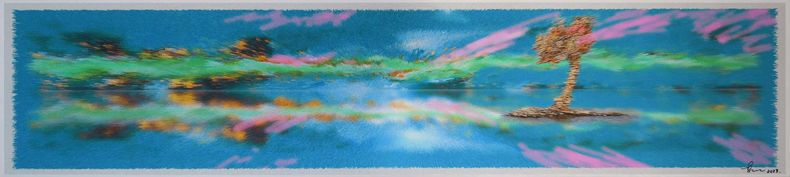
Technology is often seen as antithetical to nature, but BAISHUI’s use of tech to highlight nature’s underlying patterns is a refreshing reminder that technology itself is based on the laws of nature, and when used imaginatively can remind us of its beauty. Water seems especially well suited to work that is concerned with eroding boundaries or dissolving them altogether.
Take Water 3.0 (2025), in which BAISHUI explores not just the appearance but also the behaviour of water at an almost molecular level. Drawing on tidal data from the Qiantang River and the cascades of Niagara Falls, BAISHUI makes us see how minuscule collisions and chaotic flows create large-scale turbulence, with order and disorder coexisting in ways that seem counter-intuitive but are in fact perfectly natural.
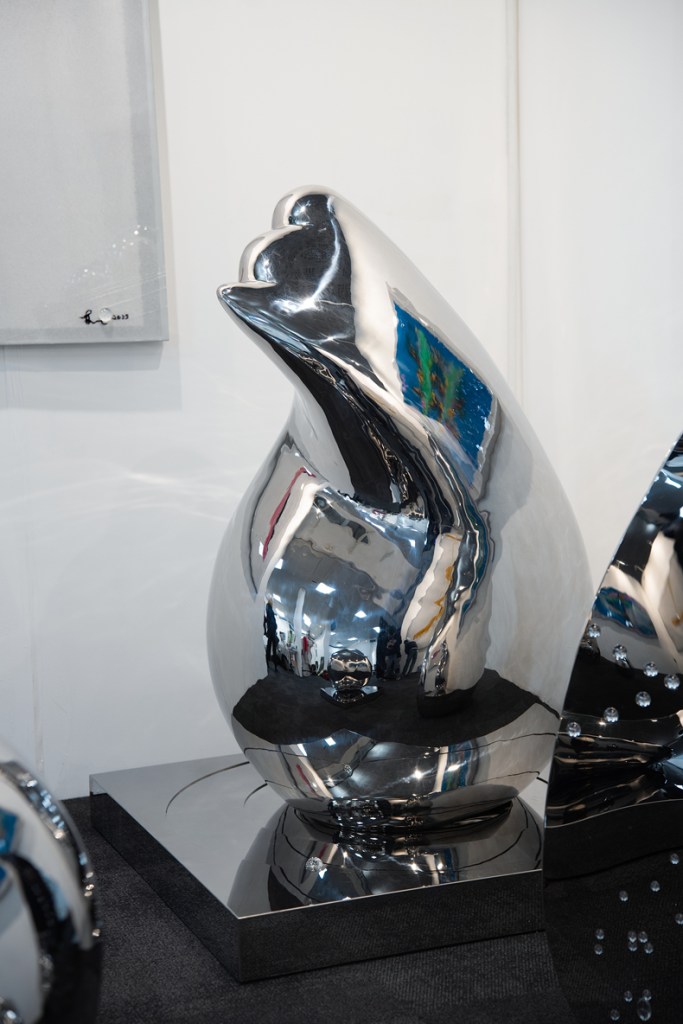
Her Raindrop series is a far simpler but no less powerful set of pieces. Confucius once said that ‘the wise find pleasure in water’; Raindrop, which uses transparent resin, mirrored stainless steel and crystal glass to capture the changing shape of raindrops as they fall from clouds, invites us to consider our own personal transformation as well as the transient nature of any given state of being.
Amid the bustle and dynamism of London Art Fair, ‘Beyond Form’ functions as an oasis, offering visitors a chance to contemplate how water – shapeless, ever-changing and all around us – can help us see the world and its many intangible truths more clearly.