From the October 2026 issue of Apollo.
On 5 March 1931, spirit distilled at Balvenie was filled into an oak sherry butt and laid down in its Dufftown warehouse in Speyside. Some 88 years later, in 2019, Malt Master Kelsey McKechnie judged the whisky ready and had it bottled. This year Balvenie released 17 bottles as the world’s oldest single malt Scotch whisky. The artist Daniel Arsham, also a whisky connoisseur, was asked to respond to the release by building the required vessel for such a rare liquid. He used oak, hand-painted bronze and copper cut from a still on the estate.
Both artist and malt master intended to show the work that goes into the process of creating fine whisky. Or as McKechnie says, ‘Does [the whisky] do justice to those men and women that work with the distillery and their spirit, and does it feel relevant for the future?’
For McKechnie, blending is akin to sculpture or design, with smell, taste and a blender’s instinct just as important as the science. Arsham, who regards everyday objects as ‘future artefacts’, allows the materials to carry this argument by drawing on Balvenie’s archives to guide his choices. ‘Materiality conveys as much as the form,’ he says. ‘In my work I always try to use materials in ways that tell a story beyond just the way that they look, so the knowledge of the material tells you a story behind it.’
Arsham was interested in something beyond bottle design, which is constrained by the need to protect the liquid. He wanted to think about how to capture and preserve it. ‘This liquid is so precious that we need to house it in something that we know is going to last,’ he says, ‘I wanted to convey the preciousness of the liquid; the bottle sits in the centre like a relic uncovered.’
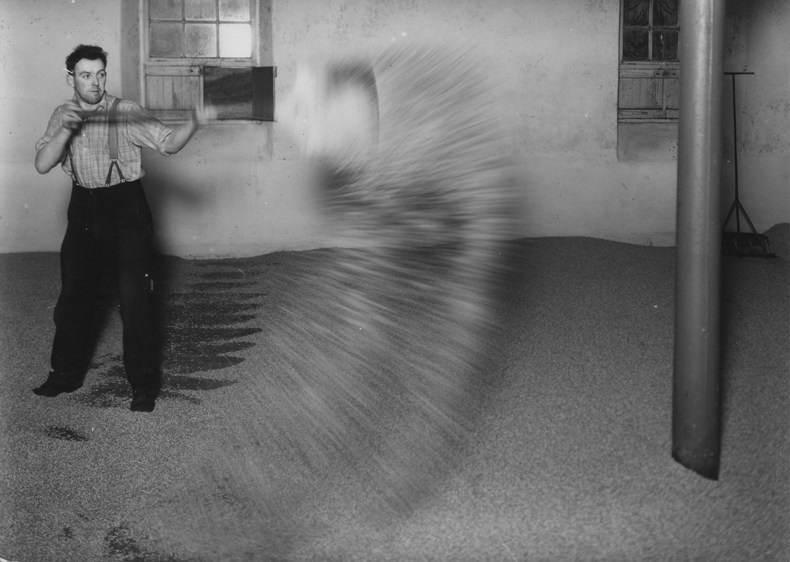
Balvenie retains a substantial archive on site, and handwritten records show the Home Malt Floor was also established in 1931. Floor malting is a technique used in the production of scotch where moistened barley is spread across the floor to germinate and turned repeatedly by hand to hold the temperature and control germination. There are photographs of the distillery team, the malt men and their dog, who would have been the very same craftsmen making this drink. To taste the oldest whisky in the world with its lively tropical notes, along with tobacco and cocoa and an extraordinary long finish of dried fruit, while the individuals who malted its barley almost a century ago stare back at you from a photograph, is a complicated order of contemplation.
Precise capture and preservation of this liquid is its own miracle. The older a whisky, the more precarious its taste becomes because alcohol evaporates at about 0.5 per cent a year through what those in the profession call ‘the angels’ share’. Almost all Scotch is casked at 63.5 per cent alcohol by volume and bottled before the alcohol falls below 40 per cent – the legal minimum for a whisky to be labelled a Scotch. Distilleries are microcosms, with their own temperatures and levels of humidity that often interfere with intentions.
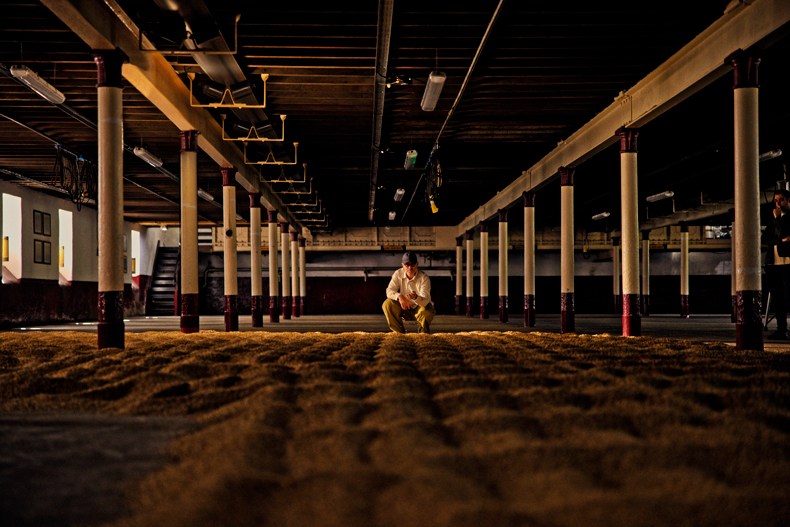
Balvenie remains unusual for keeping key crafts in-house, retaining its own cooperage, aspects of coppersmithing and traditional floor maltings. Many of the materials Arsham used to design the case were already on site. ‘The barrels are used a certain number of times and then sometimes they’re decommissioned or taken down. If I’m going to make something that’s about a sense of place I can just make it out of material already there.’ This included a decommissioned still that ‘had some of the actual copper that created our whisky ready to go, and we thought: let’s bring that into the piece.’
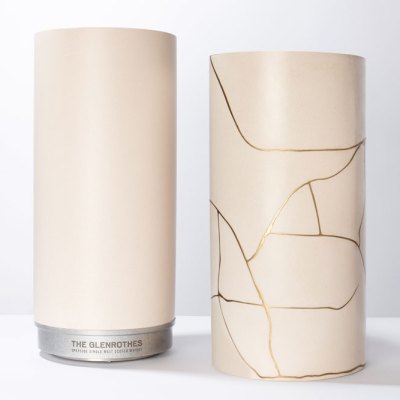
What emerged is a sculpture-case, eight layers of hand-painted bronze, one for each full decade of maturation, 88 layers of oak and a copper disc cut from that Balvenie still, the bronze matching the texture and colour of copper in the distillery. The bottle is hand-blown and sits within an 18 ct gold engraved decanter, held by technical elements that display and protect it, answering ‘a design brief that is just a little beyond just the aesthetic’.
The collaboration is important because Arsham breaks up some of the significant elements in the craft and making of whisky and recasts them to isolate one specific moment, be it the malting, the cooperage or the still. The superlatives of this whisky become a spotlight on the invisible but complex craft behind the beverage. Those who acquire one of the 17 sculpture-cases are taking away a piece of that microcosm; they take away the work of the hands – and the odd paw.
From the October 2026 issue of Apollo.