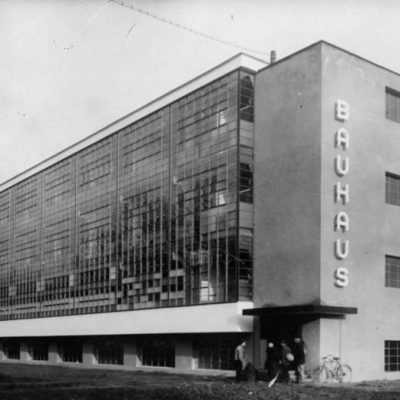
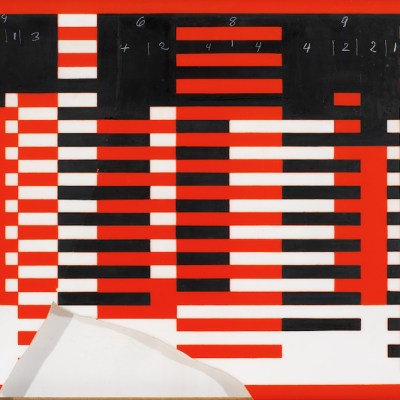
When Walter Gropius established the Bauhaus school in Weimar in 1919, he enlisted an impressive cohort of peers to teach at the school, Wassily Kandinksy, Paul Klee and László Moholy-Nagy among them. Attracted by Gropius’s vision for a school that disrupted the barrier between artists and craftspeople – and no doubt the calibre of its staff – students came to the Bauhaus in droves. One such student was Herbert Bayer, a young Austrian artist and architect who arrived from Darmstadt in 1921. After three years studying mural painting and typography under Kandinsky, Bayer returned to the Bauhaus in 1925, moving to its new location in Dessau the following year as director of printing and advertising and leaving his mark through his development of the school’s signature Universal typeface.
Bayer left the school in 1928 for a job as artistic director of Vogue’s Berlin office before heading to New York a decade later. Stints working as a commercial artist followed and, in 1944, Bayer married Joella Syrara Haweis, daughter of the poet Mina Loy, becoming step-father to Jonathan, the son Joella shared with her ex-husband Julien Levy. Two years later, the family moved west, with Bayer hired by industrialist Walter Paepcke, head of the Container Corporation of America (CCA), to make posters and other advertisements promoting Paepcke’s redevelopment of Aspen. Bayer, who would later become artistic director of the CCA, was also tasked with commissioning artists to produce advertisements for the corporation’s Great Ideas of Western Man campaign, which paired quotes from classic books with newly made artworks.
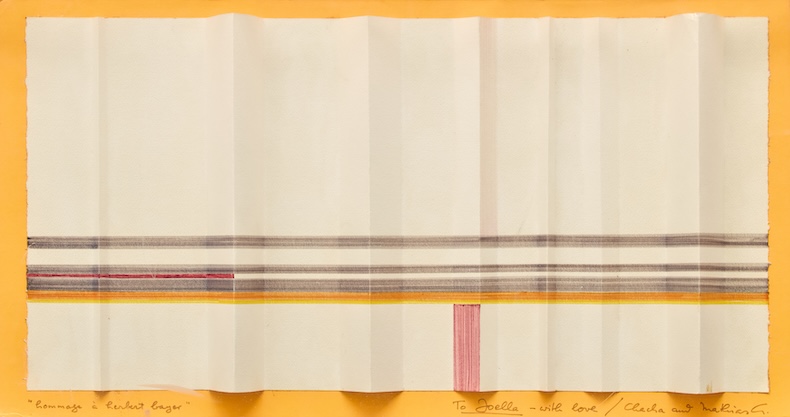
Building the art collection of the CCA gave Bayer ample opportunity to strengthen his own. Many of the works he acquired, several of which are coming up for sale at Roseberys in London on 3 June, are by artists who he met through the project, including the Italian sculptor Costantino Nivola and Josef Albers, a Bauhaus peer with whom Bayer had maintained a close relationship. Mathias Goeritz’s Hommage à Herbert Bayer (n.d.), a simple composition of horizontal lines streaking across a sheet of paper that had been folded concertina-style, nods to the bond the German-Mexican artist formed with the Bayer family, and was gifted to Joella by Goeritz and his wife. Much of Goeritz’s work was informed by his relationships with architects such as Bayer – a cross-disciplinary approach that bears the influence of the Bauhaus – and he often played with the conventions of structure, manipulating the paper to give flat works a three-dimensional quality.
When Bayer died in 1985, his stepson inherited his vast collection of art, including a screenprint by Albers from his Homage to the Square series and lithograph by Kandinsky, both of which are on offer at Roseberys. Jonathan also inherited Bayer’s artistic bent: in 1972, he moved to London to pursue a career as a photographer, later establishing the London Independent Photography group. Like his stepfather, who began working with photography in the late 1920s, creating photocollages teetering on the surreal, Jonathan used the medium to present a distorted view of life. The works he amassed by other photographers – Alfred Stieglitz and Frank Eugene among them – alongside those acquired by Bayer show a multigenerational enthusiasm for collecting that takes in many of the key artistic moments of the 20th century, from the idealised abstraction of the Bauhaus to the development of modern photography.
The Bayer Family Collection auction at Roseberys London will be held on 3 June.