From the September 2026 issue of Apollo.
Less than a quarter of the way into the Bayeux Tapestry, a small, puzzling scene interrupts the course of events. At this point, we are still in the long lead-up to the Battle of Hastings. It is 1064. Harold Godwinson has landed on Norman shores, been taken captive, and delivered to Duke William. The two men will soon set out for Brittany to whip its duke, Conan II, into submission. But for a flash we return to England. Inside a portico made of two spiral columns topped with red dragon heads, each menacingly extending a golden tongue, stands a woman. She looks static, passive, her hands just peeking out of her richly draped clothing. In front of her, a tall, tonsured cleric wearing a blue mantle strides energetically towards her. He reaches his right hand behind a column and touches the woman’s face, his thumb on her forehead, the other fingers on her cheek. It is an odd gesture, made stranger still by his balletic posture, and the fact that he holds his left hand jauntily at his waist.
We can guess that the scene takes place in England, or at least involves an English woman, due to the Latin superscript, which reads, unhelpfully, ‘where a cleric and Ælfgyva’. No verb explains what is happening between these two mysterious figures. This is the only incomplete sentence on the 70-metre-long work, and it is the only case in which a woman is named. As if this were not tantalising enough, the lower margin below Ælfgyva features an even more enigmatic figure. A naked man, squatting into a full grand plié, has one outstretched hand and another at his waist, mirroring the cleric above. His genitals are in full view, detumescent but disproportionately large. His face and hands are inexpertly embroidered, at least as compared with other parts of the Tapestry, but what we can make out of his expression suggests distress.
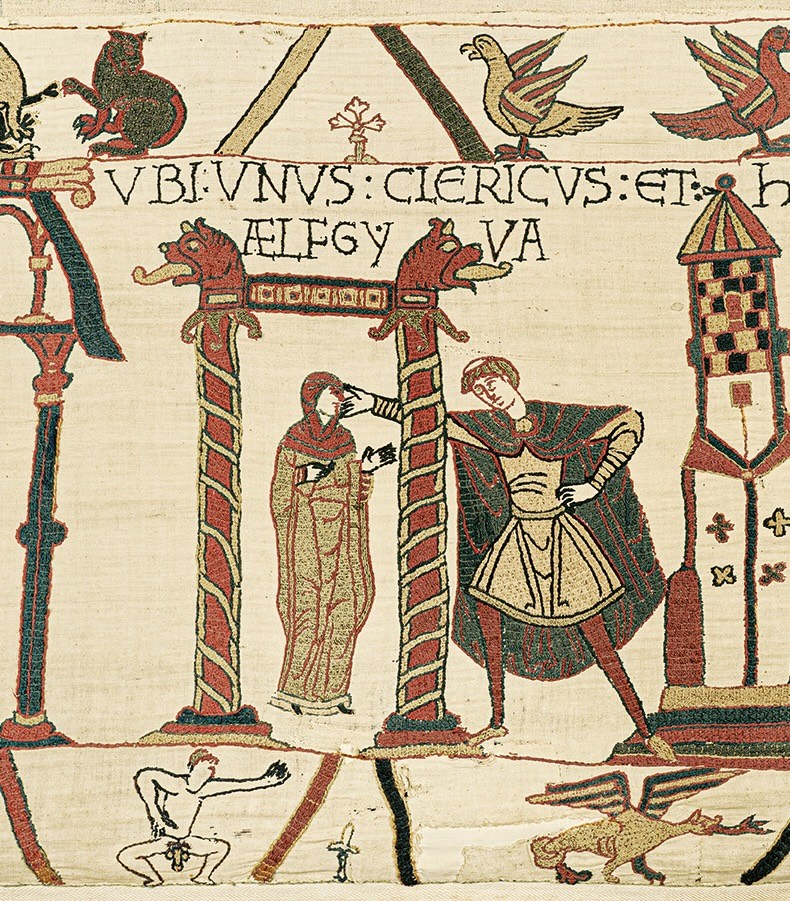
Scholars have puzzled over this scene for centuries. Who is Ælfgyva, and what is going on between her and the cleric? Is there any relationship between their encounter and the slightly tormented posture of the naked man in the margin below? Ælfgyva has at times been thought to represent Harold’s sister, promised in marriage to one of William’s men; William’s daughter Adelida, promised to Harold; Queen Emma of Normandy, whose English name was Ælfgifu; an abbess of Wilton Abbey connected to Harold; perhaps even the woman who supervised the making of the Bayeux Tapestry.
Then there is the strange touch between the two figures. Some critics have seen a ritual gesture of betrothal in the cleric’s hand, a blessing, or a reference to the miraculous healing of a nun’s eyes. Others have thought it a suggestion of sexual impropriety or abuse, or a slap. As for the naked man squatting in the border, he might symbolise the sexual excesses of the English, and the notion that their sinfulness led to the Norman Conquest. Or, as one particularly imaginative strand of interpretation has it, the image is an illustration of a fable about a man giving birth to a mouse.
The Bayeux Tapestry was likely planned and executed in the decades following the Norman Conquest in 1066. For much of its nearly millennium-long history, it has been a riddle, provoking various audiences to find its solution. The first source of confusion lies in its name. It is a monumental piece of embroidery of wool thread on linen cloth, not a tapestry. In the French tradition, the work has sometimes been called ‘Queen Matilda’s Tapestry’, since it was once thought that William the Conqueror’s wife commissioned it. The first unambiguous record of its existence lies in a 1476 inventory from Bayeux Cathedral, where it was regularly hung during certain festivals. Bishop Odo of Bayeux, William’s half-brother and a key figure in the Tapestry’s narrative, may have been its patron. It is plausible to believe that the Tapestry itself was made in England, likely in Kent, not in what is now France.
Ambiguity can be an invitation. Over the centuries, various nations have tried to claim the work for their own glory. The story was told engagingly by the art historian Carola Hicks in The Bayeux Tapestry: The Life Story of a Masterpiece (2006). Eighteenth-century antiquarians on both sides of the English Channel connected it to local legends, while also trying to understand its ‘gothic’ artistic style on its own terms. When, in 1803, Napoleon Bonaparte was contemplating a naval invasion of England, he had the Tapestry exhibited in the former Palace of the Louvre as evidence that the feat had been accomplished before. The idea of invading England also appealed to the Nazis, who saw in the Tapestry a sign of Germanic prowess. After all, the Normans were originally Scandinavian raiders, or ‘northmen’.
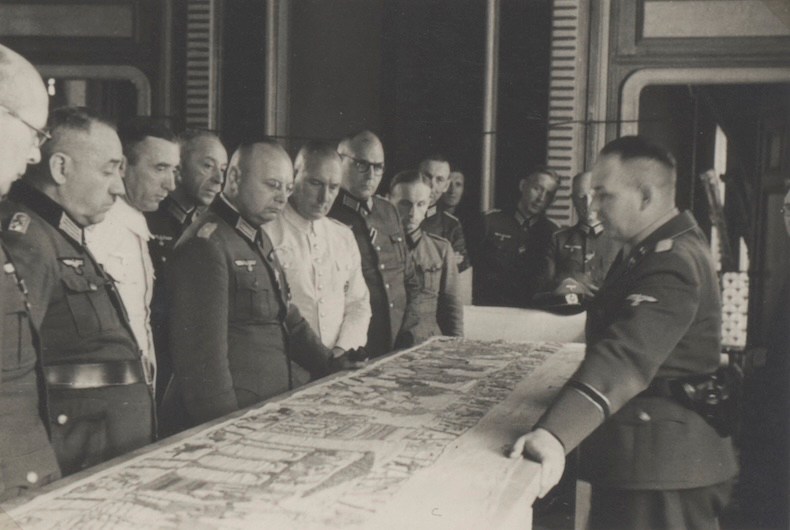
Both Napoleon and Heinrich Himmler’s Ahnenerbe (‘ancestral heritage’) research group understood the Tapestry as a monument that celebrated the success of Norman invaders. But for a such a massive piece of cloth, the Bayeux Tapestry is remarkably wriggly, ideologically speaking. It depicts the lead-up to William’s conquest of England as well as the battle itself, along with its most decisive moments. It can certainly be read as a justification of the Norman claim to the throne. It is just as easy, however, to read the Tapestry as conveying a sympathetic depiction of the English, and of their unlucky king, Harold Godwinson. We do not know how it concludes, since the last few metres are missing; one convincing argument holds that it ended with William enthroned as the conquering king. As it stands, however, the Tapestry breaks off with a depiction of the Battle of Hastings that does little to idealise the violence of war.
Shortly after the depiction of Ælfgyva and the nameless cleric, a longer scene gives us a sense of the Tapestry’s complex presentation of Harold Godwinson. He is travelling with William and his army to Mont Saint-Michel. The monastery, in its 11th-century form, rises behind the troops on horseback, prominently occupying the upper border as though reaching for heaven. The soldiers are crossing the Couesnon when both horses and men begin to stumble in that river’s notoriously sandy floor. Two soldiers hold their shields up over their heads as they ford the water. One horse falls head first, its rider almost launched off. Just ahead of them is Harold. With his left hand he holds his shield aloft, and with his right he grabs a Norman who is tumbling backward. Another man has his arms wrapped around Harold’s neck and seems to be holding on for dear life. The Normans, smaller than Harold, resemble children hanging off daddy. It may be an accident of stitch placement, but Harold seems to have bags under his eyes.
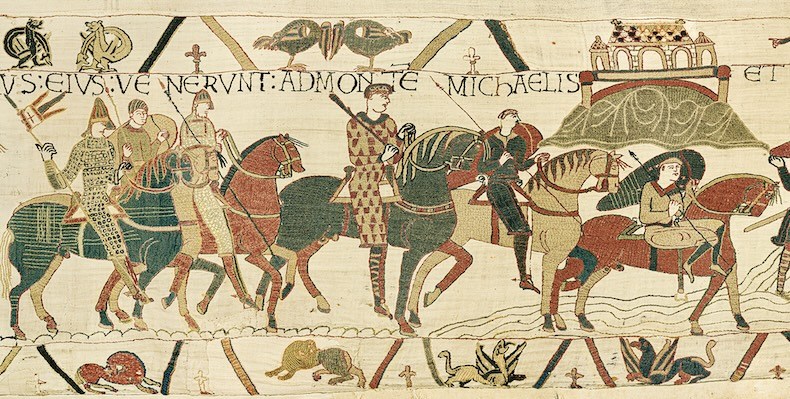
This is one of the famous complicating moments in the Tapestry narrative. Historians after the Conquest sympathetic to the Norman cause insisted that Harold had promised his support for William’s claim to the English throne during the 1064 trip. The Bayeux Tapestry shows William giving his arms to Harold, implying a relationship of fealty. It also shows Harold swearing an oath on two reliquaries, though it does not make the content of the oath explicit. To the Norman line of thinking, at any rate, Harold was a treacherous oath-breaker who deserved what was coming to him when he nabbed the crown after Edward’s death. Why, then, did the Tapestry designer portray him as a brave, even heroic, figure? One thing seems so obvious, it is almost a visual joke: Harold is on shaky ground both literally and metaphorically. Whatever the reason for his travel to Normandy – a hunting expedition, a rescue mission or a diplomatic message – when he came to French shores he walked into a trap.
The margin beneath Harold’s feet features a particularly long chain of events. In forms that lightly echo the wet sand above, six eels try to wriggle away from a man holding a knife. The man is hunting them, but then he seems to have lost his footing too, as he is lying on his back, his feet up in the air. A little further on, a wolf has clenched his teeth firmly on the hunter’s foot. Then an eagle, facing backward, seems about to chop down on the wolf’s tail. Another animal, perhaps a boar, lunges at the eagle. A centaur follows, about to grasp the boar’s tail with one hand. He looks back, however, as though expecting to be chased as well.
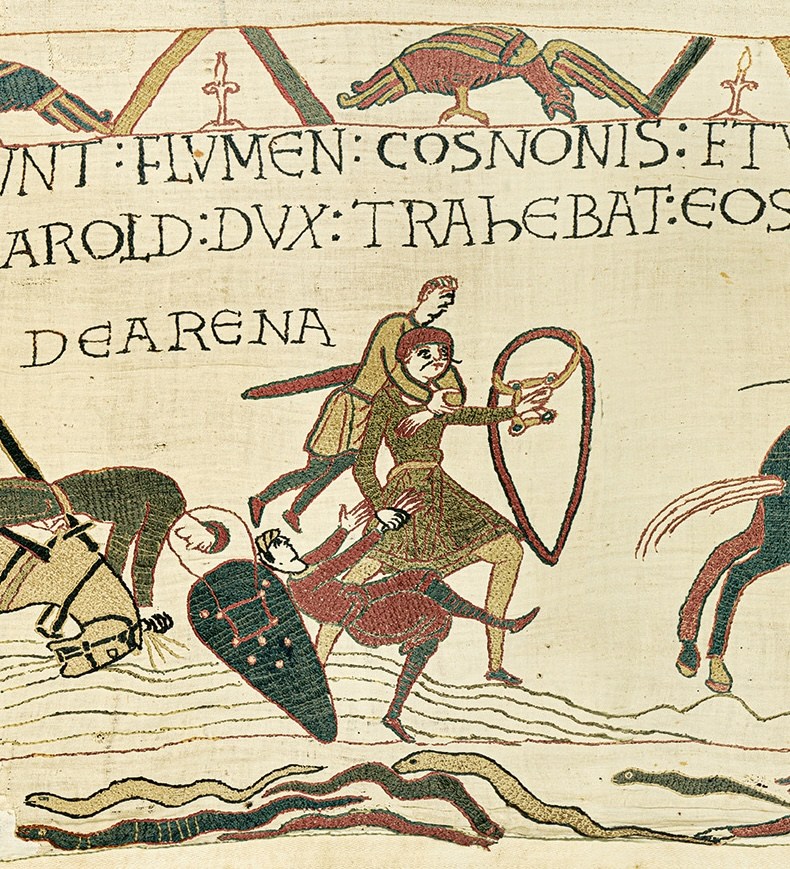
A medieval viewer gazing at this elaborate eel hunt might have thought that Harold was trying to be as slippery as an eel, to play the friend to William only to betray him later. She or he might have reflected that Harold was bound to be caught in the end. Indeed, the Norman man hanging on his back might just as well be tackling him. But the long chain of creatures that extends beyond Harold and below the following scene – William’s attack on Conan II at Dol – hints at a broader perspective. Every hunter will be someone’s prey at some point. It is only a matter of letting history roll on long enough.
Over the years, the Tapestry’s commentators have tried to solve the problem of its affiliation. It is tempting, for example, to imagine English artisans – the designer, drafters, embroiderers – spoiling an attempt at Norman propaganda with their own covert messages. A rosier view was offered by Howard Bloch, who argued in A Needle in the Right Hand of God (2006) that the Tapestry’s ambivalent message, in which both English and Norman figures could be interpreted positively, is an attempt to craft a united identity for the newly fused nation. But perhaps ambiguity was less of an issue for medieval audiences than it is for us. Medieval people did not necessarily expect their art to provide them with clear moral lessons and political positions. They knew that riddles can have multiple answers.
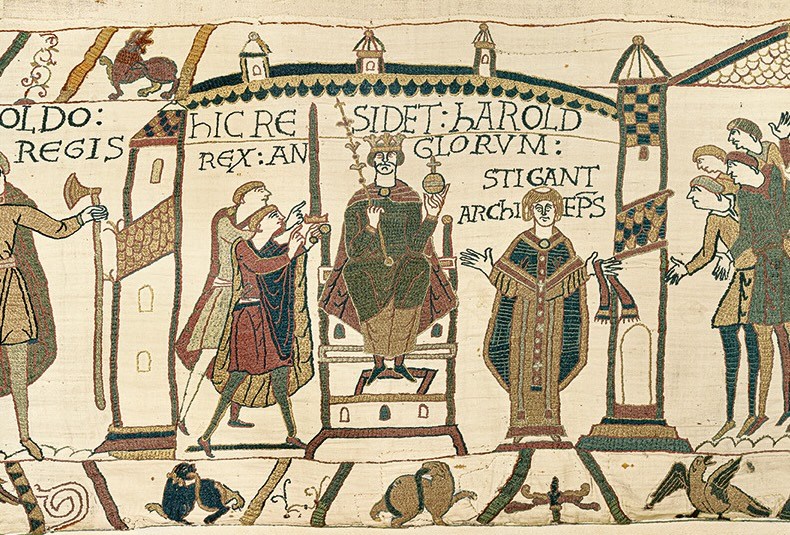
For all its visual appeal, the Bayeux Tapestry is also a bookish work. Its Latin captions indicate that at least some of its intended viewers must have had training in grammar. Medieval grammatical education was not limited to correctness, or parts of speech; it was also training in the imaginative interpretation of language. English monasteries had a long tradition of using Latin verse riddles to cultivate this capacity in their pupils. The tenth-century collection of Old English poetry now known as the Exeter Book contains a collection of almost a hundred riddles on themes both high (Creation, wisdom, Scripture, stars) and low (onions, dough, horns). Unlike their Latin precedents, the Old English riddles have no set solutions. They were texts to be worked through, played with, occasionally laughed at. Just like the Bayeux Tapestry, these poems offer us glimpses of early medieval animal life, cooking, hunting and religious rituals. A number of them bear both an erotic interpretation and an ‘innocent’ one – much like the scene with Ælfgyva and the cleric.
The Bayeux Tapestry can be understood as one grand enigma, but it also bears more explicit traces of the classroom. Commentators have long recognised that illustrations of well-known Aesopian fables are tucked into its borders between all those peacocks, lions and griffins. Most notably, Harold’s voyage to Normandy is underscored by a series of recognisable scenes: the proud crow who loses his cheese to a fox, the lamb who tries to out-argue a wolf and is eaten for his efforts, a crane who pulls a bone from a wolf’s throat and receives no reward. Fables seem more straightforward to the modern eye than riddles do; after all, they usually ended in snappy moralisations. In practice, however, medieval authors could experiment with the form, either adapting key details in the stories, or changing the final lesson, even in ways that no longer seemed to follow. The purpose of fables was not to deliver an easily digested precept, but to teach pupils to think for themselves.
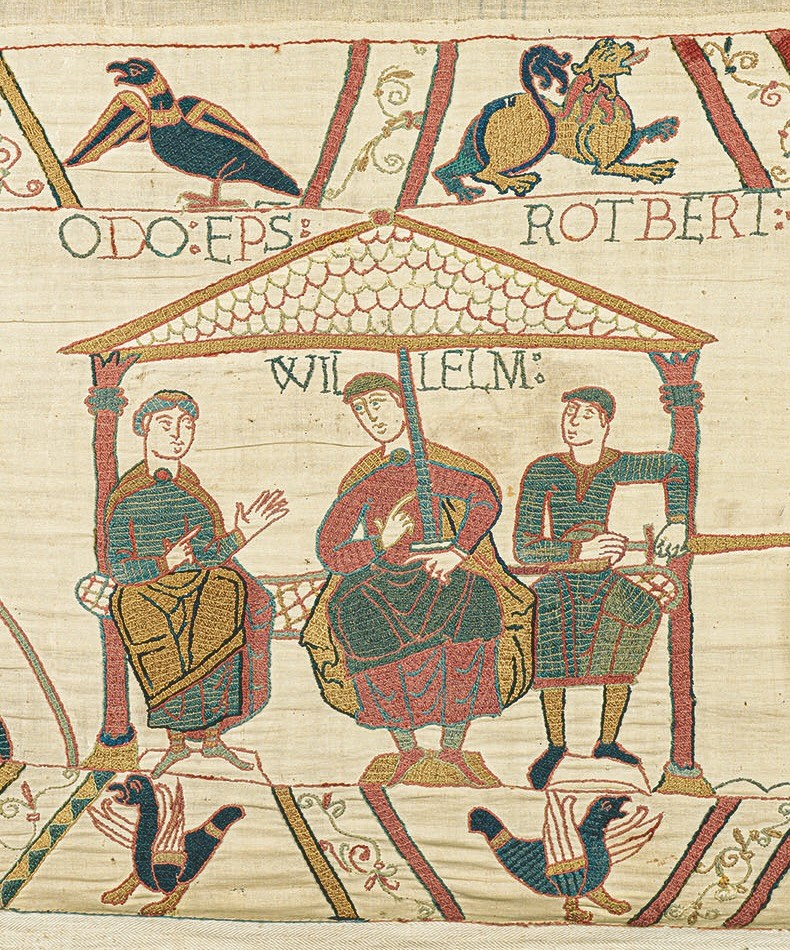
An educated medieval viewer of the Tapestry might have read the fables accompanying Harold’s travels as foreshadowing his future losses. He or she might also have read them as an indication that in 1064, Harold was still like a child, about to learn a series of basic but vital lessons on the workings of power in the world. I suspect they would have been less concerned with whether the Tapestry portrayed William or Harold as the more worthy magnate. The Tapestry refuses to provide a single message when it comes to the main characters of history. What it does, without question, is invite its viewers to pay attention to the margins.
Near the end of the Tapestry, with the Battle of Hastings well under way, something strange happens to those margins. Above the fighting warriors, the illustrations remain as they were before: birds and various other creatures confronted and addorsed in a way that recalls the decoration of Byzantine silks, with thick, adorned diagonal lines and stylised plants dividing them. Underneath, two birds fall on their backs and then the margin gives way to one long series of soldiers’ corpses. They are bent backwards, unnaturally, or have their arms and legs splayed out. They are pierced by arrows in the back, in the face or in the shoulder. Some have had their heads chopped off. Swords lie broken.
From this point until the end of the Tapestry as we have it, the lower border serves as an extension of the fight in the main register. Norman horses fall above and lie dead below. A steady series of Norman archers advances, its line punctuated by the occasional body of another dead fighter. Finally, just before Harold dies, the lower border reveals the after-effects of battle. Men despoil the field, gathering shields and swords. They pull armour off fallen warriors, sometimes struggling so much that it almost seems the bodies of the dead are dancing. The naked corpses are embroidered in a simple outline stitch, rendering them pale and ghostly. Here are no more fables, no more riddles or allusions. The Tapestry shows the devastation of war in a way anyone can read.
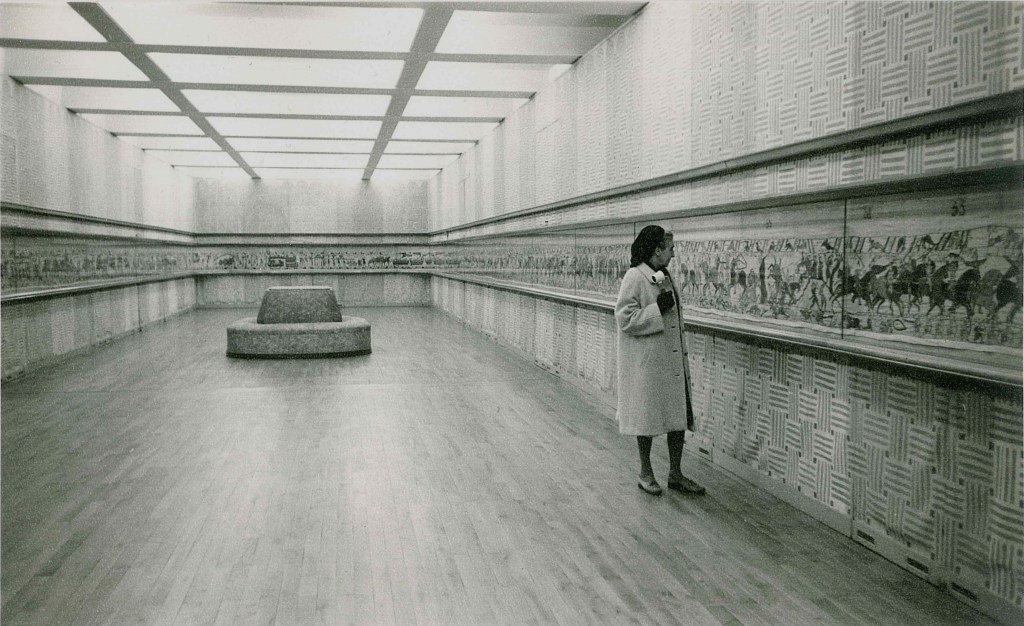
‘The Bayeux Tapestry’ is at the British Museum, London, from 10 September–11 July 2027.
From the September 2026 issue of Apollo.