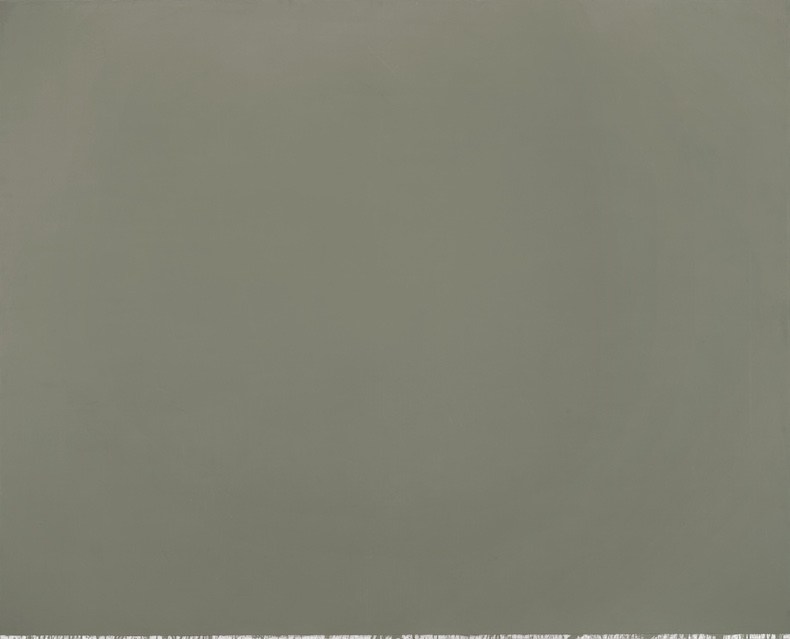
The new catalogue raisonné of Brice Marden’s paintings carries some brief but evocative notes on individual works, and the one appended to the entry on Nebraska (1966) quotes the artist’s recollection of a road trip through the state that inspired it. He talked of ‘subtle changes in the landscape – you’d be driving along and then you’d suddenly go over a little rise, and there was this incredible gorge or something – not big, huge thing, but with little trees in it’. The anecdote invites you along with him, pointing out detail and incident, yet the painting in which he memorialised all this isn’t a landscape or a figure group but a silent and enigmatic monochrome, nothing but a cool, pale green expanse of oil and beeswax on canvas. ‘The green I saw was exquisite,’ he remembers, and that’s Marden: to love him is often to keep faith with the idea that colour alone can speak multitudes.
Marden died in 2023 and to mark the publication of the catalogue raisonné Gagosian has staged a crowded but impressive survey of six decades of his work. The show inevitably has an elegiac quality, which is underscored by the fact that it comes at a pluralistic moment in contemporary painting. Today, anything goes, but when Marden was making his reputation in the 1970s – something he did powerfully fast, scoring a survey at the Guggenheim barely a decade after his first New York solo show – he did so as an end-times modernist. His work was seen as part of a lineage stretching back to Manet, Cézanne and Matisse. Critics whispered that his were ‘the last paintings’.
Marden started very dark: his earliest work, from the mid 1960s, feels shadowed – blocked, almost – by Jasper Johns’ grey pictures and black abstract canvases by artists such as Frank Stella and Ad Reinhardt. It’s not until Nebraska (and the experience that informed it) that the mood lightens and he finds his voice. Marden knew it and he never sold the picture; it provides a moving introduction to Gagosian’s show. In Nebraska he’s fully in charge of his métier: the beeswax in the paint renders a delicious matt surface that holds the eye while the edges of the picture – softly shadowed in places and with a green-spattered strip running along the base – provide a proscenium arch for the mystery within. Marden’s career would continue to evolve in response to new experiences. He and his wife, the painter Helen Marden, visited Hydra in Greece in 1971 and bought a house there two years later; a painting such as Summer Table (1972–73) is said to be soaked with the palette of the Med. Later there would a series drawing on the colour of the bleached rock on the island and of the olive groves. But all this inspiration was channeled into panels of pure colour. When Marden discovered Chinese poetry and calligraphy in the 1980s there was a more notable shift: the Cold Mountain series, named after Han Shan, a poet of the Tang dynasty (618–907), has calligraphic forms dangling like cobwebs from above. In subsequent years the linearity of the web forms became more uniform, the lines curving and weaving about the picture space as if exploring the limits of its edges and depths. The seeds of these works are said to derive from epitaphs on Chinese gravestones, or the colour of a cactus, or his two daughters’ standing figures, but formally they remain fairly consistent – and consistently preoccupied with the example of Jackson Pollock’s drip paintings.
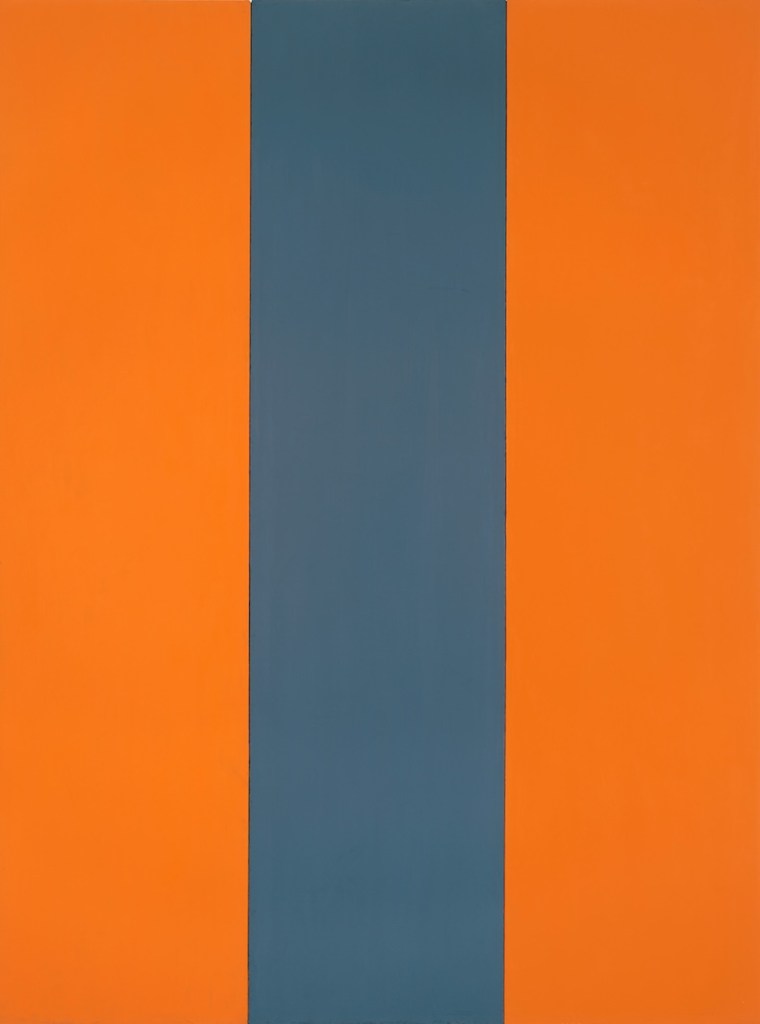
The exhibition’s title, ‘I Am Plane Image’, derives from Marden’s understanding of how modernism unfolded, with a consistent ‘tightening [of] the relationship of the image to the plane’. To speak to this tradition he had ‘to keep the plane and the image locked together’. This suggests that, for Marden, there really are images buried in those pure abstract planes of his, images that record experience as richly as colour does. To believe all that requires an act of faith, yet at their best Marden’s pictures don’t need all the allusive references attached to them; they hold their own, the paintings strongly bonded into a unity, compelling in their palette alone (when colour is the focus) or in the weaving and shimmying of forms (when the later work takes on more formal complication). As for the grand claims made for Marden as a major vanguard painter (and the very last!), they’re less convincing. On the contrary, his questing spirit makes him seem old-fashioned: he went to the sources of cultures East and West and with that inspiration brought a kind of lyric poetry to high modern painting. It’s wild to think that he built this career in the 1970s, when painting was going through its toughest times. Today painting is everywhere but it’s utterly aimless, and over that I’d take Marden’s romanticism any day of the week.
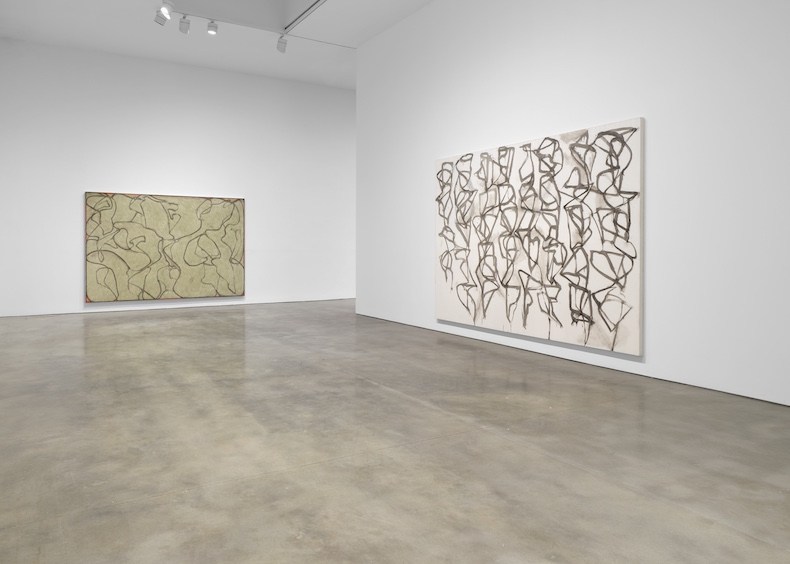
‘Brice Marden: I Am Plane Image’ is at Gagosian, New York, until 12 December.
Brice Marden: Catalogue Raisonné of Paintings, 1961–2023, edited by Tiffany Bell, is published by Gagosian Gallery.