The tolling of the architectural ‘heritage at risk’ bell has become a British end-of-year event. SAVE Britain’s Heritage, the doughty rapid-response organisation set up by journalists in 1975, has always been adept at publicity. In 1978 it published a special report, Left to Rot, a powerfully illustrated account of an epidemic of decaying structures across Britain, the text highlighting the fragility and rarity of essential legal or financial measures such as compulsory purchase or grant aid. A decade later it was, again, SAVE that began collating an annual ‘risk list’.
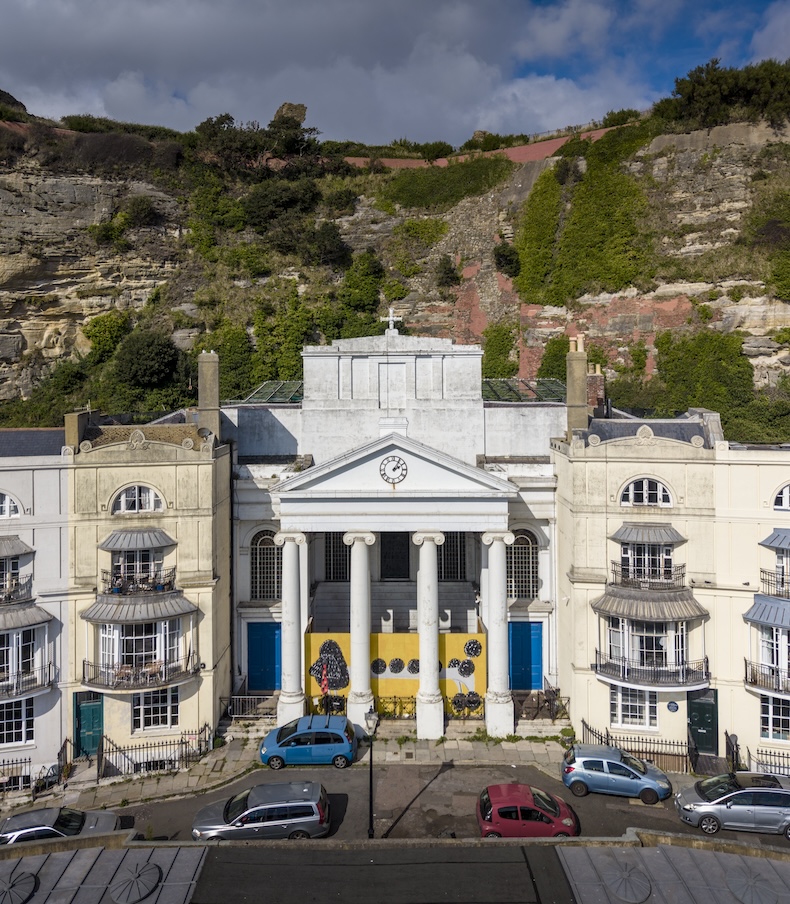
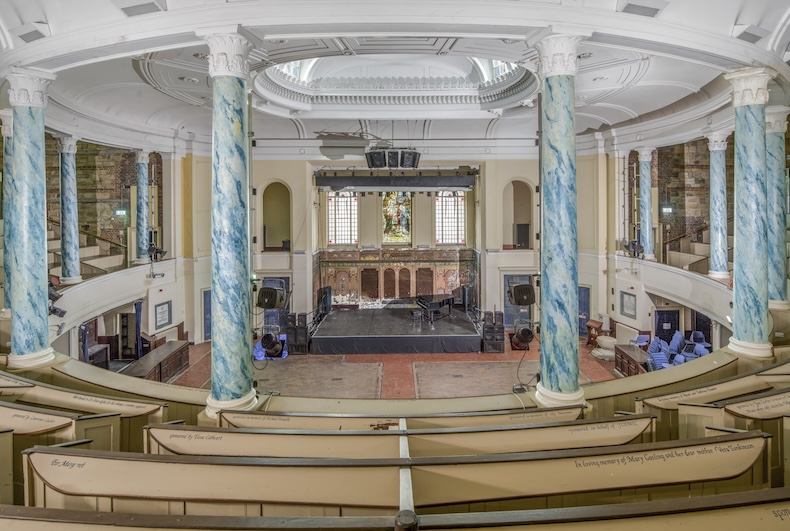
English Heritage took time to follow SAVE’s lead, confining its depressing roll call to listed structures and protected sites. In 2025 its successor organisation, Historic England, celebrated 129 rescues, but added 138 further cases for concern. One of those is St Mary in the Castle, an eye-catching 19th-century church in Hastings, fronted by the Pelham Arcade, built contemporaneously and one of the earliest shopping malls in Britain. Hastings Borough Council has been running a formal Expression of Interest (EOI) process to identify a new ‘partner, operator, or consortium’ for the buildings’ urgent revitalisation. This group of Grade 2* structures is the keystone to the seafront: at best, as here, architecture can be vital musculature in the urban body.
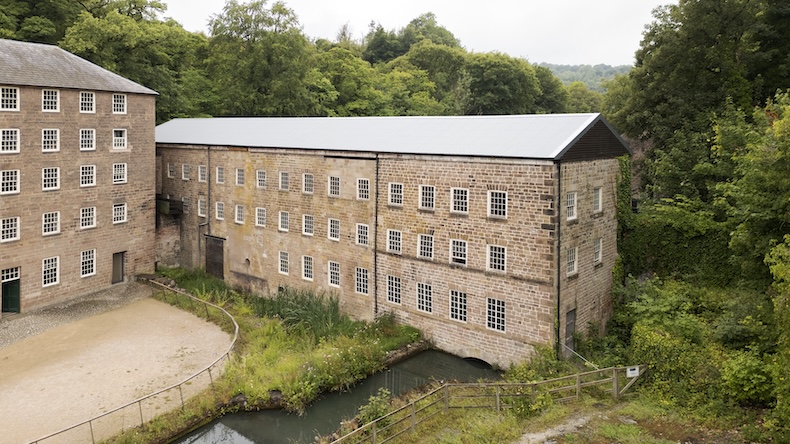
The risk lists cover every kind of site and structure, from eye-candy follies in parkland undergrowth to oversize hulks or skeletal, obsolescent remains. Broken or neglected buildings such as Cromford Mills in Derbyshire’s Derwent Valley are a feature of the landscape around Britain, and in all they run into the thousands. Architects and engineers, in practice as in education, are being cajoled into considering reuse and repurposing wherever possible, but why has this taken so long?
The Twentieth Century Society’s ‘Risk List 2025’, its second biennial survey of ‘ten buildings you can help save’, identifies the threats as neglect (in one case), dereliction (two cases) and demolition (the other seven). A report with punchy graphics and clear text includes several sad reminders of once triumphant lottery-funded projects and proud Millennium schemes. It identifies celebrated buildings such as the former National Centre for Popular Music in Sheffield, which functioned as such for a mere 15 months before becoming, more successfully, the student union for Sheffield Hallam University. Now redundant and stranded, Branson Coates’s huddle of four sizeable steel baubles in the city centre looks to be heading for scrap. The Twentieth Century Society failed to persuade Historic England to support its listing. ‘Reuse them or lose them’ is the Society’s bald campaign line; here, sadly, adaptive reuse was stopped in its tracks.
SAVE marked its own 50th birthday with appropriate publicity for half a century’s triumphs and failures. Among the locations that the organisation celebrated was Plymouth. There it concentrated on a cluster of community initiatives within the heavily bombed city centre, a handful of surviving buildings reanimated by a welter of ideas. In 1975 who could have imagined hydroponics being established on the dance floor of a former club, or a mushroom farm in its basement? Orthodoxies shift, novelties run their course, yet – arson, random disaster and demolition apart – buildings tend to stand fast. The challenge is to match them to needs. In Plymouth, the conjunction of a group of dynamic people with varied skills and wide experience has been the engine. Yet SAVE’s tally of Buildings at Risk currently amounts to 1,251 ‘live’ cases, potentially a fantastic resource available to local authorities and communities everywhere in the country – why not a system of empty space registers, as the authors argued in the 1978 report, but now collated with advanced technology? A chance for spatial recognition?
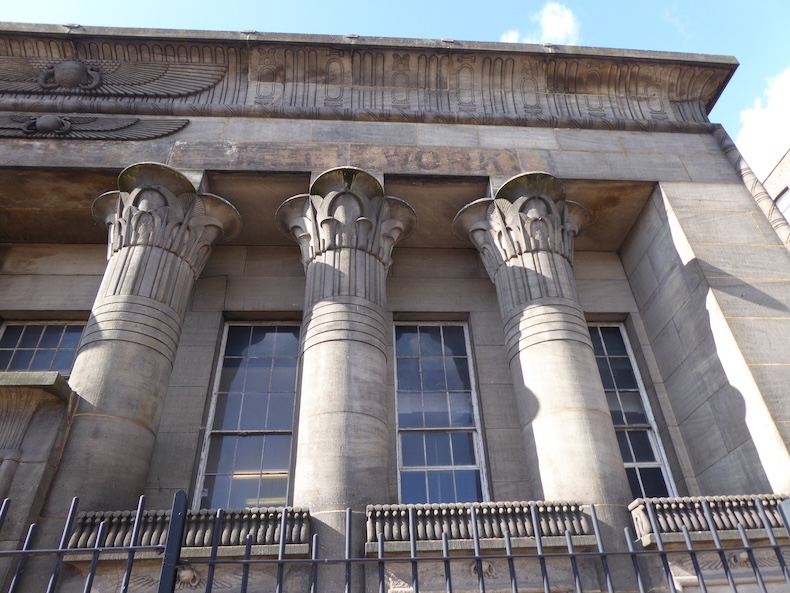
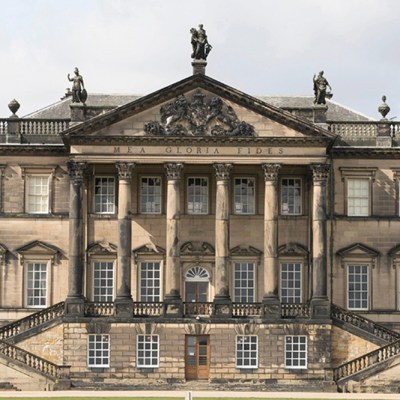
The sheer size of a failing building can be its downfall. In recent years SAVE supported the reinvention of Wentworth Woodhouse, a massive Georgian country house in Yorkshire, brought low equally by mining subsidence and societal change. In 2008 the Victorian Society’s risk list reported the plight of the Grade 1-listed Temple Works in Holbeck, Leeds. This immense single-storey flax-weaving shed was built for the Marshall family in the late 1830s, designed by engineer James Coombe. An office with Egyptian-style frontage based on the Temple of Horus at Edfu was added in 1842 by Joseph Bonomi the Younger. It featured at some length in Benjamin Disraeli’s socially progressive novel Sybil (1845). The future prime minister described it as ‘one of the marvels of the district […] a single room, spreading over nearly two acres, and holding more than two thousand workpeople. The roof of groined arches, lighted by ventilating domes at the height of eighteen feet, was supported by hollow cast-iron columns, through which the drainage of the roof was effected.’ Compared to the familiar multi-storey weaving mills of the locality, the scale and exoticism of this radical shed with its glinting roofscape must have astonished the people of Leeds – as did the sheep which grazed the grassy roof (helping to maintain the humidity needed for spinning linen thread) but which periodically crashed through the conical rooflights.
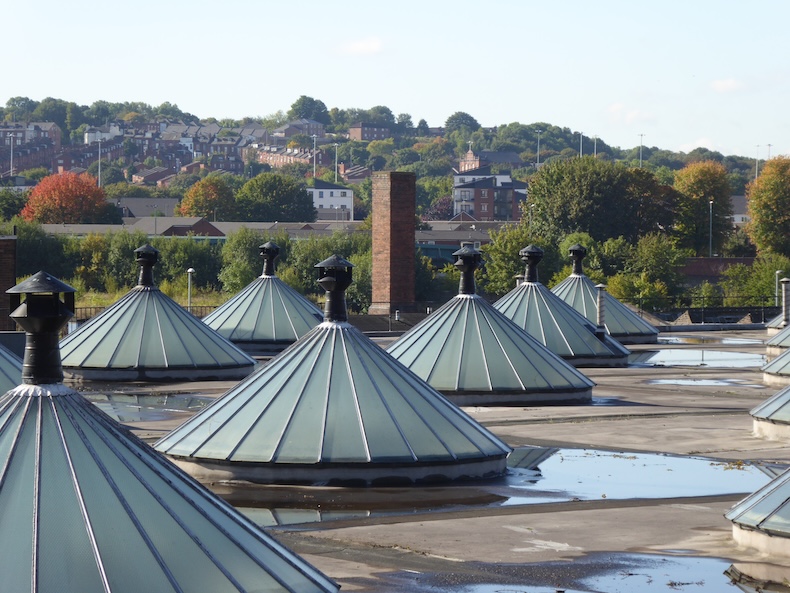
The Marshalls ceased trading in 1886 and thereafter the building limped along. Serving as Kay’s mail-order catalogue headquarters – an Amazon warehouse avant la lettre – it made it into the mid 20th century before lying empty and deteriorating. More recently, moves were made to secure the building and its vast floorspace as a storage base for the British Library North, already outgrowing its home at Boston Spa. Last year a £10 million grant was confirmed from central government, complementing grants from the West Yorkshire Combined Authority and Historic England. There are more funds to find but every reason to fight on.
Temple Works, a conveniently short walk from Leeds train station, is a building of rarity and quality. Bonomi had been in John Soane’s office as a youth and later became curator of Soane’s house museum, where top-lighting (if not the use of sheep) is one of its many glories. Drawings for Temple Works are included in ‘Egypt: Influencing British Design 1775–2025’, at the Soane Museum until 18 January. See their genius for yourself.