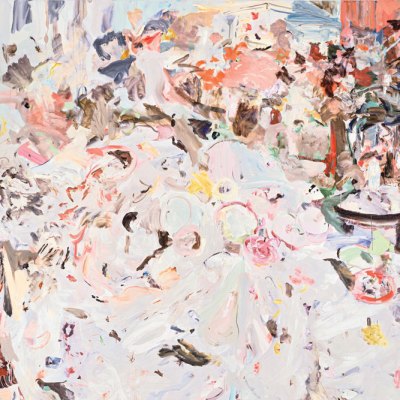
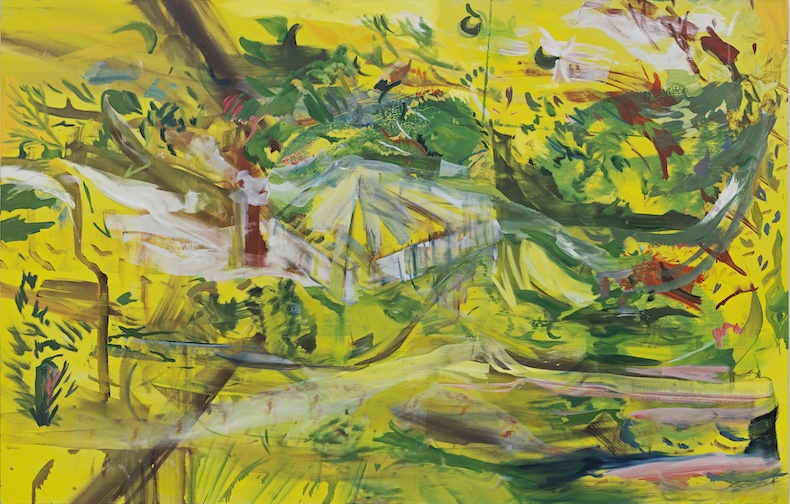
Almost all of Cecily Brown’s paintings involve quasi-pastoral scenarios in which something strange has happened, is in the process of happening, or is most certainly going to happen. These works are emphatic in style and execution and yet they withhold rather than deliver information. To call them nature paintings might prompt the viewer to expect something harmonious, but what Brown unleashes is a blizzard of painterly dissonance. You can’t simply contemplate a Cecily Brown tableau, because your imagination is summoned to be constantly on the lookout for ideational flying debris.
Brown was brought up in the UK but moved to New York in her twenties, where she has lived and painted ever since. ‘Cecily Brown: Picture Making’ at the Serpentine is her first major solo show in the UK since 2005, and most of the works here were produced over the last few years in direct response to the landscape surrounding the Serpentine, though there are also earlier works sprinkled throughout. Outside the gallery, the trimmed lawns and orderly flower beds of Kensington Gardens offer a time-honoured model of carefully curated nature that Brown’s paintings thrust into a centrifuge.
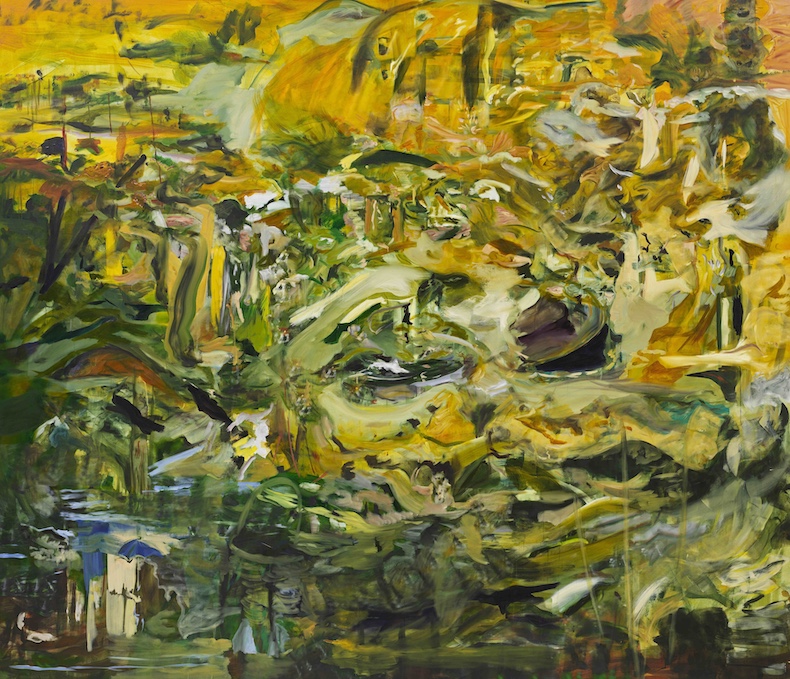
There is in all of Brown’s work a metamorphic principle that has deep roots in classical mythology. Arboreal and vegetable growths are capable of simulating humanoid forms and faces, while domestic interiors are made to blend seamlessly with wild exteriors. There are numerous references here to the pastoral scenes of classical mythology: the sort that involve the cute gambolling of nymphs and shepherds. But in Brown’s vision – and especially in her recent paintings, which are marked by surges of incandescence that contrast with the darker tones of much of the work she made in the 2000s – these kinds of backdrop that could be measured by the kilometre in countless neoclassical villas look like they have been hit by a hurricane carrying a day-glo palette.
Like the Serpentine gallery itself, this show is akin to a suite of garden rooms designed to enable a smooth transition from culture to nature and vice versa. But in Brown’s hands, such smoothness is absent as nature reverts rapidly to its most feral. The artist disarms us at first by reviving the stereotypes of the pastoral tradition, but then she mixes them all up in a comprehensive dissolution of boundaries, amalgamation of territories and confusion of scales. A single garden plant is made to look monumental while a fallen tree trunk has been scaled down to appear shrunken beside it. If this is to be judged in the context of the history of landscape painting, then it is both very badly behaved and thoroughly exhilarating.
The fallen tree trunk is perhaps the most important leitmotif in the new works. When it is used to bridge a gap and create a crossing place over water, as it is in several paintings, it becomes symptomatic of Brown’s obsessively transitional practice. When it appears in Nature Walk with Deer and Duck (2024), the bridging function of the fallen log chimes with the torso of a deer that seems to point in two different directions at once, its antlered head looking to the right superimposed on its left-facing haunches. Every identifiable form projected in Brown’s vision of nature is subjected to a painterly version of double exposure, in which different planes of reality appear to be sliding past one another without engaging except in the viewer’s eye. The large green growths in the background of this painting could be cacti, or palm trees, or conifers, such is their ghostly ambivalence.
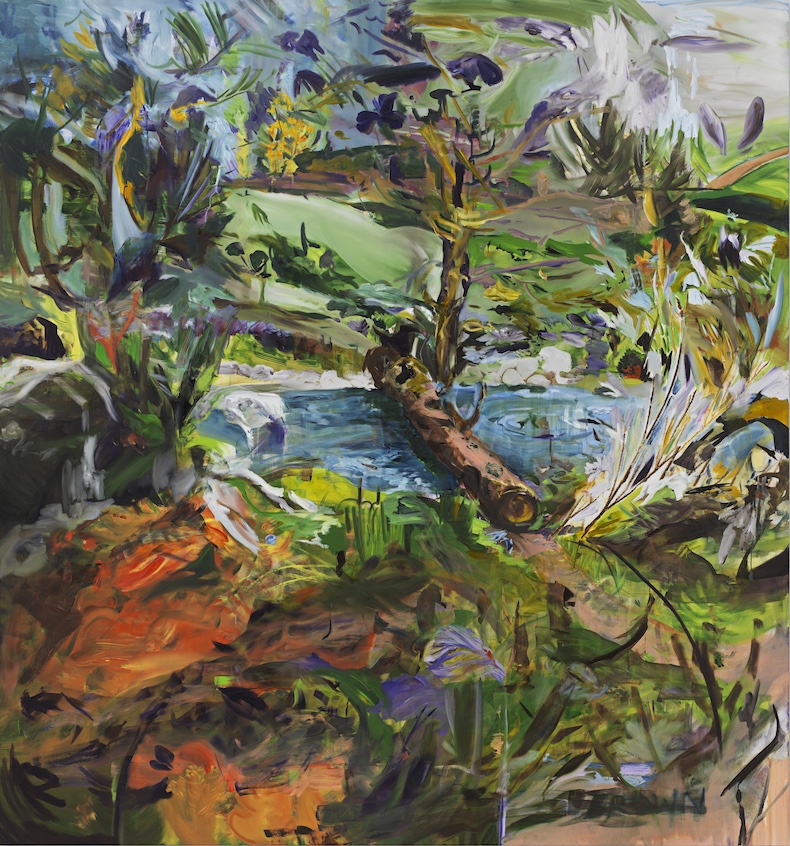
In Nature Walk with Paranoia (2024), the placing of a log across a blue stream is made to feel like the laying of a trap. The log is the only inert thing in the scene, but it invites the risk of crossing – in the imagination at least – as a way of feeling the precariousness of human–natural relations. It is a situation to which a small degree of elemental danger has been restored. There are several logs over streams that invite a response of one kind or another from the individual viewer. They present a choice that we must make on our own; teamwork runs too much of a risk.
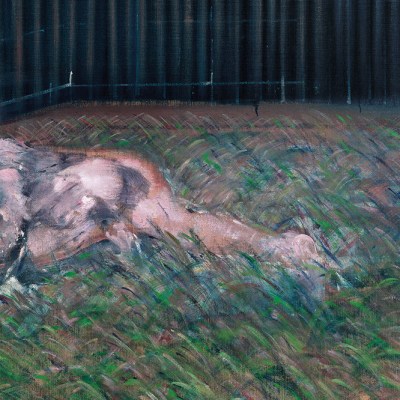
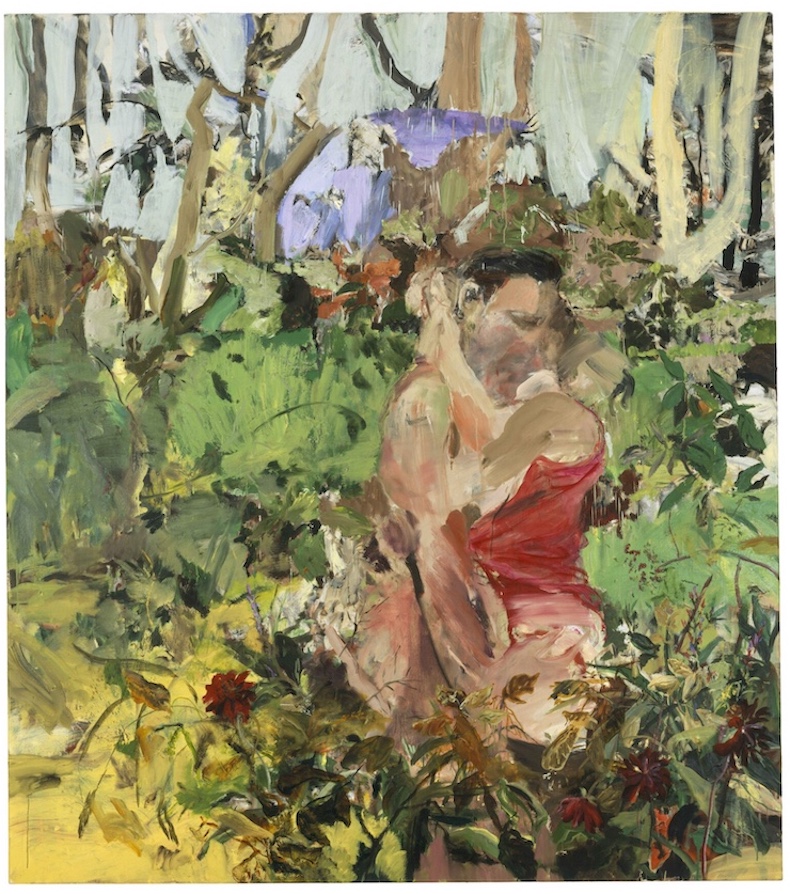
Perhaps the most unnerving of Brown’s paintings are those earlier works in which the human form (or something like it) is included. Couple (2003–04), whose very title implies cooperation, is in fact an alarming tableau in which the heads and bodies of two lovers appear to have merged completely. A momentary embrace has been rendered permanent, as if the two lovers have somehow become trapped inside a double exposure from which no return is conceivable. The limbs of trees behind them are reaching up to the light and away from the densely encroaching undergrowth that gathers round them. There is a force and even violence in the brushwork here that renders this collision of bodies as desperate and brutal as the mauled human forms in the work of Francis Bacon – whom Brown knew when she was a child and whose painterly extremism seems to have left a lasting impression on her creative imagination.
Brown’s version of nature is full of hidden traps and seemingly alien dimensions for which nothing in the Western tradition of landscape painting can prepare you. There is also a set of intricate drawings in this show which seem designed to transport the viewer, like Alice through the looking glass, into a parallel universe. Untitled (the 5 senses) ripples with glimpses of alternate realities – urban and rural, solid and liquid – and with different measures of time and space. It seems to lure us into a previously undiscovered and undisclosed world to which the Serpentine – for the time being at least – is the only portal.
‘Cecily Brown: Picture Making’ is at Serpentine South Gallery, London, until 6 September.