From the October 2026 issue of Apollo.
Andy Burnham’s plan to remain living in Manchester and spend at least one day a week working there from No.10 North is intended to rebalance power across the country and keep the government in touch with the world outside London. This is a new experiment, but it also calls to mind an earlier attempt to keep the British prime minster connected to a world away from Westminster – and a very different prime-ministerial place, whose role in the political and social life of this new premiership is not yet known.
Chequers Court in Buckinghamshire, a 16th-century house of relatively modest proportions, has been the prime minister’s official country residence for more than a century. Now managed by a trust, it was bequeathed to the nation in 1917 by the soldier, politician and collector Arthur Lee (later Viscount Lee of Fareham) and his American wife Ruth.
The gift came at a contradictory moment. The decline of the country house was accelerating during the First World War, but the Lees were not alone in considering the possession of one as essential to the pursuit of a political career. Profound social and political change meant that ‘future wielders of power’ might not, in Lee’s words, ‘be as in the past men of wealth and famous descent’ and might not therefore come with their own country house.
There were other considerations, too. As the Chequers Estate Act 1917 states, ‘the better the health of our rulers the more sanely will they rule and the inducement to spend two days a week in the high and pure air of the Chiltern Hills and woods will, it is hoped, benefit the nation as well as its chosen leaders.’ A sculpture of Hygeia, goddess of health, made by the Bromsgrove Guild of Applied Arts (1909), stands in the middle of the forecourt lawn, introducing the theme of physical wellbeing to visitors.
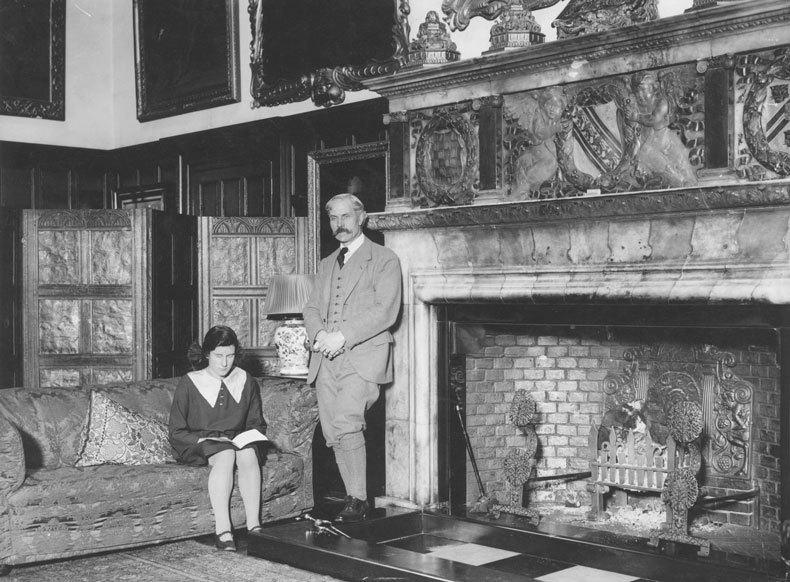
David Lloyd George was the first prime minister to occupy Chequers, in 1921, though he never really felt at home there. Stanley Baldwin loved it as a place where he could be private and ‘perch on a fence and look at the landscape without being shooed off’. Ramsay MacDonald called it ‘an abode mellow with age and sanctified by the ghosts of vanished generations, given to the nation so that Prime Ministers might know that birds sing, flowers bloom and body and mind may rest’. Neville Chamberlain took a particular interest in the trees and left behind an album of tree photographs. Winston Churchill and his family stayed at Chequers during weekends throughout the Second World War, except when a full moon made the house a target for German bombers.
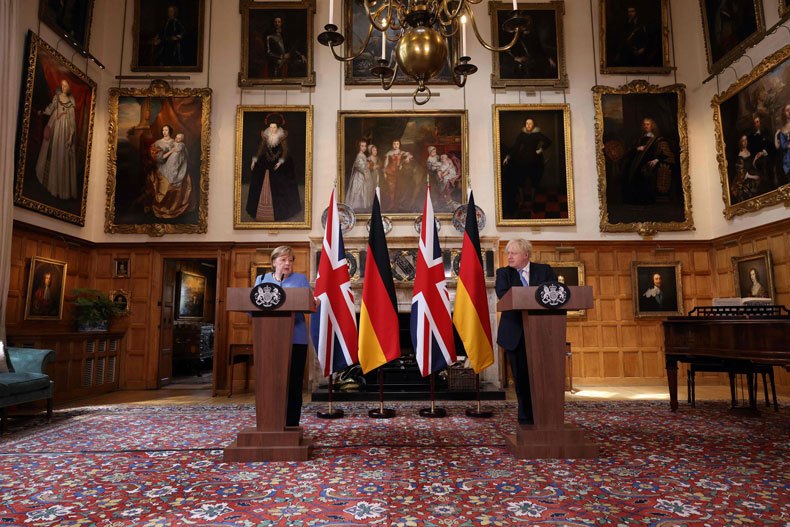
The private retreat also plays a major role in the workings of government and international statecraft. A turning point in the Cold War was reached at Chequers in 1984 when Margaret Thatcher declared that she and Mikhail Gorbachev could ‘do business together’ and it was to Chequers that President Volodymyr Zelensky came to meet Rishi Sunak to discuss the Russian invasion of Ukraine. Tony Blair used it a lot during the Cool Britannia years, bringing together people from the worlds of culture and sport; David Cameron said that Chancellor Angela Merkel preferred Chequers to Downing Street, discussions deepened by late-night drinks and country walks.
Built of brick, with tall chimneys, gables and mullioned windows, Chequers is the epitome of an old English manor house – a building type particularly cherished and mythologised around the turn of the 20th century. The name is believed to be derived from a 12th-century owner, who was an official in the King’s Exchequer, but the house that exists today was built in the 16th century for the merchant and politician William Hawtrey. He acted as custodian for Lady Mary Grey (younger sister of Jane) when she was placed under house arrest by Elizabeth I, and her room is still one of the most atmospheric in the house. Chequers passed via descent in the female line and by marriage through the Wooleys, the Crokes, the Thurbanes, the Russells (who gothicised it in the early 19th century) and the Astleys (who de-gothiscised it), before the Lees took it on in 1909. They restored it with the help of the architect Reginald Blomfield, giving it a strong Arts and Crafts aesthetic.
The Lees and Blomfield aimed to distil the essence of an Elizabethan house into a modern and efficient home. Many original features were retained, while authentic elements from other houses (including panelling) and copies of things from other houses (including ceilings) were combined, in remodelled spaces, with new additions, such as the splendid chimneypiece in the Great Hall, sculpted in alabaster and touchstone. Paintings and other works of art joined the collections already there. The Lees consciously obscured the origins of much of what they created, though Ruth Lee’s diaries are invaluable for understanding the process and the dealers, designers and makers involved. She thought Chequers ‘so beautiful […] like being carried off yr feet by Helen of Troy’. Philip de László’s elegiac portrait of the Lees – The Last Days of Chequers (1920) – shows them sitting in the Hawtrey Room, among portraits of previous occupants, immersed in their poetic fiction. Ruth’s needlework chimes with the tapestry behind her.
The tapestries at Chequers were one of the most significant losses from the collection in the 1970s, when some of the contents were sold, for fear of the house becoming too ‘museumy’ and to pay for much-needed updates. When Edward Heath thought the dark panelling too gloomy, Colefax and Fowler were brought in to lighten it. Among other work, the firm also discovered and restored the pale blue paint of the library, which the Russells had created in the Long Gallery around 1780. Around the same time, the US ambassador, Walter Annenberg, paid for the construction of an indoor swimming pool at one end of the Rose Garden, having been surprised to find that there was not one there already.
Some prime-ministerial interventions are relatively fleeting, such as Thatcher’s fitted carpets, while others retain the presence of those that pass through the house. This is most visible through the commissioning of armorial stained-glass window panels, designed in conjunction with each incumbent. John Major’s incorporates crickets (the insect) in reference to his love of cricket (the sport); Gordon Brown’s is notably understated.
The collection at Chequers still remains to be studied in depth, though the paintings (particularly rich in British portraits and Dutch 17th-century works) can be seen on the Art UK website. But the works on paper, books, photographs, furniture, ceramics, textiles and metalwork are little known. Among the more surprising items is Angelica Kauffman’s portrait of Mrs Charles Russsell, who founded a mock-heroic ‘Most Noble Order of the Needle’; the manuscript of the memoirs of the actor-author Mary Robinson; and a linen hanging embroidered by British officers recovering at Chequers during the First World War.
In the setting of Chequers, works acquire unexpected layers of meaning, and thinking about how to deploy them is both a challenge and a delight. Where, for example, to hang Frans Snyders’s The Lion and the Mouse so that the lion doesn’t frighten the children but the message of the fable is not missed: that the most powerful would do well to remember the little guy. Should Peter Lely’s Perryer Family (1655) go back where it used to be, in pride of place in the Great Hall? (If so, it would be demoting a version of Van Dyck’s portrait of the children of Charles I.)
While there are several swanky Stuart portraits at Chequers, it is impossible to forget that this is first and foremost a parliamentary house, in more than one sense of the word. In 1715 the owner of the house, Joanna Thurbane, married John Russell, a grandson of Oliver Cromwell, and so there is a large collection of portraits, weapons, prints, miniatures, personal items and letters relating to him. When the Lees moved in, a solicitor found Cromwell’s life mask locked in a cupboard. The Lees added to these holdings and created the Cromwell Passage, which is lined with portraits of the Lord Protector and his family.
In this parliamentary, non-dynastic, non-aristocratic and warmly hospitable house, the delicate choreography of Britain’s constitutional monarchy means that royal visits to Chequers are extremely rare, made at the express invitation of the prime minister. However, among the props of quiet statecraft that prime ministers have at their disposal is an object that conjures the aura of royalty and the complexities of British history in a way that is both theatrical and intimate.
The so-called Chequers Ring, sparkling and full of secrets, is one of the few surviving jewels probably worn by Elizabeth I. Made of mother-of-pearl and set with gold, rubies and diamonds, the locket ring opens to reveal portraits of the queen herself and, almost certainly, her mother Anne Boleyn. This tiny relic has become the traditional highlight of the tour prime ministers give to visiting dignitaries, recalling for a moment the rituals of a Renaissance collector sharing their greatest marvel with an honoured guest. A world away from Downing Street, No.10 North and the business of modern government, and full of magic.
From the October 2026 issue of Apollo.