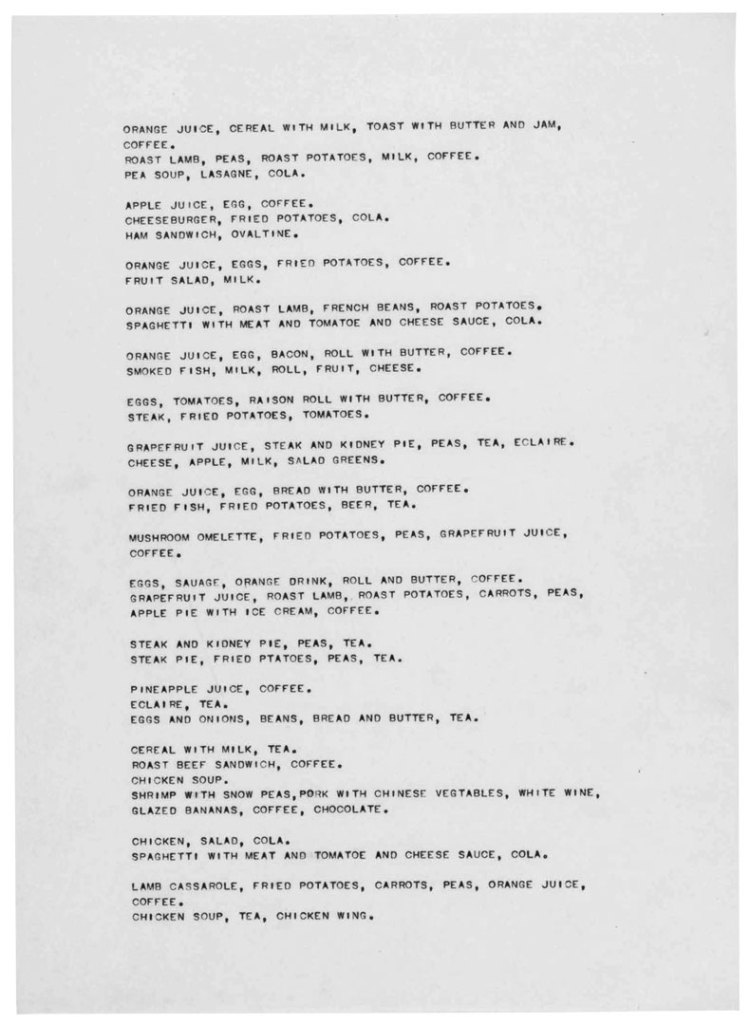
Christine Kozlov’s breakfast on 20 February 1969 consisted of eggs, bacon and toast (with butter and jam), polished off with a glass of orange juice and a cup of coffee. I know this because she recorded it – along with everything else she ate, from that morning up until 12 June – on 12 typewritten pages, titling the resulting work Eating Piece (2/20/1969–6/12/1969), Figurative Work No. 1 (1969). Recording things, making lists and performing repetitive actions were all very much a thing at the time. Kozlov’s friend On Kawara painted the day’s date on the same monochromatic background over and over again for nearly five decades. Joseph Kosuth, her classmate at the School of Visual Arts in New York, endlessly reproduced dictionary definitions on big black and white canvases, like an undergrad struggling to find an opening line for their coursework. But Kozlov took it to extremes.

She collected telegrams, postcards, photo-booth portraits, blank film and newspaper cuttings. She once exhibited a self-explanatory work titled 271 Blank Sheets of Paper Corresponding to 271 Days of Concepts Rejected (1968).For a touring show curated by the critic Lucy Lippard in 1973, she presented a list of every single neuroscience article published in the year 1969 (Raven Row’s catalogue deftly describes the work, Neurological Compilation: The Physical Mind Since 1945 (Project 1: The Bibliography), as ‘a representation of the thinking about the thing that thinks’). Mostly she catalogued her own work – on index cards, in exhibition catalogues, on scraps of paper – with these ‘works lists’ considered by curator Rhea Anastas not just ‘works’ in themselves, but works of a ‘startlingly innovative’ kind. In Kozlov’s oeuvre, the museological work of collating, cataloguing, archiving and exhibiting becomes not simply an adjunct or necessary intermediary but the very essence of art itself.
It is an approach made all the more ironic by Kozlov’s relative exclusion from the annals of conceptual art. She appeared nowhere in Tate Britain’s landmark ‘Conceptual Art in Britain, 1964–1979’ show, even though she had moved to the UK before the end of the period covered by the exhibition. Nor did she feature in ‘Voids: A Retrospective’ at the Pompidou in 2009, despite her fascination with absences and emptiness. Both shows found room for friends and collaborators of hers such as Kosuth, Art & Language and stanley brouwn, all of whose work can also be seen at Raven Row. Her name appears nowhere in Wikipedia’s list of ‘Notable conceptual artists’. She merits just one mention apiece in Peter Osborne’s doorstopper on the subject for Phaidon in 2002 and Robert C. Morgan’s Conceptual Art: An American Perspective (1994). No mention at all in Daniel Marzona’s book Conceptual Art from 2005.
In some ways, Kozlov’s story resembles the operation of one of her own more widely exhibited works. Information: No Theory (1970) consists of a reel-to-reel machine fitted with a microphone and continuous loop tape set to record whatever occurs in the room throughout the life of the exhibition. But since it keeps on going, after every two minutes, any new sounds will simply overwrite whatever was previously recorded, and so on, ad infinitum. It presents a ceaseless activity of inscription leaving (almost) no trace behind to show for it.
At the heart of Kozlov’s work is a forceful gesture of negation. Much of the work she made and collected dealt with refusals, renunciations and voids of various sorts, from that sheaf of blank sheets representing rejected ideas to the big Kosuth work mounted on board featuring the definition of the word ‘nothing’ blown up to billboard size (drawn from Kozlov’s personal archive). The very first work in the show at Raven Row confronts the viewer with a big, bold stamped text declaring ‘This is not art.’ In a note scrawled on a scrap of paper exhibited nearby, Kozlov calls the work ‘a bit of a joke’ and maybe it was, but that doesn’t mean it can’t signify something profound. In 1968, Marcel Duchamp had told a Newsweek reporter, ‘If I call it art, it’s art.’ Kozlov’s stamp (from the following year) suggests it’s more complicated than that. After all, if an artist has the power to make something art by a simple act of declaration, then surely they possess the authority to say when it isn’t. Yet when we find ourselves smiling at the sight of Kozlov’s stamped paper, this surely derives from the knowledge that the statement is false: quite clearly, this is, actually,a work of art – no matter what its author might claim.
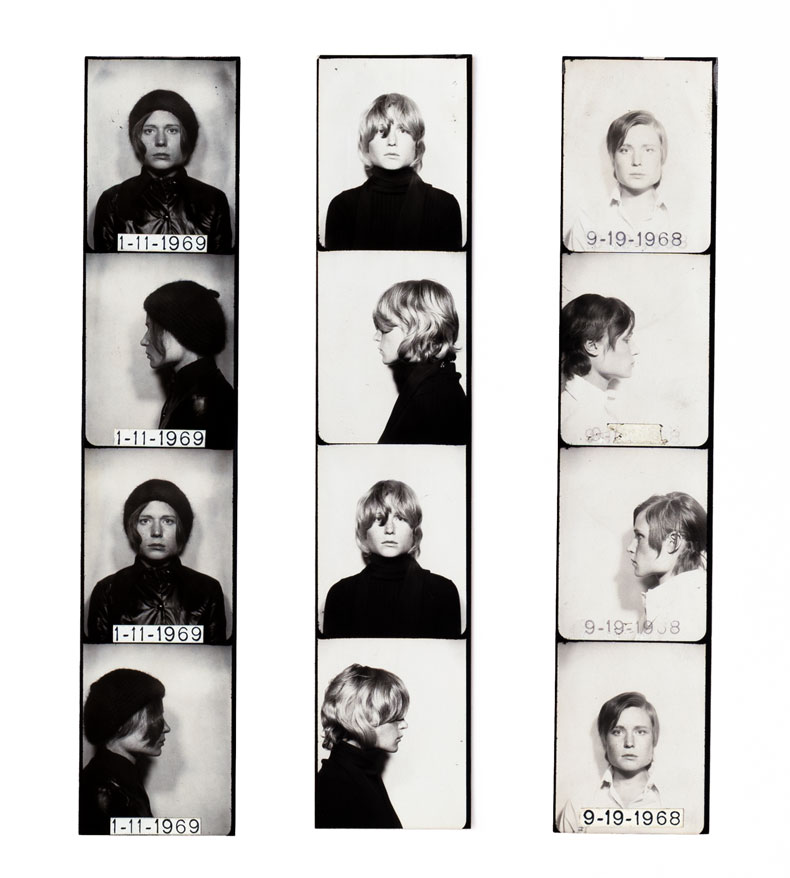
For all her elusiveness, Kozlov is surprisingly present in the show at Raven Row. There are handwritten notes including scribbled comments on existing work and half-formed unrealised plans; the photo-booth self-portraits (1968–70) where she poses in berets, shades and flying caps as if for a series of mountebank’s mugshots; work by her close friends drawn from her own personal collection. We also see Kozlov caught on video in a loft somewhere jamming with friends (who just happen to include the experimental rock band Red Krayola and future Oscar winner Kathryn Bigelow). We catch sight of her in close-up, kissing Trisha Brown Dance Company performer Penelope Newcombe in a video by Joan Jonas (Two Women, 1973). We’re even told what she had for dinner each day for four months at the end of the 1960s. All of which amounts to a markedly intimate portrait of this most enigmatic of artists, whose intellectual footprint and influence on other artists has been much greater than the historical record might suggest. Raven Row deserves praise for restoring Kozlov to the history of conceptual art. Even in her absence, her work has had deep and lasting effects.
‘Conceptual Art and Christine Kozlov’ is at Raven Row, London, until 26 April.