This review of City of the Gallows: Art and Execution in Eighteenth-Century London by Meredith Gamer appears in the September 2026 issue of Apollo.
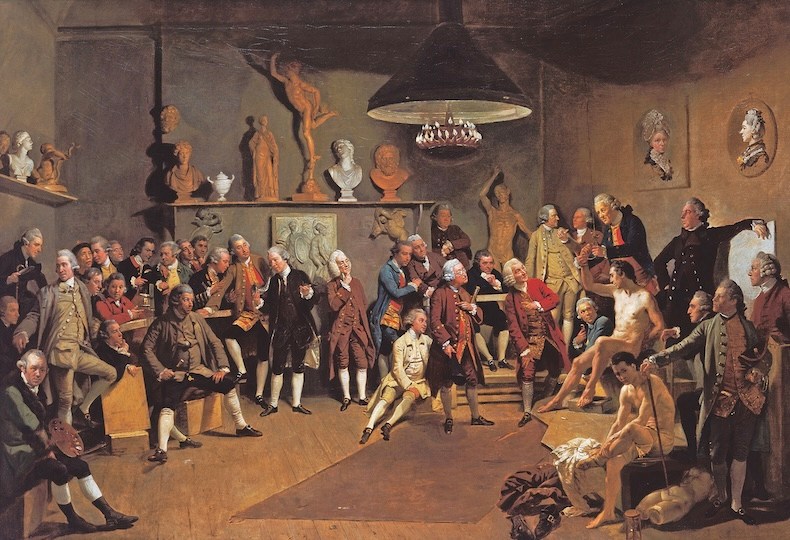
When eight men were hanged at Tyburn in March 1755, the artists were ready. A group gathered to select the most ‘well shaped’ corpse. They needed it warm, for immediate dispatch to the Royal Academy. Once arrived, they used ‘a Screw’ and props to arrange the still malleable body in a suitably artistic pose. A couple of hours later rigor mortis set in and physician William Hunter began to peel back the skin, exposing the muscles beneath. Finally, there began a laborious process of plaster casting. The resulting écorché figure (from the French ‘flayed’) can be seen against the back wall in Johan Zoffany’s group portrait of the Royal Academicians (1771–72). Among so many identifiable images of 18th-century luminaries, the figure is at once an artist’s prop and teaching aid, a sculpture and the body of an anonymous man executed by the state.
As Meredith Gamer shows in this engrossing study, capital punishment was ubiquitous in 18th-century London. Executions at Tyburn’s distinctive three-legged gibbet, at the intersection of modern-day Oxford Street and Marble Arch, were scheduled every six weeks, attended in some high-profile cases by audiences of up to 500,000. For Gamer, these spectacles can be considered a macabre inversion of art and image-making in this period, the condemned being publicly asphyxiated in what was popularly dubbed ‘the sheriff’s picture frame’. Indeed, art and death grew up together. While Britain was nourishing the new generation of artists, connoisseurs and collectors who would establish its first Royal Academy in 1768, the state was killing an average of 30 people a year, leading the rest of Europe by some margin. (Brussels executed 40 people over the entire century; Florence, four).
As exhibition spaces for art grew, so did the number of hanging offences. The so-called Bloody Code, a series of laws passed between 1680 and 1820, made more than 200 crimes punishable by death, from coining, embezzlement and pickpocketing to wounding a deer and stealing from shipwrecks. Moreover, this sweeping defence of property rights was ‘conceived and deployed’, Gamer writes, ‘as a tool of terror by the rich against the poor’. All eight of the men from whom the Academicians selected their first écorché (Hunter made at least three) had been executed for crimes against property. Most were in their late teens or early twenties. They had all been born in poverty far from London – ‘which may help to explain,’ Gamer notes, ‘why their corpses were so easy […] to claim’.
City of the Gallows is scholarship at its most satisfying. Covering popular woodcuts and chapbooks, cant dictionaries, anatomical drawings, the prints of William Hogarth and the paintings of Joseph Wright of Derby, it offers a new lens on some familiar material and makes a convincing case for looking again at its central theme. Its argument rests on the seductive structural opposition between ‘low’ and ‘high’ forms of representation. Tyburn created exemplary images for working people. ‘Why are Men hanged,’ asked author and magistrate Henry Fielding, sardonically, ‘but in order to frighten other Folks? And how can that be, if Folks can’t see them hanged[?]’ Fine art, by contrast, increasingly aimed to provide elevated models for polite emulation – but in practice, things were rarely so neat.
For Gamer, Wright’s Experiment on a Bird in the Air Pump (1768) can be read as a sublimation of the scaffold, a ‘scene of suffocation’ for (semi-)public consumption and discussion. Conversely, it was notoriously difficult to control the meaning of the ritual at Tyburn. Commentators wrung their hands at the lack of piety and awe among the spectacle’s would-be moral and spiritual beneficiaries. ‘’Tis made a kind of Jest,’ one anonymous writer complained, ‘a Game, a Rendezvous of Mob, Shouting and Hallowing, a sort of Holy-Day or Play-Day, at least an Idle-Day.’ Instead of meeting their deaths with penitence, the condemned, roused by the crowd, were frequently drunk and defiant, and, by arousing the crowd’s sympathy, undermined the point of publicity.
Crammed with text and incident, William Hogarth’s works are often regarded as ‘readable’, but he is always interested in the nuances of interpretation. Hogarth’s Four Stages of Cruelty print series of the 1750s, together with Gin Lane and Beer Street, forms one of Gamer’s focal points. The former follows the apparently irredeemable Tom Nero’s progress from juvenile barbarism to murder and, finally, hanging and post-mortem dissection. Gamer stresses Hogarth’s credentials as a moralist; he maintained that (like the gallows) his prints were intended to be useful ‘to the lower Class of People’ as instances of vice punished. In fact, a year after the final print, the 1752 ‘Murder Act’ added public dissection to the formal penalty for homicide, intending to impose a ‘peculiar Mark of Infamy’ on the condemned, while at the same time flattening them to the status of anonymous teaching aids for Britain’s expanding medical and artistic communities. Yet, as earlier scholars have pointed out, Tom’s examiners are hardly modelling the kind of awed response required by advocates of capital punishment; ‘calloused’ by such sights, writes Gamer, they are ‘cautionary examples of the moral risks and social dangers posed by all forms of violence’.
Gamer uses Hogarth’s prints as an example of a desire to discipline or challenge the potentially wayward eye, in an age of increasing sophistication in the production and consumption of visual material. Undoubtedly this desire and the anxieties that birthed it help explain the affinities between 18th-century urban art and 18th-century capital punishment. Yet the author is occasionally too keen to pursue neat resolutions: Four Stages of Cruelty also demonstrates the class consciousness explored elsewhere in the book and abundantly in evidence across Hogarth’s life and work. As her discussion of Hunter’s écorché process demonstrates, Gamer is strongest when thinking about the full moral complexity of her subject and its centrality to 18th-century culture.
From the September 2026 issue of Apollo.