From the September 2026 issue of Apollo.
Correggio’s Madonna of Saint Sebastian in Dresden shows the artist imbuing an old subject with new life, say Andreas Plackinger and Steffi Bodechtel.
‘Everything that is to be seen by his hand is admired as something divine.’ So said Vasari of the painter Antonio Allegri, better known as Correggio (c. 1489–1534), the name of the town in which he was born, some 60km north-west of Bologna in what is now Emilia-Romagna. Little is known about his early years, but at his peak he was so renowned that patrons were willing to wait years for him to complete work. In 1522 he agreed to make frescoes for the dome of Parma Cathedral, the most prestigious commission of his career; he didn’t finish until 1530, but few would argue that this novel depiction of the Virgin ascending into heaven, with its illusionistic sense of upward motion, wasn’t worth the wait.
Correggio probably began his career in Mantua, not far from his birthplace, where he came under the influence of Andrea Mantegna, before moving in his twenties to Parma, where he decorated the Benedictine convent of San Paolo in 1518/19 and the church of San Giovanni Evangelista in 1520–24. This raised his profile among patricians throughout the Emilian region, including confraternities – groups of bourgeois laymen who would come together for religious or charitable causes.
There were at least 13 confraternities in Modena, a two- or three-day walk from Parma. One was the Confraternity of Saint Sebastian, founded in 1501 during a plague that was ravaging the city. Saint Sebastian was considered a ‘plague saint’; the arrows that pierce his body in most paintings of him can be seen as symbols of infectious disease. The Confraternity acquired enough land to build an oratory, then commissioned from Correggio an altarpiece depicting the Virgin with Saint Sebastian, which he completed around 1524.
Whereas Correggio’s early work was indebted to Mantegna, with a distinctively sculptural approach to painting figures, by the 1520s he was modelling through light and colour rather than through defined contours. Throughout northern Italy a genre known as the sacra conversazione – an image of the Virgin surrounded by saints – was growing in vigour and visibility. This was thanks largely to Raphael, whose Madonna of Foligno (1511–12) – painted for the chamberlain of Pope Julius II, displayed in the church of Santa Maria in Aracoeli in Rome and now in the Pinacoteca Vaticana – made the visual conceit of the Madonna as a celestial vision, appearing amid clouds rather than on a throne, more prominent than ever. Correggio’s earliest known painting, the Madonna of Saint Francis (1514–15), is clearly a reaction to Raphael’s Sistine Madonna (1512/13) in Piacenza – evident not just in the bright blue and red of the Virgin’s mantle but also in the cherubs’ faces appearing in the clouds behind her.
Correggio was approaching the height of his powers when he made the Madonna of Saint Sebastian. One of his innovations was the eerily accurate rendering of fleshly texture in paint, characterised by morbidezza (softness) and dolcezza (sweetness) – terms used by Vasari, who suggested that if Correggio had gone to live in Rome he ‘would have brought sweat to the brow of many who were held to be great men in his time’. Equally impressive was Correggio’s composition and conception of space. Compared to his earlier Madonna of Saint Francis it is full of movement. Even the voluminous blue-grey clouds appear to be descending down the picture plane. They seem a three-dimensional extension of the blue in the background that frames the angels’ heads, which are arranged into a sweeping arc above and behind the Virgin – a conceit probably borrowed from Raphael’s Madonna of Foligno, which Correggio would have seen on a visit to Rome.
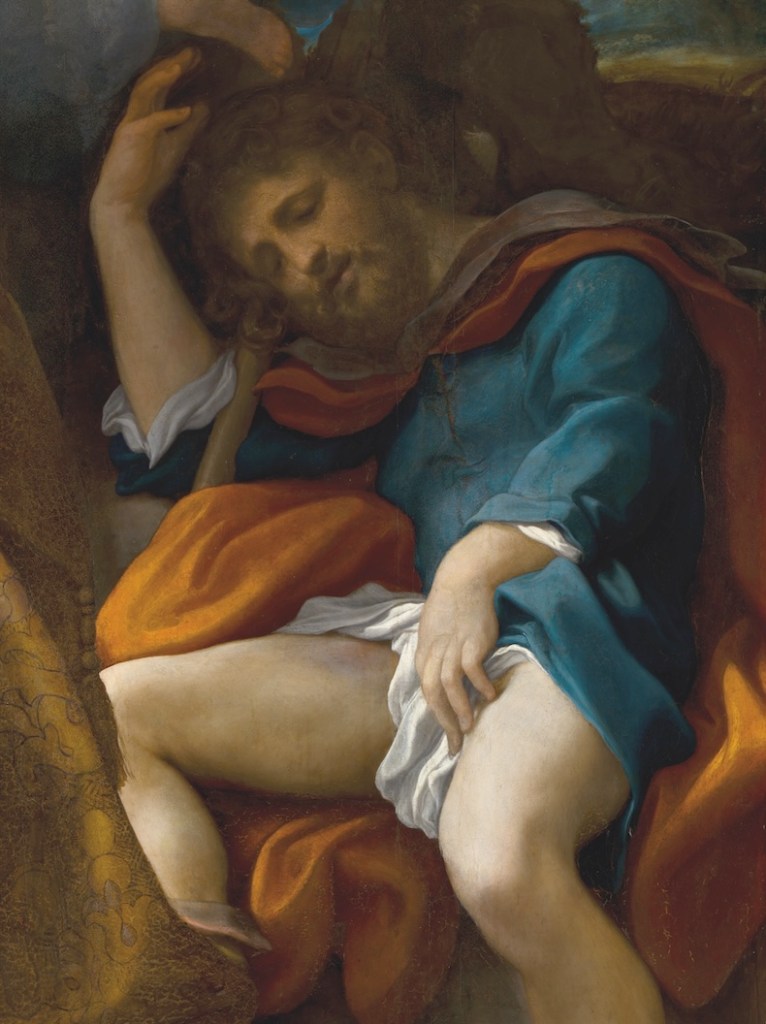
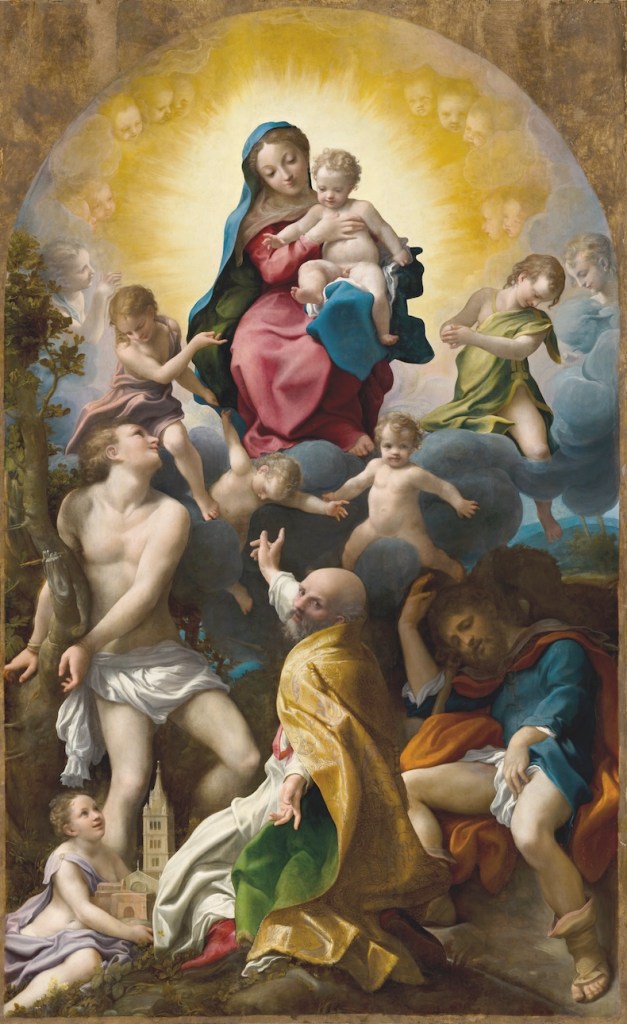
The figure on the right is Saint Roch, another ‘plague saint’, who is said to have been healed from infection while in a dream and is usually depicted with traces of buboes on his bare legs – but not here. Correggio has him still sleeping, already healed, and it’s almost as if the entire vision of the Madonna is issuing out of his right hand.
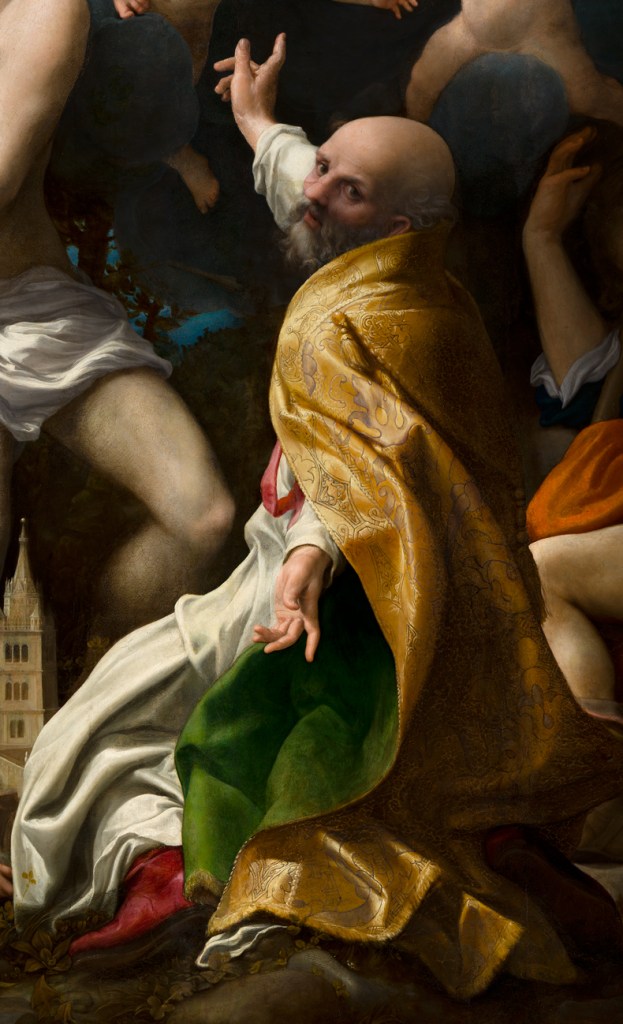
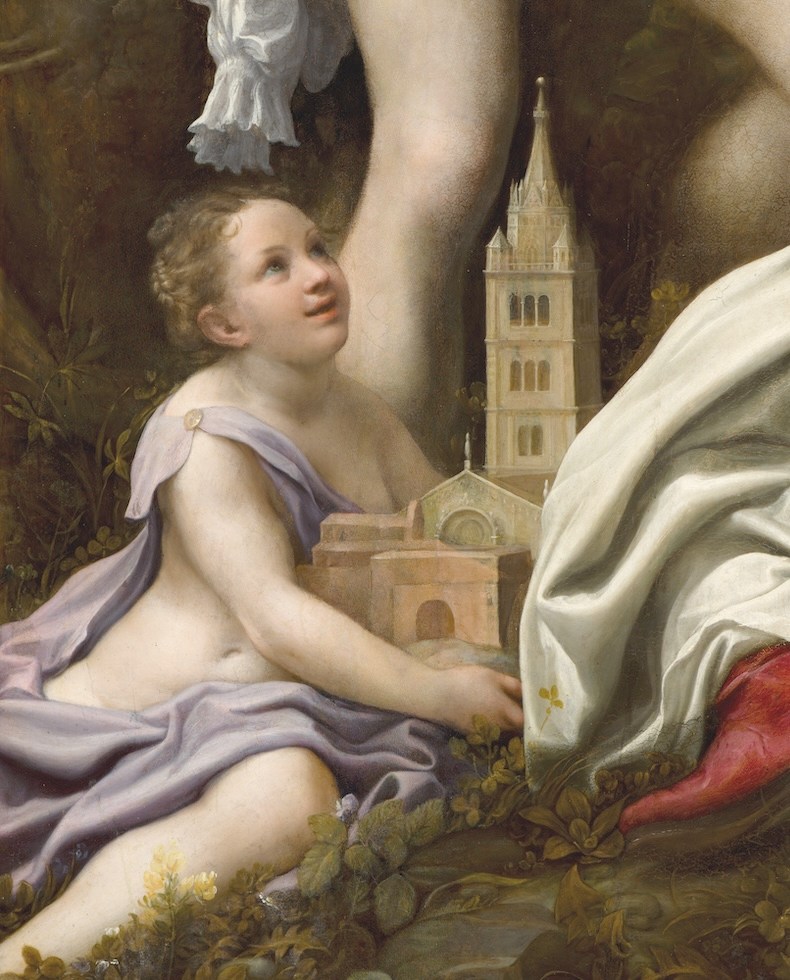
Where Saint Roch is shrouded mostly in darkness, the light shines on Saint Gimignano, the patron saint of Modena, who is wearing a magnificent golden mantle with green velvet lining. Here he is an intermediary between the viewer and the Virgin: his face is turned to us while his body is turned to her, his outstretched arms linking the realms of the earthbound and the heavenly. Beside him is a little angel who holds a model of the Cathedral of Modena – a figure that recurs in Emilian painting and is nicknamed la Modenina. The image of an angel carrying the model of a city dates back to at least the 14th century, but Correggio’s Modenina is a particularly childlike, playful, lovely creature.
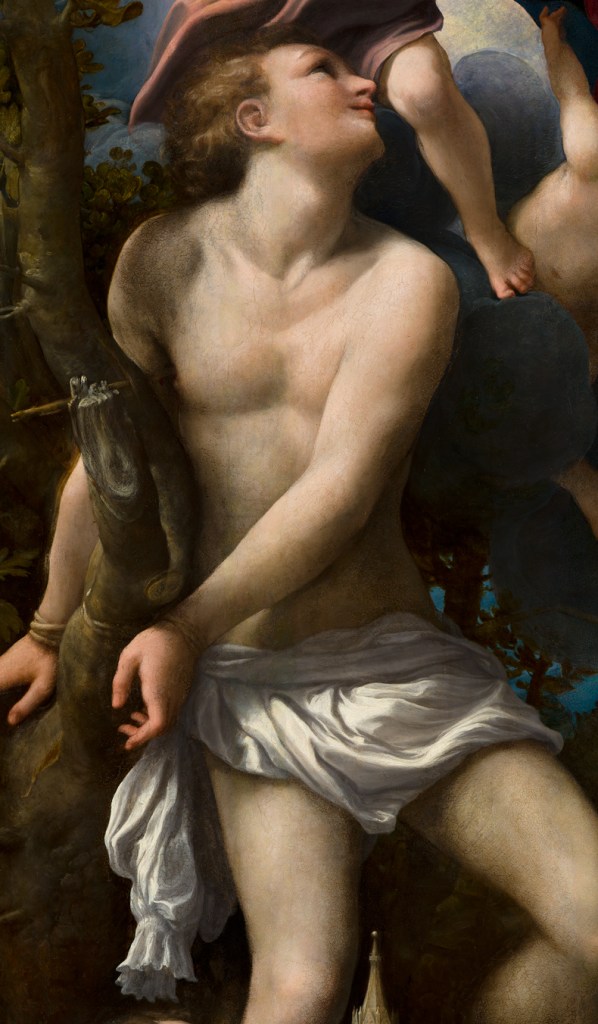
Tied to a slender oak tree on the left of the painting, his head turned to the Virgin, is Saint Sebastian. He is standing upright, in contrapposto, and the men next to him are kneeling and sitting, so that we are invited to read the painting from right to left, our eye travelling gently upwards until Sebastian’s gaze directs our own to the Virgin – the apex of the painting, the Queen of Heaven surrounded by her court.
The colours are extraordinarily vivid on their own terms: blue, green, red, yellow, side by side, intensifying each other. But it’s Correggio’s use of light that really brings them out. This is most obvious in the coruscating light behind the Virgin, which looks like a supernova, but can also be seen in the flashes of light on Saint Gimignano’s gold mantle, or the drapery around Saint Sebastian’s hips: what looks at first like a white loincloth is in fact a fancy shirt with frilled cuffs, made to seem entirely real by Correggio’s handling of light.
Correggio was painting on a dark imprimatura, a thin layer of paint applied to the ground. So he was developing colour not from light to dark, but from dark to light – an unusual approach. He wasn’t the first artist to do this: it’s clear from some of Leonardo’s unfinished paintings, for example, that he was experimenting with darker grounds. But Leonardo would also paint the darkness, whereas Correggio developed darkness by not painting, by creating transparencies. In the Madonna of Saint Sebastian, when you look at the dark brown hair of the angels flanking the Virgin, you’re looking directly at the imprimatura. The bright tufts and whorls are made by thin strokes of lead white. This is a masterclass in the economical application of paint; for Correggio, less was more.
Baroque painters, some 75 years later, would frequently use a dark imprimatura; Correggio laid the groundwork for the style that would dominate 17th-century Italian art. But it’s not only the imprimatura of the Madonna of Saint Sebastian that anticipates the baroque: it’s also the dynamism and the drama. Much of this drama has become apparent again only recently. The painting has been restored 13 times – usually to its detriment. It has a thicker dossier of paperwork on its restorations than any other work in the collection of the Gemäldegalerie Alte Meister in Dresden. The first known restoration was commissioned by the Confraternity in 1611. Sometime in the mid 17th century it entered the collection of the Duke of Modena, at which point it was restored again by the court painter Flaminio Torri, who painted over some of the angels’ heads.
In fact, this painting has been copied by painters and reproduced in prints so many times over the centuries that we have a parallel record of the changes undergone by the original. The most important source is an engraving from the second half of the 16th century by Cristofano Bertelli, which contains details that vanished later – not just the angels’ heads but also an arrow piercing Saint Sebastian’s chest, and a trickle of blood running down from the arrowhead. The most recent restoration uncovered these details and a second, broken arrow embedded in his hip, a detail that was lost mere decades after the painting was completed, when warping of the underlying support caused some paint to flake off along one of the joints.
The main revelation of the restoration, however, has been the vivid colour and sense of volume that dazzled Correggio’s contemporaries and subsequent generations of artists. His innovations were so numerous that different painters took different things from his work. Lelio Orsi, a Mannerist par excellence, was inspired by the complexity of his compositions. In 1580, Annibale Carracci wrote to his cousin Lodovico of how the figures in some of Correggio’s work in Parma seemed to be ‘breathing, living and laughing with such grace and truthfulness that one is compelled to laugh and rejoice along with them’. Centuries later, Correggio’s influence can be seen in the work of François Boucher, who was taken by the master’s renderings of a girlish Virgin, and of the German neoclassicist Anton Raphael Mengs, who marvelled at the refined texture of the paint and the hidden brushwork.
What makes this painting especially appealing to a contemporary audience – besides the firework of light and colour and the complex interplay of glances – is how approachable the figures seem. Correggio bridges the distance between the viewer and the sacred figures – a gap that many of his contemporaries were uninterested in closing. None of the angels have wings or haloes. The Christ Child is playfully grabbing at thin air: in compositional terms it creates a powerful invisible line from his right hand to the hand of one of the angels, but it’s also simply something we’ve all seen infants do. The white sheet on which he is sitting is unusual for the period: it’s a kind of Renaissance nappy, protecting the Virgin’s mantle from some of the messier realities of babyhood. Vasari may have found Correggio’s work divine, but it’s these earthy, human qualities that unlock that higher plane.
As told to Arjun Sajip.
Andreas Plackinger is curator of ‘Correggio: Movingly Human’, which is at the Gemäldegalerie Alte Meister, Dresden, from 19 September until 10 January 2027.
Steffi Bodechtel is a conservator at the Staatliche Kunstsammlungen Dresden.
From the September 2026 issue of Apollo.