From the January 2010 issue of Apollo.
David Hockney is now almost as well known for his ideas about art history as he is for his own paintings and drawings. His views about the techniques used by great painters in the past received massive publicity when they were first presented in 2001, in a book, Secret Knowledge, and a BBC television film. This was not surprising. He is among the best-known contemporary artists, and his theories attempt to overturn the received notion of the development of Western painting from the early 15th century onwards. What Hockney was saying was so unorthodox that his argument has been neither decisively refuted nor accepted.
Despite a second edition of the book in 2006 his ideas remain in intellectual limbo. Nonetheless, what Hockney and his collaborators are saying about such great masters as Caravaggio cannot be ignored. Yet it presents evidence of a kind – deduced from the optical clues in paintings, or practical experiment – that is alien to art history as it has grown up since the 19th century: a text-based discipline, ultimately depending on the scrutiny of written historical sources.
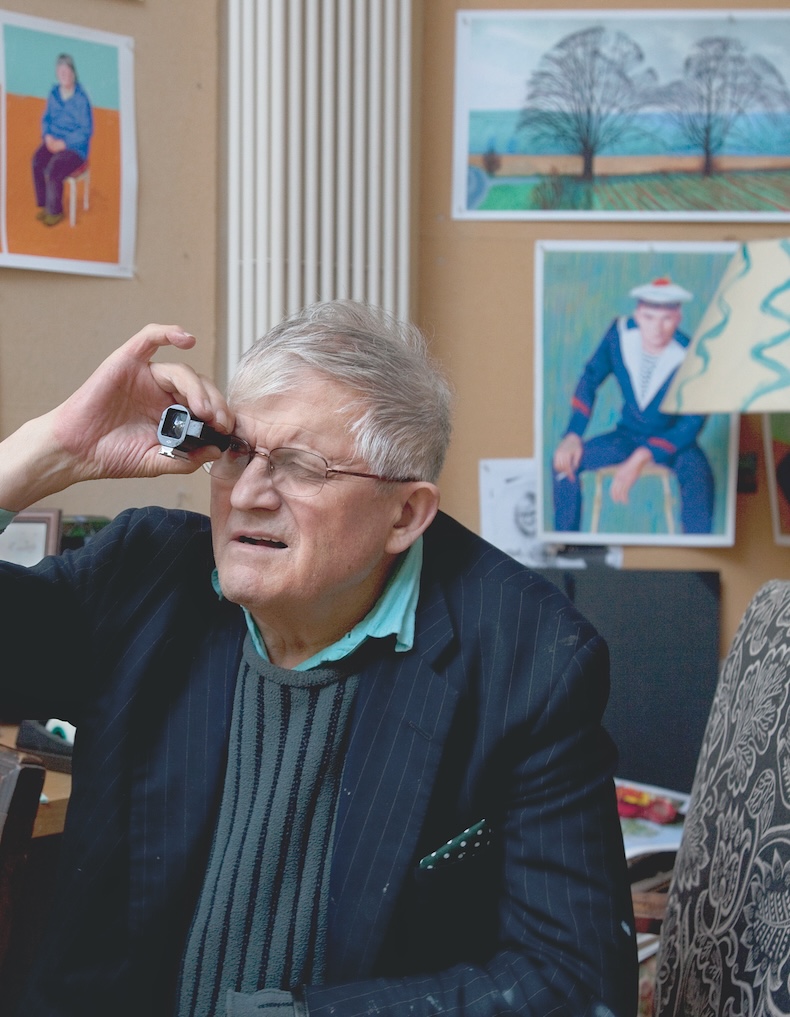
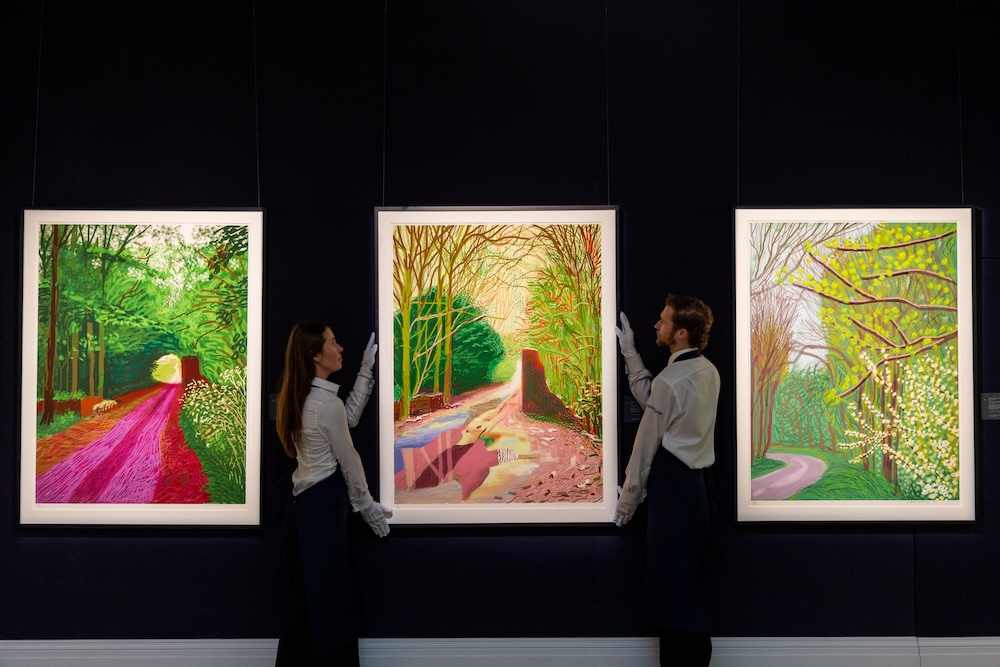
Hockney’s activity as a painter and his newer, alternative role as a revisionary art historian are linked. As an artist, although quite conservative in subject-matter – he generally continues to work in such time-honoured genres as landscape, portraiture and still life – he has always been extremely innovative in using new technology. Hardly had the fax appeared in the 1980s than Hockney was making fax-prints. In the last year, he has executed hundreds of drawings, delicate and beautiful, using the illuminated screen of his iPhone as easel and palette. ‘I’ve been fascinated with the iPhone’, he explains, ‘because I think it’s very visual. I didn’t begin drawing on it until last January. I’m drawing them mostly with my thumb.’ ‘I’m not a mad technical person, but anything visual appeals to me.’ This predilection, perhaps, has made Hockney sensitive to the enterprising use of what was then cutting-edge technology by artists in the past. Thus the work of the great photographer Henri Cartier-Bresson, he points out to me, depended on a couple of new bits of photographic kit – just as innovative as the iPhone when they first appeared.
‘Cartier-Bresson needed the fast film and the first 35mm hand-held camera, which was the Leica around 1922. Before that you needed a tripod for everything, so photographs couldn’t be made quickly.’ His art was a matter of capturing an instant in a way that would have been impossible for a Victorian photographer. That does not diminish Cartier-Bresson’s talent or achievement.
Once Hockney has made this point it seems obvious – although it hasn’t been emphasised before – and uncontroversial. But that second term could not be applied to Hockney’s views about earlier phases of art history. Many European artists from the 15th century onwards, he argues, had been using the optical technology of their times as a tool – just as Cartier-Bresson did the Leica. But ‘uncontroversial’ Secret Knowledge definitely wasn’t.
It stirred up a debate that still simmers on the internet, and set off a dispute that – almost a decade later – is still not settled. Hockney himself has returned to painting after the two-year period for which he worked almost full-time as an art historical iconoclast. But he has not changed his views – on the contrary they continue to expand and mature. Hockney and a collaborator, Charles Falco, professor of optical science, who also holds the chair of condensed matter physics at the University of Arizona, argued that many artists, including Holbein, Van Eyck, Hals and Velázquez, were using lenses as tools to make projections – in effect fleeting optical images, photography without the fixative.
Two of the most striking and plausible cases are those of Vermeer and Caravaggio. Since the 19th century it has been repeatedly suggested that Vermeer used a camera obscura (which projects an image of reality). In 2002 Philip Steadman’s book Vermeer’s Camera made a detailed and highly convincing case for this theory, independently of Hockney and Falco. The notion that Caravaggio was a pre-photographer was newer, but explained many puzzling aspects of his work, such as why his figures often don’t relate to each other in space. However, the reaction of art historians to the Hockney/Falco thesis was in many cases hostile and derisive. ‘I didn’t take the criticism seriously at all,’ Hockney responds. ‘I was confident enough to feel I just felt they hadn’t looked into it. A lot of people who criticised me hadn’t made or looked at projections. You really should, because as soon as you see them you realise that simplification in them is precisely what painting has done.’
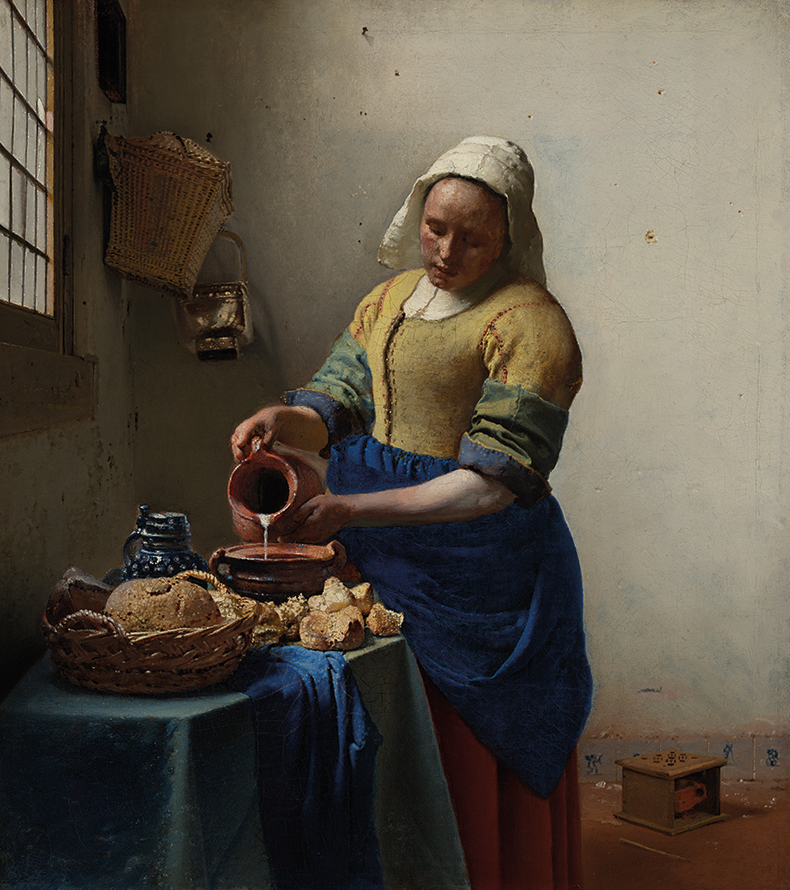
This is a crucial point. Seeing an optical projection of the kind that might have been available to a 17th-century artist such as Caravaggio is a revelatory experience. I was shown some by Hockney’s assistant David Graves, who did a great deal of work on the Secret Knowledge project. The equipment required was extremely simple: a lens, some dark curtains, a mirror. Objects in strong light were reflected by a tilted mirror towards the lens, which was placed in the middle of the curtains. When they were drawn the area behind, with easel and canvas, became a large camera obscura (literally, of course, ‘dark room’). Behind, in a dark space, the image of the object – a glass, a piece of cloth, a human head – was projected onto a white canvas. It appeared upside down, of course, but also transformed.
It is not enough to say that the result was of surprisingly high quality, although it was. The image had also metamorphosed: what I was looking at was more sumptuous than the reality; it had been, as Graves puts it, ‘condensed’ by the process. Because, perhaps, of its narrow depth of field, the lens reduces the more subtle contrasts of real light to just highlights, darks and three or four intermediary tones. Simultaneously, it harmonises and enriches colours – a product presumably of this simplification together with the diminished light level. Consequently, when projected, a piece of cheap red silk resembled velvet.
What I was looking at had many of the characteristics of 17th-century painting by Hals, Van Dyck, Vermeer or Velázquez. It was easy to see the image on the canvas in terms of liquid strokes of a brush charged with oil paint. David Graves’s head appeared in a dark void with something of the supersaturated quality and dramatic force of a Caravaggio – the actual background of sunlit bushes being eliminated also by the narrow depth of field. A projection of an ordinary glass had the lustrous visual presence of a goblet in a Dutch still life.
Of course, these observations do not constitute proof, but they are extremely suggestive. Hockney feels intuitively certain that artists were affected by such projections. ‘Remember if nobody had seen a photograph, then that projection from nature is going to be of deep interest to anyone who’s making images. If you are interested in making depictions, you are naturally interested in how many ways there are of depicting the world.’
Did they, however, actually see them? Again, all that can be shown is that suitable lenses were available, and the phenomenon was known (for example, it is described, unequivocally, by Daniel Barbaro, a patron of Titian and Veronese, in 1568 and again – with great enthusiasm – by Giambattista della Porta, a Neapolitan author on scientific matters, in the 1589 edition of his popular Magia naturalis. There he gave an account of how to produce images ‘hanging in the air… you shall see them with so much pleasure that those that see it can never enough admire it.’
Magia naturalis ran to 50 editions, and was translated into several languages, so this knowledge wasn’t all that secret, although perhaps discretion was required since Della Porta, like Galileo, attracted the hostile attention of the Church. But conventional art history requires evidence of a different kind. One immediate response to the Hockney/Falco thesis was, ‘If artists were making use of this sensational technology, why are there no documentary references to it?’ To this, there are several responses – one being that the number of first-hand accounts of artists at work in the early modern period is actually very small.
Both Caravaggio and Vermeer were adjacent to the circles in which this revolutionary technology was being tried out. In the late 16th and 17th centuries science was transformed by the application of lenses: the microscope and telescope transformed knowledge of the world beyond the range of natural vision. Vermeer was a near neighbour of Anthony van Leeuwenhoek, who used powerful lenses to observe bacteria, among other microscopic phenomena. Caravaggio’s patron Cardinal del Monte was a supporter of Galileo – who gave him a telescope – and was in touch with Della Porta. ‘The idea,’ says Hockney, ‘that the Cardinal didn’t know a lens made a picture is inconceivable to me.’ Caravaggio for a time lived in Del Monte’s palazzo near Piazza Navona. But this, again, is only circumstantial evidence.
There are many specific points on which Hockney and Falco have been challenged. Another expert on optics, David G. Stork, a scientist who is also expert in art history, has repeatedly questioned their conclusions, suggesting alternative methods by which artists could have produced the same results. The debate can be followed on their respective web sites. It might be characterised as inconclusive: Stork raises many points, to most of which Falco has a response.
There was also one big emotional objection to the Hockney/Falco thesis, vividly expressed by the late Susan Sontag at a heated symposium held in New York in 2001. ‘If David Hockney’s thesis is correct, it would be a bit like finding out that all the great lovers of history have been using Viagra.’ In other words, using optics to paint was cheating. Hockney disagrees sharply. He ‘was appalled when people said, “Well, that’s saying the Old Masters just traced their work and that’s easy.” Those arguments seemed a bit dumb about what drawing is.’ One point is that tracing, on this level, isn’t easy at all. That line of criticism also overlooks the fact that since photography was invented, plenty of artists, from Degas to Bacon, have used it without being accused of relying on artificial aids.
The accusation of cheating may be derived from the prejudices of the renaissance. In the 16th century artists and writers on art were at pains to establish that art was an intellectual endeavour, a gentlemanly pursuit quite distinct from the mechanical work of an artisan. Hence the contempt, expressed by Michelangelo, for such genres as landscape, in which northern painters specialised. He complained that ‘they paint, with a view to deceiving sensual vision’ such things as masonry, fabric and the shadows of trees: subjects most suitable in Michelangelo’s opinion (as recorded by Francesco da Hollanda), for the enjoyment of women, monks, and ‘certain noblemen who have no sense of true harmony’. That intolerance is no longer felt towards Dutch and Flemish painting. But it still seems to apply to ‘slavishly’ copying a lens-projected image. That, deep down, strikes many people as less creative than drawing what is in front of your eyes. Hockney doesn’t agree.
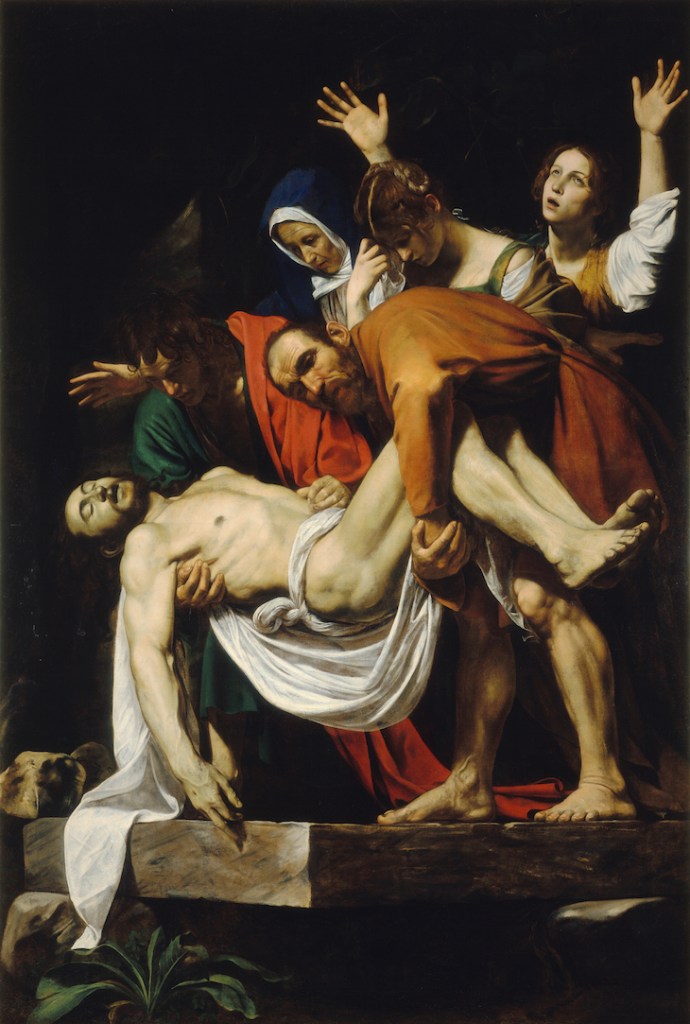
‘What Caravaggio was doing wasn’t easy, in fact it was wonderfully creative. It’s a very skilful, very original way to make a picture. His figures are a kind of collage, pieced together. It is extremely clever, it would have taken quite a bit of time to work out.’ It’s a hypothetical system that he has tried out himself. ‘We set it up in LA and it absolutely will work. It totally explains how the pictures could have been made.’ I have seen video footage of one such experiment, not included in the BBC documentary, in which Hockney and assistants attempted to reproduce the composition of Caravaggio’s Supper at Emmaus (c. 1600/01).
In the first stage, according to this reconstruction, Caravaggio would have first arranged his models in a composition, marking their positions on the canvas with the rough incisions that are so characteristic of his work that their presence is regarded as strong evidence of authenticity. Then he could draw each figure and element in position one by one using the mirror-and-lens method demonstrated to me by David Graves. Hockney does this, producing fluent drawings, upside down, with ease. The limitation of this is that only a restricted area can be projected at any one time – a head and upper body for example. So transcribing exact spatial relations is difficult.
This is precisely the point on which Caravaggio’s paintings are frequently, sometimes flagrantly, faulty. When Rubens copied Caravaggio’s Entombment of Christ (1603–04), he was obliged to omit one figure and radically reposition others. As Hockney puts it, ‘In a Florentine composition by Leonardo or Michelangelo, you feel the figures in space because the artist had sensed it in his head. But in a Caravaggio they are squeezed.’ This was a criticism that was raised in the 17th century. G.P. Bellori notes that the older painters complained that Caravaggio painted ‘all his figures… on one plane without any diminution’. Could this oddity of his style be an optical consequence of the method proposed and tried out by Hockney and his associates?
In that set-up, all the models and still life items are placed in the same plane – indeed, in exactly the same spot in relation to the mirror and lens. The canvas is moved so their projected image appears in the correct area of the composition. Similarly, that other peculiarity of Caravaggio’s mature manner – the dark background – is also an optical consequence of this method. It is the result of the narrow depth of field. In photographic terms, Caravaggio was fitting together a series of close-ups. The distance between the subject and the lens was equal to that between lens and canvas, so the projected images appeared about life-size (as is generally true of Caravaggio’s works).
This reconstruction of a possible technique of Caravaggio is the essence of Hockney’s approach. Practical and experimental, its starting point – natural for a working artist – is to ask how an image was actually made. A great attraction of Hockney’s ideas is that they connect the past in an intriguing fashion to the present. ‘Caravaggio’s technique,’ Hockney points out, ‘relates to Photoshop amazingly.’ If he is right, the history of Western art is no longer divided into two unrelated eras by the invention of photography in 1839. It becomes a continuum, in which Caravaggio and Vermeer belong in the same story as Cartier-Bresson and the movies. Caravaggio, Hockney likes to say, ‘invented Hollywood lighting’. It may be no accident that his rediscovery in the mid 20th century coincided with the vogue of the film noir.
According to Steadman’s reconstruction, Vermeer adapted Caravaggio’s method by placing his lens further from his subject, pulling back so that he was in effect working from a long-distance shot rather than a close-up. He could project an entire room, with a much wider depth of field, but on a reduced scale: an effect closer to an actual photograph – which is what, as has often been noted, Vermeer’s pictures resemble.
If true, the Hockney/Falco thesis amounts to what was described by Thomas Kuhn, the historian of science, as a paradigm shift. This occurs when a fundamentally new theoretical model is proposed – for example the transformation of physics by Einstein’s theories. This changes the entire intellectual landscape – a deeply disturbing experience for those comfortably at home in the old one. It is striking that Hockney, Falco and Steadman – Professor of Urban and Built Form Studies at University College, London – all come from outside art history. Until the new paradigm is formulated, anomalies in the previous one are characteristically ignored. The transition is marked by prolonged argument, and – at first – angry dismissal by those who cling to the previous mental map.
Something like this may now be going on if (and of course, it is a big if) Hockney and his associates are right. ‘I believe,’ he says, ‘I have found a whole history that had just been ignored. A history that doesn’t diminish what had gone on at all, in fact brings it closer to us and makes it incredibly more interesting to me, at any rate. So I just assume that art history will slowly be rewritten. All other histories are rewritten all the time. So why wouldn’t art history?’
From the January 2010 issue of Apollo.