From the October 2026 issue of Apollo.
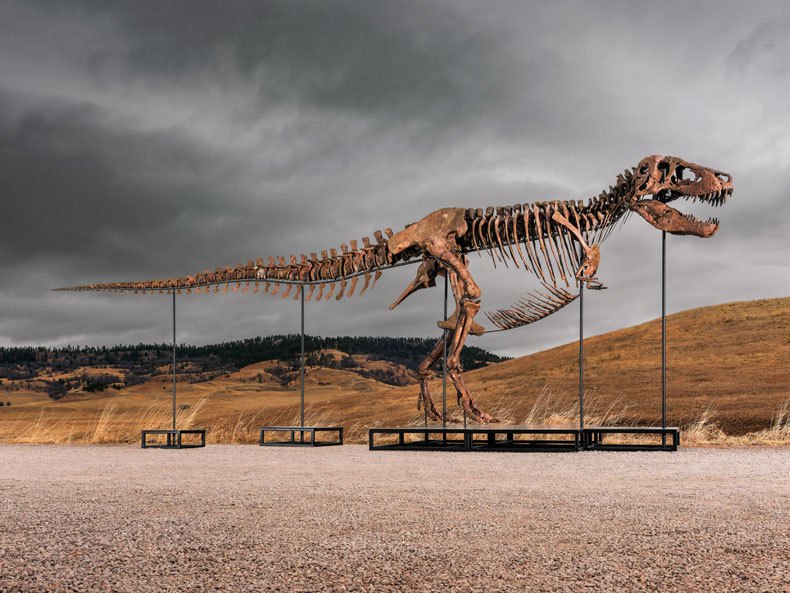
Fossilised dinosaur skeletons are a rare hot point in today’s otherwise tepid art market. In July, Sotheby’s New York sold Gus, an 11-metre-long, complete Tyrannosaurus rex skeleton for $50.1m, double the low estimate and a record price for a dinosaur at auction.
Excavated in South Dakota between 2021 and 2023, 67-million-year-old Gus was an extraordinary 82 per cent complete by bone count. Cassandra Hatton, Sotheby’s worldwide head of science and natural history, describes him as ‘the full package […] excavated, documented, prepared and mounted to the highest standards; one of the largest and most complete T. rex ever found’. The buyer remains a mystery, but – with museums priced out at that level – they are almost certainly a private individual.
Gus was not a one-off. Last year Sotheby’s sold a unique juvenile Ceratosaurus for $30.5m. The year before, the auction house sold a stegosaurus named Apex to the hedge fund boss Ken Griffin for $44.6m (Griffin has since put it on long-term loan to the American Museum of Natural History in New York). It was Stan, a T. rex sold at Christie’s in 2020 for $31.8m, that first sparked this bone rush, however. Stan is now on display at the Natural History Museum Abu Dhabi, having been bought at Christie’s by the Abu Dhabi Department of Culture and Tourism.
‘There’s been commercial collecting, of course, for a long time, but this phenomenon of dinosaurs going for such large amounts of money at auction is a really new thing,’ says Steve Brusatte, professor of palaeontology and evolution at the University of Edinburgh, citing the sale of Sue, a T. rex that ended up at the Field Museum in Chicago after selling for $8.4m at Sotheby’s in 1997, as the watershed moment for a trend that has consolidated in the past decade.
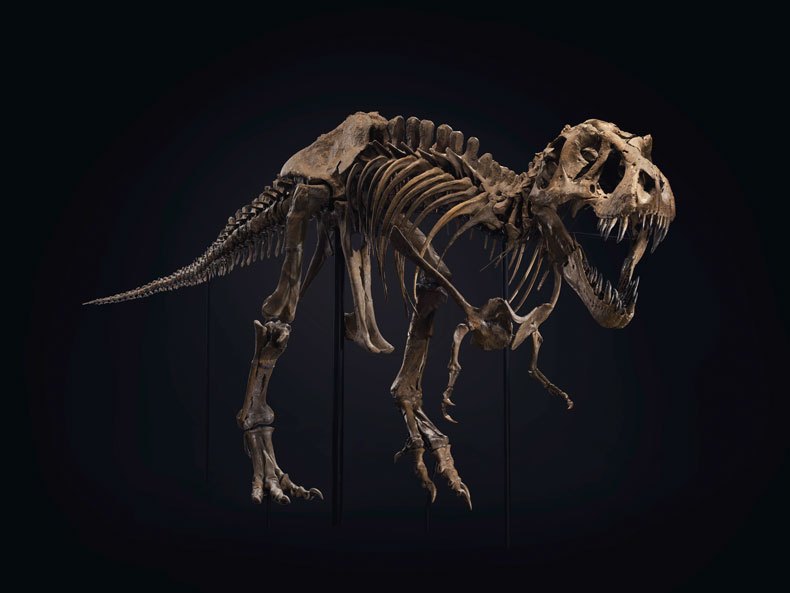
It is a trend that has ignited debate, with some palaeontologists arguing that these skeletons are scientific objects, invaluable to research, and should not be cosseted away as the latest billionaire trophy asset. In response, Hatton sets out two arguments. First, ‘the dinosaurs that are being sold are all excavated on privately owned land; universities and museums have free access to excavate fossils on public land, which private excavators are not allowed to touch, so there is no loss or competition there.’ Second, ‘it is incredibly expensive to do these excavations. The commercial palaeontologists who excavate on private land undertake the full cost of doing so, in a race against weather and erosion to save these fossils from what many of us refer to as the “second extinction”.’
Brusatte disagrees with the cost argument. ‘Museums don’t have the cash to spend $50 million on a dinosaur at auction, but museums and universities do have the cash to do excavations – we’ve been doing it for hundreds of years – so that argument is frankly bogus,’ he says. ‘The argument that no palaeontology would happen or that dinosaurs wouldn’t be excavated if it wasn’t for the oligarch class buying dinosaurs at auction is a whole load of BS.’
Away from the auction houses, antiquities dealers have been among the first to diversify into dinosaur fossils – and more broadly, natural history – as rising legislation, fears over trading potentially looted cultural heritage and reduced museum buying have made their core business increasingly tricky.
The London-based firm ArtAncient, founded by Costas Paraskevaides, has straddled antiquities and natural history since around 2012. ‘As the market has changed and supply has reduced, making it more difficult to only deal in antiquities, everyone has developed their side hustle,’ Paraskevaides says. When ArtAncient first started to deal in natural history, it felt ‘supremely undervalued’ and less competitive than sourcing antiquities, he says, ‘but now, it’s almost harder to get natural history items than it is to get antiquities.’ Buyers tend to be relatively young, Paraskevaides says, many of them in the tech sector, and aesthetics are important. ‘I would tie it to the collectibles boom – we’ve had people come to us who are serious Pokémon card collectors,’ he tells me, pointing to the Pokémon collector Dubsy, who recently bought a T. rex tooth from him.
Salomon Aaron, one of the brothers who now runs the fourth-generation antiquities dealership David Aaron, has expanded into the dinosaur market in the past decade. Aaron and his brothers realised that natural history ‘had a lot of similarities with the antiquities market, except the fact that it wasn’t as regulated, nor as developed’, he says. ‘We realised we can do it better, apply our due diligence rules to natural history, create a new benchmark for provenance, authenticity and condition.’
As with ArtAncient, Frieze Masters has become an important platform for the Aarons’ dinosaurs. At the London fair in 2023 they showed a juvenile Tyrannosaurus rex with an asking price of $20m, and last year sold a juvenile triceratops skull on the opening night with an asking price of £650,000. Another dinosaur skeleton exhibited by David Aaron at Frieze Masters in 2023, that of a newly discovered species called an Enigmacursor, priced at £450,000, was later bought by an American collector couple for London’s Natural History Museum in a deal brokered by the Aarons.
This year at Frieze Masters the gallery will exhibit another juvenile triceratops skull from the Late Cretaceous period (price yet to be confirmed at the time of writing, but it will be a six-figure sum) and a sabre-toothed cat skull, dating to around 33.7 to 23.8 million years ago, from the Badlands of South Dakota (£45,000).
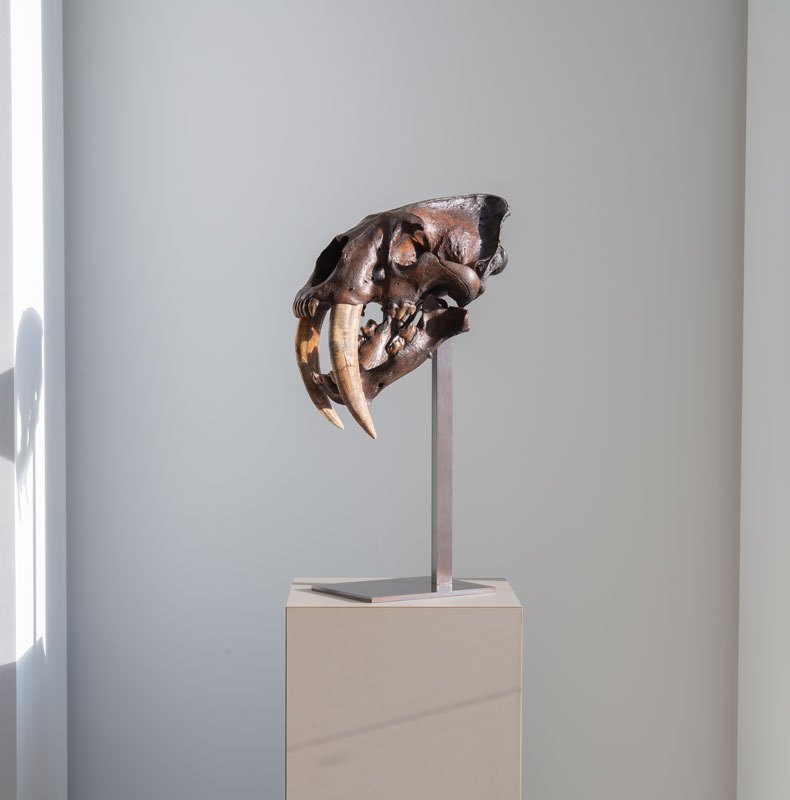
ArtAncient, meanwhile, will show a Smilodon (sabre-toothed cat) skull at Frieze Masters this year, which Paraskevaides says is ‘among the best ever found, highly complete and immaculately preserved’. Found in the prehistoric tar pits of La Brea in Los Angeles in the 1950s, the skull has come from a ‘historic collection’, Paraskevaides says. It will be priced in the seven figures and is accompanied by a letter from a curator, written in 1980, describing the practice of buying and selling fossils as ‘repugnant’.
Repugnant or not, this is a market in relative infancy and Aaron and Paraskevaides both stress the importance of applying similar levels of due diligence to natural history as are required of antiquities. They were both involved in the introduction of vetting for natural history by Frieze Masters in 2019; this year the vetters are Nigel Larkin, a conservator of natural history and palaeontology specimens, and Errol Fuller, a writer and specialist in flora and fauna.
In an effort to ‘put some guard rails in place’, Aaron steers clear of dinosaurs discovered in the 1990s or 2000s which ‘didn’t have the same thorough documentation, condition assessment or preparation’. Despite ‘booming’ demand thanks to ‘new museums and tech buyers flooding the market’, Aaron has chosen to deal only in recently excavated skeletons found on private land in the United States, ideally with a photographic or filmed record of the excavation process. Aaron predicts that as this nascent market matures, prices will start to polarise between the best and the rest.
At the moment, lower-quality specimens – sometimes composites of multiple skeletons – can still sell for high prices to less informed collectors, even when lacking thorough documentation. Those prices will likely soften as buyers become more discerning, just as record prices for the very best things will climb even higher.
Dealers in this field must have a certain appetite for risk. Aaron and Paraskevaides pay advances to finders in the United States who contact them as soon as they unearth the first bones. ‘It’s one of the weird things about this market, you have to make a commitment early, before the piece is fully excavated,’ Paraskevaides says. ‘You can’t assess the completeness of the specimen [first] because, due to the investment of time [and money] to excavate and prepare a fossil, a lot of finders want that reimbursed quite early […] so you buy it, and then they can fund the preparation.’
Paraskevaides thinks that auction houses such as Sotheby’s have helped foster this market by expecting ‘good standards of documentation for these finds’. Hatton says that her phone is full of pictures of bones sent to her by prospective sellers, so much so that Sotheby’s has a several-years-long waiting list of people looking to sell. ‘We are involved from the first day in most cases, and will even advise sellers on which labs to use in those cases where the excavators do not do their own preparation and mounting work,’ Hatton says.
Hatton says that, while museums ‘are always part of the conversation’, the private market ‘has expanded dramatically – seasoned fossil collectors, yes, but also collectors who want objects with cultural weight and scientific importance’. Hatton advises new collectors to start small and buy at public auctions : ‘This is a new market with prices just being established, so for now, the best way to know that you are paying a correct price is to buy in an open, transparent auction where you can see that others are interested as well.’ Before bidding, however, buyers must do their due diligence and study ‘provenance and legality; condition and quality; completeness; rarity and importance.’
All of the dinosaurs discussed here are from North America, as the export of fossils from countries such as China, Mongolia, Brazil and Argentina is illegal without state authorisation. But where big public prices go, a shadow market often follows and there are rising fears of illegal and reckless excavation in these countries. There are cautionary tales too, most notably the case of the actor Nicolas Cage, who had to hand over a dinosaur skull that he bought for $276,000 in 2007 from I.M. Chait, a gallery in Beverley Hills, after it emerged that the skull had been illegally exported from Mongolia. (Cage is not accused of any wrongdoing.)
This growing black market is a ‘huge concern’, says Brusatte, who draws the distinction between legally and professionally excavated dinosaurs in the United States, and the illegal activity in countries such as Brazil and Mongolia where stricter laws apply. That, Brusatte says, ‘goes to show that if you do impose stricter laws, there are going to be people who break them’.
Partly for this reason, Brusatte is opposed to the idea of the US government imposing new laws that limit the rights of landowners to sell fossils found on their property: ‘It’s just not going to happen, and even if it was, I would not advocate for it – it’s against American culture to have laws where the government can tell you what to do with your life.’ Another scenario, he thinks, is that the dinosaur trend might subside: ‘There’s a bit of a bubble, and people that have $50 million to throw around may just move on to something else.’ A third way, which Brusatte thinks the most reasonable, is to ‘acknowledge that these dinosaurs have become commodities […] but let’s try to instil a culture where if you do have the amount of money to buy a dinosaur, you don’t just put it in your seventh mansion or on your yacht, but instead you donate it to a museum, put it on display, inspire the public, take the tax breaks.’
From the October 2026 issue of Apollo.