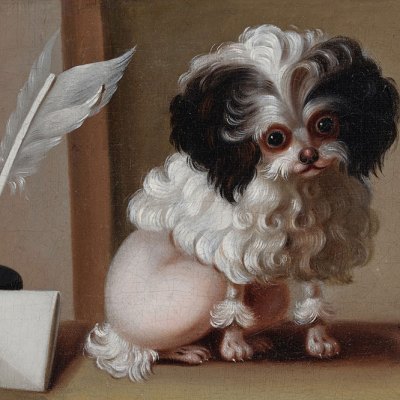
This review The Dog’s Gaze: A Visual History by Thomas W. Laqueur is published in the May 2026 issue of Apollo.
In Carpaccio’s painting Saint Augustine in his Study (1502–07), the saint sits at his desk on the far right of a large room, next to a window through which he is looking at an ‘indescribable light’. This light is mystically bringing him the news that Saint Jerome – to whom he is in the middle of writing – has died. The lower left quadrant of the painting contains an expanse of empty floor. In a preparatory drawing, the expanse is interrupted by an ermine – that is, a stoat in its white winter coat – a conventional symbol of purity. In the finished painting, however, the ermine has been replaced by a small white dog, sitting obediently and gazing up towards or past Augustine. Ruskin identified the dog as a spitz, a generic term for a large number of breeds, from huskies to Pomeranians, with thick fur and pointed muzzles.
Both versions of the image are reproduced in Thomas Laqueur’s The Dog’s Gaze, a brilliantly wise and engaging book about how dogs have been represented in art and what they represent in life. For Laqueur, this dog of Carpaccio’s is structurally essential to the way the painting works – ‘It guides the gaze to what it needs to see and understand’. More obviously, comparing the versions brings home what a dog adds to an image. Saint Augustine’s dog domesticates him, adumbrating a whole life outside the painting and outside sainthood, one that might involve play as well as prayer, affection as well as piety. Something similar is true of any portrait: the dog drags the individual out of isolation. And even a dog in a bare landscape gives it a human dimension, without bringing the baggage (race, sex, class and so on) that a human figure would. Dogs can do this because they are so intimately bound up in our lives (as cats are not): ‘Dogs can’t help being there,’ Laqueur writes, ‘being social – sometimes excessively social – and paying close attention with their eyes to our every move.’
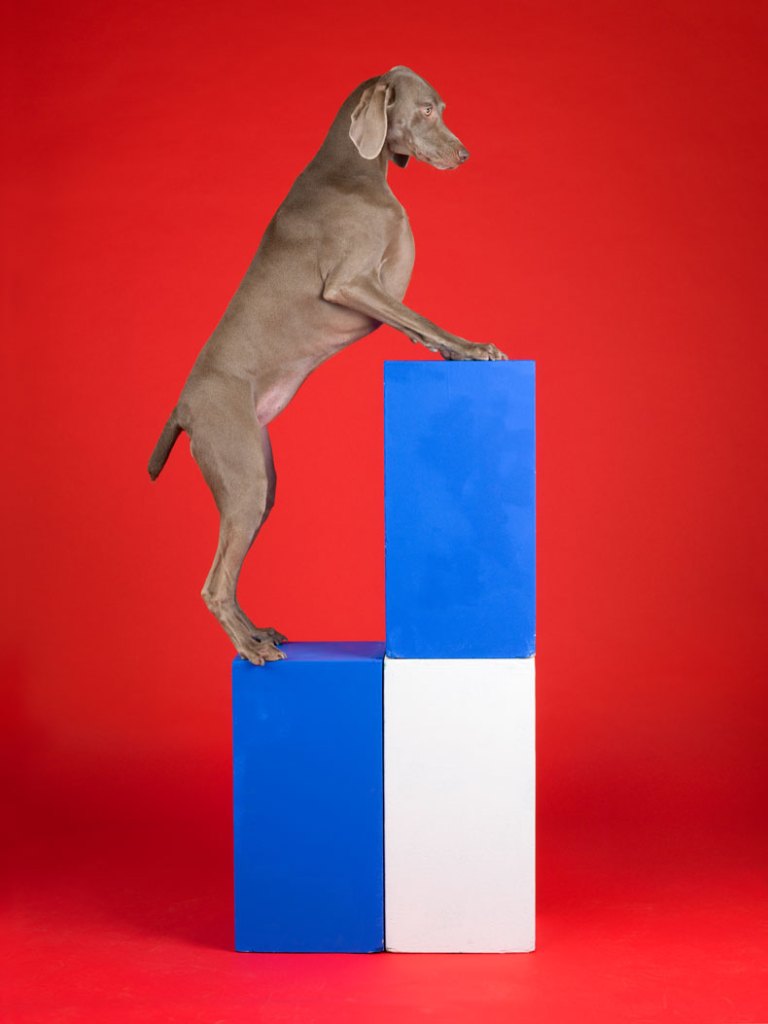
The Dog’s Gaze is in part a history of the intimacy between humans and dogs, which predates by millennia, maybe tens of millennia, our relationship with other domesticated animals, and has persisted on every inhabited continent. Laqueur offers a clear and well-informed account of the genetic and archaeological evidence of domestication, before launching into a thoughtful, erudite account of dogs in art, from prehistoric petroglyphs to Lucian Freud’s whippets, William Wegman’s photographs of Weimaraners and a yellow dog in a painting by Kerry James Marshall. Often dogs have mythological or allegorical roles to play – Actaeon’s hounds tearing him apart as he transforms into a stag, or the sleeping dog in Dürer’s Melencolia I (1514) – though the nature of the role isn’t always clear: the dog in Melencolia I isn’t himself obviously melancholy (Laqueur thinks it might be meant as a comfort rather than an emblem; I wonder whether it represents dormant appetite, the absence of desire that is one of melancholy’s bleakest effects). But Laqueur’s fundamental point is that the ways dogs have been portrayed are bound up with the ways they look with and at us: dogs are the only animal that will follow a human’s gaze to see what they are looking at. They are often painted staring adoringly at their owners, or directing our gaze – like Augustine’s spitz – at something important: in Johannes and Lucas Van Doetechum’s Landscape with the Baptism of Christ (c. 1562), the human figures are wandering through the countryside oblivious to John baptising Christ down in the river valley; only a small dog at the front of the picture, forefeet up on the parapet of a bridge, has noticed what is going on. Sometimes the dog breaks the frame of the picture, striding in from the edge, staring outwards to something we can’t see, or looking directly at the viewer, like the little dog in The Arnolfini Portrait (1434).
The argument is interesting, but the book’s main pleasures are in incidental details. It is striking how much we know about individual dogs of the past – for example, that the Scottish dog Mopsius, who belonged to the Flemish humanist scholar Justus Lipsius, and who Rubens painted with his master in The Four Philosophers (c. 1611–12), had ‘brown on the ears, round the mouth a little yellow, over each eye two yellow spots’. (Annoyingly, while the text goes to some trouble to establish that it’s Mopsius in the picture, not Lipsius’s other dog Mopsulus, the caption gets it wrong.)
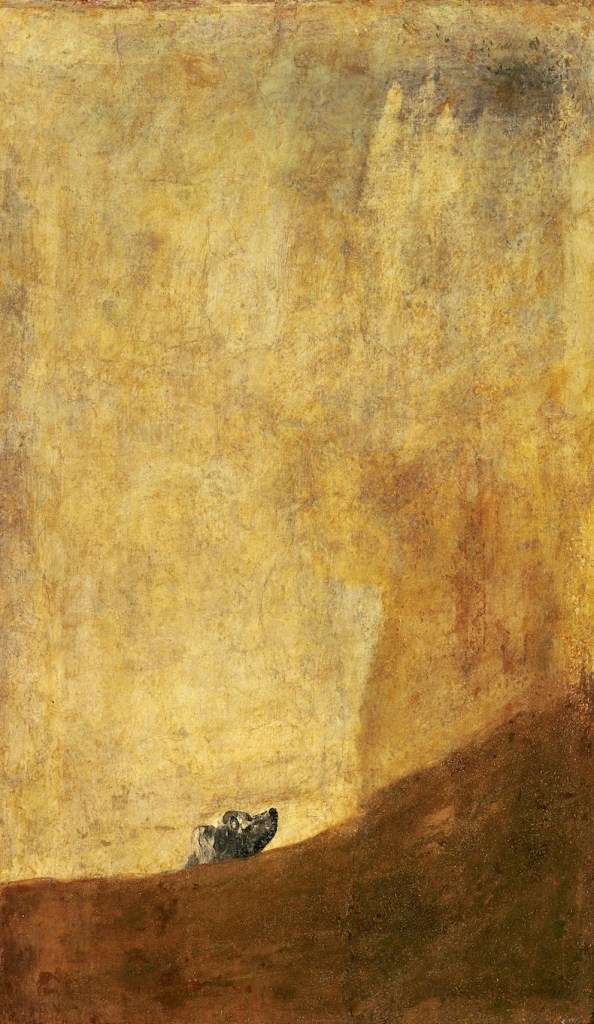
And there are many, many delightful dog pictures to look at – the book verges on the coffee-table. Most of the great dogs of art history are in here, including some of my own favourites: the solemn brown dog of Piero di Cosimo’s Satyr Mourning over a Nymph (c. 1495), in the National Gallery in London, which seems to express grief so much more acutely than the satyr does; or Goya’s drowning dog in the Prado. A number of times I wondered why a particular painting wasn’t mentioned, only to find it cropping up a few pages later. But the book also contains many paintings I didn’t know – there could be a decade’s worth of holidays in visiting them all. A proper, thorough index and endnotes make it easy to check Laqueur’s facts or to track down the minority of pictures that aren’t reproduced.
The Dog’s Gaze is not flawless: Laqueur’s point sometimes gets mislaid and he puts too much stress on dogs as structural elements, anchoring the painting or mediating between the viewers and the subject: I think he sometimes misses the way dogs function as a bridge between rational humanity and the brute, material world, or as showbiz – a way of injecting humour, or of enlivening the bottom part of the frame where it’s all feet and shadows. I very much liked a paragraph (prompted by Stanley Cavell’s writing on screwball comedy) about friendship, and how it can rely on doing things – it doesn’t matter what things – together: from this, Laqueur concludes that ‘a dog would qualify as a friend, indeed it might well rank high’. But his emphasis on dogs as companions and equals is rather modern and urban – there is more to be said than he manages about dogs and obedience, and the dog as the epitome of the contemptible (though I notice Donald Trump has got over his habit of appending ‘like a dog!’ to random sentences to make his contempt plain). But these are quibbles about a magnificent, generous book.
The Dog’s Gaze: A Visual History by Thomas W. Laqueur is published by Allen Lane.
From the May 2026 issue of Apollo.