From the June 2026 issue of Apollo.
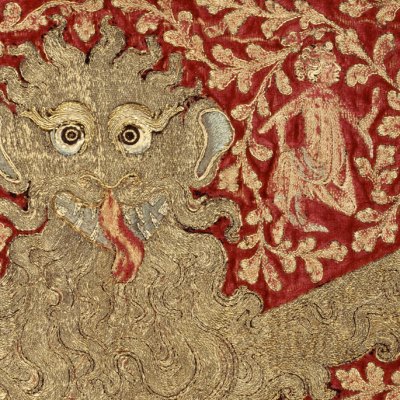
In 1827 the Librarian of Durham Cathedral decided to open the coffin of Saint Cuthbert, last sealed in 1542. A good Protestant, he wanted to prove that the corpse of the saint – declared so when his coffin was opened 11 years after his death and his body was found not to have decayed – had now rotted away. Alongside the saint’s skeleton were discovered remarkable examples of Anglo-Saxon embroidery, now on display in the Durham Cathedral Museum, which have been dated to c. 909–910, and which depict prophets and saints in gold thread and coloured silks. The most famous surviving early English embroidery, the Bayeux Tapestry, was executed in wool on linen in c. 1070, but even before the Norman Conquest the reputation of England’s embroiderers had spread across Europe. From 1100 until 1360 the particular density, technical virtuosity and creative brilliance of Opus Anglicanum, with its characteristic ‘underside couching’ of the thread and fine ‘split-stitch’ work (where the thread is split by the needle on each stitch to create fine lines), set the bar for needlework across Europe. What has mostly survived are ecclesiastical vestments that escaped the general destruction of the Reformation because they were already abroad or had been hidden by Roman Catholic recusants or repurposed. Jewelled, highly figured secular garments threaded with silver and gold, the peak of luxury, were more often worn and repaired and recycled until they fell apart – or were stripped of their silver and gold threads, which were melted down for the value of the metal.
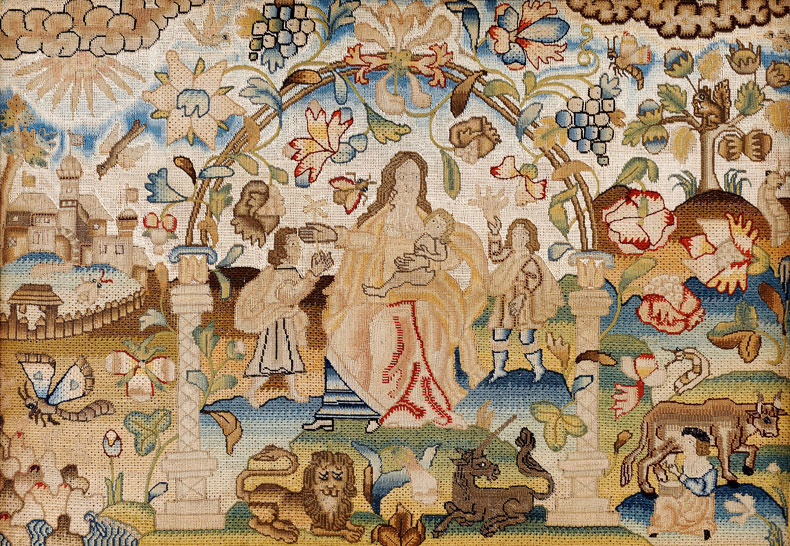
By the end of the 14th century standards of design and craftsmanship had declined, but after the Reformation money from the dissolution of the monasteries enabled a new era of secular splendour. Embroidery based on ornamental motifs common throughout Renaissance Europe became a significant feature of Elizabethan and Jacobean costume, while cut-up ecclesiastical robes inspired an appetite for appliqué. Little survives, although pieces of distinctive 16th-century English blackwork do appear on the market, such as the Seton Cap, an embroidered linen cap, late 16th century, possibly worked on by Mary, Queen of Scots, which sold at Sotheby’s London in November 2024 for £15,600. Around 1620, however, a new art form began to emerge in the home, which has survived better. A lively style of ‘raised’ embroidery – ‘stumpwork’ – developed, featuring stories from the Bible and classical mythology, gardens and rural landscapes. It was used to cover mirrors, caskets, books and other treasured objects. Though such works were dismissed by the Victorians as the work of leisured women and schoolgirls, recent scholarship has recognised that they emerged from a context of mixed amateur and professional art-making – with professional teachers, embroiderers, pattern-makers, finishers and upholsterers of both genders supporting the work of active embroiderers. Moreover, rather than simply inculcating domestic virtues such as skill, patience and diligence, embroidery offered women such as Lady Anne Clifford and Lady Jane Cheyne a medium to reflect their own lives and express religious and political views.
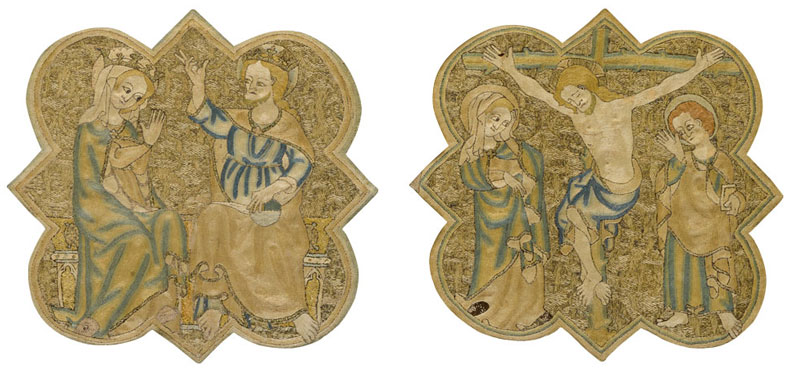
Collecting of early embroidery began in earnest in the late 19th century, with significant collections established over the next decades by, among others, Lord Leverhulme, William Burrell, Frederick Richmond and, in the United States, Irwin Untermyer. Exhibitions such as ‘English Embroidery from the Metropolitan Museum of Art, 1580–1700’ (2008–09) at Bard College and the V&A’s ‘Opus Anglicanum: Masterpieces of English Medieval Embroidery’ (2016–17) have reminded people of the technical brilliance, beauty and cultural significance of these surviving pieces. Stephanie Douglas, tapestries and textiles consultant at Sotheby’s, says that, given the lack of dedicated textile sales, the best pieces are to be found in single-owner or house sales: ‘The nice thing about these sales is that they offer excellent provenance.’ At Sotheby’s 2019 sale from the Berkeley Collection at Spetchley Park in Worcestershire, two exceptionally rare medieval Opus Anglicanum embroidered and metal-thread panels from a liturgical burse, or bag, dated 1320–30, sold for £362,500 against a £20,000–£30,000 estimate. The market for such pieces is entirely in Britain, Europe and the United States. Douglas says: ‘Collectors are quite fussy about condition. Nothing battered or tattered.’ Moth, mould, tears and light damage are all undesirables.
Dealers who have promoted these works include Joanna Booth, who has available an entire cope from around 1500, in reasonable condition. Embroidered figures of named apostles, winged angels and the Coronation of the Virgin have been applied to an Italian silk ground. ‘The market for embroideries has kept up better than for carved wood,’ Booth says, ‘perhaps because it relates to what people have in their lives’. There is also continued interest in 17th-century raised work (‘Everyone likes a rural scene’) but what used to be a very strong collector base in the United States has declined. Matthew Reeves of the London dealership Sam Fogg, which put on a show of late medieval and Renaissance textiles in 2018, says of these early pieces, ‘It is a difficult medium to understand – the nomenclature can be confusing and the textiles really need to be seen in motion to appreciate the full, vivifying, performative aspect of the medium.’ But, he argues, ‘Opus Anglicanum was Britain’s greatest contribution to the aesthetic texture of the European Middle Ages.’ Many pieces have been patched and reconfigured, inhibiting exact cataloguing, but also encouraging the preservation even of fragments. Sam Fogg mostly handles smaller pieces – burses, or heavily embroidered orphreys which would have been applied to larger vestments – but next February will mount an exhibition of textiles of the Middle Ages including copes and chasubles. The nine-year gap since the last exhibition indicates how difficult it is to find the material.
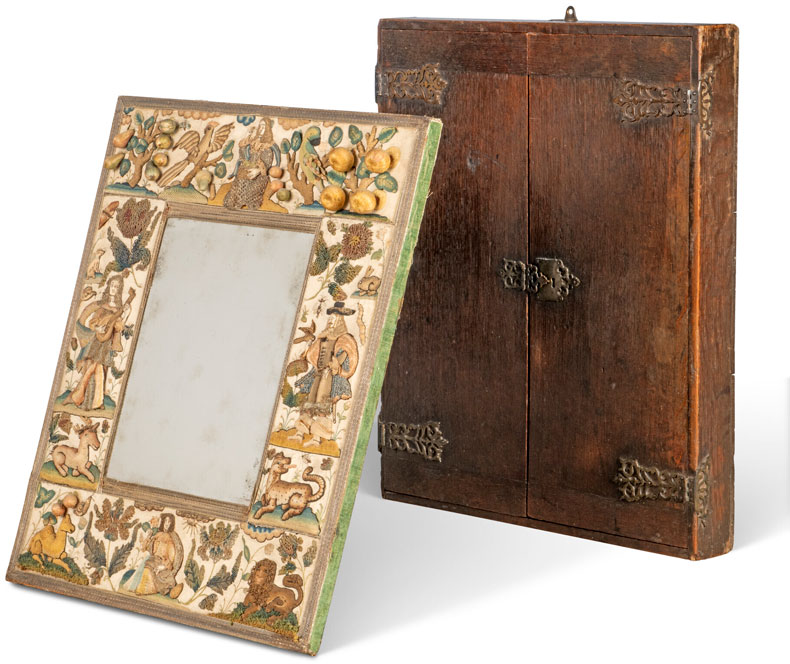
Thomas Williams, Christie’s international head of English furniture and clocks, points to ‘a natural synergy’ with collecting English furniture that goes back to the early 20th century, when great houses began to sell their contents, and a Victorian prejudice against embroidery gave way to a more Arts and Crafts and modernist-inspired appreciation of handiwork. In October 2024 Christie’s London sold a Charles II raised-work mirror, c. 1670, in excellent condition, with its original oak case, for £107,100 against an estimate £15,000–£25,000. ‘Strong competition from key collectors’ was encouraged, Williams suggests, by the mirror’s provenance – it had been owned by the well-known collectors Frederick Skull and John Parry. He says: ‘These objects provide a porthole into the 17th century. They may not compare with the ecclesiastical stitching of the 14th century and we may not be able to unpick the allegorical meanings, but we see the freshness and the joy.’ Williams notes the effect on public appreciation of Grayson Perry’s celebration of Englishness in his own tapestries.
Carolyn Houlston, of the furniture and textiles dealership Houlston, has observed ‘a huge uptick of interest in the last 10 years’. She mostly deals in late 17th-century crewelwork hangings – wool embroidery on linen – and fine silk pictures. ‘Secular or “folky” subject matter is highly prized,’ she says. Rebecca Scott, the leading dealer in English samplers, whose dealership Witney Antiques also handles other early English textiles, says: ‘Most people prefer the more amateur work, for its charm, but others choose more polished work. For both, the ambition of the piece and its decorative quality matter.’ She recently acquired a collection of needlework, the Elizabeth Hall Suite, which has, with its attendant paperwork, offered unparalleled insight into the upbringing of a Quaker woman in 17th-century London. She says there is ‘massive interest’ in the field – ‘a recognition by academics, institutions and private collectors alike that needlework is a window on to a whole discoverable landscape of female life.’
From the June 2026 issue of Apollo.