From the April 2026 issue of Apollo.
Edmonia Lewis (1844–1907), an American sculptor long based in Rome, chiselled white marble into compelling portraits of martyrs, villains and saints. She rendered Abraham Lincoln with anxious furrowed brow, Cleopatra enthroned and slumped in death throes, and Christopher Columbus triumphantly brandishing a navigational map. Lewis globetrotted to exhibit and sell her works and sat for interviews with the New York Times, among other publications. Her studio in Rome attracted admirers as elite as Pope Pius IX and the author Henry Wadsworth Longfellow.
Yet by the 1890s, for unknown reasons, she had abandoned the art world. Until recently, much about her life and career remained shrouded in mystery, including even her burial place. The Peabody Essex Museum’s revelatory, mesmerising show (travelling to the Georgia Museum of Art and the North Carolina Museum of Art) marks a triumph over research roadblocks. ‘Works remain missing and archives keep silent,’ as the curators Jeffrey Richmond-Moll and Shawnya L. Harris explain in the catalogue.
Lewis was born near Albany, New York, but her parents can be identified only tentatively as Richard Lewis, an Afro-Caribbean immigrant, and Margaret Groat Mike, part of whose family belonged to the Mississauga tribe. Edmonia, orphaned as a girl, was raised by maternal aunts. The family travelled widely to market their moccasins, baskets and pincushions, ornamented with beads imported from Italy. Lewis later told friends and reporters that she had lived in wigwams during her nomadic childhood and that her half-brother Samuel was ‘brought up in the same wild manner’.
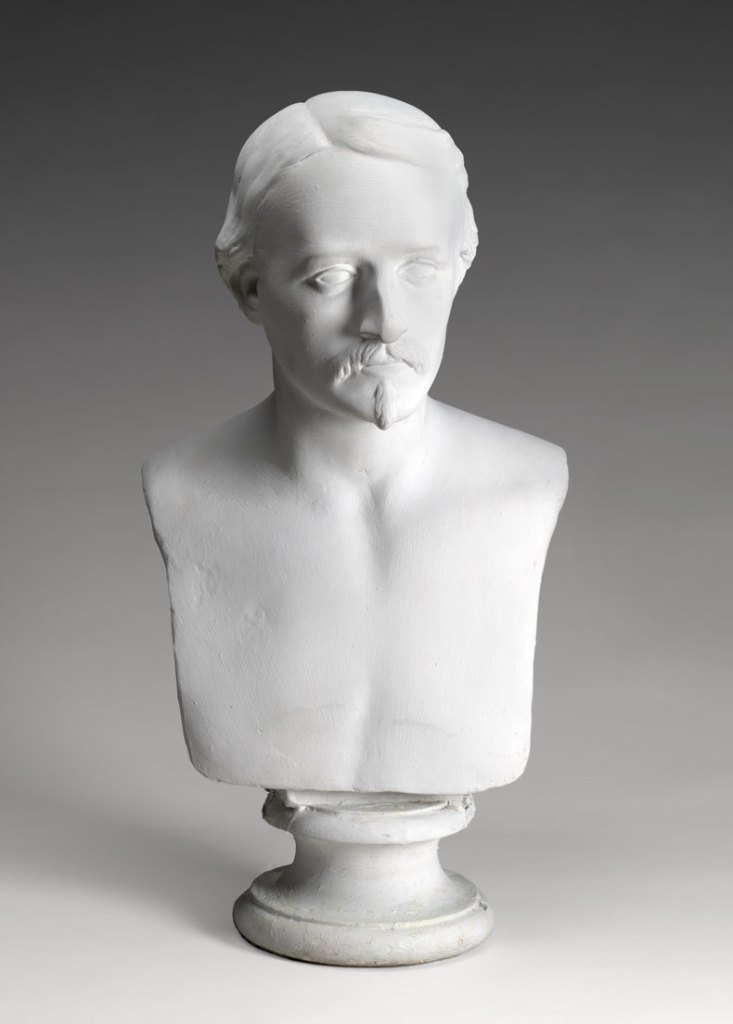
So how did this supposedly unschooled girl, nicknamed ‘Wildfire’, enrol as a teenager in colleges, where she drew praise for her budding art talent from eminences including Frederick Douglass? (Samuel, meanwhile, reinvented himself often over the years, working as a circus tightrope walker, musician, magician, miner, barber, politician and real-estate developer, eventually building his family a house in Bozeman, Montana.)
At Oberlin College, Lewis was falsely accused of various misdeeds and survived a brutal physical assault; she then followed Douglass’s advice to ‘seek the East’. By her early twenties, she had settled in Boston and found mentors and patrons for her carved stone portraits of abolitionists, Civil War heroes, emancipated Black people breaking their chains, and literati, including Voltaire. Directories listed her as the city’s only female sculptor.
Yet Lewis felt ‘constantly reminded’ of her race in stodgy New England and was ‘practically driven’ overseas. Samuel helped support her as she joined a group of maverick female expat sculptors in Rome, including Harriet Hosmer and Emma Stebbins. (Later this year, Samuel and Edmonia will be the subjects of two-person shows at institutions in Bozeman.) In Rome, as many as 20 assistants at a time helped her vary the textures of garments and footwear on multiple marble copies of the same figures, often in sizes suited for tabletops and mantelpieces.
She aimed for market appeal even to ‘people of slender purses’, she told a journalist in 1873. The assistants oversaw the business while she travelled to display artworks as far afield as Philadelphia, Chicago and California. Lewis commissioned photos of herself in defiant poses and studiedly rumpled bohemian capes. Her promotional booklets attributed her success to ‘unconquerable energy, as well as genius’. But the press still pigeonholed her as a ‘Gifted Colored Sculptor’.
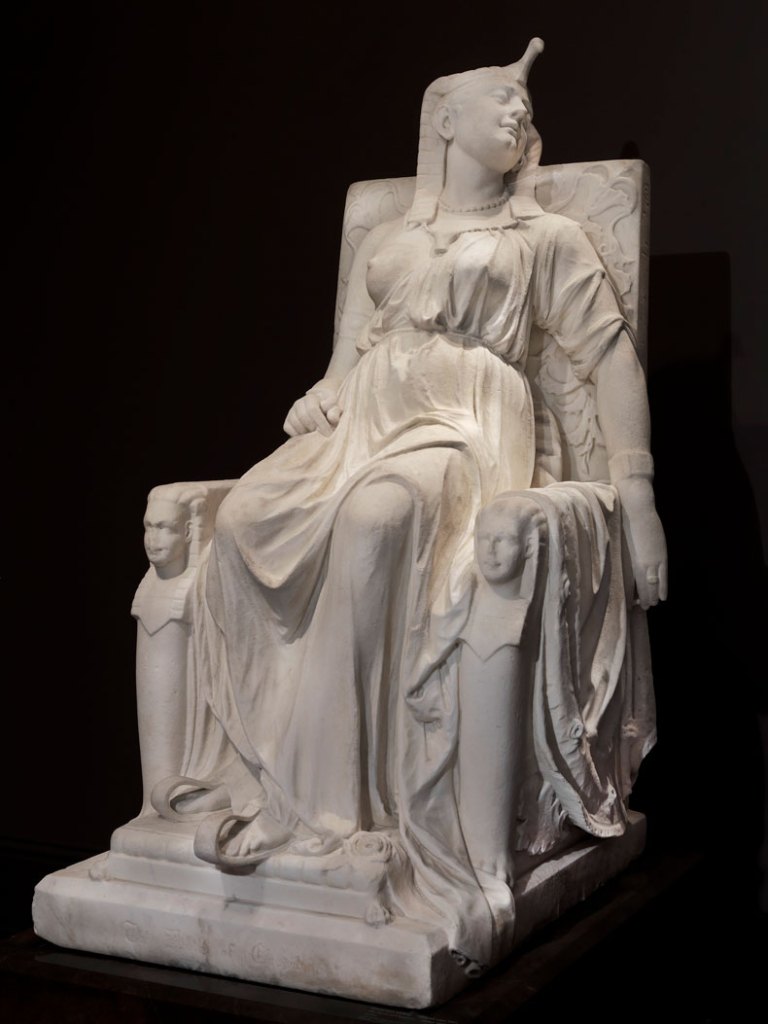
In the 1890s, Lewis spent a few years underemployed in Paris before moving to London. Her brief obituary in a British newspaper noted not much more than that she had once lived in Rome. Her sculptures, even of the likes of Lincoln and Cleopatra, ended up begrimed in basements. A few Black intellectuals, including W.E.B. Du Bois and Ida B. Wells, wrote about, collected and exhibited her works. By the 1990s, unverified legends about her circulated widely; one Lewis scholar privately declared himself ‘uncertain and uneasy’ about what had appeared in print. Not until the 2010s was Lewis’s unmarked grave identified in a Kensal Green cemetery and given a glossy black marble headstone.
In the Peabody Essex Museum’s chronological installation, the gallery wall hues shift from Bostonian brick red for her career debut to Mediterranean azure and mottled taupe for her Italian heyday in a marble-dusted studio. The museum juxtaposes her sculptures with Native American beadwork and wood carvings, as well as pieces by Black sculptors inspired by Lewis, such as Meta Vaux Warrick Fuller’s plaster medallion portrait, from the early 1900s, of the enslaved 18th-century poet Phillis Wheatley. The exhibition labels are suitably ambivalent and provocative; for Lewis’s portrait of a semi-clothed Native American woman kneeling and gazing skyward at Columbus’s feet, visitors are asked to ponder, ‘Do you feel the Native woman holds her own agency?’ Or was Lewis just savvily catering to customer demands for statues of Columbus as conqueror? After all, as she told a reporter in 1873, ‘We must sell our work if we want to live.’
In 1880, Lewis carved a standing woman swathed in rippled fabric, eyes dreamily closed, a raised fist pulling at her veil, the other hand clutching a rose. The figure was commissioned by a relative of Longfellow, exported to Boston and auctioned there in 2010. It has been lent to the Lewis retrospective by a pharmaceuticals executive in New York. I stood transfixed by this fitting symbol of a stone carver, fuelled by ‘unconquerable energy’, crossing oceans while letting no one get too close.
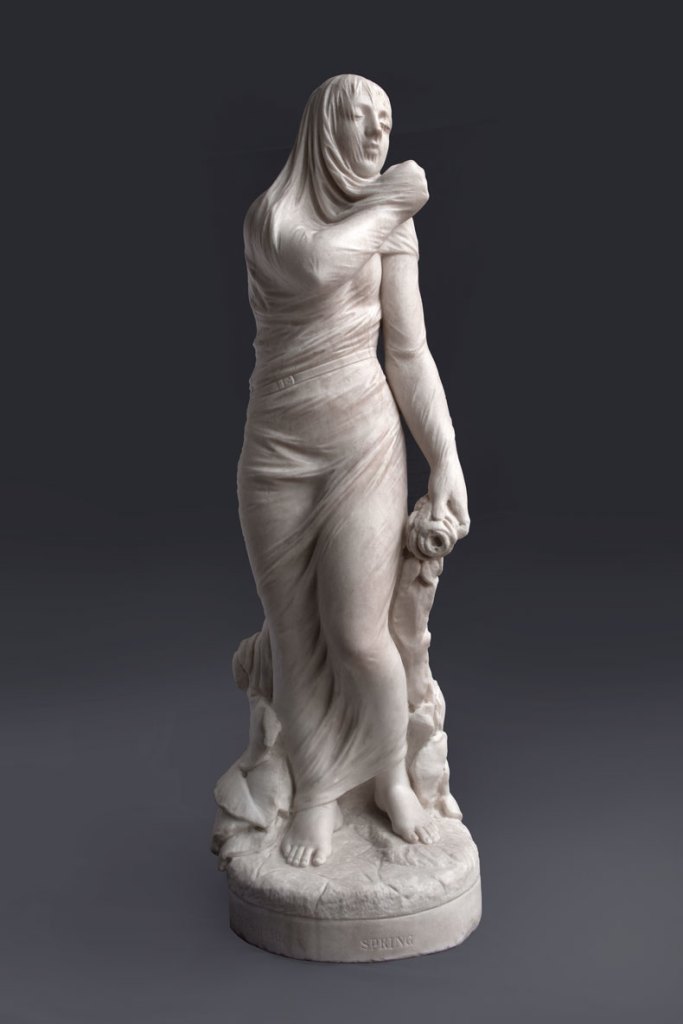
‘Edmonia Lewis: Said in Stone’ is at the Peabody Essex Museum, Salem, until 7 June.
From the April 2026 issue of Apollo.