From the January 2026 issue of Apollo. Preview and subscribe here.
A bespectacled man stands inside a kiln, its curved brick arch framing the scene. Before him – and, seemingly, looking back at him – is a curious knobbly thing. That thing is The Core of Power (1956), a ceramic sculpture by the Danish artist Axel Salto. With three prehensile-looking spouts (or perhaps snouts), it recalls a triffid – a monstrous carnivorous plant imagined by John Wyndham a few years earlier in his science fiction novel The Day of the Triffids (1951). This photograph greets visitors to ‘Playing with Fire: Edmund de Waal and Axel Salto’ at the Hepworth Wakefield, as does a smaller version of the thing itself, contained (for our safety?) in a vitrine at the centre of the first room.
Salto was something of a polymath. Born in Copenhagen in 1889, he began his career as a painter and met Picasso and Matisse in Paris. In the mid 1920s he turned to ceramic design, working with Carl Halier, artistic director of the Royal Copenhagen factory, on a wide range of stoneware. He was also a printmaker, textile designer, illustrator, author and poet, a creative breadth made clear across this exhibition.
The British art-going public – even those with a taste for ceramics – can be forgiven for never having heard of Salto. This is the first exhibition of his work on these shores and very few pieces are in UK collections (the V&A has just two pots, both minor works). ‘Playing with Fire’ brings together pieces from the CLAY Museum of Ceramic Art in Middelfart, Denmark, and the collection of Nicolai Tangen, the investment manager who founded Kunstsilo, a museum in Kristiansand, Norway, that opened in 2024. The artist, writer and long-time Salto fan Edmund de Waal has co-curated this exhibition with Sanne Flyvbjerg of CLAY, where the show made its debut. (It then moved to Kunstsilo.) If de Waal had not got involved, I suspect the exhibition might not have made it this far. It’s a good thing he did, as ‘Playing with Fire’ is a revelation.
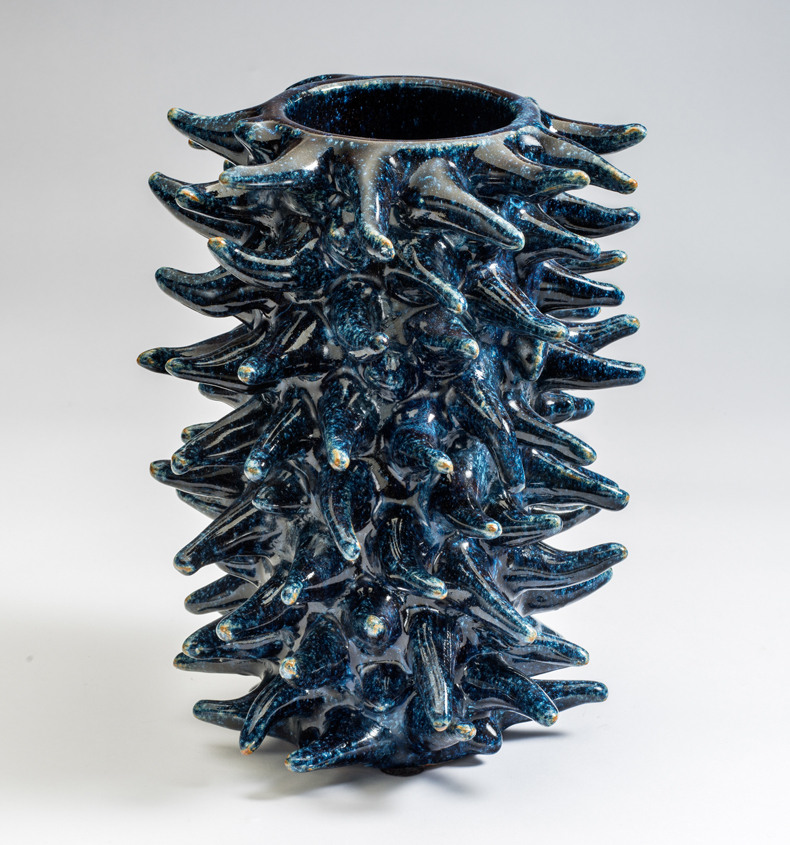
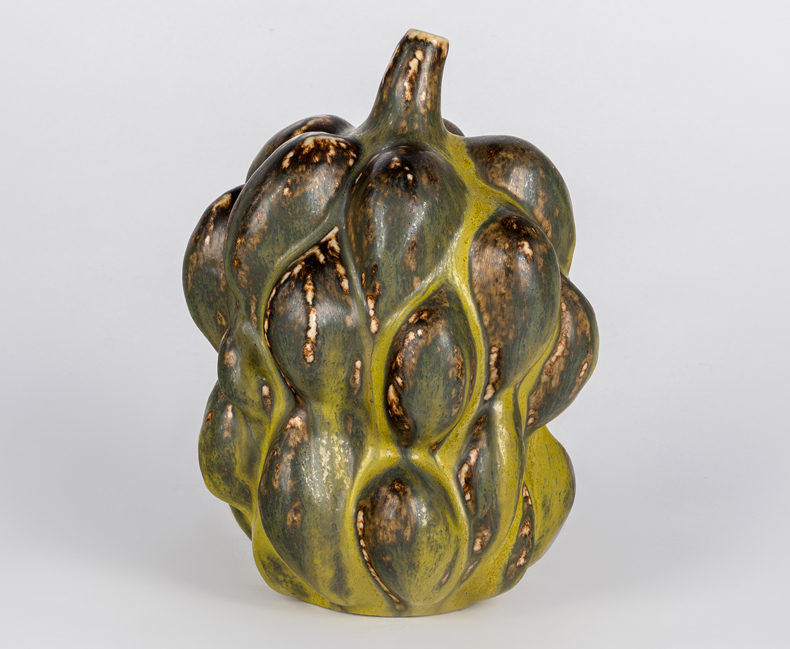
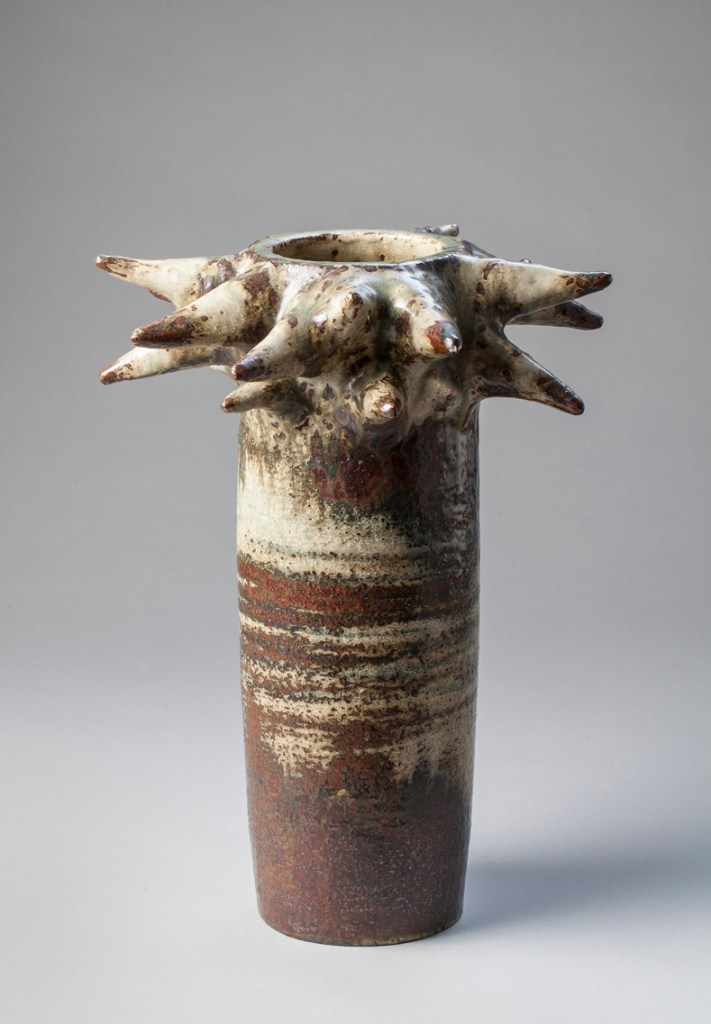
It begins with ‘Kiln’, a black-painted gallery with a box-like enclosure at its centre. Inside, ceramics are arranged on a sinuous stepped display, curved like a topographic map; unusually, no glass interrupts your line of sight. The smallest vessels are the size and shape of a serving of corn on the cob. As the pots get bigger, they become more interesting, more alive. ‘The vase is like a living organism,’ Salto wrote in 1949; ‘the body buds, the buds develop, and sprouting, even prickly vases are the result of this life.’
Here are some words I wrote while inside that black box: pine cones, breadfruit, hernia, sea anemone, flayed flesh, goat’s udder, pile of snakes, guts, bramble thicket, horns emerging, insects hatching, non-human reproductive organs (gastropod?). The magic is in Salto’s allusive skill. The more literal and figurative a vessel is, the less successful. A blood-red vase embellished with a Medusa’s head lapses into kitsch, as does another adorned with a life-size sculpture of a lizard.
Salto’s pure sculpture, on the other hand, is quite wonderful. In the next gallery, in a section titled ‘Metamorphosis’, is Actaeon (1969–74), which shows the mythical hunter kneeling during his transfiguration into a stag, still-human hands groping towards emergent antlers. Salto was fascinated by Ovid’s Metamorphoses and by the story of Actaeon in particular. He made great numbers of woodcuts, etchings, drawings, sculptures and pots that evoke transformations – flora and fauna slipping across their respective categories to become something else, something other.
A section on colour holds his beautifully patterned bookbindings; woodcut illustrations of, what else, plant life and the deer/deer-into-man motif that preoccupied Salto; vibrant wallpaper and fabric designs that feel as fresh as if they were made yesterday. In archive footage from 1956, a frowning Salto turns an onion over in his hands, sketching it with great seriousness. The resulting fabric design hangs nearby, its pattern of onions, roots dangling, looking rather like a procession of jellyfish.
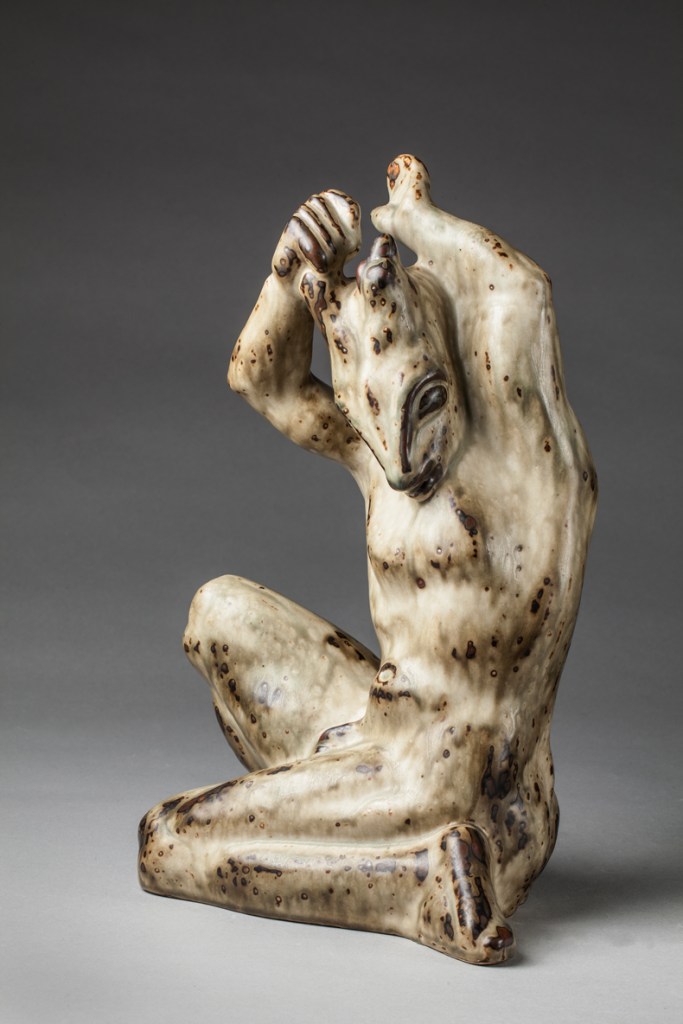
The exhibition ends with an unexpected detour into stamping, a medium Salto loved. Stamps and ink are made available for visitors to play with, alongside examples of his own, perhaps surprisingly sophisticated stamped designs. The exhibition seems to have been designed with children in mind: an unusual number of works are placed low down, sections are introduced with just a couple of short, simple sentences and there are no object labels. The only additional context given are quotes from Salto’s writings. It works – and those who want more information will find it in the paper guide provided.
What works less well in this context is de Waal’s own art. A porcelain-coated pavilion, the burning now (2023), named for Salto’s description of the moment of metamorphosis, feels rather slight next to Salto’s more muscular work. Circling the black box in the ‘Kiln’ gallery are giant versions of de Waal’s usually modestly sized lidded jars, large enough to come up to my shoulder, perhaps inspired by the scale of Salto’s The Core of Power.
I appreciated de Waal’s exhortation to touch these big pieces, from his elegies series (2023) – refreshing after the restraint required around Salto’s exposed works – and I stroked their rough unglazed clay, which is incised here and there with words by Rainer Maria Rilke (though you wouldn’t know it: most are illegible, as are de Waal’s on the burning now). What is troublesome is the striking similarity of these works to an older series by de Waal’s one-time studio mate, Julian Stair, Equivalence (2018).
None of that undermines a great achievement – a celebration of a singular artist, presented in generous, accessible form.
‘Playing with Fire: Edmund de Waal and Axel Salto’ is at the Hepworth Wakefield until 4 May 2026.
From the January 2026 issue of Apollo. Preview and subscribe here.