From the May 2026 issue of Apollo.
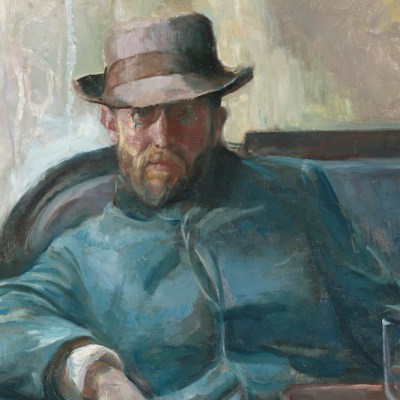
A series painted by Edvard Munch for a workers’ canteen in an Oslo chocolate factory reflects the preoccupations that drove the artist to create his famed Frieze of Life series, explains Ana María Bresciani of the Munchmuseet.
In 1914, Johan Throne Holst, Norwegian politician, industrialist and founder of the Freia chocolate factory in Oslo, published a treatise in which he laid out a progressive ethos towards workers’ rights. Staff well-being was in the interests of everyone, he wrote, and workers who were happy at work would be happy at home, and vice versa. Chocolate production was booming in Norway at this point and Throne Holst was a rich man who enjoyed the wealth and status that his factory provided him. But he saw himself as a caretaker, too, and turned his factory into one of the first in the country with a dedicated welfare system. Workers could get their uniforms washed there and were offered manicures every other week. Housing was built nearby that employees could rent cheaply and, during the First World War, staff could buy rice and other staples at low prices and could have subsidised breakfast at the canteen.
This ethos was one of the reasons why Throne Holst decided, in the early 1920s, to commission decorations for the women’s canteen at Freia. Women made up two thirds of the workforce – they had smaller hands, which helped with packing and delicate tasks, while the men were generally managers or dealing with heavy machinery. There are archive photographs that show young girls working there too until 1916, when the minimum employment age was set to 16. Never a man to do things by halves, Throne Holst decided to commission the very best artist he could get – Edvard Munch, who at that time, as now, was just about the most famous Norwegian artist there was.
It was fortunate that the head of Freia’s experimental lab, Georg Dedichen, was a childhood friend of Munch’s. The Munchmuseet has letters between Munch and Dedichen from 1921 in which the idea was first broached, and then in 1922 the official commissioning letter, sent by Throne Holst, arrived at Munch’s door. In the letter, Throne Holst thanks Munch for the sketches (at a 1:10 scale) that he has already provided – designs for friezes for both the women’s and the men’s canteen – and asks Munch to go ahead with his designs for the former. The fee offered was 80,000 Norwegian krone, a huge sum. The men’s canteen friezes were planned but never carried out: when the government introduced higher taxes on chocolate, cacao beans and cacao powder shortly after Munch was commissioned, Throne Holst decided that he couldn’t afford the expense.
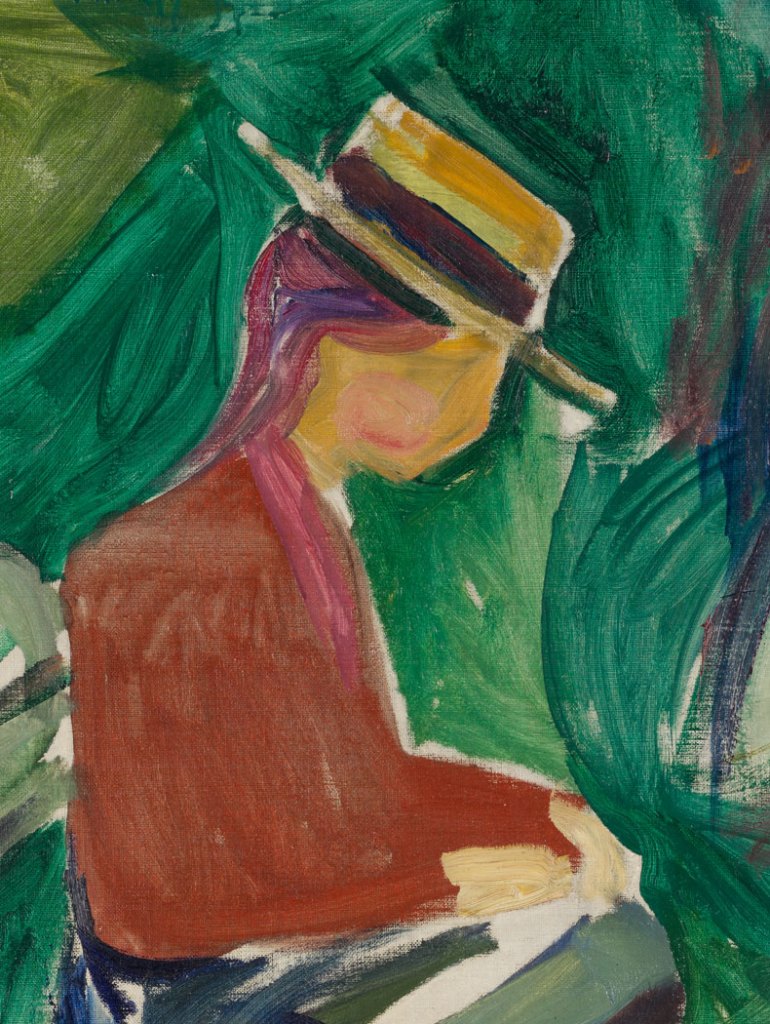
The commission took the form of 12 friezes that were to be hung around the canteen walls. The paintings are on display this month at the Munchmuseet in Oslo for the exhibition ‘Edvard Munch and the Chocolate Factory’. Munch never worked in fresco, preferring to do his work on canvas before they were transported to the factory and installed. Munch claimed that he had just two months to carry them out, since they needed to be ready by January 1923, when the canteen opened, and in his diaries the painter asks himself why on earth he said yes to the challenge. Some scholars have queried the veracity of this short timeframe; some of my colleagues have said to me, ‘you should not believe Munch to the letter.’ But however much time he really had, it’s clear from the paintings that it was speedy work. He worked in oil, with quick, loose brushstrokes, on canvases that were completely unprimed, with no preparatory drawing or underpainting; some of the finished paintings look more like preparatory work. You can see it when you’re standing in front of the paintings – how many drips there are, how thin the paint is and how some of the figures in the friezes have these strange smiley or featureless faces that feel very hastily done. It’s quite comical in parts. Even Munch himself thought that the friezes were too rushed and therefore poorly executed.
Munch’s life’s project, begun in the 1890s and continued towards the end of his life, was what he called the Frieze of Life, a loose series that includes The Scream, Vampire, Jealousy, Separation and many others – works that are full of angst and often explore the idea of men and women engaged in some kind of gender war. There is none of this in the Freia Frieze, even though Munch saw them as part of the Frieze of Life. They are all harmonious scenes, with inspiration taken from various places, including the scenery of Åsgårdstrand, where he had a house, and some from motifs that he had used in earlier works. The element that ties all 12 of these paintings together – or almost all – is that there is a shoreline visible in each one.
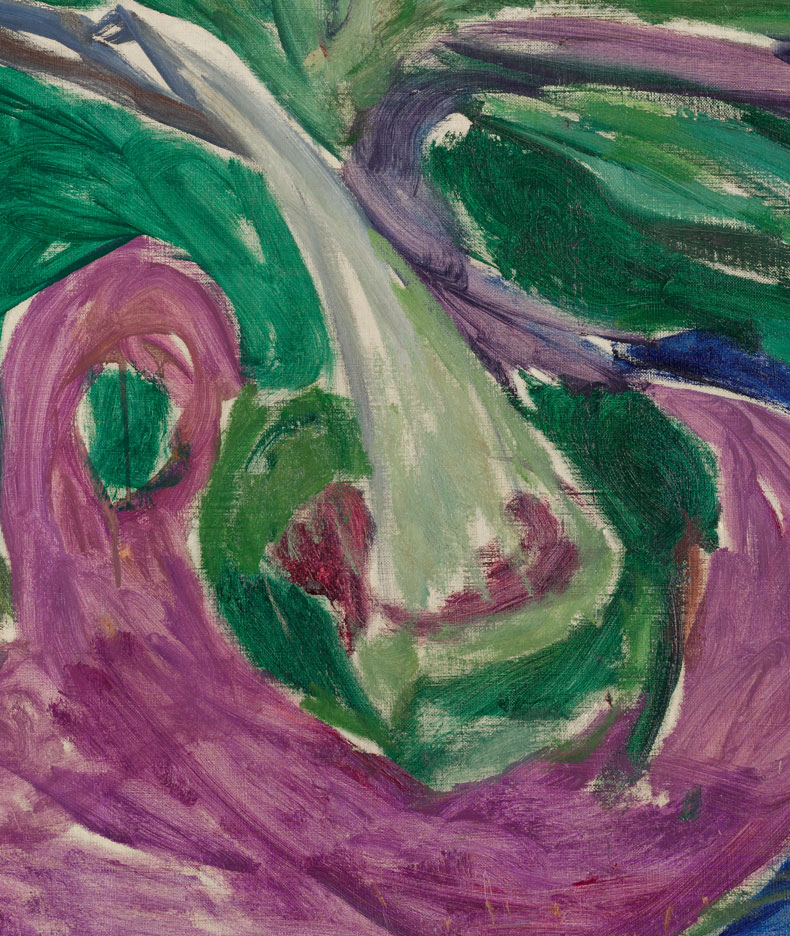
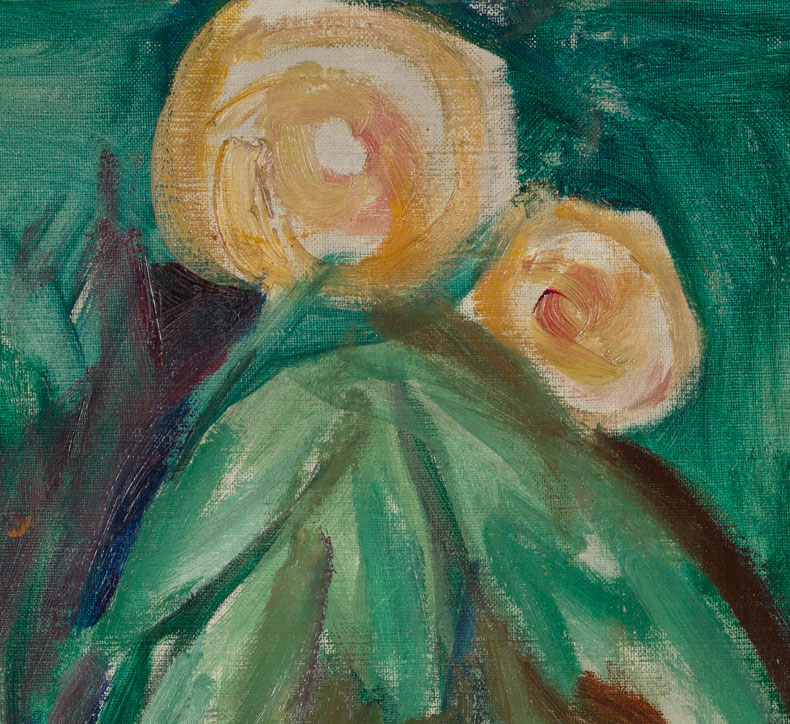
This particular painting, Frieze number IV (Girls Watering Flowers) is the only one without the sea in it. It’s a very interesting painting because it looks quite different to all the others. It is a garden scene, with two women watering plants enclosed by lush natural surroundings. The eye is drawn, naturally, to the women, dressed in colourful clothing. Their colouring and composition were borrowed from an earlier painting by Munch from the Linde Frieze, which was commissioned in 1904 by the physician and friend of Munch’s, Max Linde, who wasn’t happy with what Munch had turned out and gave most of them back to the artist. Many of the Linde panels were painted in Åsgårdstrand too, and the figures in those friezes are mostly based on the girls from the village. It is fascinating to see Munch’s sketches for the men’s canteen – also on display in this exhibition – because they are entirely different to these harmonious visions. Those were very much focused on strong men leaving the factories or groups of workers walking the streets of Kristiania (today’s Oslo). The 1920s was an important time for workers’ rights in Norway – with the right to summer holiday, an eight-hour working day and the right to demonstrate on 1 May introduced. Munch was not generally an outspoken political artist but he did express solidarity with workers, who he tended to think of as perseverant men, like himself.
The setting is clearly a garden of some kind, but there is no perspective, no view to anything outside. The combinations are strange: there is an approximation of a waterfall on the top left of the canvas, while the two tree-like forms could be anything. Munch had long been interested in sunflowers – particularly when he was painting the Reinhardt Frieze in 1906–07 – and these could well be sunflowers. Then there is a really strange flow of luminous fuschia spiralling across the bottom, which could represent water or perhaps the fertility of the soil. That colour is still shocking to the eye nowadays, though in Munch’s day it would have been even brighter. These paintings, which have resided at the Freia factory canteen for more than a century, have been dulled over the years probably due to being exposed to nicotine and cacao residue; they have been cleaned several times over the past century.
If Munch felt that he hadn’t done a good job, then he may not have been the only one. There is an anecdote the lawyer and writer Rolf Stenersen tells in his biography of Munch, published in 1946 after the artist’s death, which is entertaining but impossible to confirm. Stenersen claims that the women who worked at Freia complained about Munch’s frieze, because the houses he had painted lacked windows and chimneys. Throne Holst got back in touch with Munch and asked him to come back and ‘finish’ the friezes. Munch agreed, on the condition that the factory was to send a taxi every day to pick him up from his house in Ekely, on the outskirts of Oslo, ferry him to the factory and then back home again at the end of the day. One day, Stenersen writes, the taxi failed to arrive, so Munch marched up to the director’s office, threw his paintbrushes on to the desk and said that the workers should finish the friezes. There is a letter written by Munch – which is undated – in which he writes that ‘the little chocolate girls […] are understanding the pictures more and more’, implying that, at some point, the staff made their peace with his work.
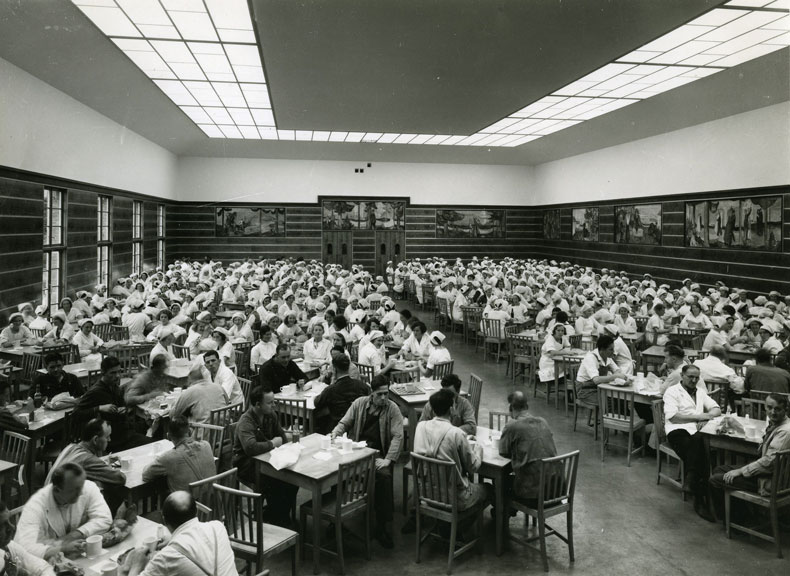
The Freia Frieze did not stay in the women’s canteen forever. It was there for 11 years, whereupon the paintings had to be moved to a brand-new refectory in 1934. Munch was still alive at this point and was involved in the rehanging of the paintings across three long walls rather than two, as they had been arranged originally. The opening of the new factory was a cultural milestone: there were orchestras based there, lectures for staff, a theatre group and even a piano donated by the Norwegian composer Edvard Grieg, and the opening weekend saw a whole tranche of festivities that attracted some 10,000 people.
The art historian Johan H. Langaard declared that ‘No factory in Europe has a more beautiful dining room’ than the Freia factory, while Norwegian newspapers mention the visits of English architects too, who apparently concurred with Langaard’s assessment. In 2015 the canteen, the surrounding park and all the art inside the factory was listed as a place of national heritage, meaning that Munch’s masterpiece can never be permanently moved from its home. Once the exhibition at the Munchmuseet has finished, they will go back to the factory, where workers will be able to eat their lunch beneath these blissful scenes for years to come.
As told to Michael Delgado.
Ana María Bresciani is a curator of ‘Edvard Munch and the Chocolate Factory’, which is at the Munchmuseet, Oslo, from 21 May–11 October.
From the May 2026 issue of Apollo.