From the March 2026 issue of Apollo.
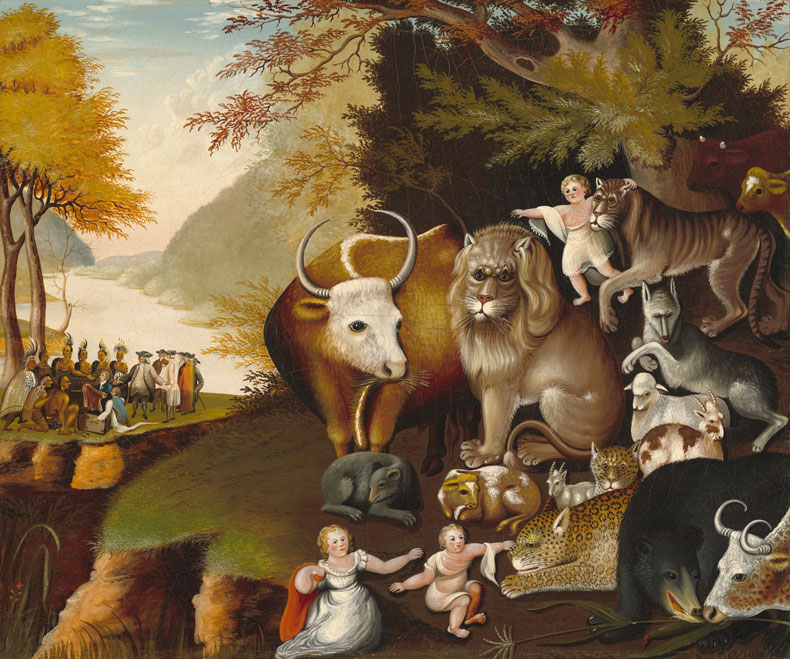
Here in snowbound Provincetown, at the tip of Cape Cod, which I visit every winter, Lacey Black, one of the fellows of the Fine Arts Work Center, recently alerted me to Edward Hicks’s Peaceable Kingdom paintings. I was smitten. Born in Pennsylvania in 1780, Hicks painted 62 versions of the same sylvan scene, including this version in the National Gallery of Art, Washington, D.C. A lion sits smugly with curly, 18th-century locks; an ox with curvaceous horns chews on stalks of corn, content with a bear cub at its feet. An angelic infant in white drawers flies in mid-air, their arm round a big cat; another strokes a sleepy leopard.
Hicks was inspired by the biblical verses of Isaiah 11, which tells of a ‘peaceable kingdom’ in which the wolf lies with the lamb and the cow feeds with the bear, led by a child in love. His creatures seem to hover on another plane, while, in the background, white men offer the Lenape tribe a treaty of peace and love that will avail them nothing. A wide river flows through the hills. The tigers of William Blake and Henri Rousseau might look on with mesmerised eyes; you could even detect Dürer’s lion leaping in there.
Hicks probably knew nothing of those artists, yet somehow his work stands with theirs. He would have certainly been at home here in Provincetown, a peaceable kingdom of its own, where coyotes, fisher cats and wild turkeys stalk its woods, while vast whales cavort off its shores. I saw them there the other day, engaged in amorous, endangered display. Thoreau thought a man might stand here and put all America behind him. Some people here feel like that now, too.
Hicks began life as a lost soul. His mother died when he was an infant and he was left in the charge of her slave, Jane. Adopted by a Quaker family, he grew up to be a youth of a lively, volatile disposition, tempted by foolish and hurtful lusts which drown men in perdition, as a testimonial written to mark his death described him. At the age of 18 he enlisted in the army, drawn to the feathered foppery of the regimental dandy, he said. But then a new pathway opened up. Favoured with a visitation of Heavenly love, he joined the Society of Friends, to preach to all without regards to sects or parties. How could he keep from singing?
In 1817, Hicks lost his beloved sister in a sudden and affecting death. Eight months with child, she jumped in a pool 10 feet wide, 10 feet deep, to save her six-year-old boy, to be followed into the water by the desperate father. All three appeared to be drowning. It was a strange and terrible scene. If it hadn’t been for a Black man who pulled up a plank to reach the father and son, the entire family would have been lost. A passing sailor retrieved the mother, but she and her unborn child were past saving. Hicks consoled himself that his sister had died in the highest exercise of the finest feelings of her nature. Yet perhaps that awful sign of the frailty of life had its echo in this painting, in which a woman and a child appear to teeter on the edge of an abyss.
Hicks’s Quaker faith was unshakeable, expressed in the paintings he made, not for sale but for family and friends. We might call them naive or folk art, but they mean what they imagine: peace in an American heaven on earth, a new creation where not one beast would be seen to frown. And Hicks was still painting them the day before he died in his 70th year, leaving this world singing.
From the March 2026 issue of Apollo.