From the April 2026 issue of Apollo.
She would likely have been among the first to admit it, but Elsa Schiaparelli was not greatly talented as a seamstress. In an era when fashion designers were still routinely referred to as ‘dressmakers’, she showed no aptitude for architectural tailoring, precision cutting or the intricacies of drape. Rather, she made her name through ideas. Schiaparelli’s father was a Piedmontese aristocrat and a professor at the University of Rome, and she had been smuggled into lectures as a girl and while still a teenager had seen Filippo Marinetti deliver his Futurist Manifesto. She had fallen into fashion almost as a sideline to her artistic endeavours; long before turning to fashion, she was pally with Marcel Duchamp and the Parisian Dadaists, and retained a strong call towards the conceptual throughout her career.
One of the key weapons in the designer’s arsenal, of which she made extensive use, is the art of transposition – taking clothing designed for a specific context and repurposing it in unexpected ways. The labels the fashion industry delights in applying to trends are an indication of its ubiquity: nautical, equestrian, military, sportswear, ‘borrowed from the boys’ and the paradoxical ‘utility’ (wherein elements of practical workwear become skeuomorphic tics, as functional as a flying buttress on a Gothic folly). As we can see from, say, the flared trouser’s long trek from swabbing decks to seafront to soirée, to flower-child festival and then to high-street ubiquity, the original context becomes abraded along the way until it is largely forgotten.
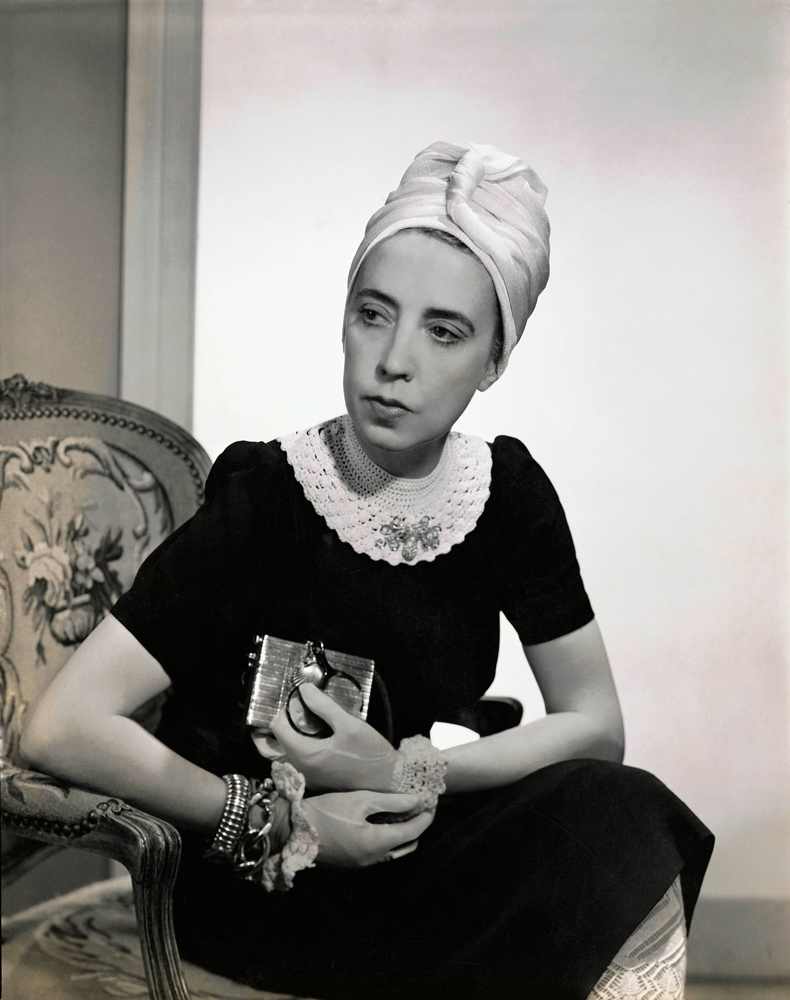
The garment that first made Schiaparelli’s name, the woollen ‘Cravat’ jumper (1927), is a case in point. She appropriated knitwear – still, in the years after the First World War, reserved exclusively for tennis, bicycling or golf – as a viable alternative for the elegant lady about town. Her graphic, Bauhaus-inflected patterns were fêted by the couturier Paul Poiret, who had liberated women from their corsets and reinvented the feminine silhouette for the 20th century. The most sensational design of all, rapidly plagiarised and replicated around the world, was said to have been inspired by the technique of frottage to which her friend Max Ernst laid claim (brass-rubbers might beg to differ, since it was a way of creating a relief image of floorboards by rubbing lead across a piece of paper). While Schiaparelli was busy transposing the sporting wardrobe into daywear, she flattened the dimensions along the way – the front was adorned with a huge trompe-l’œil floppy bow, which, like the collar, was entirely 2D, part of the knitted pattern. Other sweater designs were adorned with sailors’ tattoos, or New York skyscrapers, or even with the outlines of ribs, picked out as if by X-ray.
‘It was the time when abstract Dadaism and Futurism were the talk of the world, the time when chairs looked like tables, and tables like footstools, when it was not done to ask what a painting represented or what a poem meant,’ Schiaparelli recalled in her autobiography, Shocking Life (1954). But she was to become entwined with another interwar art movement, one which also played with the idea of transposition: Surrealism. Its chief proselytiser, André Breton, was fascinated with strange juxtapositions as a conduit to the subconscious, of the idea of something as ‘beautiful as the fortuitous encounter of a sewing machine and an umbrella on a dissecting-table’. This line was not his own, but borrowed from a poem written in the late 1860s by the self-styled Comte de Lautréamont. The inclusion of the sewing machine was significant, for the Surrealists took the idea of fashion seriously: as display, as reinvention, as the means to remodel the very proportions of the body.
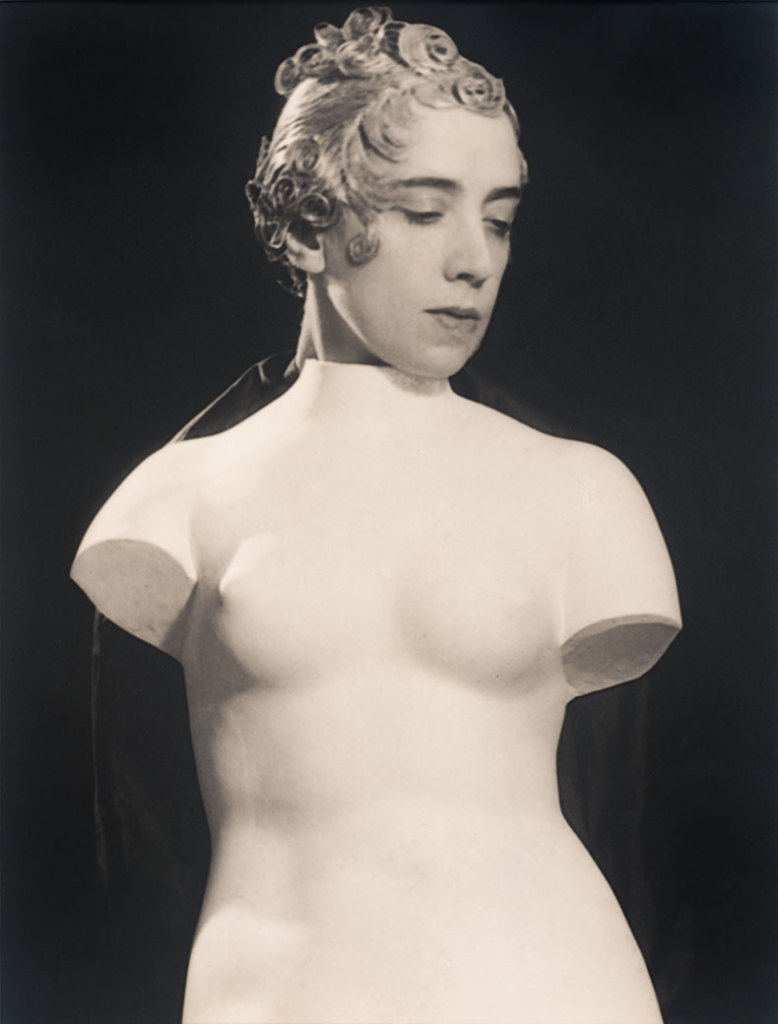
As Surrealism was itself a terribly fashionable movement, the encounter of the two was indeed fortuitous. Schiaparelli moved in circles that were at once chic and avant-garde, whose members flitted between extravagant parties and fancy-dress balls of the sort satirised by Evelyn Waugh and Noël Coward (to which Elsa might turn up attired as a goat, or a carrot). Hers was a soignée set where the roles of client, collaborator and patron were often overlapping and intermingled, which included such figures as the dissolute Mexican silver magnate and party fiend Carlos de Beistegui; the artist-photographer Man Ray, who made Elsa chief recruiting-agent for his avant-garde Société Anonyme and shot her portrait as a sort of Venus de Milo amputee; the Marchesa Luisa Casati, who would walk her pet cheetah on a diamond lead through Venice while wearing nothing but a fur cape; Daisy Fellowes, the Singer sewing-machine heiress, once memorably described as having ‘the elegance of a skeleton’; Edward James, the millionaire art patron, engaged on a (thankfully abortive) project to decorate the living room of his Lutyens country house to resemble a dog’s intestines; and, most significantly, Salvador Dalí, the mad-eyed Catalan dandy whose poverty compelled him to hawk his ideas and art with a cynicism that anticipated the full-on commercialism of Pop art.
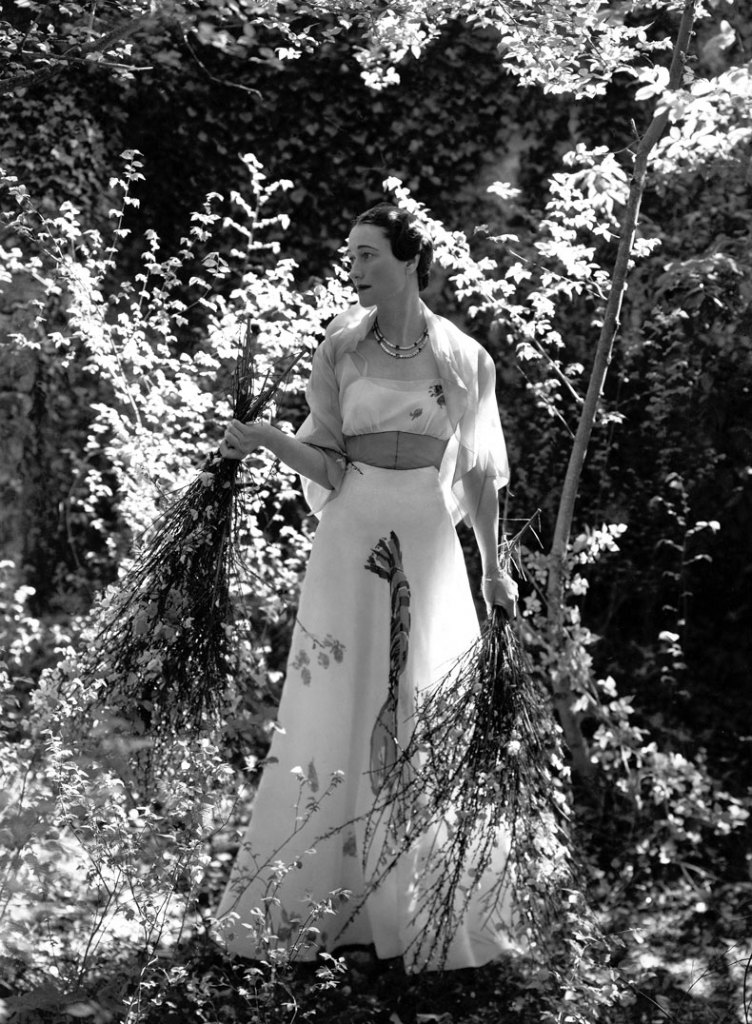
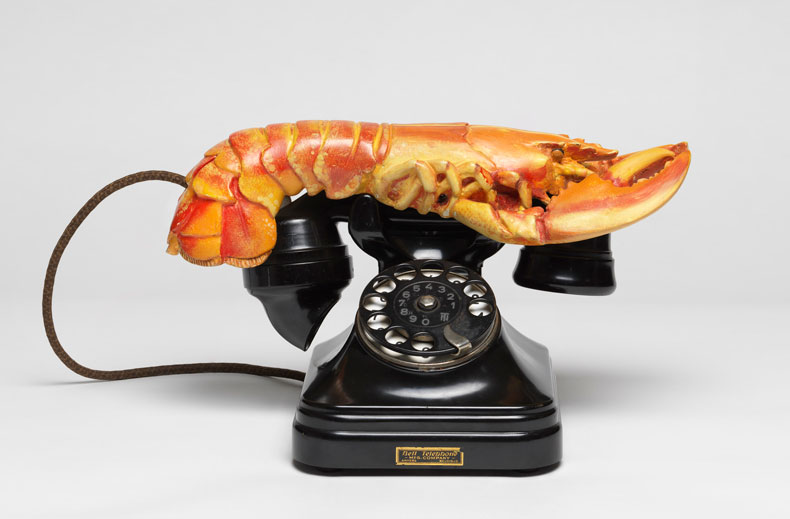
Schiaparelli was introduced to Dalí through her assistant, the New York socialite Bettina Bergery, whom he described as resembling a ‘praying mantis’. Elsa and Salvador collaborated so extensively in the mid 1930s that their themes and obsessions overlap; the huge lobster, for example, decorating the front of an organdie couture gown (acquired by Wallis Simpson for her trousseau, because she felt her public image was too joyless), echoes Dalí’s crustacean telephone – he suggested Schiaparelli add real mayonnaise to the dress design, but was rebuffed. Their first joint venture was the ‘bureau suit’ of 1936, with pockets evoking desk drawers. This was an effort to give physical form to the woman in Dalí’s painting The Anthropomorphic Cabinet of the same year, depicted with drawers emerging from her torso. It might be imagined that the idea of the body as furniture was about accessing its innermost areas, whether metaphysically or erotically; Dalí charmingly described how ‘each drawer corresponded to a smell emanating from the body of a woman’. In Schiaparelli’s version, the pockets are decorated with crystal doorknobs or pull tabs; they do not actually open like drawers (it is difficult to conceive how they might), and in some cases are trompe-l’œil, entirely without function. These suits were photographed by Cecil Beaton for Vogue in a cramped studio set emulating the desolate Catalan panoramas from Dalí’s paintings, with one of the models holding up a copy of Surrealism’s house mag Minotaure to drive the point home.
Schiaparelli had herself appeared within the pages of Minotaure in 1933, photographed by Man Ray and wearing her own creations; the shoot was to accompany a piece by the Dadaist didact Tristan Tzara that asserted a certain resemblance between hats and female genitalia. In the Freud-drenched world of the Surrealists, in which everything stands for something other than itself and almost certainly something psychosexual, this view probably carried some weight. Nevertheless, the playful headgear she created in collaboration with Dalí seemed to disprove this. Far from evoking feminine intimacies, if they are to be viewed in Freudian terms they seem to have phallic overtones. They were, again, exercises in transposition, placing things upon the head that seemingly had no right or cause to be there: one was based on an inkwell, with a large feather quill; another was shaped like a lamb cutlet, complete with the little paper crown on the tip of the bone. The most celebrated of all was their shoe hat, in which the sole extends forward like the bill of a cap, with the heel (sometimes in her signature Shocking pink) standing proud on the crown of the head. Some commentators have suggested that the fact the hat was invariably photographed side-on was a tacit admission that it looked terrible viewed from the front; but seen in action – a cheetah-print version is worn by the actress Katherine Helmond in Terry Gilliam’s Orwellian fantasia Brazil (1985) – it has a playful grace, almost abstract in its sculptural qualities.
Other designs were equally ludic, some might say ludicrous, but executed with aplomb nonetheless. Another collaboration with Dalí saw a powder compact shaped like a telephone dial, while in 1938, she designed a suit that was worn back to front, with lapels, blouse and even a floral buttonhole all displayed on the wearer’s back. Were it not for the fact that they were produced several seasons apart (meaning that to combine them would be an unspeakable sartorial faux pas), it is possible to picture a Schiaparelli client sashaying around with her clothes on back to front and a shoe on her head – oh, inverted world!
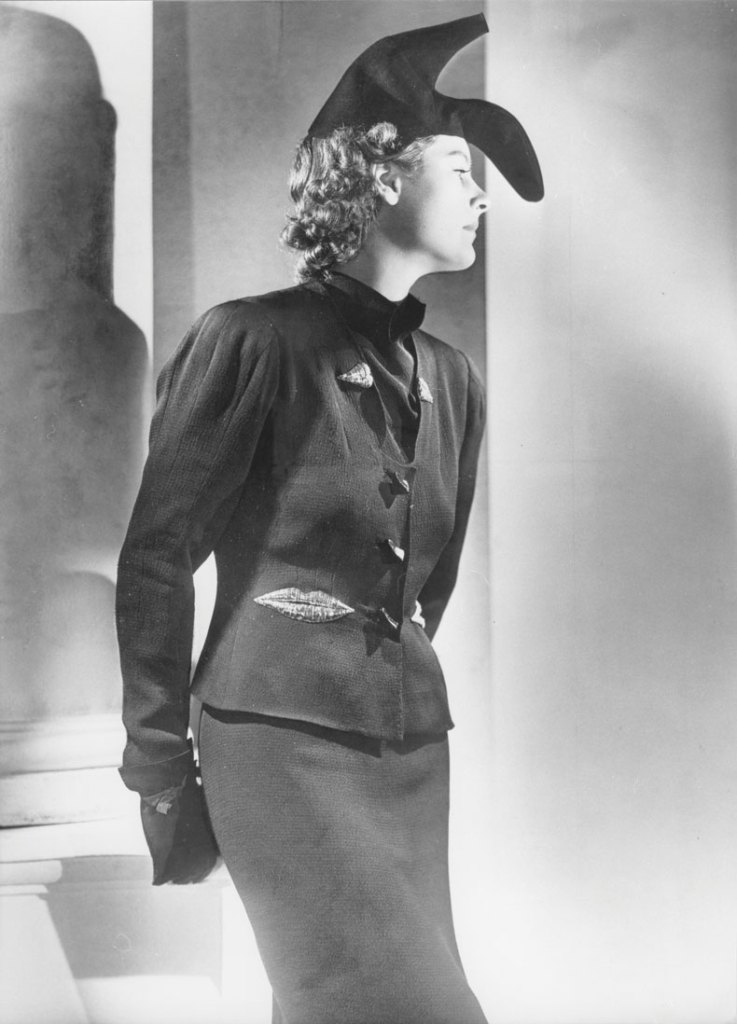
Fastenings, too, provided a canvas for Surrealist play. Buttons were replaced by butterflies, acrobats, carrots, seashells, padlocks and more. (In 1931 she had also made prominent use of the newly invented zip fastener, not hiding it away but displaying it proudly like a King’s Road punk of several decades hence; Aldous Huxley was captivated by Schiaparelli’s zips and made them a leitmotif of future fashion – and sexual liberation – in his novel Brave New World the following year.) Another witty motif was a pair of black suede gloves with red snakeskin ‘nails’ on the fingertips, blurring the distinction between the garment and the body beneath. The Surrealist Eileen Agar was reported to have worn a pair of these gloves to the midnight opening of a Magritte exhibition in London. (They were, in fact, imitations run up by Agar herself, which she later made even more Schiaparellian by attaching them to a hat.)
There are traces of Schiaparelli’s early affinity with the Futurist movement in her love of unusual and experimental textiles, including water-repellent transparent velvet, wool blended with ostrich feathers, and rhodophane, a ‘glass-like’ fabric that reportedly disintegrated after being sent to the dry-cleaner. In 1935 she devised a waxed silk with a newsprint motif composed entirely of articles about herself, both positive and negative, coupled with a folded hat in the same material, which was inspired by those worn by fishwives in Copenhagen; the Marchesa Casati was discovered in her hotel bed by Schiaparelli’s fitters drinking Pernod for breakfast and attempting to read the news clippings on hers.
While Dalí enjoyed the highest profile of her artistic collaborators, he was by no means alone. For her spring 1937 couture collection she worked alongside Jean Cocteau, who described her as ‘the dressmaker of eccentricity,’ adding: ‘Has she not the air of a young demon who tempts women, who leads the mad carnival in a burst of laughter? Her establishment in the Place Vendôme is a devil’s laboratory.’ Among their experiments together was a silk-jersey evening coat, embroidered by the master artisans of the House of Lesage to a design sketched by Cocteau. Across its back was a graphic motif of appliqué flowers arranged in a vase that then morphs, in optical-illusion fashion, into a pair of profile faces. The classical column on which the vase stands, sketched with characteristic economy of line by Cocteau, stretches down the skirt of the coat like pleats.
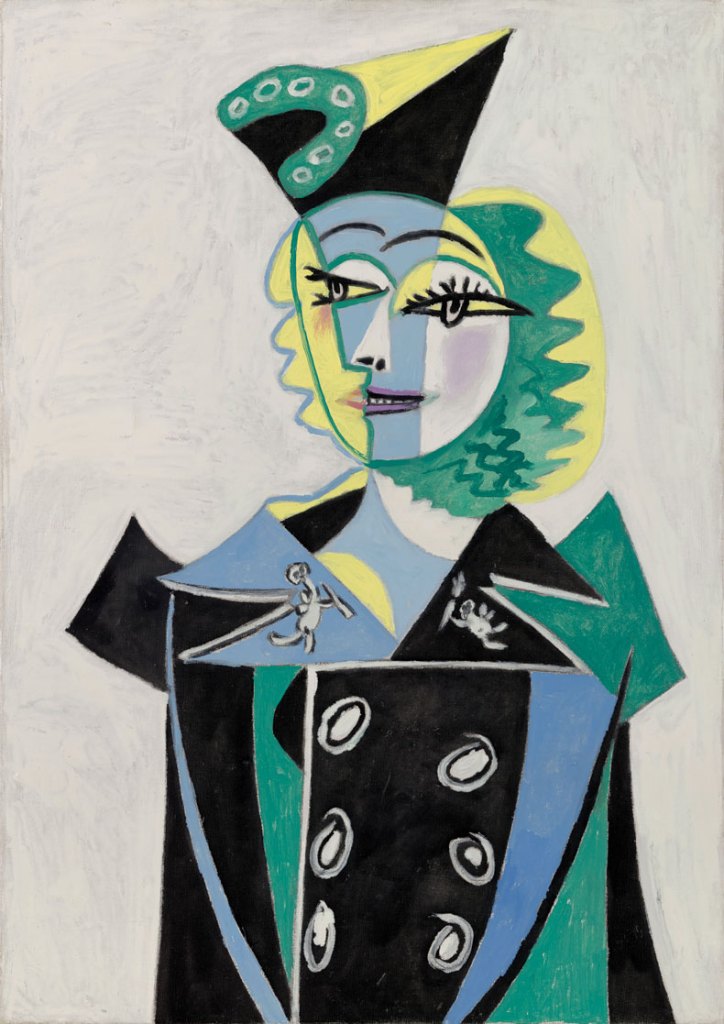
The Place Vendôme showroom that Cocteau viewed with a sort of fascinated horror was a Surrealist salon of sorts, featuring Dalí’s sofa based on the lips of Mae West (upholstered in – what else? – shocking pink) and shell-topped plaster columns concealing lights, commissioned from Alberto Giacometti. She launched a men’s cologne called Snuff that took its cue from Magritte’s La Trahison des Images, being a pipe-shaped bottle contained within a cigar box; she also produced a necklace devised by the Surrealist poet Louis Aragon that took the form of a string of porcelain aspirin pills – a talking-point at society parties, but less useful the morning after. And in 1935 the Swiss Surrealist Meret Oppenheim persuaded Schiaparelli to market a polished metal bracelet trimmed with fur, for which idea she received the princely sum of 12 Swiss francs. When the artist wore it for lunch at the Café de Flore with Dora Maar and Picasso (who would later paint Nusch Éluard in a horseshoe-embellished Schiaparelli hat), the Cubist remarked that anything could be covered with fur. ‘Even this cup and saucer,’ replied Oppenheim, who would go on to create her ‘furry cup’, Object, inspired by the encounter.
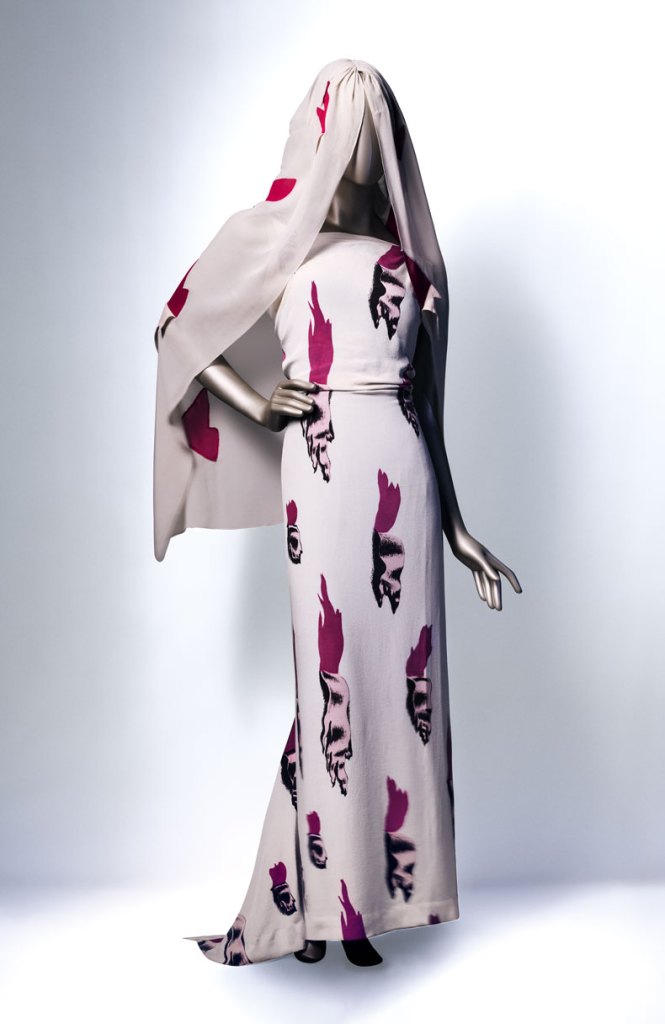
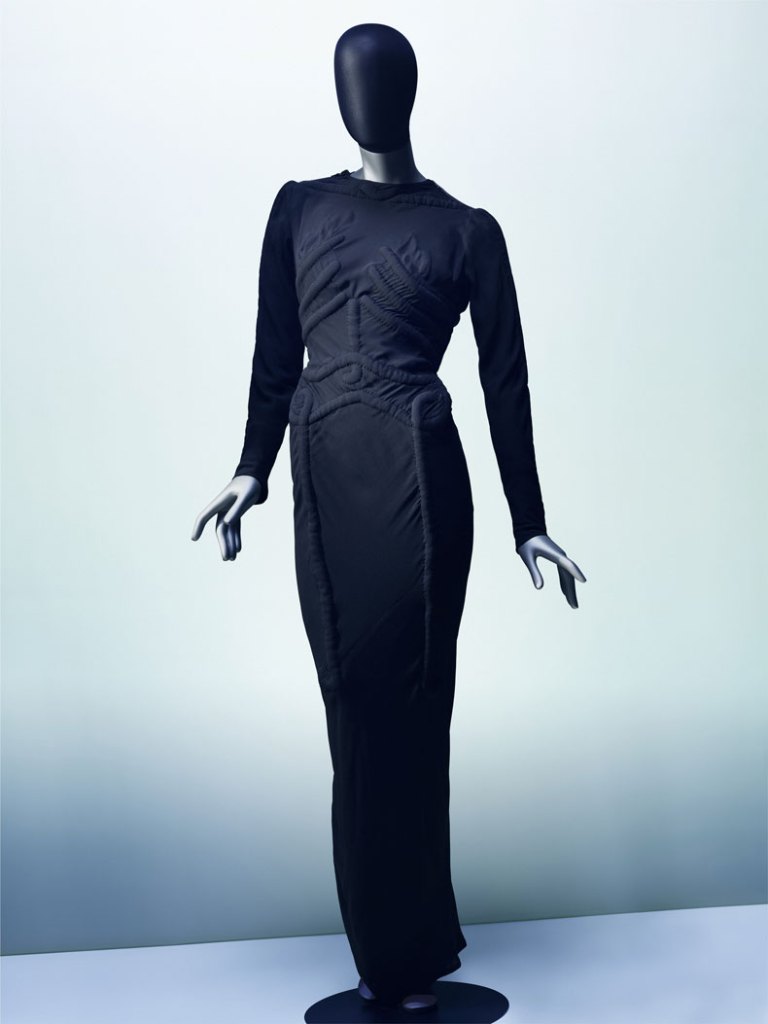
Schiaparelli’s final couture collaborations with Dalí, in 1938, had a more sinister undercurrent than previously exhibited. Resurrecting the X-ray idea from her early sweaters, a black silk-crêpe evening gown was decorated with wadded trapunto quilting to evoke a skeletal form with prominent ribs, vertebrae and leg bones. Another, known as the ‘tear dress’ (the word intended to rhyme with hair, not ear), was considerably more controversial. Schiaparelli’s beloved trompe-l’œil technique was pressed into service on a sleeveless floor-length rayon gown that appears ripped in multiple places to reveal decaying flesh beneath. Somehow, the motif becomes divorced from its grisly origins to become almost elegant, the faux holes looking forward to Vivienne Westwood and Paul Smith and the ‘deconstruction’ trends of decades later. The gown’s design was reportedly based on Dalí’s Necrophiliac Springtime (1936), which Schiaparelli owned. (In that painting the woman wearing the dress has her head replaced with a spherical bouquet of flowers; this was very possibly inspired by a story Elsa told of her childhood, when she planted seeds in her ears, nose and mouth in the hope that flowers might bloom there.) It is not much of a stretch to see premonitions of war in such designs – a sense, perhaps, that the playful Surrealist transpositions of the mid 1930s were becoming a little démodé. Dalí later seemed to suggest as much, if one can penetrate his characteristically cryptic self-mythologising: ‘Fashion is also the tragic constant of history,’ he once told an interviewer. ‘Through it you always see war coming while watching its fashion reviews and its parades of mannequins who themselves are veritable exterminating angels.’
War, when it inevitably arrived, was – as might be expected – difficult for Schiaparelli and her couture business. She spent much of the time exiled in New York, worked for the Red Cross and was interrogated by the FBI as a suspected collaborator. Her later designs never recaptured the inventiveness or acclaim of her interwar collections and, while Surrealism mouldered on, an ever more commodified proposition, there was a sense that its golden age of high fashion was firmly behind it as well. Although it might not have been uppermost in her mind when she found herself filing for bankruptcy in the 1950s, Schiaparelli was all too aware that fashion was something transient – not simply in the sense that trends ebb and flow, but that it is about the moment, that performance and circumstances are as integral to it as garments or accessories. ‘Dress designing,’ she wrote in Shocking Life, ‘is to me not a profession but an art. I found that it was a most difficult and unsatisfying art, because as soon as a dress is born it has already become a thing of the past […] A dress has no life of its own unless it is worn, and as soon as this happens another personality takes over from you and animates it, or tries to, glorifies or destroys it, or makes it into a song of beauty.’
‘Schiaparelli: Fashion Becomes Art’ is at the Victoria and Albert Museum, London, from 28 March–8 November.
From the April 2026 issue of Apollo.