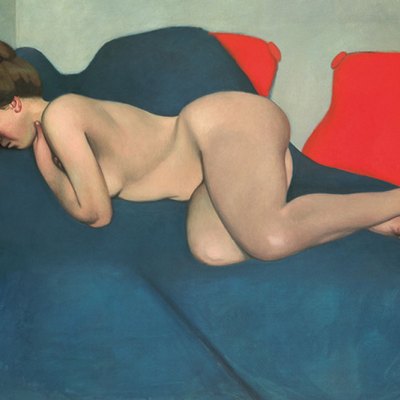
‘The Empire of Sleep’ at the Musée Marmottan Monet claims to be the first exhibition in France to explore ‘the various representations of sleep and its mysteries’. This sounds surprising coming from the country that gave us Surrealism but this is a show less concerned with what happens inside people’s heads and more with how sleep looks to those who are awake. Full of portrayals of domesticity and rest, it stretches back to the Renaissance and reaches the present but focuses on ‘the long 19th century’ from ‘the Enlightenment to the Great War’. While it acknowledges the seismic effect of Freud’s Interpretation of Dreams (1899), the ideas it tangles with are often ancient; it looks at how Greek mythology cast dreams as prophecies rather than personal reflections and explores parallels between sleep and death, waking and resurrection that are central to Christian theology.

The tone is strongly set in the opening room, decorated like a bedchamber, with five paintings hanging against a deep blue curtain. All of them show someone sleeping, from Claude Monet’s depiction of his infant son Jean in a cradle, its peaceful blues and greys drawing attention to the baby’s rosy cheeks, to Giuseppe Antonio Petrini’s The Sleep of Saint Pierre (c. 1740), depicting in a brilliantly simple blue, yellow and brown palette an old man so devoted to religious studies that he has collapsed, asleep, on to his books.
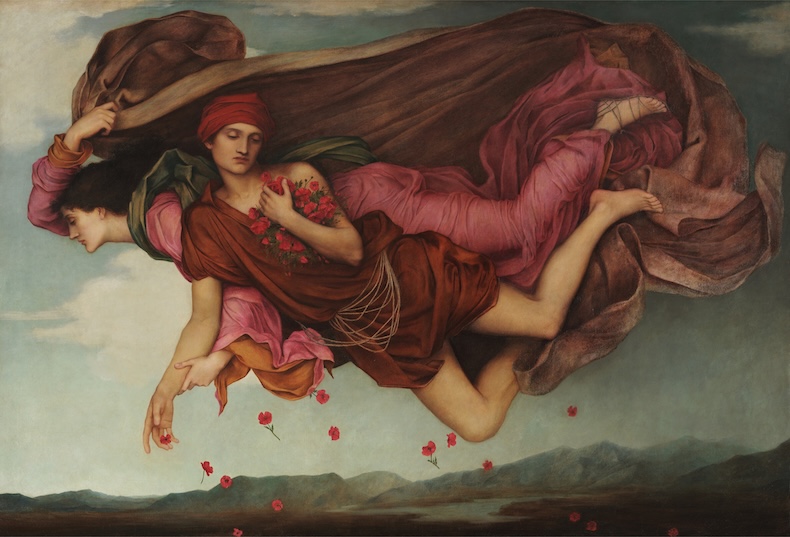
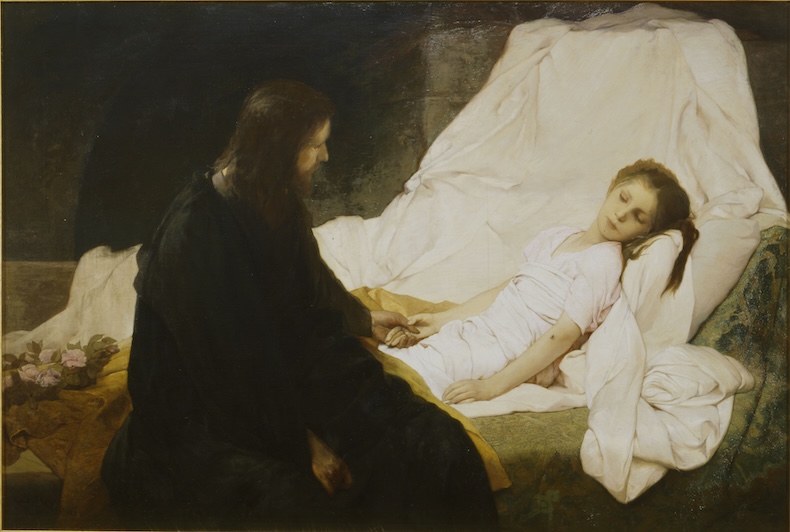
The works are arranged thematically rather than chronologically – a smart choice that stops a seemingly narrow subject from becoming repetitive. G.F. Watts’s dramatic painting of Eve being formed from Adam’s rib was made in the 1860s, a time when his contemporaries were turning away from Christian themes. The narrow, vertical composition forms a stark contrast with Evelyn de Morgan’s horizontally stunning Night and Sleep (1878), which draws on the Greek idea that Nyx (night) gave rise to both Hypnos (sleep) and Thanatos (death), with Nyx protecting Hypnos as they fly over the mountains. Gabriel von Max’s The Raising of Jairus’s Daughter (1878) is more successful as a religious painting than Watts’s; the scene of Christ awakening the daughter of a synagogue leader makes a virtue of simplicity, its two figures – one dressed in black, the other in white – making for a far less cluttered frame than the work by Watts.
Moving away from the religious and mythical and into the domestic, several artists zoom in on the beauty of the sleeping figure. This is often highly gendered when women and children are models; the inclusion of one of Jean Cocteau’s 25 Drawings of a Sleeper (1929) brings a gay perspective that anticipates Andy Warhol’s filming of John Giorno in Sleep (1964). There are early photographs such as one of a young Lewis Carroll, but the moving image is a notable absence here, despite the dream-like quality of silent film. This is a pity, as some consideration of how it changed the way artists depicted sleep would have added vital context. The discussion of sleepwalkers cannot help but invoke Robert Wiene’s film The Cabinet of Dr Caligari (1920), with its sets co-designed by German Expressionist painters.
It is in evoking the 19th-century interest in death, madness and altered psychic states that ‘The Empire of Sleep’ is most effective, securing an impressive range of works as well as intriguing curios. (The exhibition’s co-curator is the neurologist and historian of science, Laura Bossi.) An extraordinary drawing from 1853 by the neurologist Jean-Martin Charcot, known for his work at La Salpêtrière in Paris, has all the wild activity of a Bosch painting, with an explosion of male figures, nude women, angels and gargoyles striving to represent the ‘hysterical’ mind. We see Aimé-Jules Dalou’s death mask for Victor Hugo and several artists lingering by the bedsides of their dying lovers. Monet’s ghostly 1879 painting of his wife, Camille, on her deathbed, the sheets close to being a shroud, is countered by Ferdinand Hodler’s 1914 portrait of his mistress, Valentine Godé-Darel. Resting after an operation for the cancer that would kill her less than a year later, Godé-Darel gazes clearly into the distance, inviting the viewer to reflect on the cruelty of her illness and the sadness of both subject and artist.
The more recent, post-Surrealist works cleave carefully to the theme of people sleeping. Marlene Dumas’s To Dream or Not to Dream (2006) completes the circle begun by the works in the opening room. This stripped-down portrait of a woman in bed shows us that sleep is the activity that has changed the least throughout human history. Its title reminds us that we cannot control what happens in our own heads while we sleep, nor know what takes place in anyone else’s while they do.
Juliet Jacques is a writer and film-maker based in London.
‘The Empire of Sleep’ is at the Musée Marmottan Monet, Paris, until 1 March.