From the June 2026 issue of Apollo.
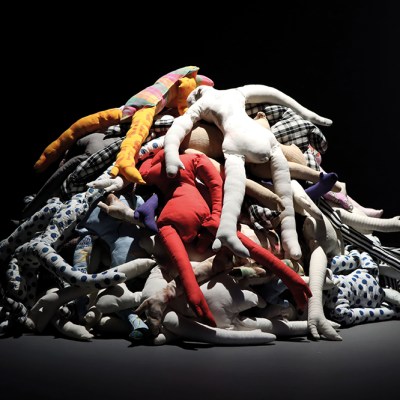
In the foyer of the National Museum of Contemporary Art (EMST) in Athens, a dog called Mr Stavros is about to have his portrait painted by the artist Alexandros Georgiou. Mr Stavros is restless but eventually complies with his owner’s request that he jump up on to a bench with a backdrop of an ocean view from a beach lined with palm trees. The setting is a small wooden booth, open on one side for the artist and subjects to enter and for the public to watch; its walls, inside and out, are covered in the likenesses of the many dogs and exceptional cats who have already sat for portraits. For the past year, Georgiou has set up studio here as part of the exhibition ‘Why Look at Animals? A Case for the Rights of Non-Human Lives’, which closed a couple of weeks before my visit at the end of April.
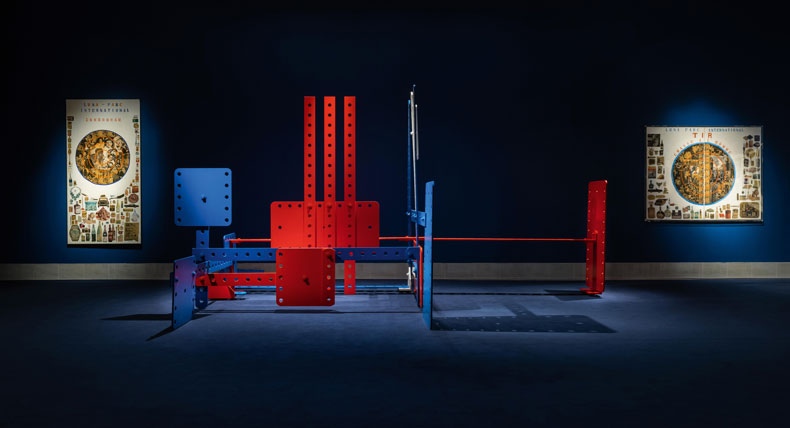
‘Why Look at Animals?’ was a year-long series of exhibitions and events at the museum. It followed another year-long project called ‘What if Women Ruled the World?’, a four-part cycle of exhibitions and a temporary redisplay of the permanent collection that presented work by only women artists. A third thematic series, ‘The Cosmopolitans’, has just begun, with three separate shows devoted to three figures of the Greek post-war avant-garde: the composer Jani Christou, the multimedia artist Niki Kanagini and the painter Stathis Logothetis. In December a major group exhibition curated by the museum’s director, Katerina Gregos, will take up the cosmopolitan theme. And this month, the permanent collection is redisplayed on the museum’s second floor under the title ‘South by Southeast’.
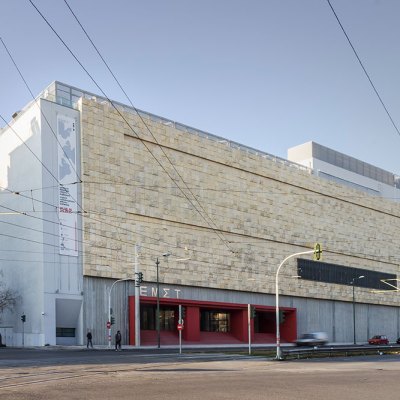
In July, it will be five years since Gregos was appointed director. It is four years since the museum has been fully operational in the former Fix brewery in Koukaki, a neighbourhood immediately south of the Acropolis. To say that EMST’s gestation has been troubled is an understatement. Anna Kafetsi, the first director of the museum – established by an act of parliament in 1997 – was appointed in 2000 and moved the new institution to the Fix site. The concrete building designed by Takis Zenetos in 1957 is a strikingly elegant structure – think streamline modern meets horizontal skyscraper. With a 90m-long facade and an area of 18,000 square metres, it is vast now, but was once truly enormous: between 1994 and ’95, more than half of the original building had been demolished to make way for a metro station that was never built. The building’s derelict state forced Kafetsi to move out and keep running EMST as a nomadic project while at the same time trying to build up a permament collection. The onset of the financial crisis in Greece meant that it didn’t return to its designated home until May 2015 – a year after the culture ministry had fired Kafetsi – and even then only half the site could be used. With the expiry of the country’s second bailout from the EU and a painfully negotiated third requiring savage cuts in public spending and a fire sale of state assets, the future for a new public museum seemed bleak. But in 2017, with EMST under a new director, Katerina Koskina, Athens shared the hosting of Documenta 14 with Kassel and the presence of one of the most important events in the calendar raised the institution’s profile considerably (at the same time, some of its permanent collection went on display in Germany). However, the culture ministry fired Koskina in 2018 and an open call for applications for a successor was cancelled.
If I have lingered on the challenges EMST has faced – and this is to skim the surface, leaving out the fraught renovation of the building – this is because, in under five years, it has established itself as one of the most interesting and politically engaged museums of contemporary art in Europe. Making a success of a museum is a team sport but, at EMST, more than at many comparable institutions, a large degree of this success is down to its director.
Gregos was first offered the job in 2018, after the international search process failed, but understandably refused to interrupt a flourishing career as an independent curator for such an uncertain proposition. Gregos had left Greece in 2006 for Brussels to become artistic director of the Argos Centre for Art and Media. Brussels remained her base for 15 years as she curated three different national pavilions at Venice (Denmark, Belgium and Croatia), was artistic director for four editions of Art Brussels and curated the first Riga Biennial in 2018 – to name just a few highlights.
In an interview with Frieze shortly after her appointment in 2021, Gregos described EMST as a museum that ‘has been in a constant state of becoming since it was first established’. When I ask her about how EMST is getting on in the business of becoming, she simply says, ‘It has become.’ After this direct answer, she looks at a list of all the museum’s exhibitions and starts counting aloud. As she keeps counting, I start to wonder if we are still having a conversation, but she stops at ‘52’, which is the number of solo shows, group exhibitions and installations EMST has put on in the last four years – a number that sounds like a mistake but isn’t. Gregos gives credit where it’s due (‘It’s a very big team effort by a very dedicated team’) but it’s clear where the impetus comes from: ‘I am the one who’s slave-driving myself. I’m not slave-driving [others]’. As for why she has put such pressure on herself: ‘From the moment that I arrived in this institution, and because everybody was really waiting for it to lift off, I felt it was my duty to really give it a boost. I felt it needed to take off like a rocket.’
There’s a pragmatic reason for the museum’s furious pace. Unlike other state institutions, EMST’s funding is decided every year, instead of in three- or four-year settlements, so the museum has to keep proving itself to the powers that be. One headache Gregos is free of, however, is direct political control, which would be the norm for a state-funded institution (EMST is entirely state-funded, but keeps the income it generates). One of her conditions for taking the job was that the museum be an arm’s-length body with a ministry-appointed board.
Being a museum director was never Gregos’s intention: ‘I was perfectly happy being an independent curator and also very fortunate, because I was active in a decade when independent curators were very sought-after for big projects and biennials, something that has now changed.’ Once she did make the move she was determined, she says, not to copy existing models and to avoid becoming ‘a franchise museum’. Nor was there any point in aspiring to be ‘a mini Tate, MoMA or Pompidou’. Curating biennials and site-specific exhibitions, she explains, ‘the deadlines are very, very tight. You never have enough time […] institutions move at a much slower pace.’ EMST has a limited budget for acquisitions – ‘not huge’ is all Gregos will say on the record – so she decided to build on the strongest points of the existing collection of around 1,400 works: ‘works by artists from this part of this world and that had a strong sociopolitical orientation. So works by Mona Hatoum or Emily Jacir or Walid Raad and the Atlas Group’. It’s a focus that has encouraged some substantial gifts, the largest so far being 140 works from the Daskalopoulos Collection, with a strong showing of Greek artists and conceptualists with a sense of fun such as Annette Messager.
‘This part of the world.’ Gregos’s understanding of what this means will startle some, invigorate others and upset the far right. It will also make sense to anyone who can look at a map. By ‘this part of the world’, Gregos is referring to ‘South East Europe, the Middle East, North Africa, the Balkans, Turkey and Mediterranean culture, which, to me, is already around 50 countries.’ It’s a view of modern Greece as not on the edge of Western Europe but at the heart of a Mediterranean/Middle Eastern culture. The same conception of the region informs the redisplay of the permament collection this month and also the title of the new exhibition cycle, ‘The Cosmopolitans’.
The subjects of the three exhibitions I see when I visit were all members of 20th-century Greek diaspora. The composer Jani Christou was born in Heliopolis in Egypt; Niki Kanagini was born in Greece but studied in Lausanne and London; and Stathis Logothetis, who was born in what is now part of modern Bulgaria and active in the Viennese art scene, was nearly 50 when he moved to Greece for good. Many visitors, and I am among them, will not know their work already; I would be amazed if anyone came away without being delighted by conceptual work that pulls off being pleasurable to look at or listen to as well as stimulating to think about. For Gregos they epitomise what she means by the word ‘cosmopolitan’: ‘I’m not looking into this privileged, nomadic, cosmopolitanism today, of the jet-setting 1%, but the territories of the former Ottoman empire, where cosmopolitan, multi-ethnic, diasporic people and ethnic groups existed very happily.’
When Gregos describes herself as a ‘highly political person’, I believe her. When talking about ‘Why Look at Animals?’, for instance, she says, quite furiously, that ‘the worst form of capitalism […] is mass exploitation and oppression of animals by large corporations’. But she doesn’t believe that art should be confused for activism, or vice versa: ‘You can be an artist and an activist, but your art takes place in the museum and your activism should take place in public space, on the street, for it to be effective.’ For Gregos, ‘The museum is a safe space. It’s a de facto safe space and let’s not pretend otherwise.’ Or, to put it another way, it is a place where you can be challenged by the art on display and bring your dog to have his portrait painted.
‘The Cosmopolitans’ series continues throughout 2026–27, at EMST, with the group exhibition opening this December.
From the June 2026 issue of Apollo.