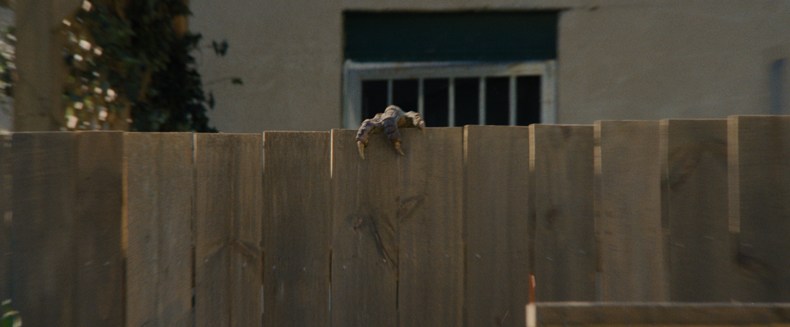
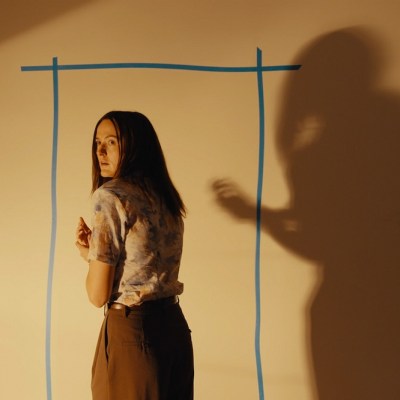
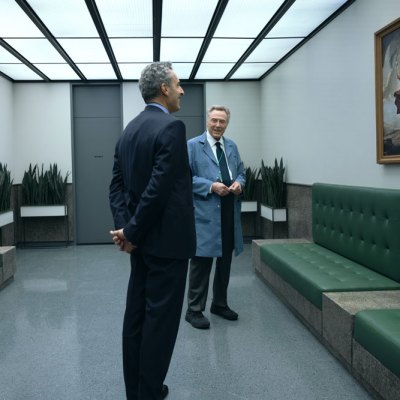
In The Poetics of Space, Gaston Bachelard notes that children’s drawings of houses often greatly exaggerate the doorknob on the front door, emphasising its importance. The house is, or should be, the safest of places, but central to that is the ability to come and go, or to govern who comes and goes. The numerous lingering shots of doorknobs in The Last House (Netflix) underscore this point. After a freakish rainstorm, the Delgado family find themselves trapped in their home. The doors and windows are sealed, glass cracks but can’t be punctured and the walls resist the sledgehammer. Through the window, they see their neighbours are in the same predicament. Perhaps everybody is. But they have running water and power and air is getting in, so they hunker down and wait.
And wait, and wait. The mysterious force that has trapped them, which is present in the continual rain, does not relent. Days turn into weeks and food dwindles. Neighbours starve. Fortunately the mother of the family (Greta Lee) started early on the indoor agriculture, but things still get desperate. The plump pet fish are eaten. The family dog, which has contributed little to proceedings, runs out of heart pills and dies, leading to an awkward conversation about what to do with the remains (or, to put it another way, leftovers). The question of whether Fido gets eaten or not is left tantalisingly unanswered, but combined with the discovery that the rickety chimney of the house allows limited access to the outdoors, leads the father of the family (Wagner Moura) – who was, conveniently, an engineer and fisherman – to figure out ways to trap wild animals using spring-loaded cages.
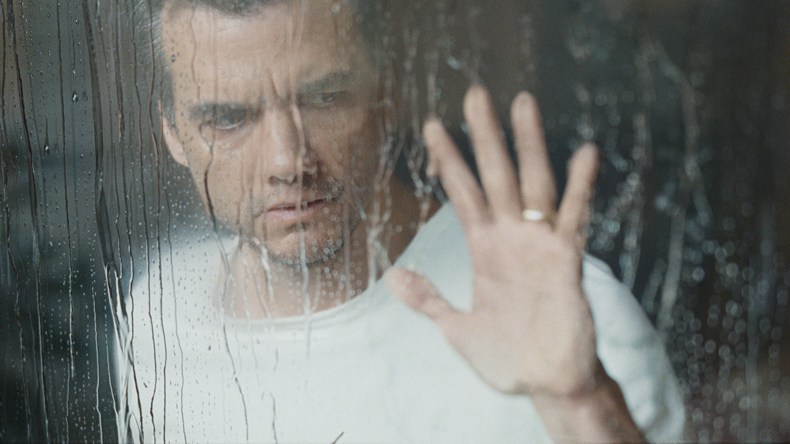
All this is very daft – and that’s before the monsters show up. The practicalities of the predicament give rise to endless cavils and questions: how does the power stay on so long, when communications are immediately knocked out? What has happened to all the people in apartment buildings, terraces and semi-detached houses? (Does the membrane that has imprisoned them recognise party walls?) The ‘chimney fishing’ devices, and the various other Heath Robinson contraptions the family develop, bring to mind films from the Home Alone and Wallace and Gromit franchises, which contributes to a general tonal confusion between pure horror and gentler family entertainment.
There are also promising glimpses of a third direction. At times The Last House looks as it it might fashion daftness into Ballardian weirdness. Years pass indoors and large parts of the house become jungly with corn and tomato plants, shot in a golden hour light. The outdoors comes inside, a surreal, impossible idyll. The enclosed house is an inherently Surrealist space – it is the perfection of the atmosphere of privacy that Surrealism requires: the privacy of childhood, the dream, the erotic reverie, the opium pipe. André Breton’s autobiographical prose work Mad Love (1937) repeatedly uses the imagery of the outdoors being brought indoors: ‘the delicate grass running before us […] it is this grass which will continue after me to line the walls of the humblest room each time two lovers enclose themselves […] becoming so dense around the bed as to hide the rest of the world…’ (I am drawing here on the English translation by Mary Ann Caws, in whose writing I found this reference.) The confusion of the outdoors and indoors is a recurring Surrealist concern, such as René Magritte’s paintings of broken windows carrying portions of far horizons into the room, or clouds drifting out of bourgeois parlour pictures; or the birds, trees, and wild animals that roam into Leonora Carrington’s interiors.
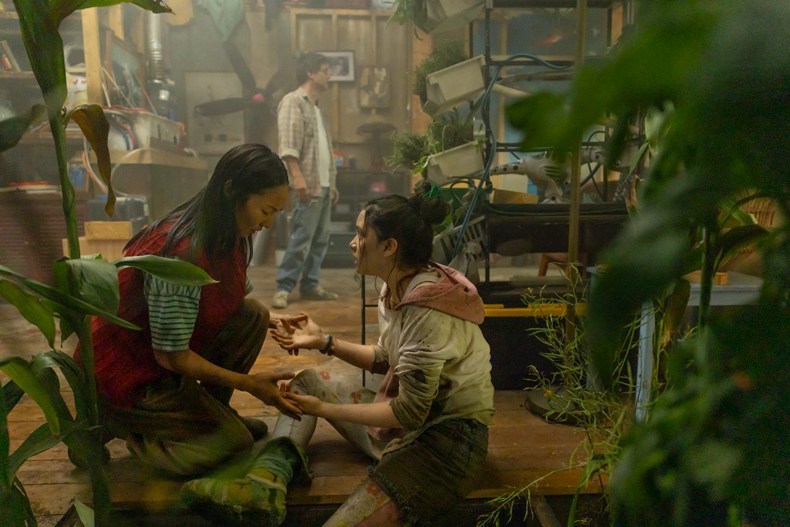
Sadly The Last House never consummates its voyage into inner space, veering instead into a misfiring monster mash. But for all its flaws, the trapped-in-the-house conceit is a fertile one, and it’s not hard to diagnose post-Covid anxieties in its claustrophobia and depiction of parenting under pressure. Clearly there is something in the water as it follows the German Netflix film Brick (2025), in which an apartment building is encased in a mysterious black barrier, and the British film Await Further Instructions (2018), in which a dysfunctional family is trapped in the house by, yes, a mysterious black barrier, and terrorised by commands from the television. Of these, the latter, which predates the pandemic, is by far the most effective exercise in horror, as well as prophecy.
Broader, if American-accented, anxieties are also evident in the suburban setting, and the house that is both refuge and slowly subsiding liability. Even while grappling with a survival situation, the parents revel in the lack of bills. The End of Oak Street, directed by David Robert Mitchell, shares many materials with The Last House: suburban domicile, nuclear family, inconvenient dog, hard-pressed and resourceful mum (Anne Hathaway), introspective and economically obsolete dad (Ewan McGregor), preposterous catastrophe. There are overlapping, clunky exchanges about how we gotta stick together, we gotta get through this, we gotta be honest with each other, we gotta survive. There are desperate modifications to the fabric of the house and food is marshalled and rationed. In The End of Oak Street, however, events move too quickly for food to become a problem. A much more urgent problem is being food, as a slice of Michigan suburb is science-magically transported from 1982 to the age of hungry dinosaurs.
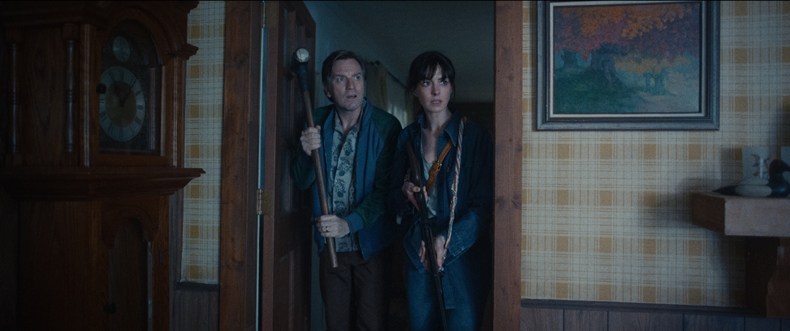
The choice to set the film in 1982 sharply focuses The End of Oak Street’s Spielbergian DNA, and the threatened suburbia of films such as Close Encounters of the Third Kind (1977), E.T. (1982) and Poltergeist (1982). (It was produced by J.J. Abrams, who in 2011 made the deliberately nostalgic suburban Spielberg homage Super 8, set in 1979.) It’s not an original observation to point out that the real lost world is financial security. But Mitchell pays greater tribute to the king of the boomer blockbusters by rationing the outlandish. We know the dinosaurs are coming, but they are artfully withheld, existing only as glimpses for a productively long time.
This is combined with some pleasing finesse in production design. In particular the wormholes that are the source of all the trouble leave neat spherical bites out of the environment, like installations by Gordon Matta-Clark. It works as a metaphor for the difference between these similar movies – while both are at heart rather silly, The End of Oak Street is crisper and more satisfying, while The Last House is jungly and confused. But I dreamed about The Last House, so it reached something deep inside.