From the December 2026 issue of Apollo.
Eva Gonzalès remains a blurry figure in French painting of the later 19th century. Her standing is yet to match the heights of her female contemporaries Mary Cassatt and Berthe Morisot, though at her best she held her own among them and the wider avant-garde, and this new exhibition at the Petit Palais in Paris deserves to win her admirers. ‘Eva Gonzalès: A Free-Spirited Artist’ is the first retrospective of her work since a posthumous tribute held two years after her death (at the age of 36 in 1883), soon after which her small corpus of some 90 paintings, 20 pastels and a handful of works on paper disappeared nearly entirely from public view, snuffing out her reputation.
Since her rediscovery in the 1990s, she has tended to be corralled as a woman Impressionist, which is sort of accurate – she shared the group’s belief in the subject matter of modern life and her later paintings leaned towards the movement stylistically – but also reductive because, like her mentor Édouard Manet, she resisted all invitations to join their ranks. The present exhibition, which travels in February to the Van Gogh Museum, Amsterdam, looks in new directions to tell her story. It is a stylish, enlightening presentation that places her in the thick of the Paris art world, but ensures the picture that emerges is of an able, determined artist who carved her own path.
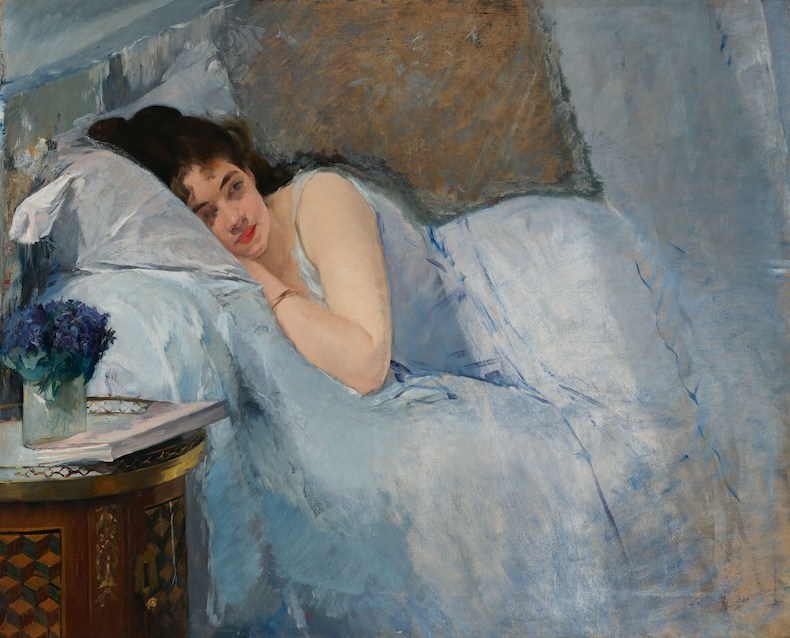
Women in quiet, genteel interiors were her special focus. Greeting you at the entrance is a blown-up detail from her painting Morning Awakening (1877), of a girl au réveil. The theme was popular at the time, and Gonzalès’s treatment of it especially fine, the cocoon of bedding a shimmering mass of chromatic whites. The sitter was her sister Jeanne, who modelled for many of the artist’s figure studies, lending them a gentle ease and sincerity that can feel absent in similar paintings by her male peers.
But who was Gonzalès? The first room sets this out by surveying the cultured milieu in which she grew up. Her father, Emmanuel, was a well-known novelist and playwright; her mother, Céline Ragut, a mezzo-soprano whose weekly salons were attended by the likes of Philippe Jourde, director of the newspaper Le Siècle, the poet Théodore de Banville and the Belgian artist Alfred Stevens. A painting by Stevens from 1879 of Gonzalès at the piano is displayed here, with ephemera such as her father’s visiting cards and receipts for her lessons with Charles Joshua Chaplin, a society portraitist of the rosy cheeks, turtledoves and blue ribbons order. Gonzalès was an impressionable teenager when she joined his studio in 1866, and her earliest works drip with his rococo-lite influence. Still, Chaplin was a politic choice: he sat on the Salon jury and was progressive enough to let his female students study from the nude. Cassatt was a fellow pupil.
The confident facture and airy character of The Catechism (1869–70) shows how swiftly Gonzalès outgrew him. Indeed, by 1869, she had moved to Manet, a friend of Stevens’s. Her parents must have been broad-minded to agree to the new arrangement, since Manet was then widely deemed a madman, his slab-like brushstrokes and rough edges an insult to public taste. Gonzalès’s belief in him is fascinating, and the show rightly delves into this complex topic.
The sheer size of Manet’s portrait of her (1870) cannot help but dominate the room. There’s also a painting of hers he corrected, but most fruitful are the pairings of her work with his. Girl with Cherries, for instance, which mirrors the v-shaped arm and tilt to the head of his Young Boy Peeling a Pear, and her Bugler, so like his Fifer as to elicit a double take.
Undoubtedly Gonzalès suffered from the association, but she countered by shrewdly entering a ‘safe’ work to the Salon alongside any more daring one, thus keeping her foot in both camps. In 1874 the Salon rejected her cryptic masterpiece A Box at the Théâtre des Italiens – posed by Jeanne and Gonzalès’s soon-to-be husband, the engraver Henri Guérard – but accepted her pastel The Pink Morning Gown. As is clear from the latter and other pastels here, Gonzalès was exceptionally talented in this medium.
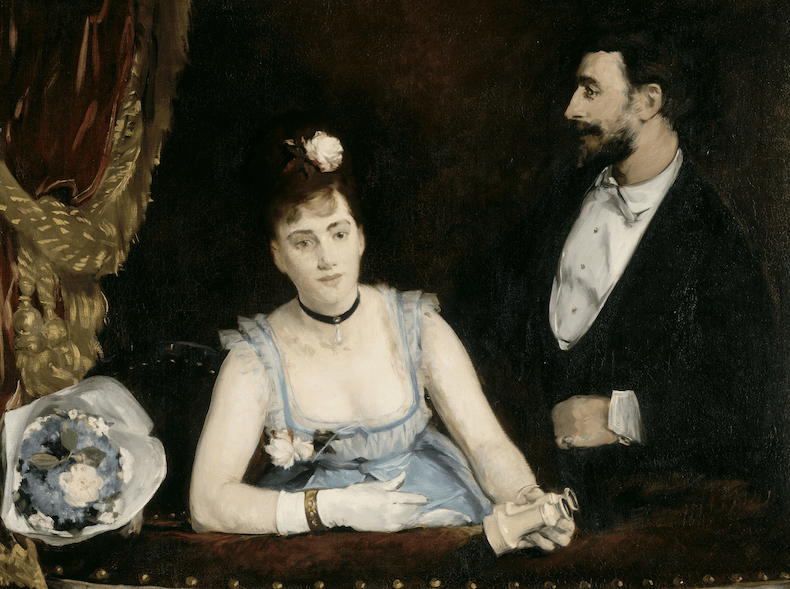
Not enough attention has previously been paid to the fact that Gonzalès was the first woman artist and possibly the first artist altogether to make the theatre box a subject for modern painting. Renoir is usually given that accolade, and his La Loge dates from the same year. The show’s excellent catalogue explores the two paintings and later examples by Degas and Cassatt in rewarding depth. On Manet’s advice, Gonzalès exhibited the rejected painting in her studio and again two years later in a space she rented around the corner from the second Impressionist exhibition. The gesture earned her no little kudos: a critic for La Vie Littéraire named her one of the ‘intransigents’ of modern painting.
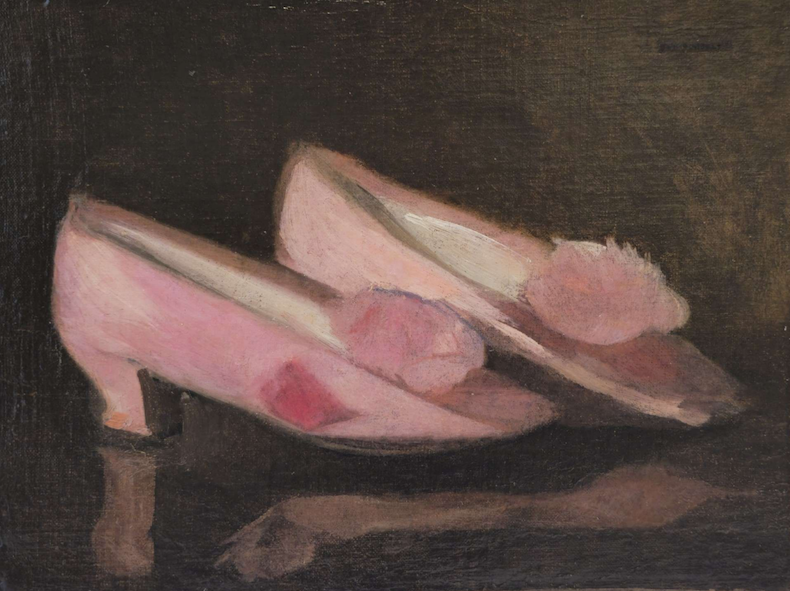
Perhaps the rejection still stung, however, because A Box at the Théâtre des Italiens seems to be the only time she threw her artist’s net beyond drawing rooms and boudoirs, or corners of greenery and beach near her family’s homes, though the exhibition shows brilliantly how even in those environments she sought opportunities to experiment. There’s a knockout little painting of a bowl of parsley, for one, but I was most seduced by a still life of satin shoes, whose sheeny pinks and dissolving reflection she evokes in wide, flat, buttery brushstrokes. Occasionally her sensitivity to the resonance of ordinary things verges on Proustian.
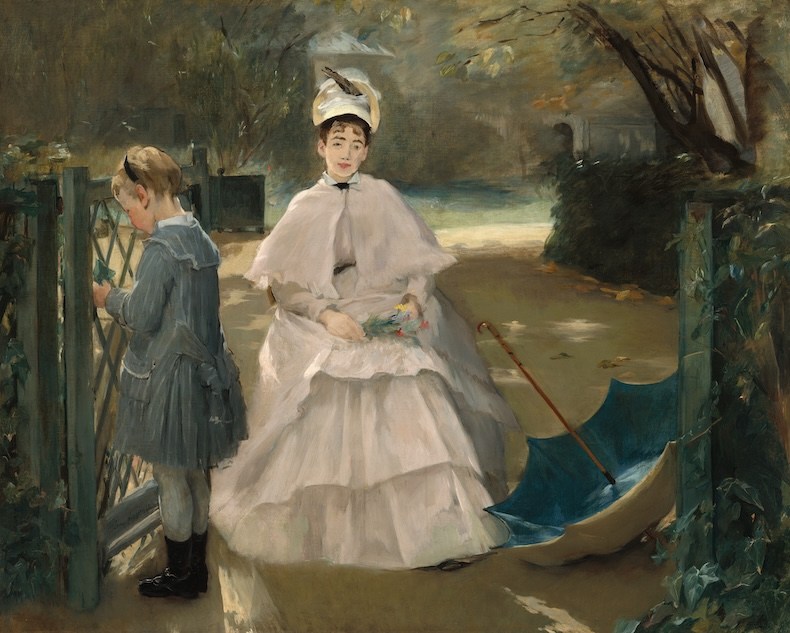
The final rooms show her moving out from under Manet’s wing: painting en plein air, in lighter, clearer colours, even leaving bits of canvas visible. Critics termed this new style of hers ‘Manet poétisé’, which sounds better than it looks: most of these works have a touch of the hybrid or the dry run about them, as if Gonzalès had not yet made the style her own – the exception being Nanny and Child (1877–78), in which the interplay of shadow and light is gorgeous. And how fascinating to learn that around that time Gonzalès visited Monet in his studio to buy a river landscape. It’s difficult not to wonder, as you leave the exhibition, where her ambition might have led her next.
‘Eva Gonzalès: A Free-Spirited Artist’ is at the Petit Palais, Paris, until 24 January 2027.
From the December 2026 issue of Apollo.